
You are using an out of date browser. It may not display this or other websites correctly.
You should upgrade or use an alternative browser.
You should upgrade or use an alternative browser.
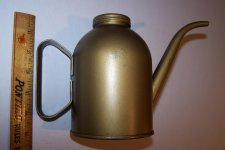
Eagle oil can?
- Thread starter hddennis
- Start date


Thanks, I 'll post a picture tomorrow of the back. It's actually 15 inches and I keep it to remind me to curb those impulse buys. I paid $12.00 at an antique mall and figured I got a steal as how many could still be around? Turns out 1938 must have been a very good year for Pontiac. I think everyone of these ever produced has survived and their all on eBay for $4.00 and up! Live & Learn.
Howard Dennis
Howard Dennis
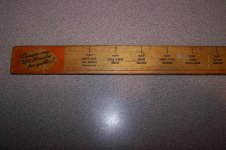

Why is old stuff so cool?
Maybe because they just don't make 'em like they used to, do they?
A ruler given out now is made of plastic, probably with poorly marked segments, and breaks when it drops on the floor.
...sorry for the diversion....
Maybe because they just don't make 'em like they used to, do they?
A ruler given out now is made of plastic, probably with poorly marked segments, and breaks when it drops on the floor.
...sorry for the diversion....
djjsr
Well-known member
Probably used for filling drip oilers and oil cups.
njfl
Well-known member
Interesting can. I'm beginning to think that the cap does not go with the body. There are a few interesting things that make me say that.
1. Note the small hole at the top of the handle. It looks a bit too small to be for hanging. Rather, I would think that a spring or wire could attach between there and the cap (perhaps a different cap) to enable the cap to be held open, or at least not lost when removed.
2. The font of EAGLE appears quite modern compared to the styling of the rest of the can.
Are there any markings on the bottom of the can? I'm surprised that only the lid would be marked. I would think that the manufacturer would want their name on the main product (the can) not just the lid.
1. Note the small hole at the top of the handle. It looks a bit too small to be for hanging. Rather, I would think that a spring or wire could attach between there and the cap (perhaps a different cap) to enable the cap to be held open, or at least not lost when removed.
2. The font of EAGLE appears quite modern compared to the styling of the rest of the can.
Are there any markings on the bottom of the can? I'm surprised that only the lid would be marked. I would think that the manufacturer would want their name on the main product (the can) not just the lid.
rickairmedic
Well-known member
I would say the lid is original with the can as there is also a hole in the center of the lid so it is possible that there was something between the lid and handle originally to keep the lid from wandering off when you filled it .
Rick
Rick
Thanks Guys, I have to say I'm at least sure this lid was with this can since it was painted as the paint and dirt patina are a perfect match. No other markings and I'm also sure this is the factory paint. The Eagle marking comment got me to wondering, so I went out to the garage to look at an old brass Eagle pump oiler I have. The letters are raised instead of stamped but they have the same odd slant and style.
Howard Dennis
Howard Dennis
njfl
Well-known member
No other markings on the can body/underside?
MAD
Well-known member
I have seen that type of can referred to as a "Tallow pot oiler" The recently made ones I have seen have all been blue so that one may be pretty old.
I think the hole is a vent. I believe some of the lube the railroads used needed to be heated up in those cans before it would flow easily. The vent would also allow air in when using a fluid oil for a smoother pour.
I think the hole is a vent. I believe some of the lube the railroads used needed to be heated up in those cans before it would flow easily. The vent would also allow air in when using a fluid oil for a smoother pour.
njfl
Well-known member
LOL. I did a little Googling. first of all, hddennis, I see you posted this on another forum also and your Pontiac ruler was also a hit there LOL.
http://www.papawswrench.com/vboard/showthread.php?p=13174
Back to your oil can. Here is a can with a similar handle with the hole in it. Perhaps or some period they just had a standard handle design as this one does not appear to be used either. I also agree that the top hole is for venting.
http://www.mulewagon.com/product/0/Eagle-Oil-Can--Railroad-Tool--Train-Engine-Oiler_912423.html
http://www.papawswrench.com/vboard/showthread.php?p=13174
Back to your oil can. Here is a can with a similar handle with the hole in it. Perhaps or some period they just had a standard handle design as this one does not appear to be used either. I also agree that the top hole is for venting.
http://www.mulewagon.com/product/0/Eagle-Oil-Can--Railroad-Tool--Train-Engine-Oiler_912423.html
MAD
Well-known member
Thanks Mad, ya beat me to it! Right after your post I Googled "Tallow Pot Oiler" and found all kinds of interesting stuff. Looks like you guys nailed it again! Really appreciate the help, Howard Dennis
Here's two I found interesting:
Tallow Pot Oiler
I think you guys are missing the boat about heavy oil use on the railroads. During the steam era heavy oil was used as a steam cylinder lubricant. Two types of oil cans were carried on the locomotive and kept sitting on the back of the hot boiler to keep the oil fluid. One can was the familiar long spout oiler often seen pictured with the engineeer. The other oiler was a squat type oil can with a curved spout called a "Tallow Pot". The fuel oils used by the railroads were signal oils and made use of a blend of kerosene and lard oil, different proportions used as the weather dictated. More kero in the winter and more lard oil during summer. This oil was used primarily in signal lanterns, ie. hand lanterns, switch lamps, markers, etc. Interior lighting was pure kerosene or on some rr's acetlyene gas.
If you want it nice and easy to pour, leave 'yer tallow pot on 'yer boiler or steam cylinder. By the time you have up steam, it's nice and runny!
Here's two I found interesting:
Tallow Pot Oiler
I think you guys are missing the boat about heavy oil use on the railroads. During the steam era heavy oil was used as a steam cylinder lubricant. Two types of oil cans were carried on the locomotive and kept sitting on the back of the hot boiler to keep the oil fluid. One can was the familiar long spout oiler often seen pictured with the engineeer. The other oiler was a squat type oil can with a curved spout called a "Tallow Pot". The fuel oils used by the railroads were signal oils and made use of a blend of kerosene and lard oil, different proportions used as the weather dictated. More kero in the winter and more lard oil during summer. This oil was used primarily in signal lanterns, ie. hand lanterns, switch lamps, markers, etc. Interior lighting was pure kerosene or on some rr's acetlyene gas.
If you want it nice and easy to pour, leave 'yer tallow pot on 'yer boiler or steam cylinder. By the time you have up steam, it's nice and runny!
Last edited: