To avoid these ads, REGISTER NOW!

Earthing question in sub panel

TT_Vert

Well-known member
Joined
Mar 9, 2018
Messages
1,436
Location
Wauconda, IL.
Forgive the question. I'm not an electrician, but know enough to ge tin trouble. I have a sub panel bolted directly to my original panel. This sub panel doesn't seem to have any of it's circuits grounded. The main panel does have everything grounded. In the main panel I only see neutral busses. I also see the case has a strap from the neutral bus to it. There is a neutral wire from the main panel to the sub panel. There is continuity between the neutral on the main and sub panel neutrals as well as neutral and the cases on each. The sub panel also has a lug from the neutral bus bar to the case.

I'm trying to better grasp the grounding concept here but also would like a layments description as to why the main panel sees ground yet the other doesn't. For reference I was looking at one outlet that tests correctly and is attached directly on the main box there are two wires (One hot and one neutral). I assume the box is being used for he ground. If this was the case I'd assume that the sub box would also be grounded since there is continuity between the two boxes.

The two GCFI breakers in the sub panel I have added while doing some basement work and when testing the outlets I noticed no ground on my outlets or the other existing circuit I tested. Everything works (Except having no ground so I cannot test the GCFI function).

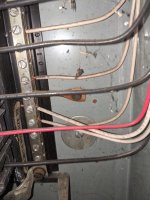
I'm clearly failing to understand grounding here. I've included a few pics. I have 2 large hot wires coming in and the one on the right I believe is a ground or neutral? The neutral bus bars on the left/right of the main panel are connected together and the top left goes to another sub panel in my garage as well as my bathroom addition that were done at the same time before I moved in. I included a few pics

Dave
 

Attachments

  • 2020-02-10 17.19.50.jpg
    2020-02-10 17.19.50.jpg
    122.7 KB · Views: 174
  • 2020-02-10 17.20.21.jpg
    2020-02-10 17.20.21.jpg
    150 KB · Views: 166
To avoid these ads, REGISTER NOW!
OP
T

TT_Vert

Well-known member
Joined
Mar 9, 2018
Messages
1,436
Location
Wauconda, IL.
See this is what I don't understand fully.

1. I don't see any grounding source, rod, pipe or otherwise to main panel. I'm guessing this is the neutral wire into the panel? I do know there is one grounding rod by my electrical meter outside but I think it's actually to ground my cable/coax feed into the house.

2. Can you explain why the ground source for the sub panel grounding bar is separate from (but sourced from) the same neutral bus bar on main panel? Would the fact my neutral and ground busses are not separate on the sub panel be why I see no ground to outlets? I am confused how that could be possible as I have continuity from what the source of that ground bus would be (the neutral bus of the main panel) and the neutral of my panel.

3. The person who installed this sub panel years ago did bond the neutral bus to the case. This case is physically bolted to the main pain and there is continuity, what problems will this create?

Thank you

Dave
 
Last edited:

Norcal

Well-known member
Joined
Mar 16, 2008
Messages
13,752
That subpanel is a mess, they bonded the neutral to the can, the whole thing looks like it's fed by 12AWG, & the neutral seems to be black too, and someone used SQ D breakers in a ITE panel, SQ D breakers cannot be used in other then a SQ D panel as they are not UL classified to be used in competitive panels, the panel needs to be redone with proper feeder conductors and separate neutral and ground bars, plus lose the existing bond on the neutral bar, even though the panel adjacent to the main panel, it must be wired as a subpanel, with neutral & grounding conductors separate.


To the OP: Is the wiring in EMT? I ask because of being from Illinois, & the Chicago area being EMT land, + seeing wiring in the main that makes me think EMT, which if it is, serves as the grounding conductor.
 
Last edited:

sberry

Banned
Joined
Jun 18, 2005
Messages
35,747
Location
Brethren, Michigan
I agree with Norcal that technically the N should be isolated, that is the code but,,,,,,,,,,,,,,,,,,,, electrically they are so close and bolted together they are essentially as 1. Back in the day they might even accept it as 1 but understanding of the code is a lot better today.
Absolutely agree it was done by someone should have the screwdriver taken away.
 
Last edited:
OP
T

TT_Vert

Well-known member
Joined
Mar 9, 2018
Messages
1,436
Location
Wauconda, IL.
That subpanel is a mess, they bonded the neutral to the can, the whole thing looks like it's fed by 12AWG, & the neutral seems to be black too, and someone used SQ D breakers in a ITE panel, SQ D breakers cannot be used in other then a SQ D panel as they are not UL classified to be used in competitive panels, the panel needs to be redone with proper feeder conductors and separate neutral and ground bars, plus lose the existing bond on the neutral bar, even though the panel adjacent to the main panel, it must be wired as a subpanel, with neutral & grounding conductors separate.


To the OP: Is the wiring in EMT? I ask because of being from Illinois, & the Chicago area being EMT land, + seeing wiring in the main that makes me think EMT, which if it is, serves as the grounding conductor.

The pic is a bit deceptive as the sub panel is fed by I believe 10ga(Haven't looked that closely but perhaps you are right now that I look closer comparing the wires) but the 220 breaker on main panel second down, top right is what feeds them. I will check that later and replace those feeds if they are 12awg. Yes they did run a black neutral to sub which I'll also fix, should that be the same gauge as the power feeds? The sub panel is "mostly" EMT but in my unincorporated area away from the city (I called the inspector to verify) NM is acceptable in a basement and doesn't even require GCFI if the basement isn't fully finished. I added the NM for my outlets in basement and the lights i put in. I went ahead and added GCFI breakers for my two 20A circuits (Used 12/2 NM and also ran the grounds as you can see in that sub panel) as a precaution since there is a sump down here which "could" fail. If the water ever gets to outlet height though I'm moving out!

I want to get a proper ground down here and it seems (as you also say) to do this I need to unbond the neutral from the case and run a separate earth. I still don't know how that'd get the circuit a proper ground though since the non GCFI breakers I have wouldn't reference that earth would they since the neutrals would still go to the neutral bus and only my GCFI breakers would have a wire going from them to the ground bus bar.

I do understand that the EMT acts as the ground in this case. What I don't understand is that the case is grounded to the neutral bus, the neutral bus between the two panels have continuity. The grounding wire that feeds all of my outlets is the neutral bus which is attached to the sub panel which also has continuity with the main panel and is grounded.

Can you explain why when testing it says I have no ground even though technically it seems (to me at least) that the sub is grounded just as the main panel is. Albeit not up to code I am confused why I don't see a ground on circuits being fed by nm when every outlet has that non insulated ground wire tied to the neutral bus which is fed by the main panel neutral bus.

I'm sure I'm being as clear as mud here but I'm trying my best to get my question across in a clear and concise fashion.

Thanks guys

Dave
 
Last edited:

sberry

Banned
Joined
Jun 18, 2005
Messages
35,747
Location
Brethren, Michigan
What I don't understand is that the case is grounded to the neutral bus, the neutral bus between the two panels have continuity. The grounding wire that feeds all of my outlets is the neutral bus which is attached to the sub panel which also has continuity with the main panel and is grounded.
It is all bonded together here, electrically it is as 1. There are so many methods of connecting panels they simply declared a point and said,,,we gonna do this all this way and didn't include a bunch of "what ifs" or exceptions if,,, etc.
They didn't want a debate, if its bolted direct, if its 6 inches, if its cable or pipe,,,, all of that. If they are 2 inches apart with pipe the pipe will carry neutral current if its bonded at the second panel. The pipe becomes a current carrying conductor. They do not want any neutrals not going on insulated wire between panels. If the second is bonded it makes any of the mechanical connections current carrying.
 
OP
T

TT_Vert

Well-known member
Joined
Mar 9, 2018
Messages
1,436
Location
Wauconda, IL.
It is all bonded together here, electrically it is as 1. There are so many methods of connecting panels they simply declared a point and said,,,we gonna do this all this way and didn't include a bunch of "what ifs" or exceptions if,,, etc.
They didn't want a debate, if its bolted direct, if its 6 inches, if its cable or pipe,,,, all of that. If they are 2 inches apart with pipe the pipe will carry neutral current if its bonded at the second panel. The pipe becomes a current carrying conductor. They do not want any neutrals not going on insulated wire between panels. If the second is bonded it makes any of the mechanical connections current carrying.

I understand they have a reason for their code. My question is WHY would I Not get a ground reference at outlets when my bare ground wires for my outlets are tied essentially to the same neutral and box is grounded the same way (Have ground and neutral continuity between them) as the other circuits (even other circuits which do have a ground run in EMT in same sub panel) Isn't the EMT in this sub panel getting it's ground reference from the box which is physically tied to the neutral bus bar. I know this is not up to code and should not be in a sub panel but I'm trying to wrap my head around the why I would have no neutral just in my NM circuit before I go any further. I wonder if it's due to the GCFI outlet wiring. I have to check again where I have the neutral and grounds going for those two circuits I added. Those are the two circuits w/ no ground even though I believe they are wired as the other circuits in this sub panel which do have a ground detected.
 
OP
T

TT_Vert

Well-known member
Joined
Mar 9, 2018
Messages
1,436
Location
Wauconda, IL.
Well, I'm a bit embarrassed now. While my thought process was sound my testing equipment, not so much. After I noticed no ground on one of my code required child proof outlets I tested in an older one. Turns out the ground tab on my tester was pushed in a hair. Enough to contact the non child protected outlet but not my new outlets. After pulling that ground tab out all is well. With that said a few things.

1. The feeds are 10AWG, should I increase this to 8AWG or smaller w/ the given breaker config (1 50A 220), 4 20A, 2 15A?
2. As far as the neutral, can I wrap some white electrical tape around the neutral feeds at the lug or is this even something I should worry about?
3. Should I still unbond the neutral bus bar of the sub-panel?
4. I read that I "should" be running a ground rod (2 actually) for the sub panel. Is this overkill?
5. Is the neutral wire into the main panel actually from a ground rod?
6. Have i wired my GFI breakers properly?
7. Is using a square D GFI breaker really going to bite me in the ***? Is it standard practice to use the same brand as the box? It seems ITE and Siemens are one in the same? Can Siemens breakers be used moving forward?
Attached a few more pics of the sub panel config. for reference on my GFI wiring. I have the bottom area going to the neutral bus bar (No ground bar on either box), i have the neutral going to neutra of the outlet and then the hot to the hot of the outlet. The bare copper wire also goes to the neutral bus bar.

Thanks again guys

Dave
 
Last edited:

sberry

Banned
Joined
Jun 18, 2005
Messages
35,747
Location
Brethren, Michigan
5. Is the neutral wire into the main panel actually from a ground rod?
No, it is to the center tap on the power company transformer. There is sposed to be rods or other ground electrodes connected to it. You fo not need rods for the second panel unless it was in another building.
 
OP
T

TT_Vert

Well-known member
Joined
Mar 9, 2018
Messages
1,436
Location
Wauconda, IL.
I was referring to my main panel. Is there supposed to be a ground rod or something grounding it? I see mention and videos of others w/ a dedicated ground bar in their panels, how is it determined if this is done?

Thanks
Dave
 

sberry

Banned
Joined
Jun 18, 2005
Messages
35,747
Location
Brethren, Michigan
The rods do 2 things. They try to reduce step potentials between the ground you are standing on and grounded equipment and for lightning strikes, want to deliver them to the earth rather than having them carried on electric wires and equipment.
 
OP
T

TT_Vert

Well-known member
Joined
Mar 9, 2018
Messages
1,436
Location
Wauconda, IL.
The rods do 2 things. They try to reduce step potentials between the ground you are standing on and grounded equipment and for lightning strikes, want to deliver them to the earth rather than having them carried on electric wires and equipment.

But what determines if this is done or not? I don't think I have a grounding rod and I know I don't have a ground bus.

Dave
 

sberry

Banned
Joined
Jun 18, 2005
Messages
35,747
Location
Brethren, Michigan
You don't need another ground bar at service main, it's bonded anyway. Is there any ground wire going anywhere, it could be to a rod in the footer. It will be to the neutral bar. This a grounded neutral system.
 
OP
T

TT_Vert

Well-known member
Joined
Mar 9, 2018
Messages
1,436
Location
Wauconda, IL.
You don't need another ground bar at service main, it's bonded anyway. Is there any ground wire going anywhere, it could be to a rod in the footer. It will be to the neutral bar. This a grounded neutral system.

There is no ground rod I see for anything power related. I do see a coax ground rod for my comcast. So WHEN is a ground rod installed? Only when you have a sub panel at a distance and don't want the path to ground to be the long journey back to the main panel?

Dave
 

sberry

Banned
Joined
Jun 18, 2005
Messages
35,747
Location
Brethren, Michigan
The didderence what determines it is insulating neutral between panels. This keeps operating currents from running on ground wires and any other interconnecting metal parts between panels or budings. An exame might be a copper gas line connects 2 structures. With a bonded N at the second panel the gas line could carry operating currents and faults.
 

sberry

Banned
Joined
Jun 18, 2005
Messages
35,747
Location
Brethren, Michigan
Rods are needed at service main and at detached buildings where there is service from an existing service. You don't want a lightning strike carried on the wire between buildings. Want it delivered to earth where it's at best it can be.
 
To avoid these ads, REGISTER NOW!
OP
T

TT_Vert

Well-known member
Joined
Mar 9, 2018
Messages
1,436
Location
Wauconda, IL.
Thanks so much, makes much more sense to me. My lack of knowledge here on grouding is what confused me I think. I still need to research the difference between a neutral and ground bus and why they are linked together often and then why they are often unlinked in remote locations.

Dave
 

sberry

Banned
Joined
Jun 18, 2005
Messages
35,747
Location
Brethren, Michigan
The 4th wire keeps all, everything at the same potential, all grounds on the same ssystem all tied together, no difference between any 2 pieces of equipment on the same system.
The very best earth ground might be a steel well casing. Next best buried steel water line then maybe footing steel, then ground rods.
 
Last edited:
OP
T

TT_Vert

Well-known member
Joined
Mar 9, 2018
Messages
1,436
Location
Wauconda, IL.
Sorry, what is the 4th wire? I see two power feeds in and one neutral. Or do you mean if a ground rod is added?

Dave
 

Max

ALLIANCE MEMBER
Joined
Jun 16, 2018
Messages
3,324
Location
Georgia
Whoever wired that sub-panel should get a lifetime ban from electrical work. A couple of points:
1. The two hots from the main panel to the sub-panel need to be sized to match the breaker that feeds them. It looks like a 30A breaker is feeding them? If so, 10 AWG is likely ok unless there is needed temp de-rating.
2. The neutral needs to be sized the same as the hots and wired to the neutral bar in the sub-panel.
3. You need a ground wire from the main box to the sub-panel that connects to the ground bar/box in the sub-panel. For 10 AWG I don’t know if the ground has to be the same gauge or if you can go a bit smaller. The sparkies here will know.
4. You have a 30 A feeder to the sub-panel, but the sub has a 50A breaker in it, plus lots of other 20/15s. The 50A feed will never go over 30A as the main panel breaker will blow. (Yes I know trip current is not exactly 30A and it depends on the size of the overload and duration...). You either have very little load on the sub-panel, or you need to feed it with larger wires and breaker.
5. As Norcal noted, your breakers do not match your panel. It’s clearly not to code, and opinions here vary on the severity of the issue. Still, if the breakers don’t work, then you have a good chance for a fire in your wiring if you have a fault. If it was me, I’d get the right panel or breakers.
6. Your main panel needs to be properly grounded as sberry pointed out. I can’t tell from the pic if it is or not. This isn’t optional, and if it’s not grounded you kind of wonder how it passed inspection... Once the main is grounded, then that ground is carried via a green wire to the sub-panel. Since the sub is attached to your house you should not have separate ground rods for it.

- Max
 
OP
T

TT_Vert

Well-known member
Joined
Mar 9, 2018
Messages
1,436
Location
Wauconda, IL.
Whoever wired that sub-panel should get a lifetime ban from electrical work. A couple of points:
1. The two hots from the main panel to the sub-panel need to be sized to match the breaker that feeds them. It looks like a 30A breaker is feeding them? If so, 10 AWG is likely ok unless there is needed temp de-rating.
It is 10AWG
2. The neutral needs to be sized the same as the hots and wired to the neutral bar in the sub-panel.
I'm not sure if the neutral is a 10 AWG, it goes from the neutral of sub panel to neutral of main panel, correct right?
3. You need a ground wire from the main box to the sub-panel that connects to the ground bar/box in the sub-panel. For 10 AWG I don’t know if the ground has to be the same gauge or if you can go a bit smaller. The sparkies here will know.Neither my main nor sub box have a ground bar, how can I do this w/o them?
4. You have a 30 A feeder to the sub-panel, but the sub has a 50A breaker in it, plus lots of other 20/15s. The 50A feed will never go over 30A as the main panel breaker will blow. (Yes I know trip current is not exactly 30A and it depends on the size of the overload and duration...). You either have very little load on the sub-panel, or you need to feed it with larger wires and breaker.
I have little load on the sub panel. About 20 LEDS which draw a total of 240W (~2A and the furnace electronics/fan, whatever the blower motor draws). Also have the outlets I installed but I'll never have any high current items on it. That 50A breaker feeds a 220V outlet that I don't even use or plan to use. Shouldn't a 6AWG wire be feeding that outlet w/ a 50A breaker? Those wires are going to cook long before the breaker would trip. Of course the feed breaker from the main box would trip long before but still. To make this right, should the breaker feeding the sub be larger than the largest breaker in the sub panel to prevent tripping the entire sub panel. That'd never happen w/ just me and my wife here but I'd like to have it right for the next person.


5. As Norcal noted, your breakers do not match your panel. It’s clearly not to code, and opinions here vary on the severity of the issue. Still, if the breakers don’t work, then you have a good chance for a fire in your wiring if you have a fault. If it was me, I’d get the right panel or breakers.
It seems ITE is now siemens, can I get siemens breakers since I cannot find the ITE breakers anymore? People say they are the same thing on the same assembly line.
6. Your main panel needs to be properly grounded as sberry pointed out. I can’t tell from the pic if it is or not. This isn’t optional, and if it’s not grounded you kind of wonder how it passed inspection... Once the main is grounded, then that ground is carried via a green wire to the sub-panel. Since the sub is attached to your house you should not have separate ground rods for it.

This confused me. I was told above that I did not need a ground as the neutral is the center tap from the power company and was grounded? There is only one neutral bus bar (Actually 2 that are tied together and bonded to the panel)

- Max


Thanks,

Dave
 

Attachments

  • 2020-02-11 15.20.59.jpg
    2020-02-11 15.20.59.jpg
    119.2 KB · Views: 43
  • 2020-02-11 15.20.56.jpg
    2020-02-11 15.20.56.jpg
    99.5 KB · Views: 43
  • 2020-02-11 15.20.47.jpg
    2020-02-11 15.20.47.jpg
    146.9 KB · Views: 44
  • 2020-02-10 17.19.50.jpg
    2020-02-10 17.19.50.jpg
    122.7 KB · Views: 45
Last edited:

Max

ALLIANCE MEMBER
Joined
Jun 16, 2018
Messages
3,324
Location
Georgia
1. It is 10AWG
- should be Ok unless you have conduit too full and need to temp. derate.
2. I'm not sure if the neutral is a 10 AWG, it goes from the neutral of sub panel to neutral of main panel, correct right?
- yes. But you should confirm the 10 AWG for neutral.
3. Neither my main nor sub box have a ground bar, how can I do this w/o them?
- The sparkies will have to comment as to whether that was ok with some old version of the NEC or not. For the resons sberry noted I would would fix it.
4. I have little load on the sub panel. About 20 LEDS which draw a total of 240W (~2A and the furnace electronics/fan, whatever the blower motor draws). Also have the outlets I installed but I'll never have any high current items on it. That 50A breaker feeds a 220V outlet that I don't even use or plan to use. Shouldn't a 6AWG wire be feeding that outlet w/ a 50A breaker? Those wires are going to cook long before the breaker would trip. Of course the feed breaker from the main box would trip long before but still. To make this right, should the breaker feeding the sub be larger than the largest breaker in the sub panel to prevent tripping the entire sub panel. That'd never happen w/ just me and my wife here but I'd like to have it right for the next person.

No - that would be very wrong. The main panel breaker protects the wiring to the sub-panel. The breaker matches (or is lower) than what wire can support. If you have a large breaker and too small wiring, when there is a fault the wires will get hot and burn, melt, start a fire - all kinds of bad possibilities that you do not want. If you want more power to that sub-panel, you need to upsize _both_ the main panel breaker and the wiring To the sub-panel. Right now, the best thing to do would be to remove the 50A breaker, or put a 20A in there.

5. It seems ITE is now siemens, can I get siemens breakers since I cannot find the ITE breakers anymore? People say they are the same thing on the same assembly line.
- The NEC says that you can only use breakers in a panel that are listed for that panel. I don’t know the specifics of what your panel supports.

6. This confused me. I was told above that I did not need a ground as the neutral is the center tap from the power company and was grounded? There is only one neutral bus bar (Actually 2 that are tied together and bonded to the panel)
- As I noted above, one of the practicing electricians will have to comment if some old version of the NEC allowed no ground or not. Neutral is indeed the center tap of the transformer feeding your house. However, generally your house provides a ground (via a variety of NEC accepted ways) that is connected to the incoming neutral at your main panel. Your panel is outside my experience.

- Max
 

sberry

Banned
Joined
Jun 18, 2005
Messages
35,747
Location
Brethren, Michigan
The earth is too high in resistance to flow enough current to trip a breaker in a fault,, a short circuit. It needs a wire directly back to the source that created it,, which would be the transformer.
 

sberry

Banned
Joined
Jun 18, 2005
Messages
35,747
Location
Brethren, Michigan
Yes, I understand that but it was a matter of explanation, cant include every detail in a single sentence. Proper term would have been grounding electrode I spose.
 
OP
T

TT_Vert

Well-known member
Joined
Mar 9, 2018
Messages
1,436
Location
Wauconda, IL.
Fair enough, so any continuous conduit or grounding wire to the device from the neutral would be "electrically grounded" I assume? If so, i'm good there. All EMT and NM is into the neutral bus bar. I still need to unbond that sub from the main even if they are bolted to each other correct?

Dave
 

wyliesdiesels

Well-known member
Joined
Aug 14, 2012
Messages
19,994
Location
Modesto, CA
I see I'm a bit late to the party here.... but I will add in some things... FYI earthing is not the correct term for any of this...

Forgive the question. I'm not an electrician, but know enough to get in trouble. I have a sub panel bolted directly to my original panel. This sub panel doesn't seem to have any of it's circuits grounded. The main panel does have everything grounded. In the main panel I only see neutral busses. I also see the case has a strap from the neutral bus to it. There is a neutral wire from the main panel to the sub panel. There is continuity between the neutral on the main and sub panel neutrals as well as neutral and the cases on each. The sub panel also has a lug from the neutral bus bar to the case.

The circuits are grounded in the subpanel but its incorrect. The EGCs are going to the neutral bar and they should be going to a separate ground bar.

Also the neutral bar in the sub should be isolated meaning that bonding strip needs to be removed.

I'm trying to better grasp the grounding concept here but also would like a layments description as to why the main panel sees ground yet the other doesn't. For reference I was looking at one outlet that tests correctly and is attached directly on the main box there are two wires (One hot and one neutral). I assume the box is being used for he ground. If this was the case I'd assume that the sub box would also be grounded since there is continuity between the two boxes.

The two GCFI breakers in the sub panel I have added while doing some basement work and when testing the outlets I noticed no ground on my outlets or the other existing circuit I tested. Everything works (Except having no ground so I cannot test the GCFI function).

A GFCI does NOT need to be connected to an EGC/ground in order to function or test. A GFCI does not even reference the ground wire when in operation.

I'm clearly failing to understand grounding here. I've included a few pics. I have 2 large hot wires coming in and the one on the right I believe is a ground or neutral? The neutral bus bars on the left/right of the main panel are connected together and the top left goes to another sub panel in my garage as well as my bathroom addition that were done at the same time before I moved in. I included a few pics

Dave

Equipment grounding conductors work like this. The bare wire from the PoCo is neutral not ground as the PoCo does not distribute a ground to services.

The neutral bond in the main panel is what establishes the low impedance ground fault pathway. When an ungrounded conductor touches a bonded/grounded chassis, frame, conduit, panel etc., the EGC provides a low impedance fault current pathway allowing high amperage fault currents to make there way back to the neutral/ground bond in the main panel. These high energy currents cause the magnetic trip mechanism in the breaker feeding the offending circuit to trip, opening the ungrounded conductors and thus clear the fault current.

Without the neutral to ground bond in the main service panel, there would be no way for breakers to clear fault current.

Now you only want this bond in the main service panel because if you have it in subpanels and the neutral fails, then you can have dangerous shock potential and neutral current returning to the main service panel or transformer on unintended pathways such as a person touching the frame of the panel while standing on concrete or touching a ground pipe.

See this is what I don't understand fully.

1. I don't see any grounding source, rod, pipe or otherwise to main panel. I'm guessing this is the neutral wire into the panel? I do know there is one grounding rod by my electrical meter outside but I think it's actually to ground my cable/coax feed into the house.

Now grounding electrodes are an entirely different animal. Sberry already touched on this a bit earlier.

Grounding electrodes are for limiting step potential and voltage to earth as well as shunting lightning to earth. They DO NOT provide a low impedance fault current pathway.

Original code back in the day called for 1 ground rod and a water line bond if it met the requirements to be an electrode.

Nowadays, 2 rods are required or 1 UFER and nothing else.

If you have a ground rod for the cable service, it needs to be connected/bonded to the grounding electrode system for the electrical service.

2. Can you explain why the ground source for the sub panel grounding bar is separate from (but sourced from) the same neutral bus bar on main panel? Would the fact my neutral and ground busses are not separate on the sub panel be why I see no ground to outlets? I am confused how that could be possible as I have continuity from what the source of that ground bus would be (the neutral bus of the main panel) and the neutral of my panel.

your subpanel is wired incorrectly. It should have 4 wires- 4 #10s or 3 #10s if connected via metal conduit.

There needs a ground bar and neutral bar needs to be isolated.

3. The person who installed this sub panel years ago did bond the neutral bus to the case. This case is physically bolted to the main pain and there is continuity, what problems will this create?

Thank you

Dave

shock potential on the chassis if your neutral wire fails.

The pic is a bit deceptive as the sub panel is fed by I believe 10ga(Haven't looked that closely but perhaps you are right now that I look closer comparing the wires) but the 220 breaker on main panel second down, top right is what feeds them. I will check that later and replace those feeds if they are 12awg. Yes they did run a black neutral to sub which I'll also fix, should that be the same gauge as the power feeds? The sub panel is "mostly" EMT but in my unincorporated area away from the city (I called the inspector to verify) NM is acceptable in a basement and doesn't even require GCFI if the basement isn't fully finished. I added the NM for my outlets in basement and the lights i put in. I went ahead and added GCFI breakers for my two 20A circuits (Used 12/2 NM and also ran the grounds as you can see in that sub panel) as a precaution since there is a sump down here which "could" fail. If the water ever gets to outlet height though I'm moving out!

I want to get a proper ground down here and it seems (as you also say) to do this I need to unbond the neutral from the case and run a separate earth. I still don't know how that'd get the circuit a proper ground though since the non GCFI breakers I have wouldn't reference that earth would they since the neutrals would still go to the neutral bus and only my GCFI breakers would have a wire going from them to the ground bus bar.

yes the neutral needs to be white insulated and should be same size as ungrounded conductors.

If the panels are connected with metal conduit, then you do not need to run a separate ground wire but you do need to add a ground bar, move the grounds to it off of the neutral bar, and unbond the neutral bar.

Now dont go confusing GFCIs in the mix. has nothing to do with the issues in your subpanel.

Well, I'm a bit embarrassed now. While my thought process was sound my testing equipment, not so much. After I noticed no ground on one of my code required child proof outlets I tested in an older one. Turns out the ground tab on my tester was pushed in a hair. Enough to contact the non child protected outlet but not my new outlets. After pulling that ground tab out all is well. With that said a few things.

1. The feeds are 10AWG, should I increase this to 8AWG or smaller w/ the given breaker config (1 50A 220), 4 20A, 2 15A?

2. As far as the neutral, can I wrap some white electrical tape around the neutral feeds at the lug or is this even something I should worry about?

3. Should I still unbond the neutral bus bar of the sub-panel?

4. I read that I "should" be running a ground rod (2 actually) for the sub panel. Is this overkill?

5. Is the neutral wire into the main panel actually from a ground rod?

1. The breaker feeding the subpanel is 240v 30a so no point in increasing the feeder wire size. However, depending on the diversity of the loads in the subpanel, you may need to. Obviously you will not get 50a for that 50a 240 circuit you have running off of the subpanel.

Can you list the loads in the subpanel.

2. If you want to abide by code, then no you cant just wrap some white tape around it. that is only allowed for conductors size 4 and larger.

3. YES! most definitely.

4. NOPE you do not need ground rods for the subpanel since its in the same structure as the main. however the main does need to have grounding electrodes connected to the neutral bus bar along with a bond to metal water line and gas line if you have them.

Some PoCos allowing ground rod connections to be made at the meter pan so I would check outside first.

5. The neutral wire would most definitely NOT be coming from a ground rod. It would be coming from the neutral lug in your meter pan. However as i said above, its possible the neutral lug in your meter pan has a ground rod terminated to it.

6. Have i wired my GFCI breakers properly?

7. Is using a square DGFI breaker really going to bite me in the ***? Is it standard practice to use the same brand as the box? It seems ITE and Siemens are one in the same? Can Siemens breakers be used moving forward?
Attached a few more pics of the sub panel config. for reference on my GFI wiring. I have the bottom area going to the neutral bus bar (No ground bar on either box), i have the neutral going to neutra of the outlet and then the hot to the hot of the outlet. The bare copper wire also goes to the neutral bus bar.

Thanks again guys

Dave

6. The GFCI breaker neutral pigtail needs to go to the neutral bar in the panel and the neutral from the circuit needs to go to the breaker.

7. yes you should use the same brand and model of breaker listed for the panel. In your case ITE or siemens breakers only. Siemens is the successor to ITE.
 
Last edited:

wyliesdiesels

Well-known member
Joined
Aug 14, 2012
Messages
19,994
Location
Modesto, CA
I was referring to my main panel. Is there supposed to be a ground rod or something grounding it? I see mention and videos of others w/ a dedicated ground bar in their panels, how is it determined if this is done?

Thanks
Dave

yes the main service panel should have grounding electrodes connected to the neutral bar.

Look for a larger solid copper wire going to the neutral bar or going into the meter pan outside.

Can you take a pic of the meter pan and post it here.

a dedicated ground bar in the main is typically used when the neutral bar is full.

But what determines if this is done or not? I don't think I have a grounding rod and I know I don't have a ground bus.

Dave

Ground rods are required for the main service panel PERIOD. there is nothing to determine whether its needed or not.

There is no ground rod I see for anything power related. I do see a coax ground rod for my comcast. So WHEN is a ground rod installed? Only when you have a sub panel at a distance and don't want the path to ground to be the long journey back to the main panel?

Dave

A ground rod should always be installed for the main service panel. This is a requirement not an option.

As to your question about the subpanel, that has nothing to do with needing a ground rod.

Did you look at the pic that wizard posted earlier in the thread?

Thanks so much, makes much more sense to me. My lack of knowledge here on grouding is what confused me I think. I still need to research the difference between a neutral and ground bus and why they are linked together often and then why they are often unlinked in remote locations.

Dave

look at the diagram that wizard posted above.

Neutral and ground are ONLY bonded at main service panel. NEVER in a subpanel except for detached structures in existing installs prior to 2008.

Sorry, what is the 4th wire? I see two power feeds in and one neutral. Or do you mean if a ground rod is added?

Dave

The 4th wire between main and sub would be the equipment grounding conductor.

1. I'm not sure if the neutral is a 10 AWG, it goes from the neutral of sub panel to neutral of main panel, correct right?

2. Neither my main nor sub box have a ground bar, how can I do this w/o them?

3. I have little load on the sub panel. About 20 LEDS which draw a total of 240W (~2A and the furnace electronics/fan, whatever the blower motor draws). Also have the outlets I installed but I'll never have any high current items on it. That 50A breaker feeds a 220V outlet that I don't even use or plan to use. Shouldn't a 6AWG wire be feeding that outlet w/ a 50A breaker? Those wires are going to cook long before the breaker would trip. Of course the feed breaker from the main box would trip long before but still. To make this right, should the breaker feeding the sub be larger than the largest breaker in the sub panel to prevent tripping the entire sub panel. That'd never happen w/ just me and my wife here but I'd like to have it right for the next person.

1. yes that is correct.

2. main does not need one since the neutral bar isnt full. Ground wires can go to the neutral bar in a main panel.

Subpanel needs one added so you can unbond the neutral bar. buy a ground bar that is the same brand as the panel.

3. The 30a feeder for the sub sounds like it is ok for the current load but yes it would trip if the 50a outlet is used for equipment that draws more than 30a.
50a outlet couldve been installed for a welder and thus the smaller gauge wire is ok.

As to increasing the breaker size, you could do this and change to 50a but would need to change the wire to #8 THWN.

Fair enough, so any continuous conduit or grounding wire to the device from the neutral would be "electrically grounded" I assume? If so, i'm good there.

On a main service panel that is correct but you must have wires ran to the circuit for both neutral and ground to prevent neutral current from flowing on the wrong pathways.

On a subpanel, the EGC/ground wires should only be going to the ground bar. They will also be grounded due to the bond in the main service panel.

All EMT and NM is into the neutral bus bar. I still need to unbond that sub from the main even if they are bolted to each other correct?

Dave

yes the neutral bar in the sub needs to be unbonded and a ground bar needs to be added still. move ground wires over to new ground bar and leave neural wires on neutral bar.
 

alfredeneuman

Well-known member
Joined
Mar 3, 2011
Messages
4,580
Location
Fullerton, CA
Next best buried steel water line then maybe footing steel, then ground rods.

Footing Steel (UFER doesn't need a supplemental electrode)
Buried copper water line (More conductive than steel, but still requires a supplemental electrode)
Ground Rod (If 1 does not test <25 ohms to ground, then you need a 2nd)
 
OP
T

TT_Vert

Well-known member
Joined
Mar 9, 2018
Messages
1,436
Location
Wauconda, IL.
I certainly see no grounding bar or conductors coming into my box. Just the two power and one neutral. THere was a fairly large addition put on it back in 05 and a permit was pulled/200A service in house and 100A in new garage added. I have to assume it was up to code. I don't know if that sub panel was put in after the fact or what

Dave
 

Innovate1

Well-known member
Joined
Jul 28, 2014
Messages
4,283
Location
Illinois near St. Louis, Missouri
I scanned this thread and didn't see a clear explanation of the difference between ground and neutral. They are connected together in the main panel. From there they are separate - a separate ground and neutral is run to any sub panel. Thus 4 wires - 2 hots, neutral and ground. Neutral is intended to carry load current. Ground is for connection to the frame of things for safety only. Operating current could burn out the ground wire so it is reserved for only ground current.

A ground bar can easily be added to the sub panel. They just screw to the box.
 
To avoid these ads, REGISTER NOW!
Top Bottom