To avoid these ads, REGISTER NOW!

Easily modified wiring layout

going88mph

Member
Joined
Sep 19, 2012
Messages
23
Hello,

Getting around to wiring my new garage now. It's 24x30, stick built. I'd like to run all of the wiring on the drywall surface to make it easy to add/remove/move circuits as necessary. Additionally, the walls will be fully insulated with no disruption due to wiring or boxes.

What I'd like to do is to run wiring from the service panel to the attic space (NM-B) inside of a plywood chase. Then, along the top plates in the attic, run the exposed NM-B to a 4x4 EMT electrical box where it converts to THHN and drops back down to the garage floor level via EMT conduit.

I feel like this would give me maximum flexibility, while still adhering to the NEC.

Moving a receptacle, for example, would require unscrewing the EMT from the wall, removing the 4x4 box, and disconnecting the THHN. Then, the whole "assembly" (i.e,. the 4x4 box, the EMT drop, and receptacle) could be moved to its new location, and reconnected to the NM-B in the attic.

Does this make sense? I've seen some have argued using PVC, but PVC cannot be disassembled easily, and the junction boxes cost $5 each here, while EMT boxes are only about $1 each.
 
To avoid these ads, REGISTER NOW!

Charles (in GA)

Well-known member
Joined
Jan 11, 2006
Messages
12,489
Location
50 mi south of Atlanta
I think you are way overthinking this. Wire it with receptacles every few feet and you wont be redoing it. What you are suggesting is a huge waste of time and materials.

Charles
 
OP
G

going88mph

Member
Joined
Sep 19, 2012
Messages
23
Where exactly is the waste of materials (versus doing an entirely nm-b or entirely thhn in emt installation)?
 

Ch3No2

Well-known member
Joined
Nov 27, 2009
Messages
356
Even though I gave it much thought as where to place recepticles I went every 6' in the walls needed or not...except fot the welder, lights and compressor. I still managed to pull enough "home runs" to sustain the load for any significant changes later...and I could still pull more wire even though the walls are insulated...just my .02 cents
 

Attachments

  • Garage 29.JPG
    Garage 29.JPG
    72.2 KB · Views: 87
  • Garage 28.JPG
    Garage 28.JPG
    78.3 KB · Views: 79
  • Garage 30.JPG
    Garage 30.JPG
    76.7 KB · Views: 64

kbs2244

Well-known member
Joined
Nov 11, 2006
Messages
14,065
Go for it.
It will make you happy now and maybe in the future.
 

Zeke

Well-known member
Joined
Aug 13, 2009
Messages
17,176
Location
Long Beach CA, the sewer by the sea.
Sounds like you are wanting to avoid any horizontal surface EMT. I can get behind that.

If you do a floor plan for your equipment, you should get most of your boxes pretty close to where they need to be the first time.
 

jlckmj

Well-known member
Joined
Dec 7, 2009
Messages
732
Location
SE Wiscosin
I am doing pretty much the same thing.
Instead of going into the rafters, The wire will go up from the panel inside a chase and stapled to the osb walls, then I am going to build soffit storage along the whole length of the garage and drop down from that with a straight length of conduit to the box.

I asked an electrition friend if it was ok, and he said technically yes because the wire will be fastened to the wall inside the cabinets, and when I put the romex through the conduit drops it will be considered for protection of the wire only.

Jim
 

ForceFed70

Well-known member
Joined
Apr 27, 2010
Messages
3,441
Location
BC, Canada
My thoughts are that what you are planning will work fine but is a lot of work and material. I personally prefer more of a finished look in my garage so didn't want a bunch of surface mounted conduit. Also, conduit makes shelving, cabinets, etc harder to install.

What I did with my garage was to over-wire with 20A split recepticles every 6' and 240V 30A plugs wherever I thought I could possibly use them.

But, I also left easy access from the panel to the attic. So if I need a circuit in the future I can easily run wire up into the attic and then down the wall wherever needed (in conduit of course).
 

Charles (in GA)

Well-known member
Joined
Jan 11, 2006
Messages
12,489
Location
50 mi south of Atlanta
One of the problems is that, unless you leave an excess of wire on every circuit (and I don't think an inspector would go along with this) then, every time you decided to move a box in the attic and relocate a downpipe and receptacle, you would have to install a junction box at the point where you were removing the box, in order to have a place to splice on additional wire to get to your "new" location. Extra splices, extra boxes. Spend the time, money and materials up front that you won't be climbing into the attic disconnecting stuff, messing around in the insulation, pulling out the nailed in clips holding romex down, relocating the box, patching holes in the ceiling and screw holes in the walls, making new holes, splicing wires, nailing down wires....... What happens when it becomes necessary to do this in the summer to accommodate some new "need" and its 150F in the attic?

It just is not worth it to attempt to save a little on wire.

Charles
 
To avoid these ads, REGISTER NOW!

brewchief

Well-known member
Joined
Sep 20, 2008
Messages
2,370
Location
Michigan
Unless you have a pretty steep roof you will find it's not real easy to do any work close to the walls where the trusses sit, very tough when you need both hands. The first time you are laying in fiberglass soaked in sweat holding a flashlight in your teeth trying to unhook or reconnect a junction box you will regret it.

Running it all in EMT on the surface is going to be the easiest to modify in the future if you ask me.
 

buzz4041

Well-known member
Joined
Sep 13, 2011
Messages
730
Location
South Texas
I agree with Charles. Do a plan and wire it up. You may think that this is clever but in reality you will never start moving circuits around. JMHO
 
OP
G

going88mph

Member
Joined
Sep 19, 2012
Messages
23
My reason for this was that in the last garage i had, every time id get new equipment, there was no way to reconfigure the space to accommodate it where it made sense. Im talking 220v items mainly. The result was that you couldnt weld while the oven was on, or couldnt have the air compressor hooked up while milling. Super annoying. One solution already mentioned was to simply add enough circuits upfront to try to anticipate any changes. I think i may do just that until someone invents a more modular way to wire a shop.

Thanks for the discussion.
 

madosta

Well-known member
Joined
Sep 4, 2012
Messages
807
Location
Michigan
Well there are modular solutions, like bus duct that you could use... lol if you have mega $s.

Good luck.
 

Spudland_Dave

Well-known member
Joined
Mar 12, 2010
Messages
3,025
Location
Maine
Along similar lines...not looking for an "easy to add/remove" solution, but how about Pre-wiring to a general location just in case?

For example, right now I've got to get my ducks in a row on my wiring plan. The 110V stuff is easy...pound in the recepts....but 220V is tricky...WHERE to put them is the question. I think I've got my welder ones figured out, but I know down the road I'd like a Bridgeport Mill, and maybe some other tools. NO Clue where they will go because A) I dont own them yet and B) I dont know how working in my shop will be down the road.

I'm not opposed to neatly done surface EMT...
 

Charles (in GA)

Well-known member
Joined
Jan 11, 2006
Messages
12,489
Location
50 mi south of Atlanta
Along similar lines...not looking for an "easy to add/remove" solution, but how about Pre-wiring to a general location just in case?

For example, right now I've got to get my ducks in a row on my wiring plan. The 110V stuff is easy...pound in the recepts....but 220V is tricky...WHERE to put them is the question. I think I've got my welder ones figured out, but I know down the road I'd like a Bridgeport Mill, and maybe some other tools. NO Clue where they will go because A) I dont own them yet and B) I dont know how working in my shop will be down the road.

I'm not opposed to neatly done surface EMT...

While the walls are open just put a deep 4x4 metal box and EMT up thru the header of the wall, every other wall bay or three. Then you can pull wire where ever you want later.

I'm somewhat being sarcastic here, that would be a lot of boxes, EMT and blank cover plates, mostly going to waste. But you could easily pull wires wherever you needed, later on if you wanted to save money on copper wire. Otherwise you get a rather strange looking hodge podge of recessed and surface mount boxes. But you will end up with that later on probably.

My real feeling is to install lots of 120v receptacles and wire them up. For 240v receptacles, install them where you can forsee them, and if you need more (I generally never remove functional installed receptacles) just add them.

You can worry over this all day long, but the best you can do is plan ahead and do the best you can, and if you need something else later, add it.
 

Spudland_Dave

Well-known member
Joined
Mar 12, 2010
Messages
3,025
Location
Maine
You can worry over this all day long, but the best you can do is plan ahead and do the best you can, and if you need something else later, add it.

Quote of the week right there! LOL.

Instead of EMT, why not ENT? Could Pre "Plumb" right from the panel to the box...then just pull whatever size THHN you needed. To help defer costs I was actually contemplating doing that just this morning. We werent even PLANNING on insulating or sheathing the garage this year, but now I've got both insulation and a lift of rock sitting in the garage/shop...with the holidays and everything, I gotta watch my pennies.
 

Falcon67

Well-known member
Joined
Jun 11, 2009
Messages
18,371
Location
Merkel, TX
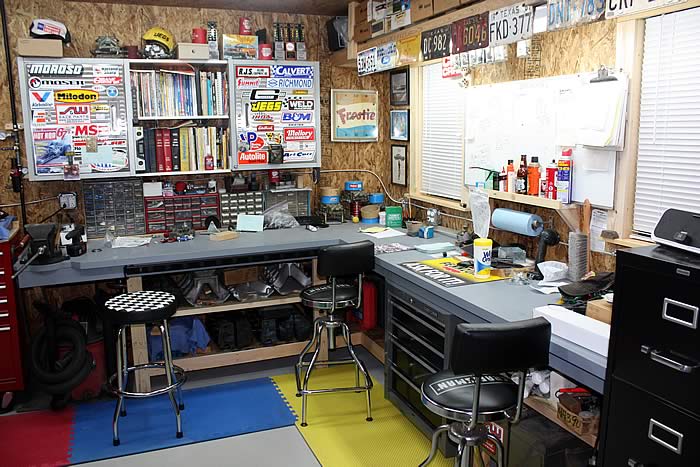
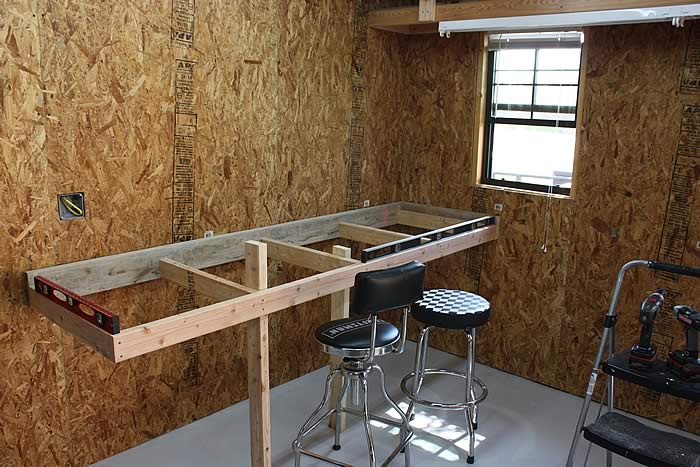
In my layout, I put wall plugs every 8' in the area where the cars, etc are stashed and things just need general power - golf cart charger, buffers, etc. I have a lot of tools on wheels like the wash tank, metal saw, miter saw. On the walls where benches were located in the 12x24 "tool room", I put deep 4" boxes in the wall, one on each long wall. These are fed by NM cable. Once the walls were insulated and covered, I set a 4" open back box on the wall box and came out of that with MC cable to 4x boxes mounted on the face of the OSB. I put all my junk in place - more or less - and then ran the MC on the surface, placing the 4x boxes where I needed them. If I change it all up, all I need to buy is more MC cable to move it all around. Or to add something. I used the rounded edge boxes and the covers that let you bolt on the plugs. I could make as many covers sitting at the bench as I needed, then just places boxes, ran MC, wired on the covers and done.

I considered EMT drops - but this is more flexible and I don't have to dig around in the attic and re-route cable to change something on the ground floor.

Everything 240V got a direct run. That's big stuff that doesn't move, typically. Compressor, well pump, mill - that kind of stuff. When I get a 240V welder (only 120V - 140A type now) I'll run a centrally located drop and use a cord if needed.

Example here - box on the left side behind the vice is where the drop for that wall is located. Everything else is surface mount. If I had done the "every 6'" thing, there would be at least one plug on that back wall that would be unusable thanks to the part bins.
ShopBench.jpg


Before - before I know where everything will end up :lol:
Bench1.jpg
 
Last edited:
To avoid these ads, REGISTER NOW!
Top Bottom