To avoid these ads, REGISTER NOW!

Eaton 40 amp Double Pole GFCI Tripping

justsam

Well-known member
Joined
Aug 20, 2010
Messages
1,268
Location
Penngrove, California
Perhaps it is a different "Ghost in the Machine" in regard to post processing of the detected current imbalance. Under FCC part 15.5 devices must not cause harmful interference as well as they must accept interference from other devices. I would not be surprised if some "budget" , or early devices lack filtering or noise suppression. Couple that with long antennas known as the house wiring and I see a potential. If you do not think GFCI's are unintentional or incidental radiators, hold an AM radio close to one as opposed to a non GFCI. There are well documented and verified cases of GFCI receptacles and breakers being tripped by high level RF such as from amateur radio transmitters which are orders of magnitude higher than an unintended or incidental radiator.
 
To avoid these ads, REGISTER NOW!

justsam

Well-known member
Joined
Aug 20, 2010
Messages
1,268
Location
Penngrove, California
that applies to radio transmitters. GFCIs do not transmit microwaves
Actually it applies to things that become transmitters but that is not their intended purpose. It also applies to devices that become unintended receivers and they must be designed to not accept interference.

Early LED bulbs that found their way into garage door openers caused issues with the openers no longer working. Classic case of either or both devices not being FCC part 15 compliant. Neither of their design purposes was to be a transmitter or communication receiver, yet they interfered with one another. Clearly the square waves generated in modern logic create interference it is just a case of how much is accepted, or FCC compliant.

I n regard to false trip on GFCI's it is a long shot that but plausible non the less.

Not sure how microwaves got in the discussion, as it is not in the radio spectrum in question.
 

wyliesdiesels

Well-known member
Joined
Aug 14, 2012
Messages
20,089
Location
Modesto, CA
Actually it applies to things that become transmitters but that is not their intended purpose. It also applies to devices that become unintended receivers and they must be designed to not accept interference.

Early LED bulbs that found their way into garage door openers caused issues with the openers no longer working. Classic case of either or both devices not being FCC part 15 compliant. Neither of their design purposes was to be a transmitter or communication receiver, yet they interfered with one another. Clearly the square waves generated in modern logic create interference it is just a case of how much is accepted, or FCC compliant.

In regard to false trip on GFCI's it is a long shot that but plausible non the less.

Do you have documented cases of GFCIs doing that?

in regards to the light bulbs how do you know they were creating signal wirelessly? and how do you know they were receiving it wirelessly?
 

dscheidt

Well-known member
Joined
Apr 26, 2017
Messages
2,909
Do you have documented cases of GFCIs doing that?

in regards to the light bulbs how do you know they were creating signal wirelessly? and how do you know they were receiving it wirelessly?
some led drivers use a switched mode power supply,a and they generate a lot of RF noise. The first LED bulbs I bought went into our kitchen overhead light. They lasted until baseball season, when my wife discovered she couldn't listen to the ballgame when the kitchen light was on, because the bulbs killed AM reception. They were a brand name bulb, and the manufacturer (feit, I think) replaced them when I complained. The replacements were marginally better.
 

BurtEggley

Well-known member
Joined
Oct 8, 2024
Messages
889
Not trolling (was late and tired, meant to edit to a fuller post), but rather pointing out that simply because you read something, especially on the internet, doesnt mean it is true. As has been stated, there is no way for them to "interfere", especially without a load on them. Anecdotal experience does not indicate proof.

While not an EE specifically, I do teach HS Engineering, including circuit design and basic residential electrical.
I wrote that happened to me with two different circuits. They were Leviton GFCI. It is not something I heard on the Internet. The problem went away when I did what an electrical article said to do. It said to only use one per circuit. I did that and the problem went away. That is a fact. Maybe it did not happen to you or Wylie, but has happened to other people. I accepted that and moved on.
 

BurtEggley

Well-known member
Joined
Oct 8, 2024
Messages
889
Do you have documented cases of GFCIs doing that?

in regards to the light bulbs how do you know they were creating signal wirelessly? and how do you know they were receiving it wirelessly?
my neighbors leaf blower used to take down my garage door opener. It would not open or close until he stopped blowing leaves. I replaced the garage door opener to a newer model and that solved it. Then people started installing cameras. They took down that newer opener seven years later to where one had to have the transmitter right up against the garage to make the opener work. We extended the opener antenna to the header over the garage and it worked again - until I added a camera to the garage and made it worse. Lived with it then another neighbor added a camera 20' from my garage and hosed it again. I replaced the opener with a new one. Nicer. It has a battery backup in it which I have used a couple times when the power is out. When the unit was put in, the garage door company dropped the battery 8' putting it in. I had them replace it because it could have been damaged. When they came back out to replace the battery, they took out the LED I put in it and refused to put it back in because they said they are tired of calls to fix openers when the only thing wrong is someone put an LED light in it. Apparently some people do not buy the specially approved LEDs that do not cause problems.

The actual problem with many pieces of equipment used today, including LED bulbs is that they contain an inexpensive switch-mode power AC to DC supply without a proper filter added. Those put out significant noise over the whole AC system they are attached too. A special capacitor can fix that noise.

So yes, equipment in the house can put out RF and cause all sorts of issues just like a old car, with copper plug wires and non-resistor plugs, would to your AM radio.


Cruzan80

Well-known member
Joined
Jul 22, 2015
Messages
4,324
Location
Denver, CO
I wrote that happened to me with two different circuits. They were Leviton GFCI. It is not something I heard on the Internet. The problem went away when I did what an electrical article said to do. It said to only use one per circuit. I did that and the problem went away. That is a fact. Maybe it did not happen to you or Wylie, but has happened to other people. I accepted that and moved on.
Again, Anecdotal experience does not indicate proof. If it makes you happy to think that was the reason, great. However, with the same loads and items plugged in, there is no way for one to contribute causing another to trip. Either it is enough to trip, or it isn't. You are confusing two issues (multiple GFCI and RF interference) Here is a link specifically recommending the Leviton for being much less susceptible to RF interference (specifically HAM radio, which is far "noisier" than a simple LED). https://www.arrl.org/gfci-and-afci-devices
 
To avoid these ads, REGISTER NOW!

Cruzan80

Well-known member
Joined
Jul 22, 2015
Messages
4,324
Location
Denver, CO
Good thing the OP got his question answered
Last post by OP:
It is a single circuit. I either plug the welder in or I plug the heater in. It's either or. I'm think the receptacle has an issue. Will test as soon as I can. Breaker is off until I figure it out.

It has only been a day, and if the receptacle was the issue, it is possible the OP found and solved his problem, and just hasn't updated us yet.
 

PCustoms

Well-known member
Joined
Jul 23, 2011
Messages
23,552
Location
VT
Last post by OP:


It has only been a day, and if the receptacle was the issue, it is possible the OP found and solved his problem, and just hasn't updated us yet.

I was more referring to the semantics/bickering
 

BurtEggley

Well-known member
Joined
Oct 8, 2024
Messages
889
Again, Anecdotal experience does not indicate proof. If it makes you happy to think that was the reason, great. However, with the same loads and items plugged in, there is no way for one to contribute causing another to trip. Either it is enough to trip, or it isn't. You are confusing two issues (multiple GFCI and RF interference) Here is a link specifically recommending the Leviton for being much less susceptible to RF interference (specifically HAM radio, which is far "noisier" than a simple LED). https://www.arrl.org/gfci-and-afci-devices
The first double GFCI circuits were GFCI 1 Line -> GFCI 2 Line like the image below. This pair tripped each other maybe once every six months randomly. After researching it, removing one solved the problem. The pair I unintentionally wired into the same circuit were wired GFCI 1 Line -> Load -> GFCI 2 Line. This pair tripped more frequently, maybe every 8 - 10 weeks or so. Regardless, removing the second one stopped the tripping. BECAUSE it happened to me first hand, I mentioned it for the OP just in case he had a similar issue.

multiple-gfci-outlet-wiring.gif
 

Cruzan80

Well-known member
Joined
Jul 22, 2015
Messages
4,324
Location
Denver, CO
The first double GFCI circuits were GFCI 1 Line -> GFCI 2 Line like the image below. This pair tripped each other maybe once every six months randomly. After researching it, removing one solved the problem.
You can keep repeating yourself, but it doesn't change the fact that a GFCI doesn't affect anything upstream of itself. That isn't how electricity works.

Correlation =/= Causation (Just because you changed something, doesn't mean it was related to a different thing that happened).
 
OP
B

BigTicket

Well-known member
Joined
Nov 14, 2023
Messages
61
Update. I switched back to the 50-amp GFCI breaker, and as before, no tripping. I will pick up another 40-amp GFCI and try it again. I think it was an issue with the 40A GFCI breaker. Wiring looked good, and using the same receptacle with the 50-amp breaker without issue.
 

mm08822

Well-known member
Joined
Jan 13, 2012
Messages
6,061
Location
NJ
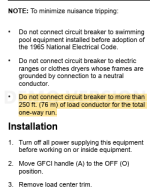
Here's an example for leakage current based on conductor length. It's from a current day Homeline 50A GFCI CB.
1770097470382.png
 
To avoid these ads, REGISTER NOW!
Top Bottom