
To avoid these ads, REGISTER NOW!

Educate me on taps. Dies also !

theoldwizard1

Well-known member
Joined
Feb 22, 2011
Messages
43,137
Location
SE MI
So I am working over at my buddies house and he is tapping 14-20 in a 1" blind hole in some aluminum for me. (His house, his tools; i'll watch.). Then the sound we all hate to hear. Ping!!

He says he has a friend who is a machinist who can get it the busted piece out, but that is not my issue.


Very simply, what is the best raw material and other advice for taps ? We are talking general purpose (aluminum and mild steel) hand tapings. Carbon steel ? HSS ? Why ?

What are the "best bang for the buck" brands for a DIY ?


I am dying to see Astro's new set ! I have an old Craftsman set (70s) that has service me well.
 
To avoid these ads, REGISTER NOW!

Jim Johnstone

Well-known member
Joined
Apr 11, 2011
Messages
1,841
Location
Brantford, Ontario
HSS is superior to carbon steel taps. HSS taps will be made from an actual tool steel as opposed to just carbon steel. They are typically through hardened whereas most carbon steels only case harden.

I'm not the best guy to ask about specific brands since I get all mine through machine shop suppliers and I never buy any from retail type stores, but I've heard guys mention the Irwin taps as being pretty good.
 

ibedayank

Well-known member
Joined
Feb 2, 2011
Messages
2,619
Location
Columbia TN
HSS is superior to carbon steel taps. HSS taps will be made from an actual tool steel as opposed to just carbon steel. They are typically through hardened whereas most carbon steels only case harden.

I'm not the best guy to ask about specific brands since I get all mine through machine shop suppliers and I never buy any from retail type stores, but I've heard guys mention the Irwin taps as being pretty good.

Hanson is now Irwin
 

Astro_Pneumatic_Tools

Well-known member
Joined
Oct 30, 2013
Messages
2,108
Location
South El Monte
HSS would be the best. HSS isn't the only tool steel, but it's the only tool steel grade people seem to be making taps out of.

But HSS for aluminum and mild steel is a bit over kill, HSS for these metals run by hand it starts to lose it's main benefits in comparison. Also, HSS is hard as a dickens, hard is good for wear reduction with constant and moderate ramping loads, but not great for mis-use which is common for a tech not drilling the appropriate sized hole or just cranking on it bottoming it out or hitting a large burr.

High carbon steel in the US usually means higher than .70 content. A high carbon steel made for tooling like this should hopefully be around .80-.85 or higher. HCS from overseas can range very wildly.
 
Last edited:

T45

Well-known member
Joined
Nov 20, 2014
Messages
3,252
best bang for the buck is to buy a single tap for the job, not buy a huge set of stuff you don't need

look for your nearest fastenal or similar supplier if you have one, or try a good full service HW store.

USS and USA if you have no other indcation of quality.

at some stage, you also need the right tools for the job

"blind hole in some aluminum"

etc needs some consideration...make sure you are using the correct tap profile

you need to use lubricant on aluminum, avoid black oxide coatings, etc

once those threads start to get full with junk or you run out of room in a blind hole...:shocking:....

even with a decent quality ALU can be a hassle
 

MoonRise

Well-known member
Joined
Nov 5, 2010
Messages
4,028
Location
NJ
Proper size drilled hole to start with. And I like to make sure that the top edge of the hole is 'clean' and possibly run a deburring tool (for larger sized holes) or a quick chamfer on the top edge with a countersink or chamfering tool (just to knock the sharp edge off).

Your thread size was 1/4-20?

The 'standard' hole size for that (based on a 75% thread and a 'cutting' tap as opposed to a roll thread forming tap) would be a #7 (0.201"). Could go to a 13/64" (0.203"), at a slightly reduced thread %.

http://tapmagic.com/assets/uploads/2016/02/20160210193306-deciweb1pdf.pdf

Use tapping fluid.

http://tapmagic.com/product/2/tap-magic-aluminum

Make sure to use 'proper' tapping technique. Be coaxial to the hole, let the tap 'work' and don't force it, remember to back up often to break the chips.

Blind hole, eh? Make sure to not bottom out the tap!!! Kind of easy to do in a 'short' hole with a standard tap. A 'standard' plug tap is about 5 threads 'incomplete' at the tip to enable starting (and lining up!) the tap in the hole. For your 1/4-20 thread, that's at least 1/4 of your hole depth! If you had a "taper tap", you might have 10 incomplete threads at the tip of the tap ( :D ), so you would have 1/2 of your 1" deep hole taken up by the taper of the tap!
 

Bigblue&Goldie

Well-known member
Joined
Mar 12, 2009
Messages
10,674
Location
AZ
If you know what you are working on ahead of time I would invest in a quality tap/die from McMaster or one of the other industrial suppliers. Whatever you do, don't buy cheap imports. Taps are one of those tools that will seriously bite you in the *** for cheaping out on.
 
OP
T

theoldwizard1

Well-known member
Joined
Feb 22, 2011
Messages
43,137
Location
SE MI
Your thread size was 1/4-20?

The 'standard' hole size for that (based on a 75% thread and a 'cutting' tap as opposed to a roll thread forming tap) would be a #7 (0.201"). Could go to a 13/64" (0.203"), at a slightly reduced thread %.
We actually used a 13/64 drill but did not have Tap Magic on hand.


Blind hole, eh? Make sure to not bottom out the tap!!! Kind of easy to do in a 'short' hole with a standard tap.
The hole was about 1+" deep. We did not have a "bottoming" tap. I think I will buy a few.
 
OP
T

theoldwizard1

Well-known member
Joined
Feb 22, 2011
Messages
43,137
Location
SE MI
Also, HSS is hard as a dickens, hard is good for wear reduction with constant and moderate ramping loads, but not great for mis-use which is common for a tech not drilling the appropriate sized hole or just cranking on it bottoming it out or hitting a large burr.
So if I hear what you are saying, HCS is more "robust" for DIYers.

High carbon steel in the US usually means higher than .70 content. A high carbon steel made for tooling like this should hopefully be around .80-.85 or higher. HCS from overseas can range very wildly.

The only on shore manufacturer of HCS tap that I have found is Norseman.
 

Astro_Pneumatic_Tools

Well-known member
Joined
Oct 30, 2013
Messages
2,108
Location
South El Monte
So if I hear what you are saying, HCS is more "robust" for DIYers.

Not necessarily, just saying HSS's HRC level is what I'd qualify as always brittle. That opinion is independent of how I feel about HCS. HCS can be made to be brittle, or too soft.


The only on shore manufacturer of HCS tap that I have found is Norseman.

There's a good handful of US MFG's making High Carbon Steel tap and die sets, the main ones being mentioned often in threads like this.
 

600SL

Well-known member
Joined
Apr 26, 2012
Messages
1,794
Location
Connecticut
So if I hear what you are saying, HCS is more "robust" for DIYers.


The only on shore manufacturer of HCS tap that I have found is Norseman.

Yes but on any heat treated steels it just will not work. If you only work with AL High carbon is the way to go.
 

AndrewDouglasBird

Well-known member
Joined
Oct 15, 2013
Messages
217
Location
Vancouver, WA
I wouldn't even bother with HC steel. Even as a hobbyist, they just aren't worth it. Go HSS or better. HSS is actually quite flexible in the tapping world where solid carbide taps are common.
 

OccupantRJ

Well-known member
Joined
May 15, 2009
Messages
11,029
Location
Eastern North Carolina
At work, doing tool and die work along with general machining, I use import taps from MSC these days and have absolutely no issues with them. Started using them because of too many hands using them to buy the good stuff. Once it narrowed down to just me, I kept using them because they work. A lot of them that I am getting are made in Poland or Romania. For the production machining it's a different game.
 

Jim Johnstone

Well-known member
Joined
Apr 11, 2011
Messages
1,841
Location
Brantford, Ontario
I wouldn't even bother with HC steel. Even as a hobbyist, they just aren't worth it. Go HSS or better. HSS is actually quite flexible in the tapping world where solid carbide taps are common.
Solid carbide taps are fun. I had one blow up so violently in a VMC that a chunk of the tap shattered the safety glass that I was standing beside. Scared the hell out of me. Fun way to "break in a 3 week old $500 000 mazak.
 
To avoid these ads, REGISTER NOW!

Jim Johnstone

Well-known member
Joined
Apr 11, 2011
Messages
1,841
Location
Brantford, Ontario
At work, doing tool and die work along with general machining, I use import taps from MSC these days and have absolutely no issues with them. Started using them because of too many hands using them to buy the good stuff. Once it narrowed down to just me, I kept using them because they work. A lot of them that I am getting are made in Poland or Romania. For the production machining it's a different game.
Nothing wrong with import tools from eastern Europe. They are lightyears ahead of China. Some really nice tools and tooling come from the likes of Czech Republic and Poland.
 

lbhsbz

Well-known member
Joined
Jan 13, 2010
Messages
1,173
Location
Long Beach CA
Good quality HSS taps are not only harder, but considerably sharper too. Understand that hand taps need to be turned back every 1-2 turns to break the chips, otherwise they will bind and break. In a critical piece, where a broken tap would cause hell, grind an undercut in the tap shank right below the square drive. If you bind up the tap, it will break at the undercut, leaving you plenty of meat to grab it with vise grips and get it out.
 

LXCam

ALLIANCE MEMBER
Joined
Apr 23, 2013
Messages
19,109
Location
AZ
HSS is the best overall choice but it is more likely to break if abused. I got a bit impatient and broke one off a few weeks ago. I since purchased a hand tapper to guide the tap straight in. Good web price from Enco. I haven't used it yet so I cant report.

http://www.use-enco.com/CGI/INSRIT?PMAKA=318-0007&PMPXNO=953101&PARTPG=INLMK3


Since the OP got all kinds of great advice there's no need to make another suggestion. But I've had that hand tapper for 5 years and it's great for getting a nice square cut. I've switched to spiral flute taps for the hand tapper as those make tapping a single operation run without having to back out to break the chips. But 90% of what I use the hand tapper on is aluminum too.
 

Finky198

Well-known member
Joined
Feb 25, 2014
Messages
2,120
Location
North East
I'd say with any tap and die sets ( regardless of material ), the most important thing is the technique and skill which with they're used.

A Straight and proprerly sized hole (spec to tolerances If needed), clearing debris before cutting, sharp clean tap or die for given material, cutting fluid, breaking the chips, feeling the tension/ torque... Sometimes cleaning midway through the process. It all about skill, not rushing, not biting off to much metal at a time...

I have snap on Rebranded Irwin (HC steel) they work perfectly fine for hand tapping...
IMHO... there is truly no need for anything higher quality unless your regularly dealing with harder materials or a high production environment ...
 
Last edited:

jar944

Well-known member
Joined
Jul 26, 2010
Messages
5,912
Location
Northern VA
Buy them individually, they should be ground HSS. I've also hasd great luck with the eastern European imports from enco or msc.

Spiral tip (or spiral flute for blind holes) are best if you plan on power taping.
 

leg17

Well-known member
Joined
Aug 11, 2011
Messages
1,371
Location
Kentucky
Just like a knife blade.
HSS is just about as sharp as the HC tap, (or knife blade for that matter), but it will STAY that way longer than the HC one will.
 

akalian

Well-known member
Joined
Apr 27, 2016
Messages
355
Location
St. George Utah
As mentioned earlier, the proper hole size is critical, as is the lubricating fluid. Tap magic is the best, hands down. There are two flavors of it. One is for aluminum, the other is for every thing else.

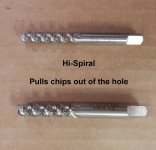
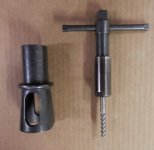
They make bottoming taps, but I've found a better solution. They are called Hi-Spiral and go by other names, but the shape is distinctive. They pull the chips out of the hole rather than clog up the works. But they are very delicate, and require the use of an alignment fixture to be sure the tap is perpendicular to the work. There are many variations, I've included the one I have had for a very long time. The hole size is critical using the Hi-Spiral taps and while the correct drill size for a 1/4-20 is a #7, and that's OK for aluminum, I like to go one size larger for steel to a #6 when drilling and tapping in steel with Hi-Spiral taps.

This doesn't apply to bottoming taps, but just regular tapping. The most common taps have 3 or 4 flutes, and the chips tend to clog in the lands. You have to go forward, and then back to clear out the chips. The better solution provided it's not a blind hole is to use a Spiral tap. It goes by other names, and shouldn't be confused with the Hi-spiral taps. Two entirely different profiles. They are easy to spot. I've included a pic of a regular tap and a spiral tap.

The only drill bits I use are 135 degree split point Cobalt. They are a bit pricey but don't walk off the punch mark, and will drill most anything and outlast high speed steel by a wide margin.
 

Attachments

  • tap-3.jpg
    tap-3.jpg
    124.8 KB · Views: 36
  • tap-5.jpg
    tap-5.jpg
    122.4 KB · Views: 36
  • tap-4.jpg
    tap-4.jpg
    127.8 KB · Views: 37
  • tap-2.jpg
    tap-2.jpg
    125 KB · Views: 33
  • tap-6.jpg
    tap-6.jpg
    143.1 KB · Views: 36
  • tap-1.jpg
    tap-1.jpg
    150.9 KB · Views: 39

dbabicky

Well-known member
Joined
Dec 30, 2012
Messages
874
Location
NE Wisconsin
Believe it or not, I purchased a fairly large tap and dye set from Sears/Craftsman about 30-31 years ago. I've added the odd ball sizes here and there over the years, but, it has really served me well. They are a very good quality tap and dye set for the home Mechanic/machinist.
Now, with that said, that was 30+ years ago I purchased them and cannot speak for the quality of todays sets, or country of origin.
 

Kracin

Well-known member
Joined
Mar 25, 2013
Messages
1,666
Location
Omaha, NE
So I am working over at my buddies house and he is tapping 14-20 in a 1" blind hole in some aluminum for me. (His house, his tools; i'll watch.). Then the sound we all hate to hear. Ping!!

He says he has a friend who is a machinist who can get it the busted piece out, but that is not my issue.


Very simply, what is the best raw material and other advice for taps ? We are talking general purpose (aluminum and mild steel) hand tapings. Carbon steel ? HSS ? Why ?

What are the "best bang for the buck" brands for a DIY ?


I am dying to see Astro's new set ! I have an old Craftsman set (70s) that has service me well.

for your buddy, tell him to put some nitric acid in the hole and let it sit for a little. then neutralize and get back to workin
 

Adam.C

Banned
Joined
Jan 29, 2013
Messages
1,490
If you break taps in 1" aluminum, chances are good the problem is not the quality of the tap.
 

Jason280

Well-known member
Joined
Mar 4, 2012
Messages
3,160
If you break taps in 1" aluminum, chances are good the problem is not the quality of the tap.

I was thinking the same thing.

If you need a quality 1/4-20 tap, I have a few different styles laying around as extras. I'll have to check my tap box, but I am pretty sure I have plug, spiral, and gun style.
 

MushCreek

Well-known member
Joined
Jan 14, 2015
Messages
9,763
Location
Upstate South Carolina
In my work, I tap a lot of tool steel (not hardened, of course) so I buy good quality taps, usually TIN coated for wear. I generally reach for a gun tap, and then finish with a bottoming tap. Alignment and a steady feed are key. When tapping a blind hole, you really want to sneak up on it. I've used some thick gooey tapping fluids for really tough materials, but I don't know the brand off-hand. WD-40 is a decent lube for aluminum when you don't have anything else.

If you drill certain materials with a dull drill, you can work-harden it to the point of being impossible to tap. Also, certain tap sizes are weaker than others. 1/4-20 is somewhat weak; 6-32 is particularly fragile. If you don't have a tap-drill chart, you can calculate the drill size by subtracting the pitch from the diameter. 1/4-20 is 20 threads per inch, making each thread .050". 1/4" (.250) minus .050" equals .200. The closest drill size is .201", but it doesn't hurt to go up a bit in tough materials. Metric is easier; just subtract the pitch from the diameter, since metric threads are defined by the pitch of one thread, versus threads-per-inch.
 
To avoid these ads, REGISTER NOW!
Top Bottom