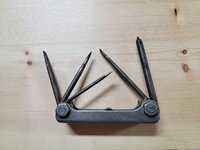
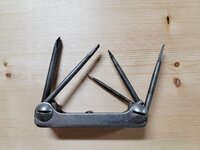
Ron I used to own a Eklind vertical mill attachment. (now long gone)
Do you know when they made them?
Those were long gone by the time I went to work for them. I was told that Eklind made a lot of things unrelated to hex keys in an attempt to find a niche market that generated enough profit. From what I'd heard there were many attempts at manufacturing different items that were started and dropped when they didn't generate enough business. Sort of throw enough things against the wall and see what sticks business model. Howard Eklind, so I was told, was a structural engineer focused on bridge construction. That was likely fine when he graduated from college as there are a lot of bridges in Chicago. Once they were all built the lucrative contracts dried up and something else had to be found to keep the doors open. That may very well have been a part of the "Contract Machining" end of things.
Howard took over the family operations and tried a lot of things, including items for the war effort that also were good until the end of the war. Don't know when they decided to devote all energies to hex keys but that's what it was by the time I arrived in the mid 90's. Hex keys were still being fed into the stamping presses by hand in sheared stock lengths of 12 feet because a friend of Howard told him they couldn't be fed by coil feeder..... We proved that silly notion to be wrong. Eklind Tool was approached by several people from McMaster, Grainger, and other industrial suppliers about the "ball end" hex keys because the patent Bondhus had was due to expire soon. The supply houses told Howard that Johnny Bondhus had some price increases that irritated them and that they would rather do business with Eklind. Bondhus used an opposed broaching process that was indexed 3 times to achieve the ball profile. A German firm presented a new approach to profiling that used a single lip cutter that resembled a lathe with "live" tooling synchronized with the headstock. Coupled with magazine feed we would later achieve cycle times of under 10 seconds from part to part with replaceable cutter inserts as opposed to the expensive broaches that needed periodic resharpening that Bondhus used. This was a clear manufacturing advantage, a new product market, and a leap ahead of all competitors so Howard decided to pursue it. I was selected to spearhead the project and off to Germany I went for the machine build and evaluation because the German firm had no experience with this application for the process.
The project was interesting for a lowly toolmaker from Chicago. I was exposed to European culture, lingering Nazi sympathizers, Interpol investigation, industrial espionage, and great beer. That's a bit off topic and not what you asked for. Do you recall what machine the vertical head was supposed to fit?