To avoid these ads, REGISTER NOW!

Electric baseboard heater Inop.

RM209

Well-known member
Joined
Apr 17, 2009
Messages
892
Location
MD
Helping my sister troubleshoot an electric heater problem in her basement. The 30-year old baseboard heater is 240-volt 2000 watts. It is controlled by a 240-volt thermostat that controls two separate baseboard heaters, that are fed by individual wires. One of the baseboard heaters was removed a few years ago and capped off. I checked the thermostat, and both legs have power coming in, and both legs have power going out when the thermostat is turned on. When turned off, no power is coming out of the thermostat. The inoperative heater had power at both legs when the thermostat was on, and showed no power when the thermostat is in the off position.
All connections were checked with a Greenlee power non-contact detector. I replaced the old, rusty baseboard heater, and the new heater doesn’t work. Any suggestions as to the possible problem? Perhaps low voltage on one of the legs? My next step is to verify voltage at all connections with a digital voltmeter.

Thanks,
RM209
 
To avoid these ads, REGISTER NOW!

iron block

Well-known member
Joined
Jun 22, 2015
Messages
262
Location
Bay Area, CA
Can you clarify a couple of things, please:

1. Are you replacing the capped-off heater, or leaving that one capped off and replacing the other one?

2. Is each heater 2000 watts, or is that the total for both?

3. Is the thermostat mounted in the baseboard heater, or on the wall?

A few pix would be great.
 
OP
R

RM209

Well-known member
Joined
Apr 17, 2009
Messages
892
Location
MD
Can you clarify a couple of things, please:

1. Are you replacing the capped-off heater, or leaving that one capped off and replacing the other one?

2. Is each heater 2000 watts, or is that the total for both?


3. Is the thermostat mounted in the baseboard heater, or on the wall?


A few pix would be great.

I'm leaving the capped-off leg asks, and repairing the heater that's inop.

Each heater was 2,000 watts, but there's only one in place now.

The thermostat is mounted on the wall, and controls both legs.

I'll try and take a pic or two.

Thanks,
RM209
 
OP
R

RM209

Well-known member
Joined
Apr 17, 2009
Messages
892
Location
MD
Went to my sisters’ house on Christmas day, and found a few minutes to check the voltage at the baseboard heater. One leg had 123 volts, while the other leg only had 27 volts. Ran out of time for more testing, but the next steps are to check the voltage at the thermostat and circuit breaker in the panel. I’ll be visiting her again in a couple of weeks.

RM209
 
To avoid these ads, REGISTER NOW!

wyliesdiesels

Well-known member
Joined
Aug 14, 2012
Messages
19,999
Location
Modesto, CA
Went to my sisters’ house on Christmas day, and found a few minutes to check the voltage at the baseboard heater. One leg had 123 volts, while the other leg only had 27 volts. Ran out of time for more testing, but the next steps are to check the voltage at the thermostat and circuit breaker in the panel. I’ll be visiting her again in a couple of weeks.

RM209

And what specifically was your test method?

Hot to ground or hot to something else?

Youre on the right track. Next test point should be the thermostat.
 
Last edited:
OP
R

RM209

Well-known member
Joined
Apr 17, 2009
Messages
892
Location
MD
And what specifically was your test method?

How to ground or hot to something else?

Youre on the right track. Next test point should be the thermostat.


I used a Fluke digital voltmeter; connected each leg to the ground wire. I'm hoping it's a bad thermostat; that would be an easy fix.

Thanks,
RM209
 

Dingleburry

Well-known member
Joined
Mar 2, 2016
Messages
593
Location
Great white north in an igloo
Pretty sure the only way to check voltage on 240v is phase to phase. Had a problem with cartridge heaters a while back 220v. Checking phase to ground gave me voltage. On both sides of heater. Checking voltage across the heater, or phase to phase gave very little voltage. Dont remember voltage values. Clamp gave me 0 amps. So what was happening from what i believe, essentially you have voltage from 1 leg only. When your measuring on one side of heater to groung you get voltage, measure other side to ground voltage... well your measuring the same phase. Yes its voltage but its only 1 phase. 240 has no neutral. You use 120v x 2 hots. So when you call for heat and only 1 phase of the switch (thermostat) closes, you only got one phase. You get voltage all the way through the circuit back up to the switch.
In the pic if L1 switch is stuck open, and L2 is closed voltage will travel through the circuit back to the switch.
pg161fig4.gif


Id check voltage drop across thermostat leads. On the in/out. Or supply side to load side. On both phases. Or disconnect and check resistance. Never check resistance on a live circuit.

Voltage drop if checking live:
Very little voltage (mV) across both legs when closed (heater on)
If you get 120v (Or somewher around there should be 120v drop across heater so 120v from phase 1, referenced to voltage on phase 2 after voltage drop of heater)
Your thermostat is stuck closed.
When the switch is open (heater off) im not as sure.
Id say it should be 120v across. On both legs.

Resistance would be easier. Disconnect both incoming power and heater leads and resistance check with switch open and closed.
OL while open (heater off)
Under 1 ohm while closed (heater on)
While heater leads are disconnected check ohms through heating element. From the leads that connect into thermostat.
Should be 10? 20? 30? Dont know value about that one

Just what i would do. Im no electrician. Just a dude with a multimeter. I very rarely work on 240v. Mostly 600v 3 phase. Its a little different.

Hope that helps. Even just a little.
 
Last edited:

mm08822

Well-known member
Joined
Jan 13, 2012
Messages
5,898
Location
NJ
Pretty sure the only way to check voltage on 240v is phase to phase. Had a problem with cartridge heaters a while back 220v. Checking phase to ground gave me voltage. On both sides of heater. Checking voltage across the heater, or phase to phase gave very little voltage. Dont remember voltage values. Clamp gave me 0 amps. So what was happening from what i believe, essentially you have voltage from 1 leg only. When your measuring on one side of heater to groung you get voltage, measure other side to ground voltage... well your measuring the same phase. Yes its voltage but its only 1 phase. 240 has no neutral. You use 120v x 2 hots. So when you call for heat and only 1 phase of the switch (thermostat) closes, you only got one phase. You get voltage all the way through the circuit back up to the switch.
In the pic if L1 switch is stuck open, and L2 is closed voltage will travel through the circuit back to the switch.
pg161fig4.gif


Id check voltage drop across thermostat leads. On the in/out. Or supply side to load side. On both phases. Or disconnect and check resistance. Never check resistance on a live circuit.

Voltage drop if checking live:
Very little voltage (mV) across both legs when closed (heater on)
If you get 120v (Or somewher around there should be 120v drop across heater so 120v from phase 1, referenced to voltage on phase 2 after voltage drop of heater)
Your thermostat is stuck closed.
When the switch is open (heater off) im not as sure.
Id say it should be 120v across. On both legs.

Resistance would be easier. Disconnect both incoming power and heater leads and resistance check with switch open and closed.
OL while open (heater off)
Under 1 ohm while closed (heater on)
While heater leads are disconnected check ohms through heating element. From the leads that connect into thermostat.
Should be 10? 20? 30? Dont know value about that one

Just what i would do. Im no electrician. Just a dude with a multimeter. I very rarely work on 240v. Mostly 600v 3 phase. Its a little different.

Hope that helps. Even just a little.

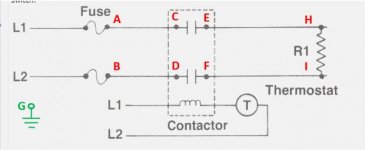
Using DB's hijacked diagram, I made some test points, so you can easily test/record and report back.

With power on and t-stat set at to off/lowest temp record voltages:
A-G
B-G
A-B

C-G
D-G
C-D

With power on and t-stat set at 90F record voltages:
E-G
F-G
E-F

H-G
I-G
H-I

C-E
D-F

With circuit power OFF and t-stat set to off/lowest temp, check resistance:
H-I
 

Attachments

  • Screen Shot 01-02-17 at 05.19 PM.jpg
    Screen Shot 01-02-17 at 05.19 PM.jpg
    14.4 KB · Views: 5
OP
R

RM209

Well-known member
Joined
Apr 17, 2009
Messages
892
Location
MD
I'll be going back in a couple of weeks, and will print out the diagram so I can be sure I'm checking the right points on the thermostat.

Thanks for the info.

RM209.
 
To avoid these ads, REGISTER NOW!
Top Bottom