To avoid these ads, REGISTER NOW!

Electric heat in concrete floor?

NuthinFancy

Active member
Joined
Jun 24, 2015
Messages
27
Location
SE Wisconsin
I'm working on the design of my new shop and thinking about heating. The winters can get chilly here in Milwaukee and I'd like to be able to use the shop year round, but not necessarily in extreme cold.

The plan is for a 30' x 15' building of 2x6 walls with spray-on insulation for walls and ceiling. About 19' (of the 30' length) will be my workshop with the remainder being unheated storage space. I don't plan to insulate the storage portion. The floor will be a slab - poured concrete.

My only option for heat is electric and I'm curious if anyone has experience with electric radiant heat in a concrete floor?

I found of a couple of suppliers, but I'm not sure if this practical for my region or not.

http://www.suntouch.com/indoor-solutions/electric-slab-heating/

http://www.wattsradiant.com/products/slabheat/
 
To avoid these ads, REGISTER NOW!

Randy in Maine

Well-known member
Joined
Nov 21, 2010
Messages
2,176
Location
The Beach
If you are the one paying for the electric heat, you should consider using SIPs (as opposed to the 2x4 construction likely cheaper and tighter) and I would double up the insulation under the poured concrete from 2" to 4".

If it were me I would still look into running some pex in the slab even if I had to use an electric boiler.
 
Last edited:

FatFenderBowTie

Well-known member
Joined
Aug 16, 2010
Messages
273
Location
Manitoba boonies
I am using in floor heat in one of the colder climates in Canada and it works fine here.
I only had the option for electric heat as well...and only keep my shop between 52-55...but have been very happy with it so far.
 

Rookie2

Well-known member
Joined
Feb 27, 2013
Messages
1,925
Location
Western Pa.
I would divide the concrete pad and insulate the underside and perimeter to keep the heat in. I installed pre built mats in a patio and it wasn't too hard but on a floor that size I would say that you have to protect the heating elements from the work crew as its poured.
A local electric supplier can possibly help you . Our mats were custom built to lay down and roll out like a carpet. I'll try to find out the company name.

You may want to use the kind that goes on top of the concrete pad with thin set and add ceramic tile on top. I think this would conserve energy and heats faster rather than heating the concrete 24hrs a day.
 
Last edited:

theoldwizard1

Well-known member
Joined
Feb 22, 2011
Messages
43,340
Location
SE MI
If you are the one paying for the electric heat, you should consider using SIPs (as opposed to the 2x4 construction likely cheaper and tighter) and I would double up the insulation under the poured concrete from 2" to 4".

If it were me I would still look into running some pex in the slab even if I had to use an electric boiler.

EVERYTHING HE SAID !


I sure wish they sold hot water heat exchangers for min-split heat pumps (like they do in other parts of the world), but I think you would need an auxiliary heat source for those really cold (-10F) nights !
 

theoldwizard1

Well-known member
Joined
Feb 22, 2011
Messages
43,340
Location
SE MI
I am using in floor heat in one of the colder climates in Canada and it works fine here.
I only had the option for electric heat as well...and only keep my shop between 52-55...but have been very happy with it so far.

What is your insulation "package" ?
 

FatFenderBowTie

Well-known member
Joined
Aug 16, 2010
Messages
273
Location
Manitoba boonies
My walls are fiberglass bat insulation....and the attic is blown in loose.

You can see my build here

http://www.garagejournal.com/forum/showthread.php?t=78719

2 apologies...one my link seems to go to the last page of my build for some reason...and second I misunderstood your original question for electric slab heat...

My heat is pex filled with antifreeze heated by a boiler
 
Last edited:

Showkey

"MEMBER EMERITUS"
Joined
Aug 9, 2014
Messages
8,638
Location
Wausau WI
It will not be cheap to run and it will very slow to react from a set back.

Think it might be wise to get a power use estimate. I have used sun touch in several bath floor heating situations all in a conditioned space and a medium bath uses 500 or more watts when on ( have not timed the on time).

Material cost estimate ????? for a shop ? Medium bath can be $1000 in materials.
 

CNGsaves

Well-known member
Joined
Sep 26, 2012
Messages
13,233
Location
KS and OK
Where in Milwaukee, WI doesn't have Natural Gas ??? NG is in glut supply and ALL over Wisconsin . . . . why not heat with cheapest source for next foreseeable 20+ years ??

Also, this is new shop you're planning in WI . . . . AND . . . right out of gate you are deciding to NOT INSULATE portion of shop ??? WHY !! :eyecrazy:

Think you should wipe slate clean and Start Over with shop design.

INSULATE absolutely ALL walls, ceiling, and even the floor.
 

Dick in Wisconsin

Well-known member
Joined
Mar 3, 2012
Messages
3,048
Location
Shawano, Wisconsin
Where in Milwaukee, WI doesn't have Natural Gas ??? NG is in glut supply and ALL over Wisconsin . . . . why not heat with cheapest source for next foreseeable 20+ years ??

Also, this is new shop you're planning in WI . . . . AND . . . right out of gate you are deciding to NOT INSULATE portion of shop ??? WHY !! :eyecrazy:

Think you should wipe slate clean and Start Over with shop design.

INSULATE absolutely ALL walls, ceiling, and even the floor.

I have the same questions that Mr. CNG has. Where in the Milwaukee area are you? What about propane? How do you heat your house?

First, I would insulate the entire building. You can insulate between the heated and unheated sections of the building.

Second, make sure you put lots of insulation around the perimeter of the foundation and under the slab.

Third, rather than electric coils in the concrete, have you thought about putting pex in the concrete and using an electric water heater to heat the water. I think that would be much more efficient.
 
OP
N

NuthinFancy

Active member
Joined
Jun 24, 2015
Messages
27
Location
SE Wisconsin
Thanks to everyone who replied. It's given me some food for thought.
An electric boiler and PEX is starting to sound like a possibility.

**** - what benefit would I get by heating the whole structure?
The shed/storage section is just for the lawnmower, yard tools, etc.
I agree that insulating it sounds nice, but should I spend the money to insulate it?

Although if I do go the boiler/PEX route, the boiler would end up in the shed portion and that might justify insulating the whole thing...
 

jvitez

Well-known member
Joined
Nov 30, 2009
Messages
2,429
Location
Big Sky Country, Canada
Yes, you most certainly can install electric heating cables in a concrete slab:

http://www.ouellet.com/en-us/products/residential-products-en.aspx?product=OWC-R

But maximizing insulation and minimizing air infiltration are key in reducing energy use and maximizing comfort.

If you really want both a heated and unheated portion in the same structure, you're going to need to isolate one from the other, like an attached garage is isolated from a house. Spray foam is an excellent choice. Are you planning on a ventilated or non-ventilated roof system? If ventilated, blown in insulation is far far cheaper than spray foam.
 

BadgerBoilerMN

Well-known member
Joined
Aug 4, 2011
Messages
837
Location
Minneapolis
First a ACCA Manual 'J' Heat Load, then 1/2" barrier pex with a properly sized Thermolec or Electro Boiler with outdoor reset.

We use 2" of XPS under our slabs here in Minnesota and on designs in colder climates here and in Canada.

Once you have 2" inches down the return on investment approaches zero very quickly.

I foamed my entire 1921 farm house but went to blown glass and batts in the shop walls with 18" of cellulose in the attic. Again, when you get past a R-21 wall in this climate you have reached a point of diminishing returns.

Look at a quality overhead door; mine is R-21.

Finally, a well insulated garage will be quite comfortable with a mini-split heat pump (heat and cool) and operate at 1/3 the cost of an electric boiler. I have both since my feet are always cold and I bring cold vehicles into the garage side on occasion. OK, I am a zealot and in the business.

The truth about slab-on-ground insulation is best found in the skimpy documents related to frost protected shallow foundations (FPSF). When you look at the data and run a few models on dedicated software, as we do, you will find that wing insulation at the corners has a greater impact than doubling the insulation the middle or "field" of any slab. I did neither since mine of was not a true FPSF but a converted pole barn.

Whether the slab is heated or not the heat flux to the ground is minimal once the indoor design temperature is met and maintained. The cooler the room temperature the less insulation is needed, bottom, top or sides.

http://www2.iccsafe.org/states/newjersey/NJ_Residential/PDFs/NJ_Res_Chapter4.pdf
 

bzinsky

Well-known member
Joined
Oct 27, 2014
Messages
5,565
Electric resistance heat will have the same efficiency no matter how much you spend. It all converts the same amount energy into heat. Electric radiant floor heat will just be spending a lot of money to have warm floors, it won't save you anything on heating costs (it may even cost slightly more)

If you're only option is electric, nothing is going to compete with a heat pump. A mini split heat pump is probably the cheapest and easiest.
 

bzinsky

Well-known member
Joined
Oct 27, 2014
Messages
5,565
Third, rather than electric coils in the concrete, have you thought about putting pex in the concrete and using an electric water heater to heat the water. I think that would be much more efficient.

It wouldn't be. The only reason it's more efficient in fossil fuel situations is because radiant floors circulate the water at lower temperatures, lower temperature water means more heat is absorbed from the flame. The efficiency of burning is all about the heat you create vs the heat that you let escape out the exhaust. (incase anybody wondered why high efficiency heaters can use PVC exhaust)

With electric resistance, it doesn't matter. x energy = x heat, whether it comes from light bulbs, a $20 space heater, a computer processor heat sink, or a complex radiant floor/electric boiler setup.

The only way I know of that is create more heat from electric is to use a heat pump, which doesn't get it's heat from resistance, it gets it heat from absorbing it from an external source. A mini split is an air source heat pump, so it absorbs heat from the outside air. You can imagine why up until recently they had a problem operating in cold climates. Amazing they can heat a room by absorbing the heat from the outside air when it's 5 degrees out.
 
Last edited:
To avoid these ads, REGISTER NOW!

BadgerBoilerMN

Well-known member
Joined
Aug 4, 2011
Messages
837
Location
Minneapolis
The first reason for radiant floor heating is comfort. In large rooms the air temperature will be lower, most especially at the ceiling where the largest heat load usually resides with warm air heating systems. The reason we use hydronics is mainly convertibility and secondly longevity. Wire doesn't last like PEX.

I have a twin-head Fujitsu in my office and shop respectively but radiant is the main heat source when things get cold and uncomfortable i.e. below zero.

Efficiency and comfort are not the same thing. One almost always gives way to the other depending on your priorities.
 

Crazy68Dart

Well-known member
Joined
Apr 10, 2010
Messages
484
Location
NE Ohio
I would do water, not wire. You can get a pretty nice electric boiler, outdoor reset, etc. for reasonable cost. For the size of your building assuming you insulate well, you won't need much. PEX is extremely durable and relatively easy to work with. The prep (all that insulation board, cutting, fitting, vapor barrier, PEX placement, etc.) like most things is time consuming. I've yet to get my mechanicals/heat source in cause I want my slab to cure up nice, but next year I am looking forward to it.
 

Attachments

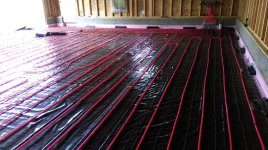
  • 151004-IMAG2236.jpg
    151004-IMAG2236.jpg
    123.9 KB · Views: 29
OP
N

NuthinFancy

Active member
Joined
Jun 24, 2015
Messages
27
Location
SE Wisconsin
Badger - The idea of having both sounds nice, but isn't in my budget. This a hobby shop for me; it sounds like you use yours full-time. Thanks for the tip on insulating and the PDF - I'll be digesting that for a while. :)

Crazy - that's a nice layout you've got - I would say time well-spent. I see you brought the foundation walls up above grade as I plan to do. Is the rest of the foundation cinder block? I'm curious why you chose CB over poured concrete?
 

theoldwizard1

Well-known member
Joined
Feb 22, 2011
Messages
43,340
Location
SE MI
Finally, a well insulated garage will be quite comfortable with a mini-split heat pump (heat and cool) and operate at 1/3 the cost of an electric boiler. I have both since my feet are always cold and I bring cold vehicles into the garage side on occasion. OK, I am a zealot and in the business.

Radiant heated floor AND a mini-split is truly the best of both worlds. I wish the mini-split companies would sell heat exchangers for radiant heat like they do in other parts of the world !!


BB-MN: Do you run the in floor heat all of the time or only when you are in the garage ? The other way to ask the question is, how long does it take for the floor to "recover" after your boiler has been off for more than 8 hours ?
 

Crazy68Dart

Well-known member
Joined
Apr 10, 2010
Messages
484
Location
NE Ohio
Thanks! It was likely the most cost-effective to do block. I never really discussed it with the mason. I have all kinds of pics of the build start to finish. I guess I should start a build thread...
 

myredracer

Well-known member
Joined
Nov 1, 2015
Messages
557
Location
Langley, BC
I'm an EE and I used to (now retired) design electric underfloor heating in large industrial workshops. Pyrotenax mineral insulated cable with an overall plastic was used. It looks like it was bought out and is now Raychem Pentair now.

I would insulate the sn*t out of the garage. Use rigid foam board around the foundation wall on the outside down to 2' below grade. Use min. 2" rigid foam (closed cell) under the slab - 3 - 4" would be better. A 5" thick slab would be better than 4" - for electric or hot water heat. The temp. of soil 25 - 30' and more below grade is relatively constant at about 55F so once the slab is up to temp. and stable, the heat loss to the ground is minimal compared to walls, ceiling, doors & windows. I would also use some sort of thermal break between the slab edge and foundation wall. I used foam sill gasket but there are other products that will be thicker and better.

We have hot water in-floor heating in our 1800 sq. ft. attached workshop/garage. I bought 3" rigid foam insulation from a building material recycler and was a LOT cheaper than buying new. I love the feel of a heated floor. Very even and no restrictions on where to place things on the floor. As noted, very slow to react when there's a call for heat. It's not something you can crank up when you want to work in there and then turn it down on the way out. Best to set it to a temp. you want and leave it alone.

I would recommend going with hot water due to fuel costs but you have to factor in the cost of a boiler and the piping. We also use our boiler for radiant heating in part of the house and for domestic hot water so didn't a bunch of extra equip. Our boiler room looks like something from a space shuttle it's so complicated! Not sure if there is a simpler way of doing hydronic heating without needing a complex boiler setup. Part of our house is heated electrically. The power bill seems to have gotten out of control in recent years to due utility co. increases. Natural gas *seems* cheaper in comparison. Electric heating cables will have a lower initial capital cost and you may try doing a cost comparison between the two fuels and see how long the payback period is. You won't have to set the temp. as high as in a house and will probably find 60+/- F is fine.

If you ever intend to turn down the temp. to a min. above freezing, you should use a low temperature thermostat as regular ones don't work well at lower temps. and you may think the temp. is down but can still be running up a gas/elec. bill. Honeywell makes one.

BTW, if you use hot water piping, you have to make darn sure the concrete placers don't walk all over the piping and kink or crush it. No way to fix that afterwards.
 
Last edited:

Randy in Maine

Well-known member
Joined
Nov 21, 2010
Messages
2,176
Location
The Beach
Suggestion:

Put the 2" of foam under the floor and run the pex tubing in the slab (even if you won't be using it now). For as small of a building you are building the cost won't be huge. If you or your next of kin decide to do something else down the road, the hard part will already be done.

If you insulate the building well, even heating it with a a couple of electric heaters baseboard heaters or space heaters won't cost you a ton for a few years if you don't use it much.
 

Dick in Wisconsin

Well-known member
Joined
Mar 3, 2012
Messages
3,048
Location
Shawano, Wisconsin
**** - what benefit would I get by heating the whole structure?
The shed/storage section is just for the lawnmower, yard tools, etc.
I agree that insulating it sounds nice, but should I spend the money to insulate it?

Not suggesting that you heat the "shed" portion, just insulate it. By insulating the "shed", the heat loss from the common wall (even though its well insulated) will be reduced.

Still curious why apparently don't have access to NG or propane.
 

404

Well-known member
Joined
Aug 23, 2014
Messages
3,463
Location
Mass
Please do use a heat pump or mini split for the heat. There is a big multiplier in effectiveness for the electricity used.
 
OP
N

NuthinFancy

Active member
Joined
Jun 24, 2015
Messages
27
Location
SE Wisconsin
****: I like your thinking on insulting the shed portion.

My limited understanding is that if spray-on closed-cell insulation is used in the roof, then traditional venting (e.g. attic or air space) is not required, but I'm still researching this topic.

Technically, NG is available, but two things rule it out:
1) it's at the other end of an 80-foot ranch-style house and would require substantial concrete work to get to the new structure (cost).
2) I don't want combustion taking place near the dust I plan to be making. Overly cautious? Perhaps. I can live with that. ;)

404: That sure sounds nice, do you have empirical data on this? That's, uh, quite the sig you've got there. :headscrat
 

TractorJeff

Well-known member
Joined
Dec 8, 2013
Messages
3,309
Location
Elkhorn, WI
Put the boiler in its own room to isolate it from the dust. Dust isn't good for your health and is both a fire and explosion hazard! If you are generating that much dust, you need to look into a vacuum system for your equipment plus factor in the time wasted keeping it clean afterwards.
Go with a NG boiler!
My gas bill was so ridiculously cheap this past month that I am having a hard time justifying the time normally spent feeding two woodstoves to heat my house!
 

404

Well-known member
Joined
Aug 23, 2014
Messages
3,463
Location
Mass
404: That sure sounds nice, do you have empirical data on this? That's, uh, quite the sig you've got there. :headscrat

The heat pump is more efficient because it uses the electricity to move heat from a colder area to a warmer one. Heat is extracted from colder outside air, this heat is raised in temperature, and then the heat is dumped into the house.

https://en.wikipedia.org/wiki/Seasonal_energy_efficiency_ratio

My sig is about the old social custom of burning women whose husbands had died. As you can imagine it was not a good outcome for the widow.

https://en.wikipedia.org/wiki/Sati_(practice)

The cultures that did this would make the excuse that this was their culture or social custom, and any one that did not like it could **** out and MYOB.

This man:

https://en.wikipedia.org/wiki/Charles_James_Napier

Told the widow burners that the British custom was to hang anyone involved in this disgusting practice, and he did, putting an end to it. The British Empire did get a lot of things right.
 

CNGsaves

Well-known member
Joined
Sep 26, 2012
Messages
13,233
Location
KS and OK
****: I like your thinking on insulting the shed portion.

My limited understanding is that if spray-on closed-cell insulation is used in the roof, then traditional venting (e.g. attic or air space) is not required, but I'm still researching this topic.

Technically, NG is available, but two things rule it out:
1) it's at the other end of an 80-foot ranch-style house and would require substantial concrete work to get to the new structure (cost).
2) I don't want combustion taking place near the dust I plan to be making. Overly cautious? Perhaps. I can live with that
. ;)

404: That sure sounds nice, do you have empirical data on this? That's, uh, quite the sig you've got there. :headscrat

You're artificially ruling out the best and CHEAPEST "fuel" source (NG) by not checking out all your options. NG fired boiler in Wisconsin with radiant floor PEX would be terrific setup.

To get your NG supply out to detached garage, the size of house is not the significant factor. NG flow capacity (ie pressure, meter, and pipe size) are the key factors. All you have to do is bury yellow plastic polyethylene pipe from just after gas meter, then across the yard to detached garage. Risers are used on each end to transition from plastic below ground to steel above ground.

+1 to do HEAT LOAD Calc that BadgerBoiler-MN is telling you - - he's the guru. NG fired boiler into pex would keep that shop toasty comfortable in the most harsh Wisconsin winter. ;) Once you know heat load at garage, then you work backwards to make sure you have proper size yellow PE pipe buried over to NG fuel source, and ultimately enough flow/meter size to handle all your NG demands of the property.

NG is your answer. Get all the proper information before you rule it out.
 

Dick in Wisconsin

Well-known member
Joined
Mar 3, 2012
Messages
3,048
Location
Shawano, Wisconsin
****: I like your thinking on insulting the shed portion.

My limited understanding is that if spray-on closed-cell insulation is used in the roof, then traditional venting (e.g. attic or air space) is not required, but I'm still researching this topic.

Technically, NG is available, but two things rule it out:
1) it's at the other end of an 80-foot ranch-style house and would require substantial concrete work to get to the new structure (cost).
2) I don't want combustion taking place near the dust I plan to be making. Overly cautious? Perhaps. I can live with that. ;)

I believe your understanding is correct because with the closed cell foam you don't have to worry about warm, most air infiltrating the insulation, getting to the cold side, and condensing causing a mess. Hopefully someone else can confirm what I'm saying and probably say it more eloquently.

Is there NG to the house? Run the NG line through the house and then outside to your shop. That is what I'm doing. The gas line in our house stopped about 25 feet from where it goes outside the new shop. Plumber ran a new line from closest point to the wall and then out. Need more pressure to run everything. WE Energies is putting in a bigger meter with more pressure (their cost), plumber is putting in a couple of valves to hold down the pressure for the other NG appliances. Put the boiler in the "unheated" shed away from the dust. Mine is on the wall.

The heat pump is more efficient because it uses the electricity to move heat from a colder area to a warmer one. Heat is extracted from colder outside air, this heat is raised in temperature, and then the heat is dumped into the house.
https://en.wikipedia.org/wiki/Seasonal_energy_efficiency_ratio

I agree 100% with 404. Heat pump is much more efficient than electric resistance heating. But once the outside temp gets down to say 40 degrees (certainly 30 degrees), the heat pump's efficiently really starts to fall off because there is so little "heat" in the air to "pump" to the room you're heating. Air to Air heat pumps are much more prevalent south of Wisconsin.

Here is my take on the whole thing:

1. Heating the floor by in-floor heat (whether electric resistance or water heated by boiler or residential hot water heater) provides you with heat close to the floor. Heating using a traditional garage gas force air hung from the ceiling makes it difficult to get the heat to the floor.

2. Cheapest in-floor heat to install is probably electric resistance. No boiler to buy, plumb, install.

3. Electric resistance in-floor heat will require a pretty good sized electrical service to provide enough heat plus run all your machines in the shop, unless you use all hand tools.

NG is your answer. Get all the proper information before you rule it out.

All that said ... I have to agree with Mr. CNGsaves.

Keep us posted.
 
Last edited:
To avoid these ads, REGISTER NOW!
Top Bottom