To avoid these ads, REGISTER NOW!

electric motor torque

allroads

Member
Joined
Sep 6, 2016
Messages
24
Ok. Another philosophical.

scenario
1. 1 hp motor - 120 volt - 15 amp, 17xx rpm with a 4 inch pulley
2. 1 hp motor - 120 volt - 20 amp, 34xx rpm with a 2 inch pulley.

Which has more torque ? I heard a 1700rpm motor starts with more torque, but would be reduced with the pulley? Would it be a wash? Would the final drive on both be identical in power and speed to the driven device? (compressor with 10 inch pulley)

If amps were the same, would that matter?
 
To avoid these ads, REGISTER NOW!

A_Pmech

Well-known member
Joined
May 8, 2007
Messages
8,002
Location
IL
They both have the same belt pull.

1hp 1750 RPM with twice the pulley circumference = 1hp 3600 RPM with half the pulley circumference.
 
OP
A

allroads

Member
Joined
Sep 6, 2016
Messages
24
Well, ok. So with that, does that mean a 1hp at 1750 and 2 inch pulley has 2x the torque of a 1hp 3600 with 2 inch pulley?

IE, doesnt the torque drop as the pulley size gets larger, regardless of the speed?


They both have the same belt pull.

1hp 1750 RPM with twice the pulley circumference = 1hp 3600 RPM with half the pulley circumference.
 

kctyphoon

Banned
Joined
Jun 9, 2014
Messages
9,102
Location
Jersey/Staten Island
has more torque?
I would "guess" yes.. my thought would be the smaller pulley would have an easier time turning a load up to full speed when compared to a motor that has the same HP, that was using a larger pulley.. regardless of final rpm, my feeling would be the motor with a 2" pulley would have an easier time turning the load to full speed, and could carry more of a load too..

Mind you, I'm basing this on just pure gut feeling with no mathematics to back up my claim.. I could be completely wrong..

Sent from my XT1096 using Tapatalk
 
OP
A

allroads

Member
Joined
Sep 6, 2016
Messages
24
Ya I would have done the same thing, but somewhere I read that a 1700 rpm motor has more inherant Torque even if HP is the same than an equiv electric motor at 3400. Just not sure if anyone "knew" for sure, and is it a linear relationship.

Thanks though! Id guess too! Shorter pully is like lower gearing, but does not account for greater torque of a lower rpm motor potentially?


I would "guess" yes.. my thought would be the smaller pulley would have an easier time turning a load up to full speed when compared to a motor that has the same HP, that was using a larger pulley.. regardless of final rpm, my feeling would be the motor with a 2" pulley would have an easier time turning the load to full speed, and could carry more of a load too..

Mind you, I'm basing this on just pure gut feeling with no mathematics to back up my claim.. I could be completely wrong..

Sent from my XT1096 using Tapatalk
 

A_Pmech

Well-known member
Joined
May 8, 2007
Messages
8,002
Location
IL
At the pulley it is no longer torque, but belt pull.

The 1750 RPM motor has twice the torque of the 3600 RPM motor, but it is acting through a lever twice as long.

Sent from my SM-G930V using Tapatalk
 
OP
A

allroads

Member
Joined
Sep 6, 2016
Messages
24
So, I could swap in either one and the compressor pump would not know the difference?

reason being, the 3400 rpm motor i have is old and pulls 19 amps and blows the circuit with a 3 inch pulley, but not a 2 inch pulley.

Can get a 1700 rpm motor that pulls 15 amps, and figure that should NOT blow the circuit since it will max out at 15 amps, but can I regain speed at the compressor by putting a 4 inch pulley on it.

Sounds like yes?
 
OP
A

allroads

Member
Joined
Sep 6, 2016
Messages
24
oops. I guess I was a bit off. To regain the speed of the 34xx/3 inch i would need a 17xx/6 inch pulley. But, basic question remains.
 

jallyn

Well-known member
Joined
Jun 29, 2015
Messages
448
Location
Fort Wayne, Indiana
The old setup of 3400 rpm and a 3 inch pulley gives 534 inches per second belt speed.

Your proposal of 1700 rpm and a 4 inch pulley gives 356 inches per second belt speed.

Also 3400 rpm and a 2 inch pulley gives 356 inches per second belt speed.

Either scenario greatly reduces compressor speed, noise, cfm, and brake hp required, so yes if you change it in either way you've suggested you will stop tripping your circuit breaker. The next question is...can you live with 33% less compressed air?
 
OP
A

allroads

Member
Joined
Sep 6, 2016
Messages
24
right, sorry, Would be a 1700 rpm 15 amp with a 6 inch pulley to regain the orig speed.

Is this ludicrous?

ie, is 1700 rpm 15 amp and 6 inch pulley a good replacement option for a
3400 rpm 20 amp 3 inch pulley motor, or am i missing something fundamental, like a drop in ability to even TURN the compressor with a pulley that large
 

jallyn

Well-known member
Joined
Jun 29, 2015
Messages
448
Location
Fort Wayne, Indiana
OK, if you want the same output then use the 1700 rpm motor and 6" pulley. The motor is rated for 15 amps at full load which is less than the other motors.
 
OP
A

allroads

Member
Joined
Sep 6, 2016
Messages
24
yup. but will it be unable to turn that large a pulley the same, or does the double torque of the 1700 motor negate this problem.
 

jallyn

Well-known member
Joined
Jun 29, 2015
Messages
448
Location
Fort Wayne, Indiana
Is the old motor rated for 1 hp? If so a new 1 hp motor will work. Power is proportional to RPM x torque, so pairing the slower motor with a larger pulley equalizes belt speed to the same compressor load, thus same work is being performed.
 

larry_g

Well-known member
Joined
Apr 28, 2007
Messages
16,867
Location
oregon
Your ignoring motor efficiency. Your old motor probably only converts 85% of the input electrical power to mechanical work. The newer motor may be above 90% eff. It is going to take the same power (watts) to turn the compressor at a given speed. If a slight rise in motor efficiency will make t he difference you may get away with a 6" dirve pulley. You need to monitor the real amp draw you are experiencing and then make your decisions with real data, not guess work or theory.

I would suggest that you get a current meter and run your compressor and see whatthe max current draw is now. Then put the 3" pulley back on and check at what pressure the breaker pops. You can then figure if you can run a 2.5"-2.75" drive pulley and achieve 115 psi or so. There is a sweet spot in there that you have just before popping the breaker.

You can have fast fill or high pressure but not both within the limitations of your pump and the power your electrical circuit can provide. Torque is not your problem, power is. Whether you call it horsepower or watts. Torque is only one part of the equation.

lg
no neat sig line
 
Last edited:
OP
A

allroads

Member
Joined
Sep 6, 2016
Messages
24
ya, thought of that. Since im no engineer, i was wondering if there was an easier way/equation.

Even if the 19 amp motor draws exactly 15 with a 2.5 inch pulley, it will be spinning the compressor slower than stock (3 inch pulley).

Was wondering if there was a way to get the same amount of work out of a smaller, torquier, same HP, larger pullied motor as the stock motor so the RPM's dont go down.

HERES another question along the same vein:
IE, can a 15 amp motor at full work do more work/turn more power than a 19 amp motor run at 15 amps max.
 

seber

Well-known member
Joined
May 31, 2016
Messages
4,192
Location
Deep East Tx.
Since power = force x distance, the two combinations are theoretically the same torque. However, just because the motor says 1 hp doesn't make it so. Sears came up with developed horspower years ago which had nothing to do with real power. The fact that one draws 33% more power would indicate that it is likely a more powerful motor. Also 1 hp = 745 watts. With efficiency loss most one hp motors will draw around 9 amps. Those nubers for power draw seem awfully high.
 
To avoid these ads, REGISTER NOW!

larry_g

Well-known member
Joined
Apr 28, 2007
Messages
16,867
Location
oregon
HERES another question along the same vein:
IE, can a 15 amp motor at full work do more work/turn more power than a 19 amp motor run at 15 amps max.

Forget what the motor plate says for amperage. You can only answer that question if you also know the efficiency of the motor. If you have two motors of the same efficiency, draw the same current at the same voltage then yes the power out is the same.

lg
no neat sig line
 

MikeF2316

Well-known member
Joined
Dec 29, 2012
Messages
9,605
Location
Thornhill, ON
There's efficiency improvements using a slower motor. Everything else equal, the slower motor will have less losses from friction and be quieter. Plus with a bigger pulley there will be more contact between the belt and pulley, so it won't have to be as tight, plus it will flex less and will last longer.
 

WhiskeyRanger

Well-known member
Joined
Mar 28, 2015
Messages
398
So, I could swap in either one and the compressor pump would not know the difference?

reason being, the 3400 rpm motor i have is old and pulls 19 amps and blows the circuit with a 3 inch pulley, but not a 2 inch pulley.

Can get a 1700 rpm motor that pulls 15 amps, and figure that should NOT blow the circuit since it will max out at 15 amps, but can I regain speed at the compressor by putting a 4 inch pulley on it.

Sounds like yes?

Short answer is yes. Slower motor, bigger pulley. TxN/5252. Double one, half the other, answer comes out the same. What is the letter code on each motor? If you post pictures of the nameplates, it's possible to figure out for sure if it will solve your problem.
 

weg_guy

Active member
Joined
Nov 5, 2015
Messages
32
Interesting question that I do not know the answer to.

But from what I do know about 3 phase motors at least is that a 2 pole motor has a much smaller rotor than a 4 pole motor. I would assume that the extra mass of a 4 pole rotor may somehow even on a 1hp scale equate to more torque at a lower rpm or at startup. Also a 3600rpm motor has to be balanced 4 times greater than a 1800 rpm motor otherwise you will have noticeable vibration which is going to be hard on bearings. For instance the NEMA spec for a 1800 rpm motor is roughly 1mil of imbalance where as its roughly .25 mils for 3600rpm. Where I work we balance ALL 3600rpm motors even ones as small as .75hp where as we don't usually balance a 1800 rpm motor unless its over 50hp. So even a small 3" pulley which looks semetrical and "balanced" would probably throw things out of balance more than you might think running at 3600rpm even on a small motor.

Also most industrial application compressors use a 3600 rpm motor. At least the ones I work on are high rpm.
 

md21722

Well-known member
Joined
Nov 30, 2015
Messages
1,840
Location
Mt Juliet, TN
Almost all high dollar "industrial" or "commercial" compressors at least reciprocating types are 1800rpm. The cheap ones at big box stores run 3600rpm. Others have already provided correct information about motor torque and the effect of pulleys on torque.

But If a 1hp motor is tripping a 15A 115V circuit then there is something wrong with the motor, pump, or wiring. Are extension cords involved? How far from the panel? Normally 1.5hp effective is fine on a 15A 115V circuit unless excessive distances are invokved. A loaded 2hp needs a 20A circuit but 230V is better.
 
Last edited:
OP
A

allroads

Member
Joined
Sep 6, 2016
Messages
24
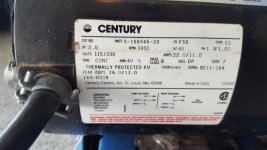
heres the plate.
Old motor is dual voltage, and at 110, seems to be able to pull 19 amps per the plate. Dont know why.

I put up a nother picture of a different motor i have. its a 2 HP, with similar specs.

so why is this 1 hp pulling so many amps?
 

Attachments

  • 20160902_173328.jpg
    20160902_173328.jpg
    144.1 KB · Views: 12
  • 20160903_182055.jpg
    20160903_182055.jpg
    139.2 KB · Views: 12
Last edited:
OP
A

allroads

Member
Joined
Sep 6, 2016
Messages
24
no extension cords. and im using the cord from when it was wired 220, so its high guage. I just put a new plug on the end.
plug is closest plug to the breaker. Id estimate the plug is rougtly 10 ft from teh breaker. The panel is on the other side of the wall from the plug so i cant get much closer.
 
OP
A

allroads

Member
Joined
Sep 6, 2016
Messages
24
Dont have access to the smaller motor yet. Here aer Two of the larger motors which both have really high amp draws. posted just above..

Short answer is yes. Slower motor, bigger pulley. TxN/5252. Double one, half the other, answer comes out the same. What is the letter code on each motor? If you post pictures of the nameplates, it's possible to figure out for sure if it will solve your problem.
 

jallyn

Well-known member
Joined
Jun 29, 2015
Messages
448
Location
Fort Wayne, Indiana
heres the plate.
Old motor is dual voltage, and at 110, seems to be able to pull 19 amps per the plate. Dont know why.

I put up a nother picture of a different motor i have. its a 2 HP, with similar specs.

so why is this 1 hp pulling so many amps?

Short answer is efficiency. Your old 1 hp motor appears to be less efficient at converting electrical energy into rotational energy (brake hp). So yeah, choosing a 1hp motor with lower nameplate amps is more efficient than your old motor.
 

jallyn

Well-known member
Joined
Jun 29, 2015
Messages
448
Location
Fort Wayne, Indiana
Now, if the old setup didn't use to trip the breaker then something has changed. Either the compressor has a mechanical issue requiring more power to turn it, or the breaker is getting weak, or something else. Hard to say...
 

md21722

Well-known member
Joined
Nov 30, 2015
Messages
1,840
Location
Mt Juliet, TN
Newer motors are more efficient.

A loaded motor would be expected to pull its FLA as tank pressure gets close to cutoff.

If the wire size is too small, the motor is going to try to pull it through the wire anyway, so volts will go down, and amps will go up.

You are better of wiring for 230V.

If staying with 115V, wire size should be 10-12 AWG.
 

WhiskeyRanger

Well-known member
Joined
Mar 28, 2015
Messages
398
Dont have access to the smaller motor yet. Here aer Two of the larger motors which both have really high amp draws. posted just above..

That motor is going to be pulling something like 40-50 amps on start up, if you were putting in a dedicated circuit it would require a 40A inverse time breaker. The code calls for 16A a FLC for a 1HP motor.
 
OP
A

allroads

Member
Joined
Sep 6, 2016
Messages
24
no breaker pop on startup. Takes about 2-3 min, as PSI increases.
No breaker pop at 20 psi.
 

md21722

Well-known member
Joined
Nov 30, 2015
Messages
1,840
Location
Mt Juliet, TN
You can swap the motors without any issue, but if the wire size is still to small, you may continue to experience problems. What is the wire and breaker size?

Startup current is roughly 4-6X FLA. As an example, 5HP motors that pull 23A 230V will have a startup current of about 135-170A. Circuit breakers are designed to allow the startup current to pass through. That's why one can run a 5HP motor off a 30A 240V breaker.
 

foghorn1966

Well-known member
Joined
Aug 18, 2012
Messages
228
Location
N. Alberta
There could be a bad centrifugal switch in the motor, which could cause a trip. But I'm lost on this thread. Is the OP actually having, breaker trip issues or speculating & in need of motor, sheave sizing guidance.
 
To avoid these ads, REGISTER NOW!
Top Bottom