To avoid these ads, REGISTER NOW!

electric motor vs gunk ???

radrush

Well-known member
Joined
Oct 30, 2010
Messages
828
Location
Atlanta, GA
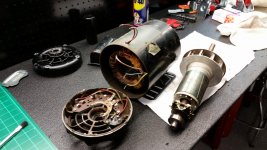
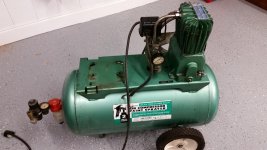
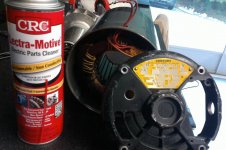
So I took possession of this vintage (antique) Sears 1973 2hp air compressor. Was doing a little clean up action on it and noticed that the inside of the electric motor is covered with a thick layer of greasy dirty gunk.

Should I attempt to clean this out? And if so with what? Dawn and garden hose?

Shark steamer?

Blast it out with a good shot of trichlorethylene?

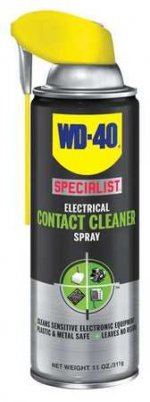
Flush it out with a hefty spray of electrical contact spray cleaner?
 

Attachments

  • attachment-4.jpg
    attachment-4.jpg
    78.9 KB · Views: 66
  • Z1sGqwqcpIx_.jpg
    Z1sGqwqcpIx_.jpg
    10 KB · Views: 44
To avoid these ads, REGISTER NOW!

dogdog

Well-known member
Joined
Nov 15, 2011
Messages
12,711
I just use a degreaser (in my case grease lighten), soft tooth brush and a garden hose.... let dry completely, re-grease bearing and certain surfaces with the red tacky grease. at least on the gunky Permanent motor I bought from ebay and countless fan motors, and windows AC units I have at home. it worked fine for me... just spray the contact area with some electrical spray to protect it....
 

crerus75

Well-known member
Joined
May 2, 2011
Messages
301
I rebuilt an old Black and Decker aluminum drill recently. Grease from the gearbox had worked its way up the armature shaft and onto the windings. The armature was a mess, with a mixture of grease and carbon dust from the brushes forming a paste coating on it.

I was afraid of hurting the varnish on the armature so I cleaned it with, I think, Simple Green and a toothbrush. It took a couple of cleanings. I rinsed it very thoroughly in the sink and blew it out with compressed air. Then I polished the commutator and put it back together. The drill runs smoother than any other vintage drill I have.

I agree with Dogdog. This is not the first motor I've cleaned this way, and I've never had a problem. I don't like Gunk all that much, mostly due to the smell. I think Greased Lightning, Simple Green, or LA's Totally Awesome (from the dollar store) will clean it just fine and rinse off easier.
 

Kracin

Well-known member
Joined
Mar 25, 2013
Messages
1,666
Location
Omaha, NE
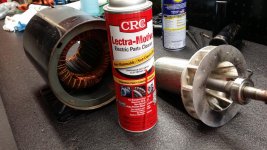
lectra motive spray cleaner, also able to be used while its running. good way to clean up the air gap between the rotor and stator. i would use a small nozzle air gun and 40 psi to blow out dirt and dust initially so its not taking more cleaner than necessary.

the motor doesn't have to be 100% clean to function 100%. as long as there isn't excessive buildup of dust and dirt that will trap heat and cause insulation failure, and you don't have so much dirt built up in the air gap that causes it to rub then you'll be fine.
 

theoldwizard1

Well-known member
Joined
Feb 22, 2011
Messages
43,236
Location
SE MI
I just use a degreaser (in my case grease lighten), soft tooth brush and a garden hose.... let dry completely, re-grease bearing and certain surfaces with the red tacky grease. at least on the gunky Permanent motor I bought from ebay and countless fan motors, and windows AC units I have at home. it worked fine for me... just spray the contact area with some electrical spray to protect it....

Good suggestion. "Dry completely" means many hours in the sun I would wait at least a full 24 hours.


OP, that vintage compressor will last a very long time, if it is not already beat to death !
 

dogdog

Well-known member
Joined
Nov 15, 2011
Messages
12,711
Good suggestion. "Dry completely" means many hours in the sun I would wait at least a full 24 hours.


OP, that vintage compressor will last a very long time, if it is not already beat to death !

in the sun and in front of a box fan at least over night. or on top of my dehumidifier if I have it running and parts are small enough. Just don't tempted to assemble it and plug it in immediately. I fry many things like that also. :evil: if you have cap in that motor, discharge it first common sense stuff.

If OP was to disassemble the motor for cleaning he/she should also fine sand paper the commutator and clean the gaps a little from those carbon deposits without cutting any fine wires by going crazy about it.
 

Showkey

"MEMBER EMERITUS"
Joined
Aug 9, 2014
Messages
8,638
Location
Wausau WI
Note to OP........those compressors were infamous for rusty tanks. Especially the bottom, they got pins holes even when drained regularly and age is against you. Just a word of caution.......been there.
 
OP
R

radrush

Well-known member
Joined
Oct 30, 2010
Messages
828
Location
Atlanta, GA
If OP was to disassemble the motor for cleaning he/she should also fine sand paper the commutator and clean the gaps a little from those carbon deposits without cutting any fine wires by going crazy about it.

I have the motor disassembled. I see that Grainer has a $43 Commutator Resurfacer, 10 In L, Med/Finish.

But you're saying to what, buff it with some fine sand pater? Can you elaborate?

Note to OP........those compressors were infamous for rusty tanks. Especially the bottom, they got pins holes even when drained regularly and age is against you. Just a word of caution.......been there.

So is this thing a time bomb? I have a couple of ultrasonic testing devices at the office. I wonder what the tank wall thickness is supposed to be? I can have a UT level 2 guy test it for me. We could test the top for reference and then test the bottom. What do you think?
 

LumpyMusic

Well-known member
Joined
May 2, 2012
Messages
492
Location
Phoenix Arizona USA
I second the SimpleGreen+Toothbrush+Water method. SG is about the only thing I use to degrease anything any more. From shower doors to car engines to old brake rotors filled with axle grease. And when I'm all done, I spray some 10%SG/90% water on my hands and it cleans them.

Never had it harm any surface, paint, skin, chrome, glass etc.


Lump
 

Showkey

"MEMBER EMERITUS"
Joined
Aug 9, 2014
Messages
8,638
Location
Wausau WI
^^^^^^^^^^^^^
:dunno::dunno:I have not seen blow out.........just more than few leak.
Testing would be interesting. Tapping with a pointed hammer ( with no pressure) to see the deforming in the bottom is the red neck testing method. Some of these will be paper thin. ( Well maybe thick paper):wtf::wtf:
 

dogdog

Well-known member
Joined
Nov 15, 2011
Messages
12,711
I have the motor disassembled. I see that Grainer has a $43 Commutator Resurfacer, 10 In L, Med/Finish.

But you're saying to what, buff it with some fine sand pater? Can you elaborate?
.................?


..... if you have to the rotor out... you could just use any fine 200 or more grit sand paper on the commutator/slip ring, if it is the motor that have one of those, just lightly sand the carbon off. Think that tool you mention is for cleaning the commutator without disassemble the motor..... Not sure never used those...

maybe 400... 1000 or your wife's finger nail file, course eraser from some art store ? just wash the dust off.....
 
Last edited:
To avoid these ads, REGISTER NOW!

Mikerodrig27

Well-known member
Joined
Oct 22, 2014
Messages
171
I use dawn soap as opposed to brake cleaner on sensitive surfaces (including brake pads/rotors/rubber boots etc) because it does not leave a residue. Dawn soap really is some amazing stuff.
 
OP
R

radrush

Well-known member
Joined
Oct 30, 2010
Messages
828
Location
Atlanta, GA
It looks like this right now. On way home from work will pick up some scotch Brite pads and some simple green.
 

Attachments

  • 20150925_211651.jpg
    20150925_211651.jpg
    152.7 KB · Views: 37
  • 20150925_211807.jpg
    20150925_211807.jpg
    148 KB · Views: 26

404

Well-known member
Joined
Aug 23, 2014
Messages
3,463
Location
Mass
I would clean and paint the outside, otherwise leave it alone.

If you must do something to it, put on new ball bearings. Read the part numbers or measure them to be sure they are common easily available bearings before you take off the old ones. They will be metric sizes most likely.

There is no commutator in this motor that needs sanding.
 
OP
R

radrush

Well-known member
Joined
Oct 30, 2010
Messages
828
Location
Atlanta, GA
Got the electric motor all cleaned out. Thanks for all the good advise on that. It's looking really good.
 

Attachments

  • 20150926_175636.jpg
    20150926_175636.jpg
    154.8 KB · Views: 28
OP
R

radrush

Well-known member
Joined
Oct 30, 2010
Messages
828
Location
Atlanta, GA
If you must do something to it, put on new ball bearings.

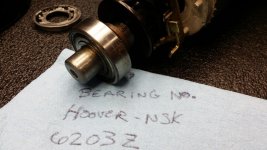
So what's the deal with this bearing on each end.

The original owner left a note indicating that he had changed the bearings in 1983, when the compressor was 10 years old. Since the compressor is now 43 years old, the bearing may be due for a change.

Two questions:

#1 The bearing is stamped HOOVER-NSK 6203Z.
I found these nearings on line but the model number has a double Z at the end. What's the difference?
6203 zz(DoubleZ) NSK Deep Groove Ball Bearing

#2. How is that bearing removed and replaced? It does NOT feel like it wants to move. Get a bigger hammer?
 

Attachments

  • 20150926_175202.jpg
    20150926_175202.jpg
    147.1 KB · Views: 14
Last edited:

cbogg

Well-known member
Joined
Feb 4, 2013
Messages
93
6203 is a very common bearing. Used in vehicle idler pulleys, shaft bearing etc. z is single shielded, zz is double. The zz should be more than fine and provide a bit more protection from debris. If you have acces to a press that'll get it off. Even carefully placing it in a vise and tapping the shaft through with a hammer and would block does the trick. On something I was trying to save but didn't have much hope for, pair of vise grips locked smaller than the inner race and bigger than the shaft and a dead blow took care of it. Some info: http://www.gizmology.net/bearings.htm might be able to source them through your local Napa,that's where I got my last 6203's from.
 
Last edited:

pcmeiners

Well-known member
Joined
Aug 13, 2009
Messages
7,948
Location
In the only town in Pennsylvania, Bloomsburg.
Z designates metal shield, double z, shield both side. Both z and zz could mean metal shield both sides. Originally meant shield on on side, open on the other side, made it easy to re-grease, also less friction then double shielded. Now shields are design with less friction in mind, thus double shields are generally used.

Been using the SKF Energy efficient bearings, really nice bearing for motors, nice roll, motors run cooler, saves a bit of power....

http://www.ebay.com/itm/E2-6203-2Z-...all-Bearing-/191336243146?hash=item2c8c875fca
 
Last edited:

Mikerodrig27

Well-known member
Joined
Oct 22, 2014
Messages
171
It's called a swing press.I've never damaged bearings by hammering them in. The trick is to hammer something that is set against the bearing. If you think about it, the concept is very similar to an actual press only in shorter spurts.
 

DonPowers

Well-known member
Joined
Dec 7, 2014
Messages
4,398
Location
On The Hair At The End Of The Dog's Tail
So I took possession of this vintage (antique) Sears 1973 2hp air compressor. Was doing a little clean up action on it and noticed that the inside of the electric motor is covered with a thick layer of greasy dirty gunk.

Should I attempt to clean this out? And if so with what? Dawn and garden hose?

Shark steamer?

Blast it out with a good shot of trichlorethylene?

Flush it out with a hefty spray of electrical contact spray cleaner?

I must be getting old, 1973 seems like it wasn't that long ago, especially for something to be considered an antique. Then again, the grandkids call my first gen iPod an antique.

BTW, nice find, if the tank is sound, It will probably out last you. Biggest problem with old compressors is water sitting in the tank for long periods of time, as previously mentioned. If the previous owner(s) blew it out on a regular basis it will be fine. The UT test would be a good idea.
 
Last edited:
To avoid these ads, REGISTER NOW!
Top Bottom