To avoid these ads, REGISTER NOW!

Electric Motor with Lost Power

tropangler

Member
Joined
Jan 18, 2024
Messages
16
I recently bought a vintage Craftsman Model 113.298240 table saw that seemed to be in great shape. The Leeson 1 HP motor sounded very good, but when I started using the saw, it didn't have enough power to comfortably rip a 2 by 4. Since this seemed strange, I then bought and installed a used Craftsman 1 HP motor. This time the saw performed well, so I have concluded that the Leeson motor is defective. My question for discussion is what is the likely problem with the motor, is it repairable and does it have any market value (it does crosscut 1 inch pine at a slow pace) ?
 
To avoid these ads, REGISTER NOW!

BTL-A4

Well-known member
Joined
Feb 28, 2018
Messages
1,252
Location
Santa Clarita
I've found that cleaning all the contacts really helps. I sprayed circuit board cleaner (made for electronic parts and evaporates quickly, leaves no residue) on and in (carefully!) a motor and it helped.
 

Maui

Well-known member
Joined
Sep 16, 2012
Messages
2,871
Location
Upstate NY
If the motor is wired for 220V power but has a 110V plug on the end, it will run up to speed under no load with no problem. But when placed under load it will perform as though it is weak/underpowered/on the fritz. I recommend you pull the cover plate and actually look inside to see how it was wired up.
 

PCustoms

Well-known member
Joined
Jul 23, 2011
Messages
22,924
Location
VT
Manual here


Don’t see a note of 220v yet. P44 only shows a 110v plug.

1738383953085.png

You know saying 110 and 220 summons an electrician to go on a rant about how it's 240v and we have hadn't 220 in hundreds of years, right?


Also OP makes no mention of wiring or any other useful information about the motor
 
Last edited:
OP
T

tropangler

Member
Joined
Jan 18, 2024
Messages
16
If the motor is wired for 220V power but has a 110V plug on the end, it will run up to speed under no load with no problem. But when placed under load it will perform as though it is weak/underpowered/on the fritz. I recommend you pull the cover plate and actually look inside to see how it was wired up.
I'd like to do that, but without a wiring diagram I'd be at a loss to determine the voltage setup. Perhaps I will see if I can get a Leeson diagram when I have time.
You know saying 110 and 220 summons and electrician to go on a rant about how it's 240v and we have hadn't 220 in hundreds of years, right?


Also OP makes no mention of wiring or any other useful information about the motor
Since the saw is ancient and probably has changed hands a few times, I'm guessing that the Leeson motor is not the original motor on the saw.
 

PCustoms

Well-known member
Joined
Jul 23, 2011
Messages
22,924
Location
VT
I'd like to do that, but without a wiring diagram I'd be at a loss to determine the voltage setup. Perhaps I will see if I can get a Leeson diagram when I have time.

Since the saw is ancient and probably has changed hands a few times, I'm guessing that the Leeson motor is not the original motor on the saw.
Doesn't matter at all if its original or not.

Should be a diagram right on the motor.

You also never said what voltage you were trying to use it on.
 

Maui

Well-known member
Joined
Sep 16, 2012
Messages
2,871
Location
Upstate NY
I'd like to do that, but without a wiring diagram I'd be at a loss to determine the voltage setup. Perhaps I will see if I can get a Leeson diagram when I have time.

Since the saw is ancient and probably has changed hands a few times, I'm guessing that the Leeson motor is not the original motor on the saw.
The wiring diagram for 110V and 220V operation should appear directly on the motor plate itself or on the underside of the access cover.
 

kaymccampbell

Well-known member
Joined
Feb 27, 2015
Messages
29,518
Location
Upstate New York
I have this saw, and its original motor. There is no provision for 240 on my original motor. I did discover that the motor got weaker over time, even with new caps. I replaced mine with a HF 3hp 240v motor. It's no 3hp, but it is a vast improvement over the original.
 
To avoid these ads, REGISTER NOW!
OP
T

tropangler

Member
Joined
Jan 18, 2024
Messages
16
The wiring diagram for 110V and 220V operation should appear directly on the motor plate itself or on the underside of the access cover.
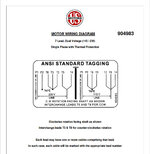
I was mistaken. There is a wiring diagram on one small corner of the Leeson nameplate. It is exactly the same as the ANSI standard. I opened up the motor this morning, checked the wiring, and it was wired for 220 volts! I rewired it for 110 volts and ran it briefly, successfully. Now I have to decide whether I keep this motor as a spare or offer it for sale on EBay.

Thanks again all you Garage Journalists for providing the collective knowledge I needed to solve this problem.
 

johnre

Well-known member
Joined
Dec 1, 2016
Messages
1,051
Location
Portland, OR
I opened up the motor this morning, checked the wiring, and it was wired for 220 volts! I rewired it for 110 volts and ran it briefly, successfully.

So the original owner had it wired to run at 240 V with a 120 V plug on the cord, and said nothing to you about this when you bought it?

I suppose it could have been used with one of these receptacles - but that doesn't excuse not changing the plug on the appliance. The karma will return to him; imagine if someone unknowingly plugs some 120 V apparatus into that particular receptacle and starts it up - motor, heating appliance, whatnot.

Or conversely, if it was a widow or someone else who unknowingly sold it that way, it would be decent of you to tell them so they can address the issue.
 
Last edited:

Cruzan80

Well-known member
Joined
Jul 22, 2015
Messages
4,217
Location
Denver, CO
I bought a Baldor buffer cheap once. PO of the seller had put a 240V 1ph plug on a 3ph unit. Seller got tired of tripping over it. Best part was when I rope started it to test, he commented that there was a string around one arm (when he bought it), and he wasn't sure why... He never knew you could do that.

Italic emphasis is mine...
OWWM Rule No. 12: Never assume a machine as received is set up correctly. Especially electrical!
 
Last edited:

Maui

Well-known member
Joined
Sep 16, 2012
Messages
2,871
Location
Upstate NY
I'm glad that you took the advice and checked the wiring Tropangler. Just be thankful that it didn't have a 220V plug on the end of the power cord with the motor wired up for 110V operation! You would have seen some fireworks then.
 

Beerhippie

Well-known member
Joined
Oct 13, 2023
Messages
9,809
Location
Far NE Oregon
So the original owner had it wired to run at 240 V with a 120 V plug on the cord, and said nothing to you about this when you bought it?

I suppose it could have been used with one of these receptacles - but that doesn't excuse not changing the plug on the appliance. The karma will return to him; imagine if someone unknowingly plugs some 120 V apparatus into that particular receptacle and starts it up - motor, heating appliance, whatnot.

Or conversely, if it was a widow or someone else who unknowingly sold it that way, it would be decent of you to tell them so they can address the issue.
I'm sure it was more of a case of ignorance. There are many folks out there who have no idea whatsoever about electrical stuff--but don't let that stop them from doing electrical stuff.

"Why did they put this damned plug on here? It doesn't fit anything in the garage... I'll just get the right plug for it."
 

whateg01

Well-known member
Joined
Mar 13, 2006
Messages
11,343
Location
doo dah, kansas, usa
I'm glad that you took the advice and checked the wiring Tropangler. Just be thankful that it didn't have a 220V plug on the end of the power cord with the motor wired up for 110V operation! You would have seen some fireworks then.
How so? He would have smoked the motor but where would the fireworks have come from?
 

johnre

Well-known member
Joined
Dec 1, 2016
Messages
1,051
Location
Portland, OR
I'm sure it was more of a case of ignorance. There are many folks out there who have no idea whatsoever about electrical stuff--but don't let that stop them from doing electrical stuff.
The saw would have been delivered from Sears running at 120 V. It was later modified to run at 240 V. Presumably the person selling it had 240 V available and was using it this way.

How so [fireworks]? He would have smoked the motor but where would the fireworks have come from?
Windings would overheat, possibly starting a fire. A contractor saw without dust extraction has lots of sawdust around it.
 
OP
T

tropangler

Member
Joined
Jan 18, 2024
Messages
16
The saw would have been delivered from Sears running at 120 V. It was later modified to run at 240 V. Presumably the person selling it had 240 V available and was using it this way.


Windings would overheat, possibly starting a fire. A contractor saw without dust extraction has lots of sawdust around it.
I suspect that the person who sold me the saw had a failed motor, replaced it with a used motor unknowing that it was wired for 220v and used it with limited success so he unloaded it on me for a price of $60. Actually, I'm pleased with the overall experience because he also threw in a router with table that I sold on EBay for $75. I then bought a similar Craftsman table saw for $75. that had a good 120v motor and a better miter gauge, plus a base that I sold for $20. and cast iron table top extensions and a ripping fence that I'm now trying to sell on EBay. All very time consuming, but being retired I have plenty of time.
 

Beerhippie

Well-known member
Joined
Oct 13, 2023
Messages
9,809
Location
Far NE Oregon
This saw would not have had a brushed universal motor
We have 240V Delta 3-phase service. Not many electricians or electrical engineers are familiar with this, as it just isn't much seen. Most places have Y 3-phase, which means any of the three legs to ground would be 120V. With Delta, two of the legs are 120V to ground (or neutral), while the third leg is 240 to ground. This causes problems. Traditionally (no idea about code in this case), the center bus of the Delta 3-phase breaker box is the "high leg". Since this is a rare condition, not everyone knows this, resulting in things being 240V that should be 120V by any other reasoning.

Even here in our very small town, some of the service is Delta and some is Y. The mains line voltages are not the same from one place to another, either, which has resulted in some spectacular results--try running 240-260V VFDs at 880V because the power company guys used the wrong transformers to replace some destroyed in a wreck (truck took the pole down--that made for a big bang).
 

whateg01

Well-known member
Joined
Mar 13, 2006
Messages
11,343
Location
doo dah, kansas, usa
We have 240V Delta 3-phase service. Not many electricians or electrical engineers are familiar with this, as it just isn't much seen. Most places have Y 3-phase, which means any of the three legs to ground would be 120V. With Delta, two of the legs are 120V to ground (or neutral), while the third leg is 240 to ground. This causes problems. Traditionally (no idea about code in this case), the center bus of the Delta 3-phase breaker box is the "high leg". Since this is a rare condition, not everyone knows this, resulting in things being 240V that should be 120V by any other reasoning.

Even here in our very small town, some of the service is Delta and some is Y. The mains line voltages are not the same from one place to another, either, which has resulted in some spectacular results--try running 240-260V VFDs at 880V because the power company guys used the wrong transformers to replace some destroyed in a wreck (truck took the pole down--that made for a big bang).
What relevance does any of that have to op? Are you saying you think op has 3ph? Or do you think craftsman sold 3ph contractor saws?
 
Last edited:

Sumboodie

Well-known member
Joined
Mar 20, 2021
Messages
10,697
Location
AK
You could be right. According to the nameplate, the Leeson motor is capable of being wired for both 120 and 240 v.
I remember a lot of table saws and compressors Sears sold in the 90s, early 2000s at dual voltage.
I bet most were setup as 120v for practicality though.
 

Sumboodie

Well-known member
Joined
Mar 20, 2021
Messages
10,697
Location
AK
Having once had a brush-type 120V motor that was wired to 240V, it's pretty spectacular! The brushes pretty much turn into fireworks.
In the 60s-70s it was common in potato houses and farm sheds in northern Maine to have 240v on a regular 120v style receptacle.
The plate would be red or marked.. usually.
Well ~15 yr old me didn't know that and plugged in the old 1960s Sears air compressor... usually went chuff chuff chuff and probably made like 3cfm.
It sure woke up when I plugged it into that 240v outlet!

I have no idea why another receptacle wasn't used. I think it'd get used for stuff like potato bin pilers, sorting tables, etc.
This would have been back when houses had maybe 60 amp power, and the shed, potato house, barn, etc fed off the house.
 

Beerhippie

Well-known member
Joined
Oct 13, 2023
Messages
9,809
Location
Far NE Oregon
What relevance does any of that have to op? Are you saying you think op has 3ph? Or do you think craftsman sold 3ph contractor saws?
Explaining my previous post in this thread, here:

Having once had a brush-type 120V motor that was wired to 240V, it's pretty spectacular! The brushes pretty much turn into fireworks.
And having an old guy memory moment.
 
To avoid these ads, REGISTER NOW!
Top Bottom