To avoid these ads, REGISTER NOW!

Electric pipe threader --> high torque wrench

bw77

Well-known member
Joined
Jul 10, 2009
Messages
1,330
Location
Upstate NY
Using a modified HF electric pipe threader as a high torque socket wrench
to remove body bolts on a Ford diesel. Shows it at 0:44.

Never saw this done before.

 
To avoid these ads, REGISTER NOW!

G_P

Well-known member
Joined
Jul 11, 2010
Messages
7,135
Location
Central CT
Thats pretty neat.
But wouldnt an impact be better? That pipe threader will smash you in the face or take you for a ride if the bolt binds. An impact will just hammer away in your hand.
 

TigerDude

Well-known member
Joined
Feb 24, 2016
Messages
127
Location
Atlanta, GA USA
Thats pretty neat.
But wouldnt an impact be better? That pipe threader will smash you in the face or take you for a ride if the bolt binds. An impact will just hammer away in your hand.
I would think you would want to place it so it's supported by equipment, like a hydraulic wrench.
 

the gypsy

Well-known member
Joined
Mar 13, 2013
Messages
1,780
Location
Montreal, Quebec, Canada
Correct me if I am wrong, but is it not dangerous to strip a bolt in the tightening mode? I never heard of it stripping in the loosening mode. Or maybe I have never noticed?
 

rlitman

Well-known member
Joined
Oct 18, 2010
Messages
24,624
Location
Long Island
He says that an impact can strip the nuts with the constant hammering action.

His wording is kind of misleading.
Here's what I took it to mean:

The body bolts connect to nuts that are captive in the frame.
Removing these body bolts with an impact runs the risk of knocking these captive nuts loose.
Removing these body bolts without an impact prevents this from happening.
 

Zeke

Well-known member
Joined
Aug 13, 2009
Messages
17,176
Location
Long Beach CA, the sewer by the sea.
Thats pretty neat.
But wouldnt an impact be better? That pipe threader will smash you in the face or take you for a ride if the bolt binds. An impact will just hammer away in your hand.

Correct me if I am wrong, but is it not dangerous to strip a bolt in the tightening mode? I never heard of it stripping in the loosening mode. Or maybe I have never noticed?

He was referring to the bolt coming loose from the mount, not the threads stripping. If the carriage bolt pops loose then you have to find a way to hold the bolt while loosening the nut.

Well, I was typing while rlitman was posting.
 

rlitman

Well-known member
Joined
Oct 18, 2010
Messages
24,624
Location
Long Island
He was referring to the bolt coming loose from the mount, not the threads stripping. If the carriage bolt pops loose then you have to find a way to hold the bolt while loosening the nut.

Well, I was typing while rlitman was posting.

Ah, carriage bolts. Same basic idea, just backwards from what I was picturing (without looking further into the process).

Yeah, I'm usually the second one to post when that happens. Guess it was my day today. ;)
 

ADSR

Well-known member
Joined
Jan 12, 2013
Messages
10,713
Look at all that JUNK in the engine compartment! Ford is absolutely the worst for cramming 10 pounds of poop in a 5 pound bag.
 

Zeke

Well-known member
Joined
Aug 13, 2009
Messages
17,176
Location
Long Beach CA, the sewer by the sea.
Ah, carriage bolts. Same basic idea, just backwards from what I was picturing (without looking further into the process).

Yeah, I'm usually the second one to post when that happens. Guess it was my day today. ;)

You were actually correct. The guy was loosening 'bolts' that threaded into a welded nut. He called them carriage bolts when they were more like a machine bolt with a hex head and a large washer.

It is the nut that the rattle gun can break if the bolt is stubborn (which undercarriage hardware always seems to be).
 
To avoid these ads, REGISTER NOW!

Zeke

Well-known member
Joined
Aug 13, 2009
Messages
17,176
Location
Long Beach CA, the sewer by the sea.
Is it possible it was cross threaded to begin with?

Thread metal can become frozen and if you are so ambitious that you won't take time to heat and move the bolt/nut back and forth to ensure that it's free before gunning it off, you might take the threads with you. Most of them time in my experience the bolt breaks before the threads come off with the bolt. But it does happen especially with threaded holes in aluminum.
 

rlitman

Well-known member
Joined
Oct 18, 2010
Messages
24,624
Location
Long Island
Is it possible it was cross threaded to begin with?

I don't think so. Last time I had this happen, it was with a lug nut. I know for a fact that this nut was installed by hand turning until snug and then finishing with a torque wrench (only several days before this happened). When removing it with an impact, it stripped out on me.

I know that the outer threads could not have been damaged (or corroded) since it was an acorn nut; so that wasn't a potential cause. I ended up hammering on it with the impact gun until it eventually came off WITH all of the stud threads, and was so hot it was actually smoking. Since I was removing the wheel to do the bearings anyway, replacing the stud was no big deal, ONCE the wheel was off, so I was quite glad it finally worked its way off.

edit: as Zeke pointed out, this is a more common issue with steel bolts corroded into an aluminum casting.
 
Last edited:

rlitman

Well-known member
Joined
Oct 18, 2010
Messages
24,624
Location
Long Island
You were actually correct. The guy was loosening 'bolts' that threaded into a welded nut. He called them carriage bolts when they were more like a machine bolt with a hex head and a large washer.

It is the nut that the rattle gun can break if the bolt is stubborn (which undercarriage hardware always seems to be).

Ah, ok. Again, I admit I didn't look too closely.

The same could happen with carriage bolts. Sending the bolt flying when removing the nut with an impact, or stripping the square hole the head fits into.
 

Cryptic1911

Well-known member
Joined
May 24, 2008
Messages
2,884
Location
Willimantic, CT
Look at all that JUNK in the engine compartment! Ford is absolutely the worst for cramming 10 pounds of poop in a 5 pound bag.

Yeah, it's ridiculous.. A friend of mine has a shop here in connecticut, and they have a guy there that specializes in ford powerstrokes. They literally have a line of 5-10 of the ford diesel trucks out back at all times, there to get the cabs pulled for motor work. I'm not even joking. They come in as fast as they can turn them over.. it's funny, nobody wants to work on the damn things because it's such a nightmare. I don't understand why they designed them that way :confused:

The guy can do these things with his eyes closed.. they have the cab off the thing and motor half apart in like two hours :3gears:
 

LXCam

ALLIANCE MEMBER
Joined
Apr 23, 2013
Messages
19,153
Location
AZ
Carriage bolts?? Well unless ford is doing something I've never seen done I think the terminology needs some clarification. I've only ever seen captive nuts used. They'll form a square or rectangular heavy gauge cap over a square but that allows the nut to float within the holder as well as an over sized bore through the frame or body so it doesn't require perfect alignment of the bolt. And I'd agree that if your bolt is seized for whatever reason the constant hammering of an impact can and will cause the cap to distort and allow the nut to spin. I've had to repair my fair flipping share of these things and it *****, normally they are buried and very difficult to get too without cutting and welding.

Just saying :)
 

Pipe

Well-known member
Joined
Feb 22, 2016
Messages
315
A lot of confusion in this thread so I'll bring it back up...

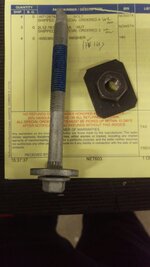
Ford cab bolts are 6 inches long w/ blue loctite and go through the rubber mounts and into a captive nut. The front two are exposed to the elements..the 2nd row are halfway exposed to elements behind the fender liner and the others are inside the interior.

The idea is an impact will rattle the captive nut design loose and free spin from the top. You either need to remove carpet, fender liner, or bend a 7/8 wrench to fit the nut depending on location at that point. My 2 foot ratchet and mini-ductor works well but the idea behind this is CONSTANT torque. When I ratchet the bolts out, you still give the cage nut a release and blow every ratchet cycle.

Pinning the nut w/ initial torque and hanging on for the ride seems to lessen the chance of the nut giving way and spinning. I'm installing a cab tomorrow and will follow up with pics of said bolts and cage nut.
 

sberry

Banned
Joined
Jun 18, 2005
Messages
35,747
Location
Brethren, Michigan
I don't think so. Last time I had this happen, it was with a lug nut. I know for a fact that this nut was installed by hand turning until snug and then finishing with a torque wrench (only several days before this happened). When removing it with an impact, it stripped out on me.

I know that the outer threads could not have been damaged (or corroded) since it was an acorn nut; so that wasn't a potential cause. I ended up hammering on it with the impact gun until it eventually came off WITH all of the stud threads, and was so hot it was actually smoking. Since I was removing the wheel to do the bearings anyway, replacing the stud was no big deal, ONCE the wheel was off, so I was quite glad it finally worked its way off.

edit: as Zeke pointed out, this is a more common issue with steel bolts corroded into an aluminum casting.

It dry seized and self welded when it was installed.
 

theoldwizard1

Well-known member
Joined
Feb 22, 2011
Messages
43,205
Location
SE MI
Once the initial breakaway torque is overcome (25" 1/2" drive breaker bar w/cheater if necessary" then any impact should buzz them right off.
 

Provincial

Well-known member
Joined
Sep 21, 2011
Messages
6,871
Location
Near Salem, OR
From at least the late 1990's (and probably earlier) Ford used a special bolt for mounting the body and pickup boxes on the F-series. They probably used these on other models as well. They are called "Trilobular", meaning that the threaded area isn't round, but a rounded triangle shape. This is also a thread-forming fastener, meaning that the "nut" isn't fully threaded and the "bolt" forms the threads in the "nut" as it is screwed in. The "nut" is a thin-walled tube with a clip attached to hold it on to the frame. The "nut" flexes and when the "bolt" is tight the flattened part of the threads ***** into the corresponding part of the "bolt" and acts as a thread locking device.

These are notoriouly difficult to unscrew. When I took the box off my 2001 F-250 I tried to unscrew a couple of the "bolts" and destroyed the Torx Plus head on one and broke the bit on the next. Out came the 4-1/2" grinder with a cutoff wheel and the job was done by cutting off the heads of the fasteners.

I can see where these fasteners would respond poorly to an impact tool. Someone was improvising a power wrench by using the pipe threader, and got the job done! They must have to deal with these quite often.
 

tcianci

Well-known member
Joined
Feb 7, 2009
Messages
4,242
Location
Walpole, Ma
From at least the late 1990's (and probably earlier) Ford used a special bolt for mounting the body and pickup boxes on the F-series. They probably used these on other models as well. They are called "Trilobular", meaning that the threaded area isn't round, but a rounded triangle shape. This is also a thread-forming fastener, meaning that the "nut" isn't fully threaded and the "bolt" forms the threads in the "nut" as it is screwed in. The "nut" is a thin-walled tube with a clip attached to hold it on to the frame. The "nut" flexes and when the "bolt" is tight the flattened part of the threads ***** into the corresponding part of the "bolt" and acts as a thread locking device.

These are notoriouly difficult to unscrew. When I took the box off my 2001 F-250 I tried to unscrew a couple of the "bolts" and destroyed the Torx Plus head on one and broke the bit on the next. Out came the 4-1/2" grinder with a cutoff wheel and the job was done by cutting off the heads of the fasteners.

I can see where these fasteners would respond poorly to an impact tool. Someone was improvising a power wrench by using the pipe threader, and got the job done! They must have to deal with these quite often.

This!!! Tri lobular threads are often mistaken as seized or cross threaded. They're designed to "roll" their own thread as they are inserted and are really good at staying put. I have had to "pin" those nuts in place. On GM products, they use a big honkin square slug of steel as a nut. By drilling a 3/16" or so hole in the nut just to the side of the bolt head, then drop a suitable punch into the hole you can catch the channel that the nut is captive in. Then you can have at the bolt any way you want.
 
Last edited:

Pipe

Well-known member
Joined
Feb 22, 2016
Messages
315
f6d9331d7c2fe107d8c307aeb9d073b7.jpg

Here's the bolt and nut. I don't have a picture of the captive cage the nut rests in. As soon as the threads get rusty an impact has a very high chance of breaking the cage and free spinning the nut.

Sent from my 0PJA2 using Tapatalk
 

Attachments

  • f6d9331d7c2fe107d8c307aeb9d073b7.jpg
    f6d9331d7c2fe107d8c307aeb9d073b7.jpg
    74.1 KB · Views: 0
To avoid these ads, REGISTER NOW!
Top Bottom