To avoid these ads, REGISTER NOW!

Electric wiring question

truck

Well-known member
Joined
Feb 8, 2008
Messages
203
Location
Manassas, Va
I'm wiring the shop and need to wire the on-demand water heater (4 30A circuits) and the dryer (1 30A circuit). The run is about 60 ft from the service panel. Plan on using 10Ga THHN. That is 5 Black, 5 White and 1 ground (figure that can be common between the water heater and the dryer). I was thinking of using PVC conduit for ease of installation since I don't have a bender, but open to suggestions.

1. Is 10Ga what I should be using on that long of run?
2. What size conduit do I need to run this in?

Truck
 
Last edited:
To avoid these ads, REGISTER NOW!

ArthurPE

Banned
Joined
Jun 14, 2009
Messages
423
1" ENT will take 15 #10 THHN
#10 is fine, that's a relatively short circuit

I'd pull 2 grounds, 1 to each piece of equipment
I'm not sure what the code requires though
 

Charles (in GA)

Well-known member
Joined
Jan 11, 2006
Messages
12,489
Location
50 mi south of Atlanta
Is the on demand water heater 240V? Thus two each 240v circuits.... a red and a black, and another red and a black, and two double pole (handle tied) 30 amp breakers. DO NOT mix up the reds and blacks. You need one red and one black from one double pole CB going to one circuit, same for the other one. You need one ground for the unit.

For the dryer you need another 240v circuit, one red, one black, and one white, and one ground (green) and a 30 amp double pole (handle tied) CB. Dryers have 120V motors in them and require the white neutral.

This gives you a total of seven current carrying wires. Since you are exceeding three current carrying wires in a conduit, you have to derate the wires to 70% of their original capacity (using table 310.16). Being conservative and using the 60 degree column, the #10 has an ampacity of 30 amps. Derate it to 70% of that and you get 21 amps, and then since it is a water heater, considered a continuous load calculate 80% of the 21 amps and you get 16.8 amps, so the biggest breaker you could use would be 15 amps. You need to rethink your wire sizes and probably add additional conduit runs.

Even if you used the 90 degree column, #10 THHN is good for 40 amps, then derate to 70% and get 28 amps and then take 80% of that for the continuous load, and get 22.4 amps which would allow a 20 amp breaker.

Charles
 
OP
T

truck

Well-known member
Joined
Feb 8, 2008
Messages
203
Location
Manassas, Va
Charles,

Yes water heater is 240v. It requires 4 double pole 30A CB.

didn't realize the dryer needed 4 wires as the plug only had 3 prongs.


What do you suggest as conduit or wire? I haven't bought either yet.

Truck
 

ArthurPE

Banned
Joined
Jun 14, 2009
Messages
423
THHN is rated at 40A (90 C)
and you shouldn't have to derate for amb temp...

I'm not sure an instantaneous water heater is considered a continuous load...
what IS the actual load for each heater circuits? should be in KW or W
you're saying the heater requires 4 30/2 240 circuits correct? not 2
that's a big load...probably staged based on demand, so you can consider it a diversity load...

if that's the case you have 8 for the heater and 3 for the dryer if it requires a N
and the 2 grounds, for a total of 13 conductors, 11 carrying current

using the equation for diversity:
w/o temp comp ~42A, use the small of the rating or calculated, so 40A

using the straight derating of 0.5 for the number of conductors (table 315.B.2.a)
gives 20A, and you need bigger wire...

more than 1 way to skin a cat...
what does the heaters manual say to use?

we have to assume the load is < 30/1.25 ~ 24A since they tell you to use a 30A CB

if you go strickly by the book 60C column and derate 50% for cond no. (11) and 0.82 for temp (94-101F) and the load is 30/1.25 ~ 24 A you'll need a conductor cabable of:

24/0.5/0.82 x 1.25 ~ 73A or #3 rated at 85A!!! and a 80A CB x 4 !!!

if the wire is derated to 21 A, you can uses a 20A breaker provided the load is <21/1.25 or ~16.8 A


310.15.C allows an engineer to calculate the allowable ampacity, and it is always larger than the std tables...

what model/mfg heater?
 
Last edited:

bward76

Active member
Joined
Jan 19, 2009
Messages
25
Can you elaborate on it needing "4 double pole 30a breakers"? Im a little confused. The way that it's worded is like saying you need 4-30a 240v circuits for a water heater. Can you snap a picture of the nameplate and post it? This may help clear things up. Charles is absolutly correct about the derating issue. That is often overlooked. Going to the 90deg table has to be verified that your breaker is 90deg as well. another option is to pull one run over and use a small 4 or 6 ckt sub pnl and split them there if it can be done in a clean manor. as far as using pvc, it tends to sag over time and looks like **** after the first summer. just my $.02
 

mrb

Well-known member
Joined
Dec 31, 2008
Messages
3,734
with regard to PVC conduit, the only place it belongs is in the ground or embedded in concrete. Use EMT. You can buy preformed bends same as you could with PVC.

I too wonder about the on demand water heater being a continuous load. These switch on elements as flow increases, so you dont even always have all the elements on. Maybe it would be considered a continuous load if you took a shower, turned on the dishwasher, then did a load of laundry or something.....
 
Last edited:

Charles (in GA)

Well-known member
Joined
Jan 11, 2006
Messages
12,489
Location
50 mi south of Atlanta
If I recall, continuous load is that which is on for more than 3 hours, or specifically electric heaters or water heaters, but I agree, a demand unit is not continuous, but, I don't like loading a circuit, any circuit, over 80% anyhow, sooooooo...............

Charles
 
OP
T

truck

Well-known member
Joined
Feb 8, 2008
Messages
203
Location
Manassas, Va
Okay fellas, here are some more details on the water heater it is a Seisco model RA-28. here is their web site: http://www.seisco.com/pages/electrical-requirements.html

Below is a copy & paste from their site with a couple of diagrams. After re-reading it states #8 AWG vs #10. So with this info in hand. How should I run the conduit? I don't mind using more then 1, but I would like as few as possible.

The Seisco tankless water heater is a flow-through electric tankless water heater that generally requires more power (kW) to operate than an electric storage tank heater. The trade-off of using more power to heat with the Seisco, only as it is needed, proves to be a better alternative to using less power while heating a storage tank heater, whether you need it or not. The energy savings associated with the flow-through (or on-demand) technology of the Seisco versus storage tank heating is discussed in the Cost Comparison section of this manual.

Like most electric storage tank water heaters, the Seisco tankless heater requires 240 volts (AC) (or 208 VAC) to operate. Several Seisco heaters require multiple double pole circuits and breakers (see the chart below for 240 volt electrical ratings and requirements). Ratings for 208 volt commercial service and 208 volt ratings can be found in the Product Description & Specification section of this manual.

CHART - SEISCO ELECTRICAL RATINGS

Seisco Model : RA-28

Maximum Power Rating (kW) : 28

Voltage Rating(VAC) : 240

Maximum Current Rating (Amps) : 116

Number of Circuits (Two Wire) : 4

Number of Circuit Breakers (Double Pole) : 4

Circuit Breaker Size (Amps) : 30


Electrical Service:

The Seisco heater is considered a non-continuous heating appliance according to the definitions in the National Electric Code, sections NEC 410 and 411. An appliance load that is not continuous for 3 hours or more is considered non-continuous. The Seisco heater, when used for standard domestic hot water applications, is considered a non-continuous heating appliance. Due to the diversity of water heating in a home, the load (amps) contribution of the Seisco heater to the overall service load of the home or building can be calculated using the optional methods of National Electrical Code, sections NEC 220-30 or 220-31. The methods and rules for calculating these loads can be found in the following section of this manual under B. National Electric Code Rules — Load Calculations.

For new dwellings, the service load should be calculated using NEC 220-30. For existing dwellings, the service load should be calculated using NEC 220-31. By both calculation methods, the Seisco load is generally added to the service load at 40% of it’s maximum nameplate rating. For instance, the maximum current (amp) rating of the Seisco Model RA-28 is 116 amps and 40% of this rating is about 47 amps. The 47 amps is typically the load added to the overall service load of the dwelling when using the optional calculation methods as described in NEC 220-30 and 220-31, not the maximum current rating, 116 amps. As a result, the Seisco Model RA-28 will fit in most homes up to 3000 square feet that have a 200 amp whole-house electrical service. Also, it is important to refer to the Seisco Product Specifications for flow rate and temperature rise ratings of each model before selecting the Seisco(s) for a home or building.


Power/Voltage Modulation:


During operation, the Seisco heater is designed to use only the power necessary to heat the water for various combinations of temperature rise and flow rate. Also, it is designed to distribute the power evenly to it’s heating elements. This is called the "Power Sharing" technology and is patented by Seisco.

The on-board microprocessor control of the Seisco determines the temperature rise and flow rate through it’s temperature sensors mounted on the heating chamber. The control then staggers the application of power to the heating elements using voltage modulation. The result is a smooth and efficient use of power to heat the water. This advanced control technology is extremely important in eliminating light flicker and fluctuations within the home or building. Also, the Seisco heater will use only about 40 to 60% of it’s power rating for most domestic water heating applications in a home, such as a standard shower, bath or kitchen sink. The Seisco heater may use more power when heating water for multiple tasks or for higher flow faucets, such as bath tub and washing machine faucets.


Disconnects and Sub-panels:

Electrical disconnect devices do not contain circuit breakers and are not required by the National Electrical Code (NEC) for residential appliances such as the Seisco water heater or any appliance rated less than 300 volts. However, disconnects may be required by the NEC for motor loads and for appliances with multiple circuits in commercial applications. The Seisco water heater does not contain any motors, but some models require multiple circuits and circuit breakers. A disconnect may be required for the Seisco in commercial applications.

Electrical sub-panels, containing circuit breakers, may be used with appliances such as the Seisco water heater in residential and commercial applications. Particularly for the models requiring multiple circuits, which are models RA-14, RA-18, RA-22 and RA-28 (see previous Chart — Seisco Electrical Ratings in this section).

In new residential construction, their is generally enough breaker spaces in the main electrical panel to accommodate multiple circuit breakers for the Seisco heater. However, in existing homes, the main electrical panel may be nearly full with circuit breakers serving existing load. In these cases, a single large breaker, rated for the entire load of the Seisco heater, can be installed at the main panel. From the main panel, a single circuit or sub-feed is installed to a sub-panel where the appropriate number of circuit breakers can be installed for the Seisco heater. Refer to the "Electrical Wiring & Breaker Guides" in this section for options that can be used to serve various Seisco Models requiring multiple circuits.


Branch Circuits and Breakers:


As a non-continuous heating appliance, the branch circuit wires and breakers must be sized to 100% of the maximum ampere rating of the appliance. It is recommended that the wire and breakers of the branch circuits and sub-feeds be rated for at least 75 degrees C. This is particularly important to avoid over heating of the wires at the connections to the breakers. Over heating at the breaker connections may cause nuisance or premature breaker trips. Refer to D. National Electrical Code Rules — Branch Circuit Protection in this section of the Seisco Product Manual for further detail and explanation.


Voltage Rating:

Seisco heaters are manufactured with common 240 volt (AC) heating elements designed for optimum operation on a standard residential 240 volt (AC) electric service. Also, the Seisco will operate at 208 VAC, a common commercial voltage, with standard 240 VAC heating elements. However, when operating the heater at 208 VAC, the power rating and the heat output rating is significantly reduced. Seisco models can be special ordered with 208 VAC heating elements to help maximize the power and heating output. Refer to the Product Specifications Table for details on the various voltage ratings.

SeiscoWiringRA28rev.jpg


wiring-dia-single-phase.jpg
 

ArthurPE

Banned
Joined
Jun 14, 2009
Messages
423
that makes sense, 4 pairs #8's, option A

load is 116A (28000/240 ~ 116.7)
per circuit 29A...using the 1.25 factor you need 36A
the 75C col ~35, the 90C ~40A for #10...
so they bump up to #8 (75C)...which is the conservative method and it doesn't cost much more when you figure in the cost of 90C CB's
 

sberry

Banned
Joined
Jun 18, 2005
Messages
35,747
Location
Brethren, Michigan
I got to wonder,, why? Just out of curiosity would one want that expensive power hungry complicated unit in the garage? If I just had to have it I would likely add another panel next to it.
 
To avoid these ads, REGISTER NOW!

ArthurPE

Banned
Joined
Jun 14, 2009
Messages
423
I got to wonder,, why? Just out of curiosity would one want that expensive power hungry complicated unit in the garage? If I just had to have it I would likely add another panel next to it.


agree, just get a small conventional water heater...
insulate it well, keep the setpoint low, and you should be fine
 

sberry

Banned
Joined
Jun 18, 2005
Messages
35,747
Location
Brethren, Michigan
I see he plans on laundry. I am a fan of gas, with the concern for power outages I like hot shower when the power is out, electric water heat adds such huge load demands.
 
OP
T

truck

Well-known member
Joined
Feb 8, 2008
Messages
203
Location
Manassas, Va
Okay, although the comments on the water heater are interesting. (I'm using the water heater because I already have it.) It still doesn't answer my conduit question which was the reason for the post.

Truck
 

Charles (in GA)

Well-known member
Joined
Jan 11, 2006
Messages
12,489
Location
50 mi south of Atlanta
Derating of the wires is based on how many are installed in the conduit. I think I would pick option C and install a 10 or 12 space subpanel right next to the heater.

Charles
 

Aceman

Well-known member
Joined
Jan 28, 2007
Messages
2,513
Location
Eastern Oregon
Derating of the wires is based on how many are installed in the conduit. I think I would pick option C and install a 10 or 12 space subpanel right next to the heater.

I disagree. By the time he bought a 2 pole breaker large enough to feed the sub(at least 125 amp+) plus the panel, etc he would still need to run a conduit for the dryer anyhow since the sub is max capacity just feeding the water heater.

At a minimum I'd run two conduits with #10 wire. Two circuits in one, three in the other. You'll have to T off to hit the dryer from one of 'em. If you tried to run it all in one, you'd need #6 and a much larger conduit.

Ideally, I'd run 2 conduits just to the heater and one to the dryer possibly, if the conduit run wasn't too difficult.

3/4 pvc would work and is diy'er friendly although I prefer EMT myself.
 
OP
T

truck

Well-known member
Joined
Feb 8, 2008
Messages
203
Location
Manassas, Va
I'm using conduit because it is in a steel building, therefor no studs to run it through and it has to be "protected" from damage. I also don't need that many ground wires - seemed to be a waste.

Truck
 

mrb

Well-known member
Joined
Dec 31, 2008
Messages
3,734
I'm using conduit because it is in a steel building, therefor no studs to run it through and it has to be "protected" from damage. I also don't need that many ground wires - seemed to be a waste.

Truck


what do you mean by 'that many ground wires" ? Unless you are using metal conduit as the ground, you need one in each conduit.
 
OP
T

truck

Well-known member
Joined
Feb 8, 2008
Messages
203
Location
Manassas, Va
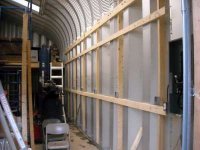
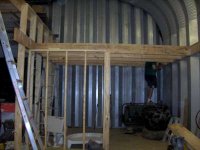
Here is a picture of what it has to go in/on. Need to run from service panel (visible in the very front of pic) up to the 2x8 and down nearly the entire length of shop and across to and down the middle wall separating the higher loft from lower loft (that is the plumbing and electric wall for the bathroom)

Truck
 

Attachments

  • DSCN0692-400.jpg
    DSCN0692-400.jpg
    17.3 KB · Views: 15
  • HPIM3040-400.jpg
    HPIM3040-400.jpg
    15.4 KB · Views: 12
OP
T

truck

Well-known member
Joined
Feb 8, 2008
Messages
203
Location
Manassas, Va
what do you mean by 'that many ground wires" ? Unless you are using metal conduit as the ground, you need one in each conduit.

Only need 1 ground for water heater and 1 for dryer. I was referring to the gnd in each NM cable.

Truck
 
To avoid these ads, REGISTER NOW!
Top Bottom