To avoid these ads, REGISTER NOW!

Electrical Advice needed...

scarpozzi

Well-known member
Joined
Apr 25, 2013
Messages
70
Location
Tennessee
I just got my permit to do the electrical work on my garage project. This is an attached garage. My main panel is 200amp that I've shrunk over the years. I've removed 6 double breakers by switching to gas for my range/water heater and upgrading my hvac system (removed 4 that way)


Question 1.
My garage is far enough from the main panel that I've decided to go ahead and put in a 100 amp sub panel. I priced copper yesterday 2-2-2-4 was much more expensive than I expected. It looks like I'm going to probably end up going with Aluminum to feed the sub. :(

1. This is 2-2-2-4 SEC Aluminum. It is 4 conductors wrapped in a gray plastic....it doesn't look like it's particularly insulated like Romex, but does this need to be run in Conduit if going through the attic or crawlspace? The Lowes guy says it's rated for attic/crawlspace. I've only terminated aluminum outside running direct/bury rated mobile home feed to my boat lift. I'm nervous about aluminum in the house because of oxydation and fire.


Question 2.
I bought these lights: http://www.homedepot.com/p/Lithonia...ture-TZR-2-54T5HO-MVOLT-1-4-GEB10PS/202516724

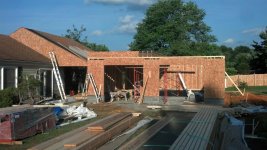
I have 16" I-Joists in my garage ceiling. (see picture)
I can't hang sheetrock until I get the electrical rough in passed....so I can't insulate the garage ceiling until then either. I'm guessing I'll need to run the wire into a ceiling box. I am scratching my head to figure out how to mount one to the I-Joists. They are essentially a split 2x4 in size. Only 2.25 inches or something wide and not all that thick either. Any ceiling boxes with nails would nail into the web(OSB) because of their predetermined angle. I'm almost tempted to run the cable and staple it...then just use an old work box and let it hang through the sheetrock without being connected to the I-Joist. Any advice there?

Question 3.
Outdoor light fixtures that mount on vinyl siding blocks:
http://www.homedepot.com/p/Builders...H=REC-_-product-5-_-100673163-_-100673284-_-N

Do these require a box behind them? The circuit will be GFCI, but I was pretty sure you just punch a small hole for your cable and run it to the block...then stuff the cables in the fixture and let the fixture seal keep the cables protected. I'm just new to this kind of siding/fixture. My last home had a box in the wall and didn't have surface mount as an option-

Thanks-

Scar
 

Attachments

  • 1345.jpg
    1345.jpg
    152.1 KB · Views: 36
To avoid these ads, REGISTER NOW!

Aceman

Well-known member
Joined
Jan 28, 2007
Messages
2,513
Location
Eastern Oregon
1. SER is fine.

2. You don't want a box behind these fixtures. What you need to do is staple the wire to the I joists so it will hang through the sheetrock where the light will go. After sheetrock and paint, you will knock out a hole in the fixture and install a romex connector. Slide the fixture over the wire hanging through the sheetrock and screw the fixture to the I joists. Then wire it up. Make sense?

3. You need a box behind the light. Flourescent strips like your previous question don't need them because they contain all the wiring and splices inside them.

Take a look through these, I haven't used them myself though:

http://www.aifittings.com/catalog/siding-mounting-blocks/
 
Last edited:

theoldwizard1

Well-known member
Joined
Feb 22, 2011
Messages
43,076
Location
SE MI
Question 1.
My garage is far enough from the main panel that I've decided to go ahead and put in a 100 amp sub panel. I priced copper yesterday 2-2-2-4 was much more expensive than I expected. It looks like I'm going to probably end up going with Aluminum to feed the sub. :(
This is 2-2-2-4 SEC Aluminum.
You can't just switch from copper to aluminum without serioulsy downgrading the breaker in the main panel. Your 100A sub panel is fine, but you may have to drop down to 80A or even 60A in the main. What is the total length of the run, panel to panel ?

This is 2-2-2-4 SEC Aluminum. It is 4 conductors wrapped in a gray plastic....it doesn't look like it's particularly insulated like Romex, but does this need to be run in Conduit if going through the attic or crawlspace? The Lowes guy says it's rated for attic/crawlspace. I've only terminated aluminum outside running direct/bury rated mobile home feed to my boat lift. I'm nervous about aluminum in the house because of oxydation and fire.
Properly installed and connected to equipment that is rated for aluminum wire, there is no issue. They do make special anti-oxidation "lube', but I will let the pros comment on the use of that.

MHF is likely cheaper, but requires a conduit when used inside.
 
OP
S

scarpozzi

Well-known member
Joined
Apr 25, 2013
Messages
70
Location
Tennessee
1. This is what they had at Lowes for $1.49 a foot... I couldn't find it on their website, but I was told the mobile home feeder cable that's not wrapped would have to be run in conduit. That's what I needed clarification on...I'd like to avoid dealing with an 80 foot run of conduit with thick cable...
http://www.ebay.com/itm/like/150680263235?lpid=82

2. Makes perfect sense. The only problem is I wanted to pre-wire future growth if I decide to add fixtures. I may have to bite the bullet and just get a few more fixtures and go all out from day 1.

3. My siding distributor has already provided me with the surface mounts. They didn't include boxes and it seems trying to line the box up with a fixture through the surface mount would be a trick. (I'll have to do it 6 times) I've already got 4 of them mounted without boxes behind them, but can put a box in pretty quick.... I just wish there was a website reference on the best way to install the box/mount. I've not been able to find one.
 
OP
S

scarpozzi

Well-known member
Joined
Apr 25, 2013
Messages
70
Location
Tennessee
You can't just switch from copper to aluminum without serioulsy downgrading the breaker in the main panel. Your 100A sub panel is fine, but you may have to drop down to 80A or even 60A in the main. What is the total length of the run, panel to panel ?


Properly installed and connected to equipment that is rated for aluminum wire, there is no issue. They do make special anti-oxidation "lube', but I will let the pros comment on the use of that.

MHF is likely cheaper, but requires a conduit when used inside.

It's probably a total of 60-70 feet counting vertical travel. I rounded up to 80 feet in case I decide to take it through the attic instead of the crawlspace. I've not decided the best path yet.

I don't want to use aluminum indoors at all. The problem is I don't seem to have many options....I priced copper yesterday and they told me it would be $10.49 per foot from an electrical supply place in town. I know you can get it much cheaper than that, but it tells me where I am. There's not enough competition for copper supply here so aluminum may make the most $$ ense.
 

pattenp

Well-known member
Joined
Jun 4, 2008
Messages
10,175
Location
Virginia - USA
Aluminum is fine inside, you're thinking of the old small aluminum that was used for structure circuit wiring. Since this is an attached garage I'm puzzled as to why you are being told to use MHF. You can use aluminum SER inside the house from the main panel to the sub-panel without the use of any conduit as long as the wire is not exposed to possible damage. MHF (Mobile Home Feeder) is a direct bury cable that is commonly used for feeding detached garages where the feed is direct buried or placed below ground in conduit. If the MHF is run inside the structure then it has to be in conduit where inside. When using aluminum use Noalox paste on the wire ends at terminations.
 
Last edited:
OP
S

scarpozzi

Well-known member
Joined
Apr 25, 2013
Messages
70
Location
Tennessee
As stated, 2-2-2-4 Aluminum is only rated at 90amps. I was originally looking at copper, which in some charts I saw stated that it was 100-110amp max.

I may be looking at 1-1-1-3 or 1/0-1/0-1/0-2 to compare with copper instead.
 

gayler

Well-known member
Joined
Sep 22, 2011
Messages
3,272
Location
Lakin Kansas
As stated, 2-2-2-4 Aluminum is only rated at 90amps. I was originally looking at copper, which in some charts I saw stated that it was 100-110amp max.

I may be looking at 1-1-1-3 or 1/0-1/0-1/0-2 to compare with copper instead.

Sorry to hijack, but I'm a little confused. I see in some cases 2-2-2-4 Aluminum rated at 90amp and some at 100amp. Is it 90a in conduit and 100a without? 100amp from disconnect to mail panal and 90amp to a subpanel?
 
Last edited:

pattenp

Well-known member
Joined
Jun 4, 2008
Messages
10,175
Location
Virginia - USA
#2 aluminum when used as a service feed to a dwelling, meaning it provides the dwelling with all power it can be used as a 100A service feed. When #2 aluminum is used as a branch feed/circuit it is limited to 90A (main-panel to sub-panel).

Sorry to hijack, but I'm a little confused. I see in some cases 2-2-2-4 Aluminum rated at 90amp and some at 100amp. Is it 90a in conduit and 100a without? 100amp from disconnect to mail panal and 90amp to a subpanel?
 

pattenp

Well-known member
Joined
Jun 4, 2008
Messages
10,175
Location
Virginia - USA
Being that the run is about 70ft, the 1-1-1-3 will be all you need.

Edit: You do know that because the sub-panel is a 100A doesn't mean you need to use wire that can handle 100A. The size of feeding breaker in the main panel protects the feeder, so with #2 Al you'd use a 90A breaker in the main panel.

As stated, 2-2-2-4 Aluminum is only rated at 90amps. I was originally looking at copper, which in some charts I saw stated that it was 100-110amp max.

I may be looking at 1-1-1-3 or 1/0-1/0-1/0-2 to compare with copper instead.
 
Last edited:

gayler

Well-known member
Joined
Sep 22, 2011
Messages
3,272
Location
Lakin Kansas
#2 aluminum when used as a service feed to a dwelling, meaning it provides the dwelling with all power it can be used as a 100A service feed. When #2 aluminum is used as a branch feed/circuit it is limited to 90A (main-panel to sub-panel).

Cool! Thanks pattenp. I just bought some for my house as the wiring to it now is cobbled together and maybe not sized properly.
 
To avoid these ads, REGISTER NOW!
OP
S

scarpozzi

Well-known member
Joined
Apr 25, 2013
Messages
70
Location
Tennessee
Being that the run is about 70ft, the 1-1-1-3 will be all you need.

Edit: You do know that because the sub-panel is a 100A doesn't mean you need to use wire that can handle 100A. The size of feeding breaker in the main panel protects the feeder, so with #2 Al you'd use a 90A breaker in the main panel.

I just already have a 100amp breaker for the main panel and my sub breaker box came with a 100amp...so I'll have a breaker on both ends even though I know it's not required. I just want to have the control.

I probably won't ever max 100amps. I'm just running a garage, a bed room, media room, and a master bathroom on those circuits.
 

KenC

Well-known member
Joined
Dec 20, 2009
Messages
2,576
You may want to check with your inspector first. In my area no aluminum is allowed inside a structure. Only allowed to be used as a service or between buildings and terminated on the outside wall. They won't even allow it from the panel up to a weatherhead if the pipe is in the wall.
 

2ManyProjects

Well-known member
Joined
Jul 18, 2013
Messages
757
Going to deal with this somewhat "out of order", as there seems to be multiple conflicting issues in play...

I just got my permit to do the electrical work on my garage project. This is an attached garage. My main panel is 200amp that I've shrunk over the years. I've removed 6 double breakers by switching to gas for my range/water heater and upgrading my hvac system (removed 4 that way)

Question 1.
My garage is far enough from the main panel that I've decided to go ahead and put in a 100 amp sub panel.

So far, so good; and I tend to agree that doing the sub-panel would be simpler and easier (and probably cheaper, in the long run) than doing several individual branch circuits.

I priced copper yesterday 2-2-2-4 was much more expensive than I expected. It looks like I'm going to probably end up going with Aluminum to feed the sub. :(

Not so fast...

1. This is what they had at Lowes for $1.49 a foot... I couldn't find it on their website, but I was told the mobile home feeder cable that's not wrapped would have to be run in conduit. That's what I needed clarification on...I'd like to avoid dealing with an 80 foot run of conduit with thick cable...
http://www.ebay.com/itm/like/150680263235?lpid=82

First, don't buy off eBay, for all sorts of reasons I don't need to belabor here.

Second, as "theoldwizard1" alluded to, if you really need 2-2-2-4 in copper, then 2-2-2-4 will NOT be adequate in aluminum. So you are comparing apples to oranges here.

It's probably a total of 60-70 feet counting vertical travel. I rounded up to 80 feet in case I decide to take it through the attic instead of the crawlspace. I've not decided the best path yet.

I don't want to use aluminum indoors at all. The problem is I don't seem to have many options....I priced copper yesterday and they told me it would be $10.49 per foot from an electrical supply place in town. I know you can get it much cheaper than that, but it tells me where I am. There's not enough competition for copper supply here so aluminum may make the most $$ ense.

That's not only way high; it's overkill.

First, 2-2-2-4 Copper SER can be had for FAR less. For example, this outfit:

http://www.wesbellwireandcable.com/SER-SEU/SER2.html

is offering it for $8.30/foot, INCLUDING delivery to your door.

But the thing is, you near-certainly do NOT need 2-2-2-4 Copper. For ~100A service to the sub-panel, 3-3-3-5:

http://www.wesbellwireandcable.com/SER-SEU/SER3.html

would surely be adequate, at less than $7.00/foot (again, delivered).

And depending on your LOCAL codes, you MIGHT even be able to use 4-4-4-6:

http://www.wesbellwireandcable.com/SER-SEU/SER4.html

which would bring the cost down to $5.30/foot -- i.e., HALF of what you were quoted from that local supply house.

1. This is 2-2-2-4 SEC Aluminum. It is 4 conductors wrapped in a gray plastic....it doesn't look like it's particularly insulated like Romex, but does this need to be run in Conduit if going through the attic or crawlspace? The Lowes guy says it's rated for attic/crawlspace. I've only terminated aluminum outside running direct/bury rated mobile home feed to my boat lift. I'm nervous about aluminum in the house because of oxydation and fire.

I won't fault you for preferring copper. But as others have noted, there HAVE been some improvements made since the days when aluminum wiring got its (well deserved) rotten reputation; and SER is not at all the same thing as NM-B. Has aluminum improved "enough" to make those concerns completely moot? Opinions vary on that one.

However, if you do go to aluminum, then you do indeed need (at least) 2-2-2-4; and even that would need to be protected by a 90A (NOT 100A) breaker at the main panel. Granted, this would likely be your least expensive alternative, even after figuring in the need to buy another breaker; but the choice is yours. Is the "peace of mind" factor that copper would give you worth an extra couple hundred bucks?


That's unfortunate.

First, as has been belabored here countless times, going with twin-tube four-foot fixtures would give you MUCH more flexibility in terms of both fixture placement and switching.

Second, from the picture you posted, it appears that you're going to have a more-or-less standard (for residential garages) 9-10 foot ceiling. Given that, those T5-HO lamps are near-certainly going to concentrate too much light into too few places, leading to uneven "spotty" illumination. In such situations, standard F32T8s are nearly always the best choice.

2. Makes perfect sense. The only problem is I wanted to pre-wire future growth if I decide to add fixtures. I may have to bite the bullet and just get a few more fixtures and go all out from day 1.

Better to do it all at once, and do it RIGHT. This would also let you implement the switching in the most ideal manner possible.

If you have not as yet opened the boxes, perhaps they are still returnable?

I have 16" I-Joists in my garage ceiling. (see picture)
I can't hang sheetrock until I get the electrical rough in passed....so I can't insulate the garage ceiling until then either. I'm guessing I'll need to run the wire into a ceiling box. I am scratching my head to figure out how to mount one to the I-Joists. They are essentially a split 2x4 in size. Only 2.25 inches or something wide and not all that thick either. Any ceiling boxes with nails would nail into the web(OSB) because of their predetermined angle. I'm almost tempted to run the cable and staple it...then just use an old work box and let it hang through the sheetrock without being connected to the I-Joist. Any advice there?

As others have noted, with at least most surface-mount fluorescent fixtures, you don't need a separate junction box. The metal chassis of the fixture itself can serve as the junction box, as long as all connections are made WITHIN that chassis. The fixtures themselves can be screwed into the bottom part of your I-joists (through an intervening layer of drywall, if need be).


1. You want mobile home feeder cable, not SER cable like you're thinking of.
MHF is likely cheaper, but requires a conduit when used inside.
Aluminum is fine inside, you're thinking of the old small aluminum that was used for structure circuit wiring. Since this is an attached garage I'm puzzled as to why you are being told to use MHF. You can use aluminum SER inside the house from the main panel to the sub-panel without the use of any conduit as long as the wire is not exposed to possible damage. MHF (Mobile Home Feeder) is a direct bury cable that is commonly used for feeding detached garages where the feed is direct buried or placed below ground in conduit. If the MHF is run inside the structure then it has to be in conduit where inside.

There seems to be some confusion/disagreement on this point; and I, for one, would like to see more discussion of this, hopefully leading to a definitive answer. For example, what exactly constitutes "not exposed to possible damage"?


As stated, 2-2-2-4 Aluminum is only rated at 90amps. I was originally looking at copper, which in some charts I saw stated that it was 100-110amp max.

Is that (relatively small) difference going to be critical for you? Just what sort of equipment/tools are you planning to run in there? And perhaps more importantly, by how many people at the same time? If this is really a "one man shop", you will be hard pressed to need more than 90 Amps.

I just already have a 100amp breaker for the main panel and my sub breaker box came with a 100amp...so I'll have a breaker on both ends even though I know it's not required. I just want to have the control.

Those two breakers serve two different purposes. As "pattenp" pointed out, it's the one in the main panel which must be sized to protect the feeder wire. The one in the sub-panel acts solely as the local disconnect (which is required if you will ever have more than six branch-circuit breakers in the sub-panel, and is a good idea regardless).

I probably won't ever max 100amps. I'm just running a garage, a bed room, media room, and a master bathroom on those circuits.

Whoa, Nellie!

Why are you running non-garage loads off the garage sub-panel? While that might be "legal", I would not recommend it. Your main panel should be MORE than adequate to handle all the loads in the house itself; and if it isn't, you need to upgrade THAT.


You may want to check with your inspector first. In my area no aluminum is allowed inside a structure. Only allowed to be used as a service or between buildings and terminated on the outside wall. They won't even allow it from the panel up to a weatherhead if the pipe is in the wall.

That, too.


theoldwizard1

Well-known member
Joined
Feb 22, 2011
Messages
43,076
Location
SE MI
#2 aluminum when used as a service feed to a dwelling, meaning it provides the dwelling with all power it can be used as a 100A service feed. When #2 aluminum is used as a branch feed/circuit it is limited to 90A (main-panel to sub-panel).

It may be further limited by the length of the run.
 

theoldwizard1

Well-known member
Joined
Feb 22, 2011
Messages
43,076
Location
SE MI
There seems to be some confusion/disagreement on this point; and I, for one, would like to see more discussion of this, hopefully leading to a definitive answer. For example, what exactly constitutes "not exposed to possible damage"?
Cable rated for direct burial should have a conduit where it transitions from underground to above ground out side of the building, where is may be contacted by "equipment" (lawn mower, string trimmer, etc), it should be inside of a Schedule 80 conduit from the pulling elbow entering the building down to the bottom of the trench. Not sure if it is a code requirement, but I would use a sweep at the bottom of the trench to transition from vertical to horizontal.
 
Last edited:

pattenp

Well-known member
Joined
Jun 4, 2008
Messages
10,175
Location
Virginia - USA
SER is not rated for direct bury. Period. It can't even be placed underground in conduit.

Most SER cable is rated for direct burial and does not require conduit inside of a building. However, if the transition from underground to above ground is out side of the building, where is may be contacted by "equipment" (lawn mower, string trimmer, etc), it should be inside of a Schedule 80 conduit from the pulling elbow entering the building down to the bottom of the trench. Not sure if it is a code requirement, but I would use a sweep at the bottom of the trench to transition from vertical to horizontal.
[/QUOTE]
 
Last edited:

pitterpat

Well-known member
Joined
Jun 30, 2011
Messages
686
Location
Indianapolis
1. .I'd like to avoid dealing with an 80 foot run of conduit with thick cable...
http://www.ebay.com/itm/like/150680263235?lpid=82

That won't kill you....lol, I did it last year. Rented a trencher, trenched and back filled it too! 80 ft.... You could look for somebody on CL that has a trencher and will do it, probably abt $150.

I think I did 2-2-2-6, multi strand...can't remember. My HVAC buddy hooked it up for me, I was the helper for the day.
 
Last edited:

wyliesdiesels

Well-known member
Joined
Aug 14, 2012
Messages
19,983
Location
Modesto, CA
That won't kill you....lol, I did it last year. Rented a trencher, trenched and back filled it too! 80 ft.... You could look for somebody on CL that has a trencher and will do it, probably abt $150.

I think I did 2-2-2-6, multi strand...can't remember. My HVAC buddy hooked it up for me, I was the helper for the day.

The OPs garage is attached so trenching doesnt apply.
 
To avoid these ads, REGISTER NOW!
Top Bottom