To avoid these ads, REGISTER NOW!

electrical feed question

Kapt

Well-known member
Joined
Jul 24, 2005
Messages
168
Location
Maryland
I'm getting ready to apply for my electrical permit and wanted to run a few ideas off the board first.

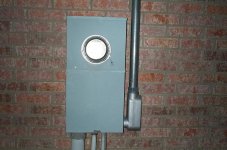
I plan on running service from my house utility meter to my detached garage using three #3 copper wires to a 100a panel. My house meter enclosure will be replaced by a 200a double lug meter enclosure with 100a going to my house and 100a going to the garage. I know that 100a in my house sounds lite, but every major appliance runs from natural gas and its been fine for the past 10 years.

Because my garage panel is now considered a main panel and there are no continuous metal pathways between the structures, I'm allowed to run only 3 wires with no gnd and the neutral and gnd bus bars should be bonded. Also, I will add gnd rods. Does this sound reasonable?

And do I need two gnd rods, or is one sufficient for the garage setup?
 
To avoid these ads, REGISTER NOW!

PAToyota

Well-known member
Joined
Jan 20, 2006
Messages
4,366
Location
South Central Pennsylvania, USA
Two rods is always preferable. Wire size depends somewhat on length of run.

I'm not sure if a double lug 200a meter base exists? I had to use a C320 meter base to get double lugs.
 

67 455 Bird ragtop

Well-known member
Joined
Jan 2, 2006
Messages
330
Location
Melbourne, FL
Might want to double check your wire size. Most charts I read say to use #2 for 100 amps but there may be others that do say #3 is ok. As for a gnd rod I am only using one for my 100 amp setup.
 

67fairlaner

Member
Joined
Mar 8, 2006
Messages
23
Location
Carleton, Mi
They will let you know on the three wire run when you apply for your permit, but if your community is using 2008 NEC rules, 4 wire is required. I would run it anyway, as there is no labor difference, & just a slight cost difference. You will need it if you ever add anything metallic from the house like a phone line or gas line. Remember if you do run 4 to keep your neutral & ground seperate in the sub. Also the 2008 rules no require everything in the garage to be GFI protected including lights & openers. Hopefully your jurisdiction isn't requiring the new code yet.
 

johansonp

Member
Joined
Jan 3, 2008
Messages
9
I understood you to mean that the garage panel is not fed from the house panel. They are both fed directly from the meter, correct?

The garage panel is then considered service equipment and the grounding equipment conductors, the grounded service conductor, and the panel must all be bonded together in the panel enclosure. A single ground rod, or more as you wish, will also be required, and its' grounding electrode conductor must also be bonded to the grounding equipment conductors, the grounded service conductor, and the panel.

Instead of multiple ground rods, you may wish to consider a ground ring.

Phone or gas feeds to the garage will be bonded to the grounding electrode conductor at the garage, and most locations require a certain amount of the grounding electrode conductor to be left exposed for this purpose.

Sometimes the local inspector wants the top of the ground rod left exposed, sometimes they want it driven below ground level. Ask him/her what is customary where you live.

PM me if you need specifics on the bonding/grounding arrangement.

Paul
 
OP
K

Kapt

Well-known member
Joined
Jul 24, 2005
Messages
168
Location
Maryland
I understood you to mean that the garage panel is not fed from the house panel. They are both fed directly from the meter, correct?

The garage panel is then considered service equipment and the grounding equipment conductors, the grounded service conductor, and the panel must all be bonded together in the panel enclosure. A single ground rod, or more as you wish, will also be required, and its' grounding electrode conductor must also be bonded to the grounding equipment conductors, the grounded service conductor, and the panel.

Instead of multiple ground rods, you may wish to consider a ground ring.

Phone or gas feeds to the garage will be bonded to the grounding electrode conductor at the garage, and most locations require a certain amount of the grounding electrode conductor to be left exposed for this purpose.

Sometimes the local inspector wants the top of the ground rod left exposed, sometimes they want it driven below ground level. Ask him/her what is customary where you live.

PM me if you need specifics on the bonding/grounding arrangement.

Paul

Yes, they are both fed from the meter. And if I understand you correctly, the neutral bar and grounding bar and equipment grounding conductor and panel must all be bonded together in the new 100a panel.

If I run a fourth wire as some of the others suggest, does that change any of the bonding requirements? The way I interpret it is that if I later add a continuous metal pathway at a future time, then the neutral and ground bus bars are no longer bonded.
 

Charles (in GA)

Well-known member
Joined
Jan 11, 2006
Messages
12,489
Location
50 mi south of Atlanta
Local inspection may require you to have dual disconnects at the meter. If that happens, the disconnects become the service and you must (with certain limited exceptions) have the four wire to the panel in the house and garage. It only makes sense to run the four wire, also makes sense to have a disconnect at the meter.

Charles
 

johansonp

Member
Joined
Jan 3, 2008
Messages
9
Local inspection may require you to have dual disconnects at the meter. If that happens, the disconnects become the service and you must (with certain limited exceptions) have the four wire to the panel in the house and garage. It only makes sense to run the four wire, also makes sense to have a disconnect at the meter.

Charles

You know Charles, I was thinking about that on the way home last night. If I were doing it I would probably install two service disconnect switches at the meter, or even bump the service up to 200A, put a new panel outside, and feed the garage from it.

Kapt, if you do that, you would be required to isolate the neutral from the panel enclosure in the house panel and move the branch circuit neutrals to the new isolated neutral bus. Like Charles said, you would end up running a new four wire feed to the panel in the house.

I've seen a lot of installations where that wasn't done, and the inspector still passed the job, probably because it can be such a pain to get new feeders to the old panel. This usually comes up when a larger service is installed and the panel in the house becomes a sub panel of the new one outside. Nonetheless, it's the right way to do it.

The NEC stipulates that the service equipment be located as close as practical to the point where the service entrance conductors enter the building, not necessarily as close to the meter as possible. They may let you slide.

Another option would be to have the power company put a new service drop right at the garage, w/ a second meter.

Future metal raceways would not change the bonding/grounding scheme.

Sounds like a fun project. Good luck!

Paul
 

aarcuda

Well-known member
Joined
Jan 31, 2006
Messages
128
Location
arkansas
Please tell me WHERE are you getting the 200A double lug meter at? I cant find one anywhere but I want to do the exact same thing as you.
 
To avoid these ads, REGISTER NOW!
OP
K

Kapt

Well-known member
Joined
Jul 24, 2005
Messages
168
Location
Maryland
Please tell me WHERE are you getting the 200A double lug meter at? I cant find one anywhere but I want to do the exact same thing as you.

I haven't looked for one yet. I'll try tomorrow and let you know what I find.
 

cw_racefan

Well-known member
Joined
Feb 7, 2006
Messages
254
Kapt - I see you're in MD, who's your POCO? If it's BGE, they provide the meter base and meter, so you're stuck with whatever they have. They have a "metering manual" or something like that online that shows the different types of meters.

Craig
 

Bib Overalls

Well-known member
Joined
Dec 4, 2006
Messages
3,318
Location
Jonesboro, Arkansas
When we built our house eight years ago we used a 200 amp Malard brand meter base. It has four circuit braker spaces in the unit in addition to two lugs to feed the house service panel.

I am using 2 spaces to run 70 amp 220 to a sub panel in my shop and one for 30 amps to our pool pump. The fouth space is reserved for the griveway lighting that my wife talks about every now and then and I keep forgetting to remember.

70 amps is more than enough for my shop. Mostly lights and utility circuits. I have one 20 amp 220 circuit for the compressor and a 50 amp 220 welder outlet that never gets used. No problems so far.
 

Attachments

  • MeterBase1.jpg
    MeterBase1.jpg
    43.8 KB · Views: 9
  • MeterBase2.jpg
    MeterBase2.jpg
    37.1 KB · Views: 11
OP
K

Kapt

Well-known member
Joined
Jul 24, 2005
Messages
168
Location
Maryland
I gave up on the double lug meter idea. I had three electricians give me estimates for my garage and not one had heard of a double lug meter for residential use in my area. Instead, I decided to upgrade my house to 200amps and run a 100 amp subpanel to the garage.

I finished the new panel in my house yesterday and got the inspection done this morning. I had to take a "heavy-up" test at the permitting office before they gave me my permit. It was an open book (NEC 2002) twenty question test.

I dug the trench to the garage, so maybe by next week I'll have power to the garage.
 
OP
K

Kapt

Well-known member
Joined
Jul 24, 2005
Messages
168
Location
Maryland
Here are some before and after pics.

electricpanel001.jpg


electricpanel006.jpg
 
To avoid these ads, REGISTER NOW!
Top Bottom