To avoid these ads, REGISTER NOW!

Electrical neutral bonding question

toyotadriver

Well-known member
Joined
Dec 30, 2010
Messages
1,586
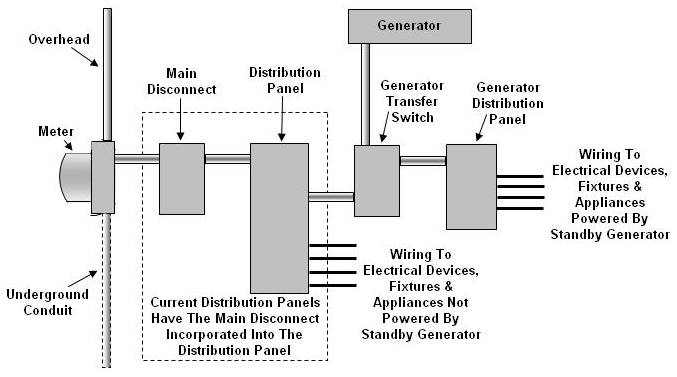
I recently put a 100 amp panel in my shop building (new build). The panel will be fed from a 3 wire (2 hot and 1 neutral) lines. The power will run from the service entrance, then to a 200 amp generator transfer switch, then at the transfer switch we will send power to the house (when it's built) as well as routing power to the shop panel.

The neutral and the ground are not bonded together (but there is a screw in the kit to bond them together through the panel case).

My understanding is that since the service entrance is grounded, that the shop panel must also be bonded to the neutral in the panel because there is not a 4th wire carrying the ground back to the service entrance.

I am running a 30 amp circuit (10/3 wire) and a 50 amp circuit (8/3 wire) so all the 220 volt circuits will be wired with a separate ground. Around here, a lot of builders still build with just 2 hot lines and 1 neutral in 220 volt circuits. The price difference between wire with a ground and without a ground isn't much so I'm going with 4 wires for each 220 volt circuits.

Am I right?
 
To avoid these ads, REGISTER NOW!

mrb

Well-known member
Joined
Dec 31, 2008
Messages
3,734
where are you located and what code cycle are you on? Cant use 8ga romex for 50 amps.

can you post a diagram of what you propose? Im having a little trouble wrapping my head around it.

Is this correct?
-you have a service somewhere.
-from this service you are supplying a 200 amp generator transfer switch
-from the load side of the transfer switch, you are running a 100 amp feeder to a shop
-in the future you will run another feeder from the load side of the transfer switch to a house.

if the neutral is bonded at the service everything downstream from there has to be 4 wire. this doesnt really have anything to do with how you run your 240v branch circuits (and i dont see any reason to install 4 wire 240v branch circuits in a shop. show me one piece of shop equipment that is 50 amps @ 240v and needs a neutral....)
 

sberry

Banned
Joined
Jun 18, 2005
Messages
35,747
Location
Brethren, Michigan
You need 4 wires from panel to panel.
My understanding is that since the service entrance is grounded, that the shop panel must also be bonded to the neutral in the panel because there is not a 4th wire carrying the ground back to the service entrance
While this is true and could be acceptable under certain circumstances in todays world its not a good idea and new codes have done away with it.
 

Falcon67

Well-known member
Joined
Jun 11, 2009
Messages
18,371
Location
Merkel, TX
My old shop was done 3 wire, bonded at the shop. If I get the new 2008 NEC right, you need 4 from your service entrance to the shop panel, with the shop panel unbonded.

All my 220 shop equipment takes two wires with a ground, no neutral required. Compressor, mill, etc. A welder might need a neutral - you'd have to refer to the welder manual. Equipment only needs a neutral if it needs to break out 110V power internally - like a dryer with a 220V heating element and 110V controls. Or 240, 120 - re: Can we stop calling it 220 thread. ;)
 
OP
T

toyotadriver

Well-known member
Joined
Dec 30, 2010
Messages
1,586
where are you located and what code cycle are you on? Cant use 8ga romex for 50 amps.

can you post a diagram of what you propose? Im having a little trouble wrapping my head around it.

Is this correct?
-you have a service somewhere.
-from this service you are supplying a 200 amp generator transfer switch
-from the load side of the transfer switch, you are running a 100 amp feeder to a shop
-in the future you will run another feeder from the load side of the transfer switch to a house.

if the neutral is bonded at the service everything downstream from there has to be 4 wire. this doesnt really have anything to do with how you run your 240v branch circuits (and i dont see any reason to install 4 wire 240v branch circuits in a shop. show me one piece of shop equipment that is 50 amps @ 240v and needs a neutral....)


Your statement is correct.

Believe it or not, codes don't apply to where I'm building. There are no permits needed and will be no inspections. I can wire it all messed up and it's legal and even if I burn it down due to stupidity, there isn't a problem. I am asking because I want it to be right in spite of the lack of codes.

My current house (built in 2008) has 3 wire service entrance. It also uses 3 wire 220 throughout (ok 240 if the term 220 upsets anyone!!). The next house will have 4 wire 220 service.

Seems to depend on what you look up but the charts that I've seen specs 8 ga for up to 50 amps. My run is only 6 feet from the breaker box.

I plan to run a 220 stick welder off the 50 amp circuit (only occasionally).

The generator transfer switch will bond the neutral and the ground.
 
OP
T

toyotadriver

Well-known member
Joined
Dec 30, 2010
Messages
1,586
You need 4 wires from panel to panel. While this is true and could be acceptable under certain circumstances in todays world its not a good idea and new codes have done away with it.


So if I understand, you can have 3 wires feeding the house and a separate ground. The service entrance will be bonded at the entrance and then 4 wires are needed to everything after the service entrance and neither the house panel or the shop panel will be bonded.

Correct?

I don't think I've seen 4 wire 200 amp rated wire. Everything at the local supply places is 3 wire. Would I have to run a 4th ground wire? If so, what gauge?
 

mrb

Well-known member
Joined
Dec 31, 2008
Messages
3,734
hm i guess missouri is one of those states with no statewide code adoption and its left up to individual municipalities.

whatever you do and however you do it, make sure you have a return path for fault current. That is the purpose of the ground. For example if you had a 3 wire feeder, ground rod at the subpanel, and neutral and ground not bonded in the subpanel, this would be very dangerous because if you had a short circuit the breaker would not trip.
 
To avoid these ads, REGISTER NOW!

Aceman

Well-known member
Joined
Jan 28, 2007
Messages
2,513
Location
Eastern Oregon
Seems confusing, I guess I need to see a one line diagram. It seems like there are going to be 2 houses, one generator and one shop.

Can you draw something up or maybe write it in a way that's easier to follow? If you write it up, start at where utility power comes in and show where it goes from there.

Something like this:

Utility--->House #1--->Generator--->Shop

Second house goes where...?
 
OP
T

toyotadriver

Well-known member
Joined
Dec 30, 2010
Messages
1,586
Seems confusing, I guess I need to see a one line diagram. It seems like there are going to be 2 houses, one generator and one shop.

Can you draw something up or maybe write it in a way that's easier to follow? If you write it up, start at where utility power comes in and show where it goes from there.

Something like this:

Utility--->House #1--->Generator--->Shop

Second house goes where...?


Not sure where you come up with 2 houses.

Plan is:

Pole-Meter/service entrance on shop 200 amp service-200 amp generator transfer switch-100 amp shop panel-200 amp house panel


The power will flow through the shop building and into the house using wire encased in conduit. At the generator transfer switch, we'll tap off a line to feed the shop.
 
Last edited:
OP
T

toyotadriver

Well-known member
Joined
Dec 30, 2010
Messages
1,586
hm i guess missouri is one of those states with no statewide code adoption and its left up to individual municipalities.

whatever you do and however you do it, make sure you have a return path for fault current. That is the purpose of the ground. For example if you had a 3 wire feeder, ground rod at the subpanel, and neutral and ground not bonded in the subpanel, this would be very dangerous because if you had a short circuit the breaker would not trip.


Ok so as I understand it, I can run 3 wire service entrance but the panels (house and shop panel) MUST be bonded. If I run 4 wire entrance, I do NOT bond at the panels but DO bond at the service entrance.

Correct?? Incorrect?

If I am understanding this correctly, I am better spending the extra money for 4 wires to feed the house and shop.

I'm all about making the wiring the best I can so I have no problem spending a little more for an extra ground wire.

Thanks for the help.
 

gnxtc2

Well-known member
Joined
Sep 3, 2010
Messages
304
Location
New york
Line diagram

electrical%20service%202%20cr.jpg


Billy T.
[email protected]
 

Gooch

Well-known member
Joined
May 30, 2009
Messages
676
Location
Petersberg, IA
Ok so as I understand it, I can run 3 wire service entrance but the panels (house and shop panel) MUST be bonded. If I run 4 wire entrance, I do NOT bond at the panels but DO bond at the service entrance.

Correct?? Incorrect?

If I am understanding this correctly, I am better spending the extra money for 4 wires to feed the house and shop.

I'm all about making the wiring the best I can so I have no problem spending a little more for an extra ground wire.

Thanks for the help.


you need 4 wires, anything after the main panel for the service needs to be fed with 4 wires. leave the shop panel unbonded(keep the neutral and ground seperate), then you need to also ground to the structural steel or metal underground water pipe, if neither are present, then you need to drive ground rods.
 
OP
T

toyotadriver

Well-known member
Joined
Dec 30, 2010
Messages
1,586
you need 4 wires, anything after the main panel for the service needs to be fed with 4 wires. leave the shop panel unbonded(keep the neutral and ground seperate), then you need to also ground to the structural steel or metal underground water pipe, if neither are present, then you need to drive ground rods.


Thank you. I'll run 4 wires to the shop and the house (when we build it). I'll keep the panels unbonded.

The neutral and ground are bonded at the service entrance right?

I'll have to drive ground rods. But, that's not a big deal. Local utility requires 1. I'll drive 2.
 
To avoid these ads, REGISTER NOW!
Top Bottom