
You are using an out of date browser. It may not display this or other websites correctly.
You should upgrade or use an alternative browser.
You should upgrade or use an alternative browser.
Electrical - Receptacles
- Thread starter hrockwell
- Start date
dsgreen3
Well-known member
I was told ground up so if the plug is not seated in all the way you wouldn't have to worry about something falling across the hot and neutral.
sberry
Banned
I will go for this. Its because the guy installed them that way or someone wanted it that way,,,,,,,,,, and I have had something like this nearly happen. The thought is a loose metal cover plate will fall off or something metal coming between the plug and recept will hit the ground pin first. This is the thinking.
From another angle I seem to like them up as I think its a smoother yank when the cord gets pulled out, you see lots of ground pins missing on cords, the get pulled out with it down and it tends to break the pin off.
From another angle I seem to like them up as I think its a smoother yank when the cord gets pulled out, you see lots of ground pins missing on cords, the get pulled out with it down and it tends to break the pin off.
readhead
Well-known member
I have heard the shorting thing for years and I don't disagree. When I did hospital work the ground up was specified. I think it is more of a regional thing.
brycez28
Well-known member
I know in Wisconsin, all new electrical work requires ground up as well (including residential).
code here is ground pin down (I was told the reason ) so it's the last to disconnect if the plug falls out of the wall
however, I do know of a fire that resulted from metal stair nosings sitting on top of a bar fridge, one fell off the fridge and fell onto the plug & outlet, it was not seated 100% and the short caused paneling to catch fire. a 150grand fire resulted. I like the ground pin up for that reason.
however, I do know of a fire that resulted from metal stair nosings sitting on top of a bar fridge, one fell off the fridge and fell onto the plug & outlet, it was not seated 100% and the short caused paneling to catch fire. a 150grand fire resulted. I like the ground pin up for that reason.
JettaGetUpandGo
Well-known member
I know in Wisconsin, all new electrical work requires ground up as well (including residential).
Do you have a source for this? I work for a residential builder in Wisconsin. All of our outlets are installed ground down and we haven't had issues with electrical inspectors. There's nothing in the NEC that I could find either. Maybe it's a municipality requirement?
I don't understand why there is a difference between residential and commercial. If there is an increased risk of shorting, then it should be ground up across the board. Metal boxes are more common in commercial, but the boxes are grounded as well.
brycez28
Well-known member
Do you have a source for this? I work for a residential builder in Wisconsin. All of our outlets are installed ground down and we haven't had issues with electrical inspectors. There's nothing in the NEC that I could find either. Maybe it's a municipality requirement?
I don't understand why there is a difference between residential and commercial. If there is an increased risk of shorting, then it should be ground up across the board. Metal boxes are more common in commercial, but the boxes are grounded as well.
This is what I was told by several electricians....but like you, in my search their wasn't any code specifying one way or another. I stand corrected.
58Yeoman
Well-known member
This very question is in this months Family Handyman mag. It says that the NEC doesn't specify either way, so both would be correct. It says that the ground is usually up in Canada and usually down in the US. I like mine on the bottom, but this house I bought in '08 has them both ways. I guess he couldn't decide either way.
LS6 Tommy
Well-known member
No NEC spec for either way. It's all about preference. That being said, 99.9% of all molded "flat" plugs, wall warts, portable power tool GFCI cables and the like that I have ever seen are designed to have the ground pin at the bottom and I have never seen a single receptacle that has any wording on it (except for GFCI recepts, they're labeled both ways), printed on a sticker or molded in, that wouldn't be upside down if installed with the ground on top. Not that that would make it a "requirement".
Tommy
Tommy
Last edited:
the gypsy
Well-known member
I agree with the ground up on any room not in a basement because of the falling across the hot and neutral. But I can also imagine the ground down in a basement which has a tendency for flooding. So here I am sitting on the fence not sure which is right.
the gypsy
Well-known member
Just a quick comment, what if wall outlets were recessed like clock outlets ? It would negate the debate or the difference of opinion.
Stuart in MN
Well-known member
This topic comes up here on just about a monthly basis, and people argue the same points over and over, but there is no code that says it has to be one way or the other. You can install them sideways if you want.
OJ Bartley
Well-known member
This very question is in this months Family Handyman mag. It says that the NEC doesn't specify either way, so both would be correct. It says that the ground is usually up in Canada and usually down in the US. I like mine on the bottom, but this house I bought in '08 has them both ways. I guess he couldn't decide either way.
That's strange, I don't recall ever seeing ground-up plugs here, in either commercial or residential applications.
I'd also be concerned about heavy wall-wart plugs having the bulk of their case up above the plug being more likely to fall out.
This topic comes up here on just about a monthly basis, and people argue the same points over and over, but there is no code that says it has to be one way or the other. You can install them sideways if you want.
LOL - that might be the safest way. If a basement flooded, the ground would be second to be hit by rising water. If an object fell on a partially detached plug, it would probably break a prong or pull the plug out of the wall before connecting to the other prong (in which case it would hit the ground first). It also wouldn't matter if they were left hung or right hung since the ground would always be in the middle.
My vote is for this!

Falcon67
Well-known member
Last shop I did the ground up thing. Big PITA mostly. This shop I did it like the house, pin down. Whats the diff between a thing shorting hot-neutral and a thing landing on the pin, then falling one way and shorting across hot to gnd. Or an ice chunk from the ******* on an 747 landing in the pool. Or the dog ************* on the car shorting out the battery charger tripping the breaker with a loud POP scaring the dog who takes off knocking over a gas can causing a fire when the fumes get to the floor fan. Damn dog.

Mustang51js
Well-known member
Let's ban metal plate covers
zmaxmotorsports
Well-known member
Life is too short to worry about such trivial stuff.I use 4sq boxes with plaster rings mounted sideways just to be different!
checkthisout
Well-known member
- Joined
- Sep 5, 2008
- Messages
- 5,232
Maybe 5% of **** you plug into any plug has a grounding prong.
Box Fan, Upright vacuum cleaner, hairdryer, toaster, hot water kettle, crockpot, coffee grinder, table lamp, TV, DVD, Nintendo, Phone Charger, laptop charger, Circular saw, drill. None of them have 3 wire plugs.
So that leaves lets see...the Vitamix, stand mixer, built-in microwave and toaster oven oh...and the powerstrip....those have 3 wire plugs so in that case if something conductive fell on the top of a partially unplugged cord in that situation it might prevent an accident?
Box Fan, Upright vacuum cleaner, hairdryer, toaster, hot water kettle, crockpot, coffee grinder, table lamp, TV, DVD, Nintendo, Phone Charger, laptop charger, Circular saw, drill. None of them have 3 wire plugs.
So that leaves lets see...the Vitamix, stand mixer, built-in microwave and toaster oven oh...and the powerstrip....those have 3 wire plugs so in that case if something conductive fell on the top of a partially unplugged cord in that situation it might prevent an accident?
gregtwojeeps
Well-known member
A true story follows that may give the readers questioning the reasoning as to why commercial/medical institutions will be seen mostly with their receptacle's ground pin socket mounted "up"....
Back in 1988 when I started to work at a large hospital as their only maintenance electrician, one of my first beeper pages was, " Maintenance to Room 403 Stat" . After I checked in at the nurse's station on the call I went in to the vacated patient room. A quick look told the story about the "sparks" being reported in a patient's room wall outlet.....
The Hillrom wall mount head board light had a pull canopy switch in it with a long metal 1/8 in. metal ball chain draped down so the patient could pull it. The patient's IV pump was plugged in to a wall receptacle that had been installed with it's ground pin down. Some eyeballing quickly showed hot spot welds damage to the light's metal chain and the IV pump's cord male plugcap blades. ..
The receptacle has been installed as a replacement unit with its ground pin down by some one in the general maintenance staff. To that day, it was the only receptacle in a patient's room or clinical room ....that I had seen installed with it's ground pin socket down. ..
So, two known issues presented a hazardous situation for the patient that had been relocated. The first being someone replaced a broken factory nylon cord pull chain fixture canopy switch cord....with a metal bead chain. Second, the hospital grade receptacle had been installed contrary to the whole facilities norm of "ground pin up" thus allowing the ball chain to drop down and coil up on top of the IV pump's exposed plugcap blades.... that had either been pulled loose slightly by a foot caught in the cord OR it never was pushed in to the wall receptacle firmly by the IV pump attendant. ..
Luckily no harm was done to the patient or facility by the spotwelds. As I settled in to my new job and helped my department head set up my own computer generated electrical dept. work order/PM program... receptacle integrity and being sure that all over bed light pull cords were built of non-conductive material... I made sure were in my top 10 preventive maintenance criteria check list.
Back in 1988 when I started to work at a large hospital as their only maintenance electrician, one of my first beeper pages was, " Maintenance to Room 403 Stat" . After I checked in at the nurse's station on the call I went in to the vacated patient room. A quick look told the story about the "sparks" being reported in a patient's room wall outlet.....
The Hillrom wall mount head board light had a pull canopy switch in it with a long metal 1/8 in. metal ball chain draped down so the patient could pull it. The patient's IV pump was plugged in to a wall receptacle that had been installed with it's ground pin down. Some eyeballing quickly showed hot spot welds damage to the light's metal chain and the IV pump's cord male plugcap blades. ..
The receptacle has been installed as a replacement unit with its ground pin down by some one in the general maintenance staff. To that day, it was the only receptacle in a patient's room or clinical room ....that I had seen installed with it's ground pin socket down. ..
So, two known issues presented a hazardous situation for the patient that had been relocated. The first being someone replaced a broken factory nylon cord pull chain fixture canopy switch cord....with a metal bead chain. Second, the hospital grade receptacle had been installed contrary to the whole facilities norm of "ground pin up" thus allowing the ball chain to drop down and coil up on top of the IV pump's exposed plugcap blades.... that had either been pulled loose slightly by a foot caught in the cord OR it never was pushed in to the wall receptacle firmly by the IV pump attendant. ..
Luckily no harm was done to the patient or facility by the spotwelds. As I settled in to my new job and helped my department head set up my own computer generated electrical dept. work order/PM program... receptacle integrity and being sure that all over bed light pull cords were built of non-conductive material... I made sure were in my top 10 preventive maintenance criteria check list.

JettaGetUpandGo
Well-known member
This happened to me. Tape slipped down the wall and hit a plug that was not quite plugged in all the way. Breaker tripped, and I went shopping for a new tape. Also replaced the receptacle and plate.
And changed my shorts!
The tape is still fine! (as long as you don't need to measure anything between 9" and 10 1/2"

Alchymist
Well-known member
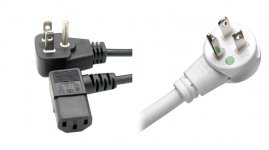
I prefer ground pin up, but it's a pain with this type plug:
This. ^^^
Angled plugs in a "ground pin UP" receptacle are a pain. That's enough for most people to want the pins down.
CD
This. ^^^
Angled plugs in a "ground pin UP" receptacle are a pain. That's enough for most people to want the pins down.
CD
Some right angle plugs are made for ground up & others ground down the ones designed sideways seem to be a good compromise because the prong being the opposite of existing conditions is annoying.
Alchymist
Well-known member
Some right angle plugs are made for ground up & others ground down the ones designed sideways seem to be a good compromise because the prong being the opposite of existing conditions is annoying.
And the ones sideways are always pointing to the wrong side.

SALIV8
Well-known member
Life is too short to worry about such trivial stuff.I use 4sq boxes with plaster rings mounted sideways just to be different!
I install sideways with the neutral down with the thought being if it hangs, when removed, could short against the metal box otherwise. and i tape around the lugs also.
gregtwojeeps
Well-known member
I install sideways with the neutral down with the thought being if it hangs, when removed, could short against the metal box otherwise. and i tape around the lugs also.
Good job ! ^^^ Horizontally mounted wall receptacles actually make sense to me. One would never have the problem like how my wife plugs in stuff. She plugs every lamp in the house in the top receptacle. (never gets unplugged) Then, every time something else needs plugged in it has to be plugged in the bottom outlet...while holding the lamp cord out of the way. Some people have such difficult lives, I know.

Charles (in GA)
Well-known member
I live in a log home. The design, one which spaces the logs apart with spacer blocks, and uses filler strips inside and out, lends itself to horizontal receptacles. The owner builder was an idiot I'm sure, from everything I've found done to this house, and the receptacles were no exception. They used the very cheapest ones they could find from the five and dime (mid '80's) and mounted them willy nilly, one turned ground pin to the left, the next might be the other way. They were all backwired (push in), many with the hot/neutral reversed.
I replaced them all with excellent quality Leviton back wire (screw and clamp plate type) that were commercial/industrial quality. Installed all of them with the ground pin to the left, put the neutral on top. That way I knew where the wide blade goes anytime I plugged in something with a wide/narrow blade (lots of two prong are polarized, some things are not).
Otherwise, with vertical receptacles, ground pin down. No reason or need for the ground pin on top.
I replaced them all with excellent quality Leviton back wire (screw and clamp plate type) that were commercial/industrial quality. Installed all of them with the ground pin to the left, put the neutral on top. That way I knew where the wide blade goes anytime I plugged in something with a wide/narrow blade (lots of two prong are polarized, some things are not).
Otherwise, with vertical receptacles, ground pin down. No reason or need for the ground pin on top.
Last edited: