To avoid these ads, REGISTER NOW!

Electrical wiring help (diagram attached)

ml504

Well-known member
Joined
Mar 19, 2008
Messages
99
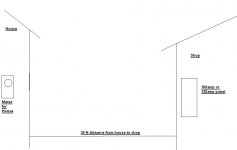
Ok, by looking at the attached diagram it shows my house and my new shop and the distance between them (39'). What I am wanting to do is run 100amps to the shop. I have a good idea of what I need to do, however, I would like some input from the experts on this board. The power coming into the meter pan as shown in the diagram is underground service from the electric company. It then goes into the house to a 200amp panel. My idea is to pull the meter and tap off of the extra lugs to some sort of a disconnect and then underground to a 100amp panel into the shop. My questions:

1. Is this the correct way of doing it? Entergy prefers pulling off of existing house rather than running a new service to the shop.
2. What is the correct part I need to mount on the house? Would it be a disconnect (only saw up to 60amps) or a 100 amp main lug?
3. What size wire would be appropriate to carry 100amp for 40 ft?

Thanks for any advice.
Matt
 

Attachments

  • Diagram.JPG
    Diagram.JPG
    23 KB · Views: 212
To avoid these ads, REGISTER NOW!

Gary S

Well-known member
Joined
Dec 27, 2008
Messages
2,972
Location
Bismarck, ND
Around here you can't pull the meter and mess with it. Our meters are sealed with the power company's sealed tag. You cut it and pull the meter, and you either pay a fine, or get disconnected. Check the rules with your power company before it hurts.

Why not put a 100 amp breaker in your 200 amp house panel and subf eed the garage like your power company wants? That is the safest and most sensible way.

That is how I did mine. The power company feeds my main house panel. I have a 100 amp breaker in the main house panel that sub feeds my 100 amp garage panel underground between the buildings. I used #2 copper to feed it. It might be slightly over wired, but I wire everything that way. My wires run through 2" conduit out of the house wall, underground to the garage, and back up through the garage wall to the sub panel.
 

Falcon67

Well-known member
Joined
Jun 11, 2009
Messages
18,371
Location
Merkel, TX
That's what I did - take off at the meter and run to a disconnect. I just called AEP and scheduled a meter pull. And when the guy got there, he said "We really don't care but Customer Service is supposed to tell you No, must have an engineer come out." LOL. This was done when I was re-doing the service entrance. He said "How much time do you need?" "About 2~3 hours" He cut the seal, handed me the meter, pulled back the pole wires and tied them to the old pole that I would be removing when I was all done, "See ya after lunch" and off he went. He had lunch, a flat tire, came back in 4 hours, looked over the work, said "Looks good", reconnected the pole drop, installed the meter lugs, tagged it and bub-bye. Zero cost. PS - I "double tapped" the meter load side lugs for the short run of #4 to the shop disconnect and he did ask if the lugs were torqued to the mfg requirements (yes) before putting the meter back in place.

So - either way mentioned works, there is just different ways you have to treat the neutral bus bar in the shop panel. My run is about 35' and I ran the whole thing by a pro electrician that is in my car club. His advice was to treat my shop panel as a service entrance, grounding and all, since the feed was straight off the incoming pole feed and meter.
 
Last edited:

jdub63

Well-known member
Joined
Jan 28, 2008
Messages
232
Location
Azle, Texas
Gotta love "taylor electric" I'm having all kinds of problems with TXU/Oncor since the move from Abilene
 
To avoid these ads, REGISTER NOW!

Falcon67

Well-known member
Joined
Jun 11, 2009
Messages
18,371
Location
Merkel, TX
Very few meter sockets up to 200 amp are made for two taps. Double tapping it not permitted (Yes, I know, its done, just stating the rules).

Charles

Absolutly right, but I was kinda stuck. FWIW - it was quad tapped before I replaced these items. Really. I will probably end up moving the house box in the future - that wall the incoming is on is deteriorating in spite of paint and preservative - it faces east, almost no overhang and was allowed to just sit with flaked off paint for many years before we moved in. That part of the hosue apparently had termite problems in the past. The window frame looks like heck. I'm sure when I get around to repairing the window frame it'll be like the living room windows - the wole end wall will get ripped out. When I get to that, I'll move the breaker box inside and it''ll for sure be 200A lotsabreakerbox with no hangers-on.

Things are bit more laid back out hee-ya, for sure. Very handy sometimes. When I rewired the house in 97, before all the de-reg stuff come along, I called the power co and told them I needed to pull the meter to put a new box on the wall. "Do you guys need to come do that? Some form or wavier, permit requirement?" "Nah - just cut the seal and don't kill yourself. Call us when you're done, we'll come put a new tag on it." No problemo. :thumbup:

City is the same way. "I may put in a new sewer line to the street. Do I need a permit and inspection to hook up to the pipe?" "No, just tell us where you want the tap and pay us." Okie-dokie. (turns out there is no sewer in the street out front).
 
Last edited:

Charles (in GA)

Well-known member
Joined
Jan 11, 2006
Messages
12,489
Location
50 mi south of Atlanta
Very few meter sockets up to 200 amp are made for two taps. Double tapping it not permitted (Yes, I know, its done, just stating the rules).

Absolutly right, but I was kinda stuck. FWIW - it was quad tapped before I replaced these items.

My comment was not aimed at you, I realized from the wording of your post, that you were aware of double tapping, and thus, the legalities of it. I made this mention for the benefit of the original poster, so he'd be aware of what he was getting into. I doubt when his meter socket is opened up that he will find an extra set of lugs to connect to.

I also realize that you gotta do what you gotta do, and if you are aware of it, and its temporary in nature its not a terrible thing. It is possible to do things in violation of the code and NOT be unsafe about it. Code is there because of the lowest common denominator, much the same as some of the rules found in the military. This falls under the "do as I say, not as I do" category. I'll never tell someone its OK to double tap, and I'll try my darnedest to not do it myself................................

Charles
 

Falcon67

Well-known member
Joined
Jun 11, 2009
Messages
18,371
Location
Merkel, TX
Excellent comments - be assured no offense was taken, just thought I'd clarify a bit. I should have thought of that - based on the apparent age of the poster's service equipment, that the meter box is likely "standard issue". Ours is a 150A unit and fortunately still had the tag inside with the lug torque requirements.

I haven't looked, but I imagine that somewhere there would be a box he could buy to hang below/next/??? the meter and get the split off to the house and to the garage. An added "bonus" from something like that would be a single point of emergency shutoff for the incoming power.
 
OP
M

ml504

Well-known member
Joined
Mar 19, 2008
Messages
99
Something I guess I am completely overlooking (go figure) now is that if I can afford to take that many amps away from my house? Granted, I doubt I will ever use a full 100 amps in the new shop, but is there a way I can tell if I can afford to pull this much? We built our house 2 years ago and everything is electric (including heat and 2 hot water heaters 40 gallons each). Looking in my panel, the heat system is on its own 100amp breaker (we live in Louisiana so the heat system does not run all day everyday). Is there a good way to tell if I am okay pulling this much to the shop or should I look at an entire seperate service to the shop all together?

Thanks,
Matt
 

Falcon67

Well-known member
Joined
Jun 11, 2009
Messages
18,371
Location
Merkel, TX
Reddy Kilowatt lives at your house. Good question - sounds like you'll want to do a load calculation on your house draw. I haven't done one for our setup but there are some web resources if you do a bit of searching. We use gas heat, so the biggest power draw in the house is the dryer and AC.

Depends on what you load your shop up with - in mine I have stuff like a lathe, 220V 60 gal. compressor, 120V MIG unit, 3/4 HP drill press, chop saw, belt sander, table saw, chop saw, 5kW electric heater, 12K BTU window unit - heck if it's got a plug I probably have at least one of it. The biggest draw is the 5kW heater in the shop - it pulls 20A per leg on a 220V circuit at full bore. The lathe is 110V right now and pulls about 13A (chinese 3/4 motor - metric HP I think). With all the lights on and some normal stuff running - that one guy can run anyway - I can pull up to around 45 on a 60 amp. Normal in the summer with the AC is about 30ish. The test I use is compressor running, lathe, lights and either the AC or heat. I have made some changes and need to re-test. If I get the chance soon, I'll post results here.

A second meter is a consideration - I had one on the shop before, mainly because the pole is right across the alley and all I needed to power up was a weatherhead. However, we soon learned that - in Texas anyway - the PUC allows the utility to charge a second meter at commercial rates. So you might ask about that first. We probably paid for the 40' of #6, the disconnect, etc, etc about 3 or 4 times before I could find time to build the run to pull power off the house.
 
Last edited:
To avoid these ads, REGISTER NOW!
Top Bottom