To avoid these ads, REGISTER NOW!

Electrician tools

472scout

Well-known member
Joined
Sep 18, 2010
Messages
1,280
Location
back 40
What are the less common electrician tools every DIY homeowner should have?

Among other things I'm specifically looking for a tool, maybe multitool, to push in the release spring on power outlets. I was replacing a few Leviton outlets the other week and surprised that none of my mini screw drivers, or anything else in my considerable tool collection, was small enough to fit in the tiny release slots.
 
To avoid these ads, REGISTER NOW!

Lkdelta

Well-known member
Joined
Sep 21, 2010
Messages
1,131
Location
40 mi.east of syracuse
What are the less common electrician tools every DIY homeowner should have?

Among other things I'm specifically looking for a tool, maybe multitool, to push in the release spring on power outlets. I was replacing a few Leviton outlets the other week and surprised that none of my mini screw drivers, or anything else in my considerable tool collection, was small enough to fit in the tiny release slots.

I had to modify one of my older mini screw drivers to take care of this.

DIY needs.. those voltage detectors
 

billp603

Well-known member
Joined
Dec 31, 2011
Messages
222
Location
NH
I've been doing work on my home electrical for 20+ years without much in the line of specialty tools. I read somewhere once to never use those quick connect slots, if I'm replacing an outlet like that I would just cut the wires and strip a new end for the screw terminals. Other than a multimeter, I also have one of these handy test lights for checking the outlet.
 

pipsters

Well-known member
Joined
Sep 1, 2010
Messages
4,899
Location
USA
There are two kinds of push ins (IIRC the correct term is "back stab"). One is just pushed in and friction fitted, the other is pushed in and secured with a screw. Those are found in the upgraded commercial type outlets (not the $0.50 outlets, the $1.50 ones). I use those all the time, and personally find they are safer/more secure than the ones that have you wrap the wire around them.
 

rlitman

Well-known member
Joined
Oct 18, 2010
Messages
24,640
Location
Long Island
I've been doing work on my home electrical for 20+ years without much in the line of specialty tools. I read somewhere once to never use those quick connect slots, if I'm replacing an outlet like that I would just cut the wires and strip a new end for the screw terminals.

Yep. Oh, and if you do find something that can push the release, you will see that the copper that comes out is badly marred. That stripped end will then easily snap at the point where the spring clip had dug into it.

So, the answer is to cut the wire close to the back of the outlet. Oh, and never use those spring clips!
 

rlitman

Well-known member
Joined
Oct 18, 2010
Messages
24,640
Location
Long Island
pipster, What brand are those push in outlets that lock down with a screw?

They're not push in, but back-wire clamped. Just about every brand makes one. Usually it will be the spec grade outlets, and sometimes it is available on the 20A outlets.
 
OP
4

472scout

Well-known member
Joined
Sep 18, 2010
Messages
1,280
Location
back 40
So far I have an outlet checker, tone generator/receiver, wire strippers (automotive type), multimeter, and the normal hand tools. I was going to buy a Cat 5 stripper the other day but then saw that there quite a few outlets that accept Cat 5 connectors on the back side. At Home Depot I saw some interesting separator/strippers for Romex??

Oh yeah I also have a HF holder for installing outlets that I've never used.
 
OP
4

472scout

Well-known member
Joined
Sep 18, 2010
Messages
1,280
Location
back 40
They're not push in, but back-wire clamped. Just about every brand makes one. Usually it will be the spec grade outlets, and sometimes it is available on the 20A outlets.

Right, I've seen those but it's been a while.
 
OP
4

472scout

Well-known member
Joined
Sep 18, 2010
Messages
1,280
Location
back 40
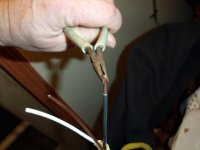
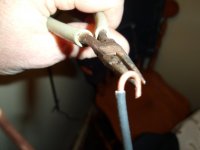
Is there a specialty tool for twisting wires to fit on a screw?

Yep. Oh, and if you do find something that can push the release, you will see that the copper that comes out is badly marred. That stripped end will then easily snap at the point where the spring clip had dug into it.

So, the answer is to cut the wire close to the back of the outlet. Oh, and never use those spring clips!

The wires looked fine on my outlets. I'm tempted to break one of my Levitons apart and see what the internals look like. 1) how much contact surface (the less contact the more heat) and 2) has strong/durable are they.
 
OP
4

472scout

Well-known member
Joined
Sep 18, 2010
Messages
1,280
Location
back 40

frankush

Well-known member
Joined
Oct 23, 2011
Messages
1,156
Location
IL
Large paperclip works well. I always cut the backstabbed ends off the wire and use the screw terminal.
 

AE2

Well-known member
Joined
Nov 28, 2012
Messages
305
Location
Atchison KS
Before I found the one at Menards, I was using a very small finish nail with some vise grips.
 

wwaarrppeedd

Well-known member
Joined
Jun 8, 2011
Messages
48
Location
ny
romex strippers are nice for 12/2, a pair of linesmans pliers are great for twisting joints. X100 on not using the stab back outlets, strip the wire, form a hook with your strippers, and wrap it around the screw. if you have more than one set of wires DO NOT feed through the outlet!!!! make joints and pigtail the outlet off the joints. more fires start with outlets overloaded by being fed through. and a tick tester is always handy http://www.fluke-direct.com/shop/it...item=1AC-A1-II&manufacturerItemNumber=2432932
 
Last edited:
OP
4

472scout

Well-known member
Joined
Sep 18, 2010
Messages
1,280
Location
back 40
More anti backstab people than I expected. I thought they were industry standard for new construction.

What problems have you guys specifically seen?
 

StevePgh

Well-known member
Joined
Jan 27, 2011
Messages
163
Location
Pittsburgh, PA
I like the Klein Bent Nose strippers, but that is largely personal preference. I also like to have a GFCI outlet tester to check that outlets are properly passed through a GFCI where required. As others mentioned, the non-contact voltage detector provides secondary verification that there is not power at the outlet or box.

While on the subject, is there a tool to strip outdoor wire (UF)? What a pain in the rear to strip. After the last time I had to do it I found this technique (slice down the center, then twist the jacket until it breaks, then pull it off the wire).
 

Zeke

Well-known member
Joined
Aug 13, 2009
Messages
17,176
Location
Long Beach CA, the sewer by the sea.
More anti backstab people than I expected. I thought they were industry standard for new construction.

What problems have you guys specifically seen?

Not for years now. Not allowed by the NEC. And Rlitman is right, cut the wires flush with the back of the receptacle and strip new. At the very least, pull the wires out of the back stabber and cut to the marring. That way you'll save a 1/4" of wire. ;) :D

Throw the stabbers away unless they have lugs on the side, in which case you can convert them.

Why are the stabbers no longer legal? Look at them. The contact is a finger spring that touches a small part of the wire's circumference. When these recept's are run in a general purpose branch circuit, the load is across every one of those tiny spring contacts. Not what you want. You want your wires wrapped around a lug or clamped so 3 sides of the wire is in contact.
 

billp603

Well-known member
Joined
Dec 31, 2011
Messages
222
Location
NH
More anti backstab people than I expected. I thought they were industry standard for new construction.

What problems have you guys specifically seen?

They are standard in new construction because they are quick (= less $$) I personally have not seen any issues, but somewhere along that way I read (or maybe saw on This Old House type show) not to use them.

There was also another thread on this subject earlier this year. http://garagejournal.com/forum/showthread.php?t=159079

Sounds like you have what you need, the tone generator is a nice bonus.
 

frankush

Well-known member
Joined
Oct 23, 2011
Messages
1,156
Location
IL
Not for years now. Not allowed by the NEC. And Rlitman is right, cut the wires flush with the back of the receptacle and strip new. At the very least, pull the wires out of the back stabber and cut to the marring. That way you'll save a 1/4" of wire. ;) :D

Throw the stabbers away unless they have lugs on the side, in which case you can convert them.

Why are the stabbers no longer legal? Look at them. The contact is a finger spring that touches a small part of the wire's circumference. When these recept's are run in a general purpose branch circuit, the load is across every one of those tiny spring contacts. Not what you want. You want your wires wrapped around a lug or clamped so 3 sides of the wire is in contact.

They are perfectly legal as long as you don't use them on AL wire. Wire type must be CU or CU clad AL solid wire. This is clarified in the 2011 NEC Handbook. See 110.14B. Handbook notes spell this out. I agree they are junk, but the manufacturers have the data to show they are safe. They also bear the UL label.

The wiring method is what is more suspect here. The devices are meant for one wire per terminal. Using the screw terminal for one hot and then stabbing another wire to feed a second device's hot terminal, is where the problem lies. Very typical to find an open neutral situation when done this way. Pigtail branch circuit splices and drop down to the device with hot, neutral and ground or whatever the device requires.
 
Last edited:
To avoid these ads, REGISTER NOW!
OP
4

472scout

Well-known member
Joined
Sep 18, 2010
Messages
1,280
Location
back 40
They are perfectly legal as long as you don't use them on AL wire. Wire type must be CU or CU clad AL solid wire. This is clarified in the 2011 NEC Handbook. See 110.14B. Handbook notes spell this out. I agree they are junk, but the manufacturers have the data to show they are safe. They also bear the UL label.

The wiring method is what is more suspect here. The devices are meant for one wire per terminal. Using the screw terminal for one hot and then stabbing another wire to feed a second device's hot terminal, is where the problem lies. Very typical to find an open neutral situation when done this way. Pigtail branch circuit splices and drop down to the device with hot, neutral and ground or whatever the device requires.

Very good info. I thought the illegal comment was suspect as my house is fairly new and has them throughout.
 

GortonsFisherman

Well-known member
Joined
Oct 31, 2012
Messages
359
Location
Somewhere nice
Those quick back-stab connections will fail sooner or later, guaranteed. May take a dozen years or so, but it's inevitable. As an electrical contractor, I couldn't begin to count how many service calls I've made over the years where they have been the culprit. If you're lucky, it's just a loss of part of the circuit that results, but I've seen a couple where the arcing was very close to starting a fire.
 

Lkdelta

Well-known member
Joined
Sep 21, 2010
Messages
1,131
Location
40 mi.east of syracuse
The wiring method is what is more suspect here. The devices are meant for one wire per terminal. Using the screw terminal for one hot and then stabbing another wire to feed a second device's hot terminal, is where the problem lies.

Pigtail branch circuit splices and drop down to the device with hot, neutral and ground or whatever the device requires.

When Pig-tailing, is there a trick to get the wire nut to grab all 3 wires tightly?

Red nuts don't seem to want to thread onto "all 3 twisted" either :dunno:
I seem to get a loose connection occasionally when doing this
 

my58

Well-known member
Joined
Apr 12, 2005
Messages
238
Location
Ventura County California
When I was in High School (A long long long time ago) I worked for an electrician doing track homes. He taught me to use the tip from my voltage tester as a release key. I have been using that method ever since.

The probes that come with the free little red HF VOM work perfectly for releasing the wire.
 

frankush

Well-known member
Joined
Oct 23, 2011
Messages
1,156
Location
IL
When Pig-tailing, is there a trick to get the wire nut to grab all 3 wires tightly?

Red nuts don't seem to want to thread onto "all 3 twisted" either :dunno:
I seem to get a loose connection occasionally when doing this

Most of the manufacturers will tell you to twist the wires together first, then install the wire nut. A few claim that is not necessary with their product. I always twist them first. The easiest way to get good at it is to practice a few times. Take some scrap. Strip the wire longer than you have to by about a half inch. Start with a 3 wire splice. Put the wires together so that the end of the insulation is even. Take a pair of linemans and grab it close to where the copper shows. Hold tight and give it a few turns releasing the twisted wire as you go. When you get good at it, go to four wires ,then five. Try to use all the same AWG size for the practice. I always leave them a little long and cut to size after the splice is made up.
 
Last edited:

Zeke

Well-known member
Joined
Aug 13, 2009
Messages
17,176
Location
Long Beach CA, the sewer by the sea.
They are perfectly legal as long as you don't use them on AL wire. Wire type must be CU or CU clad AL solid wire. This is clarified in the 2011 NEC Handbook. See 110.14B. Handbook notes spell this out. I agree they are junk, but the manufacturers have the data to show they are safe. They also bear the UL label.

The wiring method is what is more suspect here. The devices are meant for one wire per terminal. Using the screw terminal for one hot and then stabbing another wire to feed a second device's hot terminal, is where the problem lies. Very typical to find an open neutral situation when done this way. Pigtail branch circuit splices and drop down to the device with hot, neutral and ground or whatever the device requires.
I suppose you have me there. I'm looking for my information. I do a lot of work in the City of Los Angeles and as you may know, they have their own testing labs. Many products used must have an LADBS test number as well as an ICC #.

Los Angeles has an electrical test lab. It's a maze of reports for electrical, building and mechanical reports. To be honest with you, a lot of us learn through the inspection process. I do know there are instances where a back stab device of the old style (i.e., no lugs) cannot be used. They certainly are not recommended for use with 12 ga. wire. No electrician I know will use the back stab device unless it's a clamp style back wired device.

Sometimes I get tired of trying to help. If you want to use a 49 cent receptacle in your home or garage, by all means do it.

When I find all of this info, I will let you know. I have been not using back stab devices for 30 of my 41 years in construction. It's been so long that I can't even tell you why.

But I'm the guy that had to run a no. 8 bonding wire to my stucco lath because a room got within 3 feet of a swimming pool. I had to bond a metal window frame on that same job. This was in 1978.

Edit: Item 1:

"Technically they would be a violation of the NEC, section 110.3(B). It is actually a listing issue. Nationaly Recognized Testing Laboratories, such as UL, ETI, CSA, Etc. will no longer list backstab 20 amp devices, unless they have a pressure plate to seat the conductor."
http://www.electricalknowledge.com/forum/archives/1304.asp

Also, kitchen recpt's must be 20A and wired with 12 ga. wire. I'll get the citation for this.

So, if a back stab recpt is not rated for 12 ga. (according to the mfgr's), then one can assume they are not legal in a kitchen, dining room, service porch or laundry. If what's left in the house needs multi-purpose outlets on a 15A circuit in your house, you go.
 
Last edited:

Bolster

Well-known member
Joined
Jul 8, 2008
Messages
4,056
Location
Mexifornia
Question on looping wire around the screw terminal: After running your wire around the terminal screw, are you able to reach in and crimp the open end of the wire "U" closed? Ideally I'd like an almost perfect circle around the screw, but I have great difficulty finding any needlenose pliers that can reach in and close the "U" down to nearly an "O" around the screw. Or is this unnecessary? A contractor friend of mine said to "strive for making an O around the screw" and this causes me grief. Mostly I make do with "U"s (but am careful to get them running in the correct orientation so they scrunch down on tighten).
 

rodm1

Well-known member
Joined
Feb 17, 2008
Messages
2,270
When Pig-tailing, is there a trick to get the wire nut to grab all 3 wires tightly?

Red nuts don't seem to want to thread onto "all 3 twisted" either :dunno:
I seem to get a loose connection occasionally when doing this

You need to push hard on the nut while twisting. The wires (pigtails) should be twisting around each other when the nut is tight. Give each wire a good hard tug to make shire they a tight.

If you are using stranded and solid start the stranded ahead of the solid.
 
OP
4

472scout

Well-known member
Joined
Sep 18, 2010
Messages
1,280
Location
back 40
Well you guys have definitely convinced me not to use the back stab receptacles. I've never used the bottom of the line receptacles. Once I did buy a 10 pack of receptacles for some ridiculously cheap price of like $8. Got them home, took one look, and they went straight back to the store. Scary is the best word I have to describe the quality. I bet they're real popular with the uninsured, unlicensed handyman that advertise in craigslist.

What do you guys use/recommend?
 

frankush

Well-known member
Joined
Oct 23, 2011
Messages
1,156
Location
IL
I suppose you have me there. I'm looking for my information. I do a lot of work in the City of Los Angeles and as you may know, they have their own testing labs. Many products used must have an LADBS test number as well as an ICC #.

Los Angeles has an electrical test lab. It's a maze of reports for electrical, building and mechanical reports. To be honest with you, a lot of us learn through the inspection process. I do know there are instances where a back stab device of the old style (i.e., no lugs) cannot be used. They certainly are not recommended for use with 12 ga. wire. No electrician I know will use the back stab device unless it's a clamp style back wired device.

Sometimes I get tired of trying to help. If you want to use a 49 cent receptacle in your home or garage, by all means do it.

When I find all of this info, I will let you know. I have been not using back stab devices for 30 of my 41 years in construction. It's been so long that I can't even tell you why.

But I'm the guy that had to run a no. 8 bonding wire to my stucco lath because a room got within 3 feet of a swimming pool. I had to bond a metal window frame on that same job. This was in 1978.

Edit: Item 1:

"Technically they would be a violation of the NEC, section 110.3(B). It is actually a listing issue. Nationaly Recognized Testing Laboratories, such as UL, ETI, CSA, Etc. will no longer list backstab 20 amp devices, unless they have a pressure plate to seat the conductor."
http://www.electricalknowledge.com/forum/archives/1304.asp

Also, kitchen recpt's must be 20A and wired with 12 ga. wire. I'll get the citation for this.

So, if a back stab recpt is not rated for 12 ga. (according to the mfgr's), then one can assume they are not legal in a kitchen, dining room, service porch or laundry. If what's left in the house needs multi-purpose outlets on a 15A circuit in your house, you go.


No reason to dig up lots of info. There are other reasons not to use the 49 cent switches and receptacles. Most quality devices will have a nylon face. I have never seen one break or crack. Yes they do fail occassionally. When an inexpensive one breaks it literally falls apart, terminals and all. So spend a buck or a buck and a half more and get something that should last 20 years.
 
Last edited:

Zeke

Well-known member
Joined
Aug 13, 2009
Messages
17,176
Location
Long Beach CA, the sewer by the sea.
Most of the manufacturers will tell you to twist the wires together first, then install the wire nut. A few claim that is not necessary with their product. I always twist them first. The easiest way to get good at it is to practice a few times. Take some scrap. Strip the wire longer than you have to by about a half inch. Start with a 3 wire splice. Put the wires together so that the end of the insulation is even. Take a pair of linemans and grab it close to where the copper shows. Hold tight and give it a few turns releasing the twisted wire as you go. When you get good at it, go to four wires ,then five. Try to use all the same AWG size for the practice. I always leave them a little long and cut to size after the splice is made up.

This we can agree 100% on. I have a lot of respect for your electrical knowledge, make no mistake about that. I shouldn't have shot my mouth off about back stab recpt's, but we haven't seen them in inspected work here for a long time. We do almost everything in 12 ga. except a few lighting circuits.

What with all the big TV's, and all the other electronic equipment in homes today, there aren't enough outlets at the 12' rule. Hell , a master bedroom ought to have a couple of circuits divided at fourplex outlets all around. The idea that folks have a couple of night stand lights and a plug in alarm clock and that's it is way out of whack. Most homes I go into anymore I can't find an unoccupied outlet easily. I usually string out from the kitchen or a nearby bathroom.

Beats pulling the plug on their DVDR while it's recording or their computer(s).
 

frankush

Well-known member
Joined
Oct 23, 2011
Messages
1,156
Location
IL
I suppose you have me there. I'm looking for my information. I do a lot of work in the City of Los Angeles and as you may know, they have their own testing labs. Many products used must have an LADBS test number as well as an ICC #.

Los Angeles has an electrical test lab. It's a maze of reports for electrical, building and mechanical reports. To be honest with you, a lot of us learn through the inspection process. I do know there are instances where a back stab device of the old style (i.e., no lugs) cannot be used. They certainly are not recommended for use with 12 ga. wire. No electrician I know will use the back stab device unless it's a clamp style back wired device.

Sometimes I get tired of trying to help. If you want to use a 49 cent receptacle in your home or garage, by all means do it.

When I find all of this info, I will let you know. I have been not using back stab devices for 30 of my 41 years in construction. It's been so long that I can't even tell you why.

But I'm the guy that had to run a no. 8 bonding wire to my stucco lath because a room got within 3 feet of a swimming pool. I had to bond a metal window frame on that same job. This was in 1978.

Edit: Item 1:

"Technically they would be a violation of the NEC, section 110.3(B). It is actually a listing issue. Nationaly Recognized Testing Laboratories, such as UL, ETI, CSA, Etc. will no longer list backstab 20 amp devices, unless they have a pressure plate to seat the conductor."
http://www.electricalknowledge.com/forum/archives/1304.asp

Also, kitchen recpt's must be 20A and wired with 12 ga. wire. I'll get the citation for this.

So, if a back stab recpt is not rated for 12 ga. (according to the mfgr's), then one can assume they are not legal in a kitchen, dining room, service porch or laundry. If what's left in the house needs multi-purpose outlets on a 15A circuit in your house, you go.

No reason to dig up lots of info. There are other reasons not to use the 49 cent switches and receptacles. Most quality devices will have a nylon face. I have never seen one break. When an inexpensive one breaks it literally falls apart, terminals and all. So spend a buck or a buck and a half more and get something that should last 20 years.

I try to help when I can, but at times it gets frustrating. Best to walk away sometimes and leave it to others.
 

Jonboy1974

Well-known member
Joined
Oct 11, 2011
Messages
45
Location
Lexington, SC
Is there a specialty tool for twisting wires to fit on a screw?

I've always used one of the 2 holes in the end of my Klein strippers to fold the wire in to a hook.
Klein-Tools-11045-lg.jpg
 

Charles (in GA)

Well-known member
Joined
Jan 11, 2006
Messages
12,489
Location
50 mi south of Atlanta
Not for years now. Not allowed by the NEC. And Rlitman is right, cut the wires flush with the back of the receptacle and strip new. At the very least, pull the wires out of the back stabber and cut to the marring. That way you'll save a 1/4" of wire. ;) :D

Throw the stabbers away unless they have lugs on the side, in which case you can convert them.

Why are the stabbers no longer legal? Look at them. The contact is a finger spring that touches a small part of the wire's circumference. When these recept's are run in a general purpose branch circuit, the load is across every one of those tiny spring contacts. Not what you want. You want your wires wrapped around a lug or clamped so 3 sides of the wire is in contact.


They are perfectly legal as long as you don't use them on AL wire. Wire type must be CU or CU clad AL solid wire. This is clarified in the 2011 NEC Handbook. See 110.14B. Handbook notes spell this out. I agree they are junk, but the manufacturers have the data to show they are safe. They also bear the UL label.

The wiring method is what is more suspect here. The devices are meant for one wire per terminal. Using the screw terminal for one hot and then stabbing another wire to feed a second device's hot terminal, is where the problem lies. Very typical to find an open neutral situation when done this way. Pigtail branch circuit splices and drop down to the device with hot, neutral and ground or whatever the device requires.

Actually, they are legal (I have no idea why) but its not an aluminum wire issue (aluminum wire hasn't been legal in 10 and 12 gauge for quite a few years now), and you are not supposed to use a receptacle on existing AL wire unless it is marked CO/ALR {NEC 405.3(C)}.............

The actual reason they are not used much any more is that they are only approved (the new ones you can buy now) with 14 gauge wire. 12 gauge won't even fit thru the hole in the back where the push in is. Many localities will not allow 14 gauge/15 amp receptacle circuits to be used at all. 14 gauge AL was never used for branch circuits, so there is no chance of it being inserted accidentally by the DIY type who doesn't know any better.

Charles
 
Last edited:

Charles (in GA)

Well-known member
Joined
Jan 11, 2006
Messages
12,489
Location
50 mi south of Atlanta
pipster, What brand are those push in outlets that lock down with a screw?

Leviton, Hubbell, and Cooper all make these. They are labeled as commercial, industrial or spec grade (though not all commercial, industrial or spec grade are back wire capable)

These are Hubbell switch and receptacle I bought recently at a flea market. There is a serrated or notched metal plate inside that the screw pulls tight. You must back the screw way out first and then insert the wire and tighten the screw. Use the strip gauge on the receptacle or you may not get good engagement with the connections inside as you cannot see them well. Cooper uses an external plate that is easily seen and worked with.

I'm starting to see ones now with the grounding screw that is also backwired. Never did figure out why they still wanted you to twist the ground, but the newest ones are backwire all the way.

Charles

attachment.php
 
Last edited:

Charles (in GA)

Well-known member
Joined
Jan 11, 2006
Messages
12,489
Location
50 mi south of Atlanta
I've always used one of the 2 holes in the end of my Klein strippers to fold the wire in to a hook.
Klein-Tools-11045-lg.jpg

These are solid wire strippers, with a real tiny serrated jaw at the tip. They are the cats meow for stripping solid (and stranded) wire.

Klein also makes a romex sheath cutter that works well. You also will want a romex sheath ripper.

For unplugging the wires from back stab receptacles, use one of those cheesy little screwdrivers with the pocket clip and magnet that are give aways at every trade show and tool truck at Christmas.

Charles
 

Fyrme

Well-known member
Joined
Nov 28, 2012
Messages
2,231
Location
Green country, Oklahoma
Is there a specialty tool for twisting wires to fit on a screw?


Yeah, needle nose.:lol_hitti
but they do make these
http://www.homedepot.com/buy/klein-tools-2-wire-bend-phillips-screwdriver-603-4b.html#.ULgbZIYR-So

A tip that has not been made here so far is you always hook your wire on the left down and the wire on the right up. That way as the screw tightens, it tightens the hook on the wire.

some other good things to have around are
http://www.homedepot.com/h_d1/N-5yc...ord=curciut+tester&storeId=10051#.ULgc3YYR-So
http://www.homedepot.com/h_d1/N-5yc...&keyword=fish+tape&storeId=10051#.ULgdFIYR-So
http://www.homedepot.com/h_d1/N-5yc...recepticale+tester&storeId=10051#.ULgdWYYR-So
these are cheap and easy to use if you do any new romex work
http://electrical.hardwarestore.com...ing-tools/wire-and-cable-stripper-173195.aspx
 

Fyrme

Well-known member
Joined
Nov 28, 2012
Messages
2,231
Location
Green country, Oklahoma
Is there a specialty tool for twisting wires to fit on a screw?


Yeah, needle nose.:lol_hitti
but they do make these
http://www.homedepot.com/buy/klein-tools-2-wire-bend-phillips-screwdriver-603-4b.html#.ULgbZIYR-So

A tip that has not been made here so far is you always hook your wire on the left down and the wire on the right up. That way as the screw tightens, it tightens the hook on the wire.

some other good things to have around are
http://www.homedepot.com/h_d1/N-5yc...ord=curciut+tester&storeId=10051#.ULgc3YYR-So
http://www.homedepot.com/h_d1/N-5yc...&keyword=fish+tape&storeId=10051#.ULgdFIYR-So
http://www.homedepot.com/h_d1/N-5yc...recepticale+tester&storeId=10051#.ULgdWYYR-So
these are cheap and easy to use if you do any new romex work
http://electrical.hardwarestore.com...ing-tools/wire-and-cable-stripper-173195.aspx
 
To avoid these ads, REGISTER NOW!
Top Bottom