To avoid these ads, REGISTER NOW!

Electricians/electrical tools

Cadillac fan

Well-known member
Joined
Jan 5, 2014
Messages
185
Location
Victoria, Australia
Tried searching for a thread but couldn't find one.

I'm starting some basic electrical work (circuit boards, soldering, dismantling electrical items) and am wondering what tools you guys would recommend that I get.

At the moment I have:
Soldering iron
Desolder tool
Needle nose pliers (small)
Side cutters (small)
100 piece bit set
Torx bits
DMM (really cheap one)
Heaps of battery packs
Alligator clips


I am thinking of getting some electricians screwdrivers
these: http://jaycar.com.au/productView.asp?ID=WC6022 &CATID=81&form=CAT2&SUBCATID=990#1 and http://jaycar.com.au/productView.asp?ID=WC6021


Is there any other must have tools/equipment or even components that I am missing?
 
To avoid these ads, REGISTER NOW!

quattroJoe

Well-known member
Joined
Jan 9, 2014
Messages
586
Location
FL
End nippers
Thin stiff tool to help clear solder from through holes (sewing needle, etc. Look around in a craft store.)
Third hand tool
Decent roll of desolder braid (not Radio Shack brand, try Chem Wick or similar. Desolder tools aren't the best in every situation.)
Xacto style knife, metal handle will hold up much better than plastic
Tube of RTV silicone sealant, safe for securing components as it won't eat through PCBs (avoid hot glue)

Depending on how in depth you end up getting, look into a hot air or infrared preheater and a hot air rework station. Tenma brand from MCM is pretty solid mid range stuff. Aoyue rework stations are decent for the money. I'm sure you'll be wanting a nice multimeter in short order, Fluke 115 or 117 is good and affordable (by Fluke standards.)

Precision drivers are a must if not covered by your current bit set.

What type of iron are you using? I highly recommend Hakko. Their stations heat up quickly and stay hot, and the pens are thin and light- a true joy to work with. My go to is the FX-951, but for a bit less money the FX-888D is very capable as well.

It's been a while since I did board level work professionally, if I think of anything else I'll post up.
 

MFolks

Well-known member
Joined
Feb 3, 2013
Messages
1,045
Location
Springfield Mo.
Rubbing Alcohol (greater than 70%) cleans up solder flux pretty good. Acetone works too, but much more flammable. Cotton swabs for small solder clean ups, and a dispensing bottle to keep the Alcohol or Acetone clean and ready for use. Maybe a soldering fume collector, especially if you are sensitive to these fumes.

Wire strippers(I like the mechanical type that grip & pull the insulation slug off the conductor), or any of these tools: http://www.kleintools.com/catalog/strippers-cutters-crimpers
 

Sine Swept

Well-known member
Joined
Feb 2, 2014
Messages
440
One of my best finds is an AC/DC benchtop power supply. Its a Lab Volt 193P. 0-45 Vac and 0-36 DC.

I bought it from some guys mom that was cleaning house!
 
OP
C

Cadillac fan

Well-known member
Joined
Jan 5, 2014
Messages
185
Location
Victoria, Australia
Thanks for the help so far. Added some stuff to my list

I would love to get my hands on a bench top power supply. We use them in science and they are great but they are just too expensive for me at the moment.

Forgot to add, I do have wire strippers.
 

zkling

Well-known member
Joined
Jan 23, 2007
Messages
16,939
A bench supply is very handy as Sine mentioned. Why do you want a really cheap DMM? I would suggest you spend a bit of money on that one. Not saying you need to go all out, but skimping on a meter for doing board work is pretty penny wise and pound foolish IMHO.

Otherwise you sound pretty well covered for the basics. Possibly a scope down the road, depending on what type of circuits you are working on. Misc pieces of wire, both solid and stranded to make custom holders, jumpers and the like with the clips you already mentioned. Also a magnifying glass can be handy to help spec components. A few plastic picks for conductivity reasons. A grounding strap for your body is needed, again depending on what you are working on.
 

bareass172

Well-known member
Joined
Aug 5, 2012
Messages
817
Location
N'awlins
I would assume you know this by now with any experience, but don't be sucked in by the notion of cheap alligator leads. Spend for quality, you will use them CONSTANTLY and any poor connection in them will wreak havoc on all your readings. I've had mine so long I forget what brand they are, but they're good silicone wires and clips.

I can't recommend much beyond what's been said, but I have experience with stuff. I've had a 3rd hand I built myself years ago and it works fine, I just bought this Lisle thing for working on cars/bikes/whatever. It's magnetic so I can stick it to stuff for convenience. Probably not what you need at a bench.
http://www.amazon.com/gp/product/B001C6NJOA/?tag=atomicindus08-20

I bought this bench iron after a lot of research:
http://www.amazon.com/dp/B00BSW69LI/?tag=atomicindus08-20
Some people complain because of it's COO, but it had great reviews so I gave it a shot. I use it constantly and haven't had an issue yet. It did arrive with the heating element destroyed, but the company replaced the entire pencil for me, no hassle. I bought it when it was ~$65 and for the price you can't argue. It comes with a bunch of extra size tips, an extra heating element, a nice stand, etc. It has a lot of great features, heats up super fast, all what you'd expect from a bench iron. I don't know how I lived before it. ;)

I had a very old 12V DC supply I got from my dad years ago. One day I tested it and it was putting out something stupid like 18V so I scrapped it and bought an Electro Industries Digi 35A.
http://www.electroindustries.net/specifications.php
I know you said you can't afford one, but this thing has been solid as hell for me. I've owned it about 9 years now, no issues, and I got it on Ebay brand new from a reseller for about $45 at the time. They're still ~$100 now and worth every penny. That's for the 35A though, you could choose what fits for you.

Lastly, take this for what you want. I just bought this meter:
http://www.garagejournal.com/forum/showpost.php?p=3935834&postcount=73
I asked a lot of questions, talked with a lot of people and looked at a lot of options. That Snap-On is made my Test Products International and they do much more than most standard meters while still having the fine resolution that people expect only from Flukes. I won't lie, I've only had it a week but my point is this - I got it for $94 shipped. For some reason this meter is not very common on Ebay, so they usually sell for about $100. If you want a meter that will do all sorts of high end stuff, but only want to pay lesser meter money, this is hard to beat. It's $450 new from Snappy, $250 new from TPI (same meter), or ~$100 lightly used on Ebay (mine was in brand new condition, leads still sealed in their package). You may have to wait a couple weeks for one to show up on Ebay, but look at sold listings - they usually go right at that $100 price when they show.

Best of luck with your new stuff!
 

jeremy v

Banned
Joined
Jul 26, 2011
Messages
784
I would get a couple clip on heat sinks for keeping components cool during the soldering process. I would also think about getting a small jar of rosin or equivalent flux paste for prepping larger connections/wires before soldering, because just relying on the flux inside the solder core is often not enough. I like using Q-tips for spot cleaning the circuit board with alcohol after soldering. I also prefer using a brass wool mesh soldering iron tip cleaner instead of the more commonly used damp sponge. I think it does a much better job of keeping the soldering tip clean.

I second the recommendation for some soldering wick. A de-soldering tool that uses vacuum etc. is nice for circuit board work only. If you are like me, many of my solder fixes are things like fixing or replacing battery lead wires, soldering two wires together, etc. and a vacuum type tool is terrible for de-soldering that type of connection. Try to get a few different sizes if funds allow. In a pinch, some stripped finely stranded copper wire (16-24ga works great) will work if you put a little rosin flux on it before using it.

If you don't want to spend the money on a helping hand tool right now, you can get by pretty well by using an upside down aerosol paint can lid. Just cut two slits (one down each side) and slip one of the wires you are wanting to solder into each slit. Solder over the center of the lid and any extra solder then drips into the center of the lid. Cut a small round piece of thin scrap metal to fit the center hole of the paint lid and you won't have any melt through when hot solder drips.

If you are going to be doing much soldering, I would suggest eventually buying an Optivisor instead of trying to use a magnifying glass. It makes life much easier. I have two (glass #4 lens and glass #7 lens) and I love them. Be careful though, they come in different quality levels (some have glass lenses and some have plastic, get glass if you can afford it). The lenses included are numbered to identify the focal distance and magnification level. Buy one with a focal distance that matches the distance your eyes are from your work under normal circumstances.
 
Last edited:
To avoid these ads, REGISTER NOW!

jeremy v

Banned
Joined
Jul 26, 2011
Messages
784
I forgot to mention that a pair of small end cutters/nippers will come in very handy for clipping things in tighter areas. They fit in many areas where side cutters will not allow you to achieve the angle required for the cut.
 

1/2 Cup

Member Emeritus
Joined
Apr 28, 2012
Messages
19,283
Location
Shepparton. Victoria. Australia
There are some great suggestions above:thumbup:

If you need to do a little heavier electrical work can I suggest the following;

. Channellock 8" lines mans pliers.
. Channellock side cutters.
. Wattmaster or Whia electricians screw diver set.

Most of the basics are available at L&H, Middies or Delta.
Have a bit of a tyre kick at your local wholesalers.

Hope this helps.:thumbup:
 

jeremy v

Banned
Joined
Jul 26, 2011
Messages
784
Another thing I forgot to mention is that it is nice to have a couple different sizes of rosin cored soldering wire. I have a roll of Kester 0.020" dia wire and Kester 0.040" dia wire. Those two sizes are all I use for pretty much everything I encounter in electronics, home ownership repairs, and/or working on a car. If I am soldering something rarely encountered that requires wire larger than the 0.040" size I use solid soldering wire (instead of rosin core) and I brush on rosin flux in advance just like you do when soldering copper plumbing pipes.

I think one mistake most people new to electronics make is that they buy soldering wire with too large of a diameter, and then it is hard for them to get a nice connection without using too much and making a mess. Don't be afraid to stay small when it comes to wire diameter. Worst case scenario with wire that is smaller than ideal for the application, is that you just have to feed it into the joint a little faster. If the soldering wire is too large, you might not be able to perform the work at all.
 

JonnyMac

Well-known member
Joined
Dec 15, 2012
Messages
845
Location
Victoria, Australia
Get yourself an element14 account. Used to be known as Farnell. RS is another similar company but i find element14 does free over night delivery.
Also a fume extraction fan is essential for what you are doing, ,you will be going to bed with a thumping headache every night otherwise.
We have a large electronic lab at work so if you need any local advise just drop me a pm.
Jonny
 

skruft

Well-known member
Joined
May 9, 2011
Messages
759
The other posts have good advice.

The tools I use the most (aside from soldering equipment and electronics) are heat guns, screwdrivers, cutters, strippers, a knife, and pliers with short, extended nose - not sure what they are called.

I manage the different sizes and types of solder in a crude way, by placing rolls of each on a piece of tubing that is suspended over the bench. That way they do not take up space. There are also dispensers made for the bench.

Vises of various types, and third-hand tools with clips to hold work, are items I use often.

One also needs a system for keeping track of loose parts.
 

jeremy v

Banned
Joined
Jul 26, 2011
Messages
784
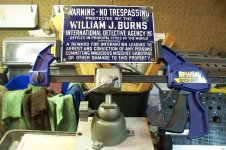
There is one thing I do for holding circuit boards that I haven't seen anyone else do before, so I thought I would mention it. I have a Panavise, but this would work in a regular bench vise as well.

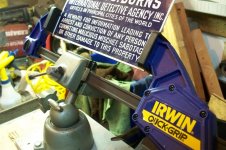
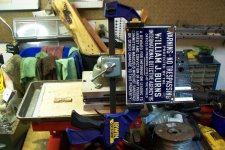
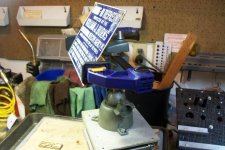
People that do a lot of work with circuit boards, model building, etc. often buy special attachments (like my first picture) for holding the work. There are various styles, and they work fine, but the cost for those extra attachments adds up quickly. Instead, I prefer to clamp a Quick Grip clamp into my Panavise and then use that as my circuit board or large part holder. I actually used to have a Panavise circuit board holder but I sold it, because I prefer the versatility of this setup. If you mainly do work with smaller items, you can use a light duty Quick Grip clamp instead so everything is less bulky.

The piece of wood is a simple scrap oak piece that I made in order to clamp the Quick Grip bar underneath the Panavise jaws instead of in them. It fills in the void thickness under the vise jaws and also accounts for the jaw screw's washer thickness (curved notch in the wood). Clamping it that way makes the attachment much more rigid and it holds very well. If I just clamped the Quick Grip bar in the plastic jaws, I found it slipped around too easily for my taste.

In my pictures, pretend that the porcelain sign is a circuit board ready for soldering.
 

Attachments

  • 2.JPG
    2.JPG
    5.8 KB · Views: 16
  • 102_4062.jpg
    102_4062.jpg
    151.8 KB · Views: 22
  • 102_4063.jpg
    102_4063.jpg
    147.9 KB · Views: 16
  • 102_4064.jpg
    102_4064.jpg
    145.3 KB · Views: 18
  • 102_4065.jpg
    102_4065.jpg
    150.6 KB · Views: 17
  • 102_4066.jpg
    102_4066.jpg
    140.1 KB · Views: 15
  • 102_4067.jpg
    102_4067.jpg
    149.9 KB · Views: 17
Last edited:

comedyman809

Well-known member
Joined
Dec 29, 2009
Messages
1,179
Location
Smithtown, NY-thats in suffolk county long island.
don't chinse on a meter, have small nut drivers both metric and SAE, i have 2 soldering irons always hot, one with a fat tip, and one with a thin. a good variable power supply, small gauge and normal size wire strippers, good micro screwdrivers and pliers set, i have a rework station that has a vacuum soldering gun for desoldering and a variable heat gun.
have 2 or 3 sizes of solder on hand, i have tubes of flux with needle spouts.
you should have plenty of small wire for trace repair.
 
To avoid these ads, REGISTER NOW!
Top Bottom