To avoid these ads, REGISTER NOW!

Electrolosis with Graphite

cclfn

Well-known member
Joined
Jul 31, 2012
Messages
308
Location
NW
I don't understand everything I know about this :eyecrazy:

Last night I was puzzled and low and behold the guys at GJ that got me into this were discussing it again. The most excellent thread by jrlp titled My take on an electrolysis tank! was very informative and I didn't want to trample it.

I started with the common variety 5 gallon bucket for my first attempt at removing rust. It needs some minor adjustments but worked as expected and no foam.


attachment.php


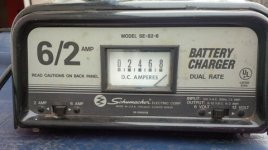
I used a charger that I picked up at a garage sale $10 as directed by previous threads.

attachment.php


Now I had this rusty vise that wanted to get in the water.


attachment.php


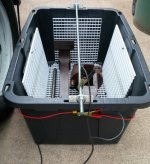
Obviously it needs a bigger tank so I built a larger version using carbon plate on the majority of the bottom with plates on all four sides to get good line of sight action (read that on one of these threads too). I used a broken florescent light grid to prevent shorting of the anodes, and zip tied them together. Drilled holes for bolting the graphite plates to the tank walls, and wired them all in series.

attachment.php


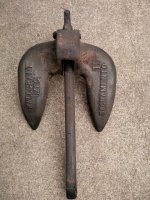
The maiden voyage with the big tank was on an old anchor I picked up at another garage sale and everything worked as planned.

attachment.php


Now I added a three foot piece of all-thread to run the length, instead of the old screwdriver shank over the sides. Then the problems began. 24 gallons of water, one and a half cups of Arm & hammer super soap and I cant keep the pieces cooking.

attachment.php


I am using bailing wire (which I think is iron wire) and doing everything the same. I thought with all the additional iron in the soup I would try more voltage; but a setting of 12V and 2amps sends a 13+ amp charge and shuts off the charger. 6v and 2 amp setting yields about a 10 amp charge. I sanded the connections, wire brushed the parts at point of contact and it just does not continue to keep the parts working.

You guys made me do this ;) so can you offer any ideas?

Thanks,

Wes
 

Attachments
  • 1-vise in tub.jpg
    1-vise in tub.jpg
    88.1 KB · Views: 326
  • 2-anchor.jpg
    2-anchor.jpg
    85.6 KB · Views: 27
  • 3-Vise box wo water.jpg
    3-Vise box wo water.jpg
    74.2 KB · Views: 328
  • 4-charger.jpg
    4-charger.jpg
    48.6 KB · Views: 319
  • 5-Prentiss rusty.jpg
    5-Prentiss rusty.jpg
    63 KB · Views: 321
  • 6-bucket.jpg
    6-bucket.jpg
    86.7 KB · Views: 323
Last edited:
To avoid these ads, REGISTER NOW!

Outlawmws

Well-known member
Joined
Aug 9, 2011
Messages
39,097
Location
The Badlands
The bailing wire is fine (You may need to sand any coatings off it) since I cannot see your pics, I have no idea what might be wrong, However, 24 gallons and LOTS more surface area; what size is the charger? It might be over capacity for the areas involved. can you tell if it is working? (BTW more volts is not the answer, more amps may be needed with the larger tank/greater surface areas...)

Is the all thread clean? You DO need good electrical contact. Also, how rusty are the parts in there? You may need to wire wheel a clean area on the part to get actual continuity...
 
OP
C

cclfn

Well-known member
Joined
Jul 31, 2012
Messages
308
Location
NW
The bailing wire is fine (You may need to sand any coatings off it) since I cannot see your pics, I have no idea what might be wrong, However, 24 gallons and LOTS more surface area; what size is the charger? It might be over capacity for the areas involved. can you tell if it is working? (BTW more volts is not the answer, more amps may be needed with the larger tank/greater surface areas...)

Is the all thread clean? You DO need good electrical contact. Also, how rusty are the parts in there? You may need to wire wheel a clean area on the part to get actual continuity...

Thanks for the input Outlaw. I will work on my contacts today but I did the same thing for the other two and didn't have any issues. I was afraid I had too much conductive surface with all that metal or something of that nature. I am too new at this and thought perhaps I was overlooking something obvious.

Wes
 

1973

Active member
Joined
Apr 29, 2012
Messages
25
It might be the battery charger. The first time I tried this it worked great with an old charger the secound time with my brand new charger it would not work at all, must be some kind of safety feature so I hooked my charger to an old battery then the battery to the tank and it worked great.
 

RGunner

Member
Joined
Aug 7, 2011
Messages
23
I think its the high resistance connections at the bailing wire, and the bailing wire itself.

Tie the lead of the charger directly to a chunk of the vise, heavy short cable.

What H2O solution were you using? Again need low resistance solution, salt water etc.
 
OP
C

cclfn

Well-known member
Joined
Jul 31, 2012
Messages
308
Location
NW
I think its the high resistance connections at the bailing wire, and the bailing wire itself.

Tie the lead of the charger directly to a chunk of the vise, heavy short cable.

What H2O solution were you using? Again need low resistance solution, salt water etc.

Today I am going to try a new connection method and get some new wire.

I am using 1 tbl spoon of arm & hammer washing detergent per gallon of water and everything is the same except for the screwdriver round.
 

kythri

Well-known member
Joined
Jan 3, 2007
Messages
6,330
Location
Lebanon, OR
Hopefully they are working now????

Let me know I seem to be having problems with sizing these correctly.

Thanks,
Wes

I see them all now, save for the one here:

The maiden voyage with the big tank was on an old anchor I picked up at another garage sale and everything worked as planned.

*** PICTURE MISSING

Now I added a three foot piece of all-thread to run the length, instead of the old screwdriver shank over the sides. Then the problems began. 24 gallons of water, one and a half cups of Arm & hammer super soap and I cant keep the pieces cooking.
 

Outlawmws

Well-known member
Joined
Aug 9, 2011
Messages
39,097
Location
The Badlands
I can see the pics now, all in the thumbnails, and all in the body EXCEPT the anchor... :dunno:

I would back off putting EVERYTHING in at once with a smaller charger. Work up to it. Also, is the charger solid state or a real transformer? (as small as it is I suspect it's solid state) How to tell? look for a transformer or "feel" for the weight of one...

With a solid state, many have complained of it not "starting" and that can be caused by the "smart" part of the circuit, as it needs to see a certain load or it will stay in "protect mode"

You mentioned a bottom plate of graphite? how is that connected?
 
Last edited:

RGunner

Member
Joined
Aug 7, 2011
Messages
23
I believe that shumacher is an older wound transformer version.

Doubt the bottom plate adds all that much, he has 4 graphite plates around the perimeter.

I still vote resistance in the circuit, or a dead shumacher (they cant run full tilt as you are showing in 2nd pic).

Got a meter, to check output / amperage?
 
Last edited:
To avoid these ads, REGISTER NOW!

Zeke

Well-known member
Joined
Aug 13, 2009
Messages
17,176
Location
Long Beach CA, the sewer by the sea.
So it's OK to use a 12v battery in the soup? With 600 amps I thought that might be a bit high. But, I don't understand the math behind how many amps will cross water and surface areas, etc.
 

DocsMachine

Well-known member
Joined
Sep 16, 2006
Messages
1,846
Couple of things:

One, you don't necessarily need "more power". In my experience (I'm by no means an expert) a lower amperage actually cleans better.

When I was cleaning parts, I'd crank my charger up to a fair level, and the stuff would be cleanish in half a day or so. But they'd be covered in black **** that had to be wire-brushed off.

Once, I put a part in, but set the charger low. It took longer (24-30 hours) but the same **** just sloughed off in the water, and what didn't, rinsed right off with a hose.

Naturally, there has to be some minimum level of amperage of course, but just because it's not boiling like a pot of stew doesn't mean nothing's happening.

And second, I think your concentration is a little weak. I seem to recall a cup of soda per 5-gallon bucket. If you only have a tablespoon per gallon, it's pretty weak.

But again, you basically can't overdo it. Throw in some extra- if you see it start to fall out of suspension at the bottom of the pail, that's fine.

The soda really doesn't do much beyond making the water conductive, so the exact ratio isn't all that important.

Doc.
 
OP
C

cclfn

Well-known member
Joined
Jul 31, 2012
Messages
308
Location
NW
I can see the pics now, all in the thumbnails, and all in the body EXCEPT the anchor... :dunno:

I would back off putting EVERYTHING in at once with a smaller charger. Work up to it. Also, is the charger solid state or a real transformer? (as small as it is I suspect it's solid state) How to tell? look for a transformer or "feel" for the weight of one...

With a solid state, many have complained of it not "starting" and that can be caused by the "smart" part of the circuit, as it needs to see a certain load or it will stay in "protect mode"

You mentioned a bottom plate of graphite? how is that connected?

Outlaw,

I believe this is a transformer and I am going to re wire very thing with better connections. When I do that I can reload in pieces and see if the quantity makes a difference. I see there is a white corrosion forming on the all-thread so that may be part of the problem. I will also use copper wire just to make sure the connections are good. The bottom plate has a channel milled the length of it, on one side. That side plate is about 14"X10" and fits into the channel, and pressure fit pieces making contact with the other side wall plate. Bottom plate worked well on the anchor (with the missing pic???) so I think the positive current flow is good through the graphite. I have several meters and as soon as I find one I will confirm that.

Rgunner may be spot on, so if I get it sorted out today I will report tomorrow.

Thanks,
Wes
 
OP
C

cclfn

Well-known member
Joined
Jul 31, 2012
Messages
308
Location
NW
Couple of things:

One, you don't necessarily need "more power". In my experience (I'm by no means an expert) a lower amperage actually cleans better.

When I was cleaning parts, I'd crank my charger up to a fair level, and the stuff would be cleanish in half a day or so. But they'd be covered in black **** that had to be wire-brushed off.

Once, I put a part in, but set the charger low. It took longer (24-30 hours) but the same **** just sloughed off in the water, and what didn't, rinsed right off with a hose.

Naturally, there has to be some minimum level of amperage of course, but just because it's not boiling like a pot of stew doesn't mean nothing's happening.

And second, I think your concentration is a little weak. I seem to recall a cup of soda per 5-gallon bucket. If you only have a tablespoon per gallon, it's pretty weak.

But again, you basically can't overdo it. Throw in some extra- if you see it start to fall out of suspension at the bottom of the pail, that's fine.

The soda really doesn't do much beyond making the water conductive, so the exact ratio isn't all that important.

Doc.
Doc,

I was thinking one table spoon per gallon was all you needed but I will add some more if the connections don't resolve the problem.

Thanks
 

Outlawmws

Well-known member
Joined
Aug 9, 2011
Messages
39,097
Location
The Badlands
cclfn,

keep any non-steel/iron out of the soup you can get heavy metal contamination and then you have disposal issues... The steel/iron bailing wire should be good, but some types have coatings, so just make sure the contact sections are "clean"; including where it contacts the parts being de-rusted.

I use rebar wire all he time, and it works fine. I make double hooks and hang the parts from a support bar of rebars similar to your all thread.
 

RGunner

Member
Joined
Aug 7, 2011
Messages
23
I'm a (anti) corrosion guy (by trade).. funny, not many of us around - these threads perk up my ears

This is simple physics.

E=IR squared (R squared)

where E is the voltage of either 6 or 12

I is the current (not getting any)... so therefore R (resistance) is infinitely large - plate size, wire size, transformer open circuit, solution > 1000oHm-cent, broken lead

Poor solution concentration, dump a quart of salt in it, or connection problems

Do let us know!
 
Last edited:
OP
C

cclfn

Well-known member
Joined
Jul 31, 2012
Messages
308
Location
NW
I'm a (anti) corrosion guy (by trade).. funny, not many of us around - these threads perk up my ears

This is simple physics.

E=IR squared (R squared)

where E is the voltage of either 6 or 12

I is the current (not getting any)... so therefore R (resistance) is infinitely large - plate size, wire size, transformer open circuit, solution > 1000oHm-cent, broken lead

Poor solution concentration, dump a quart of salt in it, or connection problems

Do let us know!

Good news bad news - maybe.

I re-did all the connections using clean copper wires and now all the parts have power and are working (evidenced by the bubbling on the metal).

I took a meter and checked the voltage at the charger connections = 6 V at the plates, 2.5 V at the wires and connecting bar 2.5 V (on each) and 2.5 V in the water. I put new water with one cup of A&H super soap so I guess I should just let it cook slow for a few days or should I find a more powerful charger.

Wes
 

Vvmvbb

Well-known member
Joined
Aug 5, 2011
Messages
743
Location
CT
I'm a (anti) corrosion guy (by trade).. funny, not many of us around - these threads perk up my ears

This is simple physics.

E=IR squared (R squared)

where E is the voltage of either 6 or 12

I is the current (not getting any)... so therefore R (resistance) is infinitely large - plate size, wire size, transformer open circuit, solution > 1000oHm-cent, broken lead

Poor solution concentration, dump a quart of salt in it, or connection problems

Do let us know!

E=IR (no squared)
 

zkling

Well-known member
Joined
Jan 23, 2007
Messages
16,939
should I find a more powerful charger.

I don't think I would do this. Typically what matters for electrolysis tanks is current density --> I/in^2. I would take out that bottom plate. I think your charger is fine. Can you take some resistance values?

The power supply I use for my tank is an old computer ps. They work really well as they typically have a few different voltage and current output options.
 
To avoid these ads, REGISTER NOW!
Top Bottom