To avoid these ads, REGISTER NOW!

Electrolysis Not Working - What Am I Doing Wrong?

PhilMeUp

Well-known member
Joined
Jun 25, 2014
Messages
104
Location
Perth, Western Australia
I’m trying to clean the rust out of a motorbike fuel tank with electrolysis, but it’s not working for me.

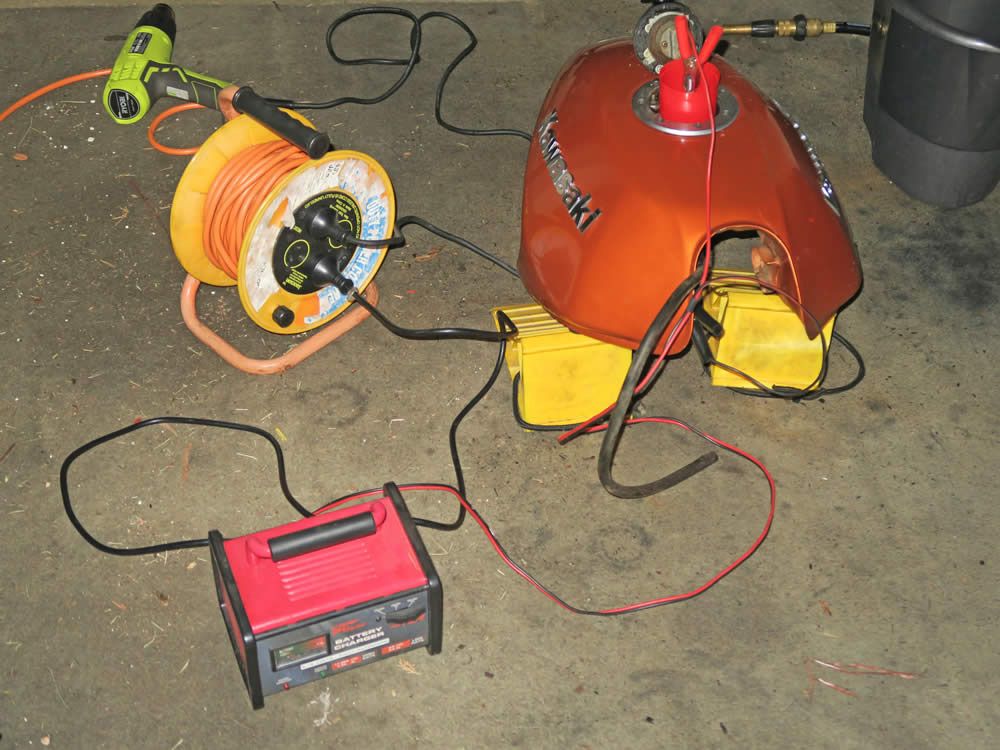
Initially, I connected the charger directly to the fuel tank. This didn’t work, and I eventually realised that the charger was shutting off automatically.

Kawasaki_Balius_10_3_5_2016.jpg


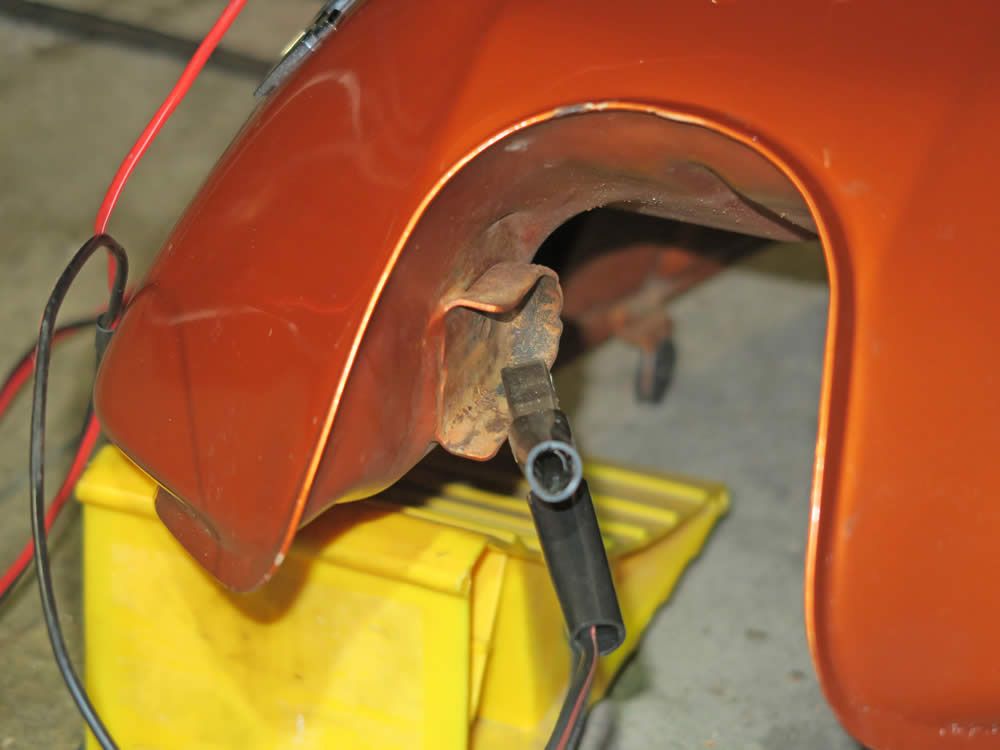
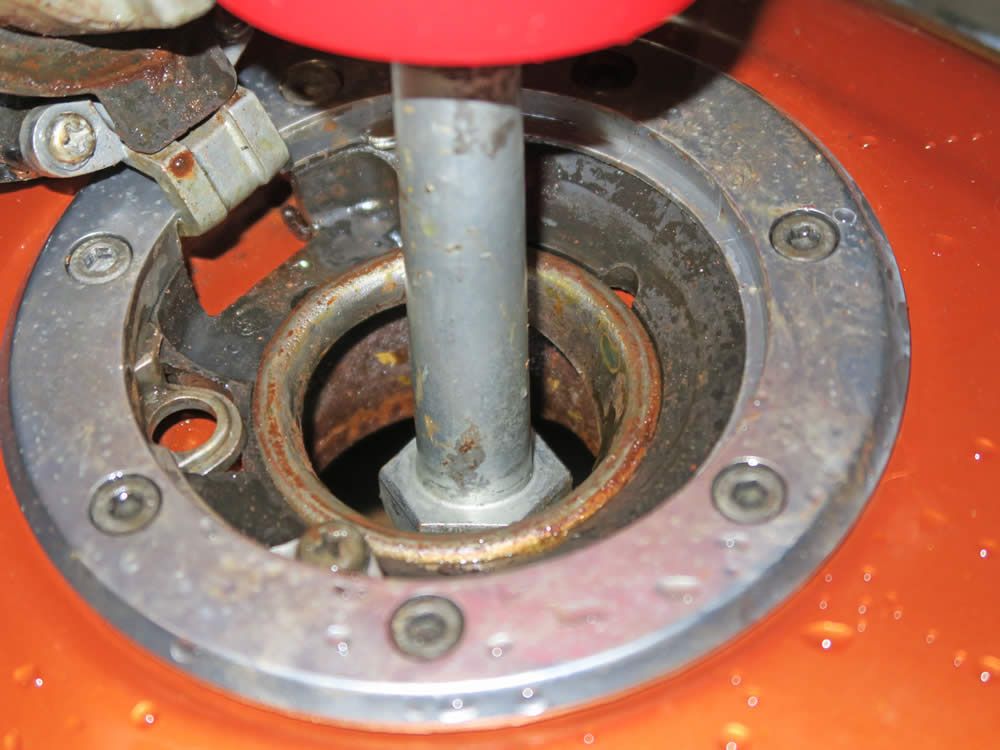
The negative lead is on bare metal.

Kawasaki_Balius_18_2_5_2016.jpg


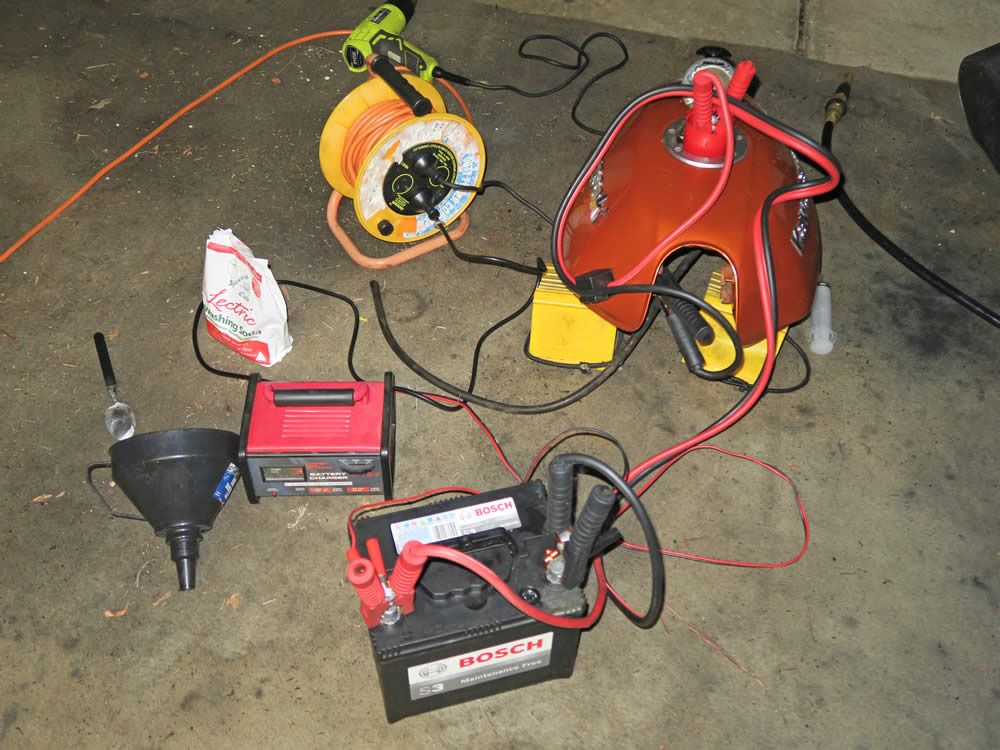
Then I tried running it through a car battery. This worked at first, but the jumper leads from the battery to the fuel tank got extremely hot - including melting the rubber at each clamp end.

For a short while there was bubbling, but it didn’t last for long.

It’s possible (ie likely) that the car battery is stuffed. Is that the problem?

What am I doing wrong here?

Kawasaki_Balius_04_4_5_2016.jpg
 
To avoid these ads, REGISTER NOW!

KenC

Well-known member
Joined
Dec 20, 2009
Messages
2,577
How is the positive lead connected in the tank? Is it possible that there is direct contact?

Pic of what you have in the tank would help, not liquid, just the electrical stuff.

And, running the battery leads direct provides no way to control the current, other than the resistance of the electrolyte. if it has very low resistance, or the probes are touching it would get very hot.
 

Steevo

Well-known member
Joined
Aug 18, 2009
Messages
8,738
Location
43.49600, -112.04300
So, what is hanging from the positive lead, and is it hanging only in the solution (by the way, what are you using for solution?), and not actually touching the steel tank anywhere?
You need the anode (what hangs from positive lead) to be steel.

This is a unique electrolysis application. I have never seen anyone use electrolysis to clean the inside of a M/C tank. Probably because the inside tank surface is so large, and the possible anode surface is so small, that it will rapidly rust up the anode and cease functioning. You then need to replace the anode and run some more.
 
Last edited:

ZRX61

Well-known member
Joined
Aug 15, 2006
Messages
28,716
Location
Solar Blight Valley, SoCal
Trying to de-rust a motorcycle gastank using that method is pretty much ******* into the wind anyway. Chemical is much faster/efficient, even if you only used vinegar.
 
OP
P

PhilMeUp

Well-known member
Joined
Jun 25, 2014
Messages
104
Location
Perth, Western Australia
How is the positive lead connected in the tank? Is it possible that there is direct contact?

Pic of what you have in the tank would help, not liquid, just the electrical stuff.

And, running the battery leads direct provides no way to control the current, other than the resistance of the electrolyte. if it has very low resistance, or the probes are touching it would get very hot.

Full set of photos: http://2fiftycc.com/index.php?threads/reminiscing-about-my-old-balius.8630/page-2#post-88762

This didn’t work at all, presumably because the charger automatically turned off the charge:

Kawasaki_Balius_10_3_5_2016.jpg


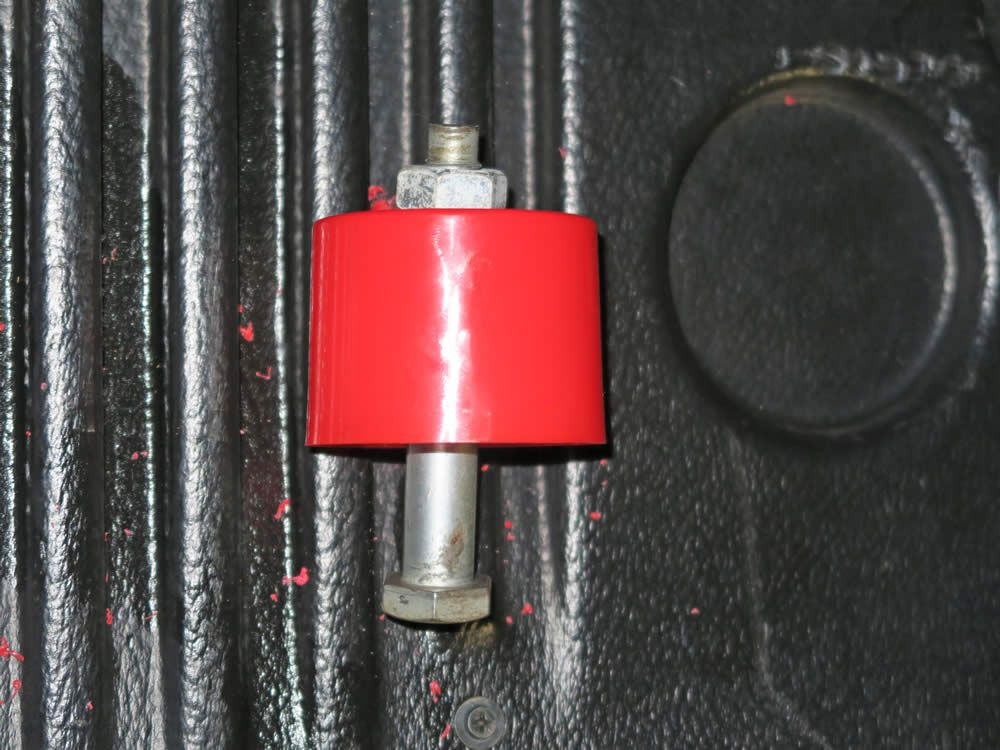
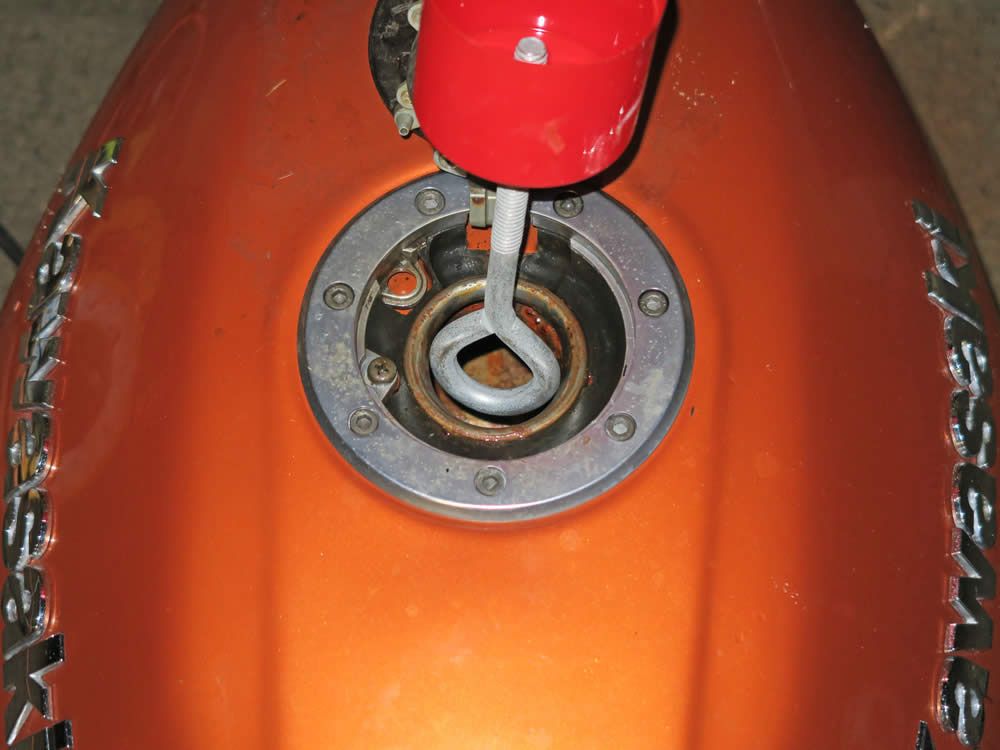
Initially I used a bolt and an aerosol can cap, but then replaced the bolt with an eye-hook bolt (slightly more surface area).

Kawasaki_Balius_08_2_5_2016.jpg


Kawasaki_Balius_12_2_5_2016.jpg


Negative lead has been connected to bare metal on the fuel tank:

Kawasaki_Balius_18_2_5_2016.jpg


The eye-hook bolt:

Kawasaki_Balius_03_3_5_2016.jpg


At one point there was bubbling and hissing, but the jumper lead cables got very hot.

So, what is hanging from the positive lead, and is it hanging only in the solution (by the way, what are you using for solution?), and not actually touching the steel tank anywhere?
You need the anode (what hangs from positive lead) to be steel.

This is a unique electrolysis application. I have never seen anyone use electrolysis to clean the inside of a M/C tank. Probably because the inside tank surface is so large, and the possible anode surface is so small, that it will rapidly rust up the anode and cease functioning. You then need to replace the anode and run some more.

I’d never even heard of this concept until last week. I did some Google searching (ie “using electrolysis to clean rust out of a gas tank”) and found information about it on car and motorbike forums everywhere. Figured I might as well give it a go.

When I was looking at this on various car and motorbike forums it was commonly noted that the electrode needs to be removed and cleaned regularly (ie every few hours).

Trying to de-rust a motorcycle gastank using that method is pretty much ******* into the wind anyway. Chemical is much faster/efficient, even if you only used vinegar.

Yep, there will be chemicals later. I figured that electrolysis was worth a go after seeing it used successfully on numerous motorbike and car forums.

When I went looking for a way to clean the rust out of the tank one of the most common Google search results was electrolysis. There are threads on motorbike forums everywhere showing good results, so I figured that was a good way to start. It was also the cheapest option ($4 for the washing soda).

For the sacrificial anode I'm currently using a steel eye-hook bolt (which has the positive lead connected to it). I've made sure that the bolt doesn't come into contact with the fuel tank in any way.

For the water, I’ve used the same washing soda and ratio (one tablespoon per 4 litres of water) as this guy:


Another clip:


Other info that I referred to:

http://caferacersunited.com/how-to-remove-rust-from-a-fuel-tank-electrolytic/

Other web sites said to use one tablespoon per 4 litres of water, but this one said one tablespoon per litre:

http://www.instructables.com/id/Electrolysis-rust-removal-motorbike-fuel-tank/?ALLSTEPS

I’ll probably end up using a POR15 kit, but want to see how far I get with electrolysis first:


oldtractors

Well-known member
Joined
Nov 19, 2007
Messages
374
Location
Iowa
I successfully cleaned a Z1 Kawasaki tank with electrolysis. I used a hunk of rebar and an old school battery charger. My current electrolysis tank is a 250 gallon tote. I use the same battery charger.
 

taumac

Well-known member
Joined
Aug 30, 2011
Messages
8,104
Location
Brooksville, Fl
It was, but I stripped it back to steel with a drill and wire brush.


Ok but probably better off getting reg old steel bolt. Make sure your neg has good connection. The better the bare metal is the better in works. Make sure that plug your holding the eye bolt allow tank to vent.
 

MFolks

Well-known member
Joined
Feb 3, 2013
Messages
1,045
Location
Springfield Mo.
Try this chemical process:

Oxalic Acid Rust Removal On Gas Tanks(Found On the internet at www.wgcarbs.com)

Just ordered a few pounds of it this morning, it "should" remove the rust in my Kaw tank and it's great for removing rust on shop tools or whatever too.

(Or try the wood bleach made by savogran, available at most hardware stores.)

I used this stuff while I lived in Florida where the humidity usually averaged 100% and it saved me a lot of labor ... it's Eco friendly too. Our humidity here in Alabama is just about as bad as on the gulf coast ... so even if it won't completely clean the tank rust out ... and I truly believe it will ... I can make good use of it

Don't know why I didn't think about it sooner, mixes with tap water, flushes out easy, it won't harm paint, plastics, aluminum or anything of that nature ... just kills the rust and leaves the metal coated to help prevent future rusting.

The guy's name is Gregg and he has a ebay store but you can buy directly from him, send payment by check or paypal. I talked to him yesterday and told him there would probably be more folks from the forum inquiring about it. He said to have whoever calls or emails to remind him they're from the forum.

It sells for $4 a pound and he can fit 4 pounds into a flat rate priority mail package and ship it for $4.95. So 4 pounds should go along way since it can be used over and over again. $20.95 for 4 pounds shipped isn't bad at all in my opinion. The only way he's making any profit on it is by buying LARGE quantities and selling small.
I'm probably going to set up a large vat to soak tanks and tools in.
This stuff will eventually turn black after heavy use but it still cleans good and washes clean with tap water.
He claims he's had several people use it for cleaning rusty tanks with great results and I know I had good luck with it before too, just never used any on a tank ... but will soon.

Here's his info: Best to try his cell first.

Gregg MacEllven
Sea Shield Marine Products (sales rep)
Mac's Pacs; teak/mahog plugs, flax, oxalic, etc.
[email protected]
310-547-2687 (home)
310-547-2606 (fax)
310-721-9667 (cell)

Late yesterday afternoon I mixed up a batch and put it inside my original KZ tank.
The tank had what I would call a medium overall surface rust throughout the inside and a fairly heavy rust build up along the entire bottom surface.

The instructions suggest warm water but I talked with Gregg and he said it wouldn't really matter as long as I wasn't looking for INSTANT results and let it soak so I used unheated water from the hose and about 8 heaping tablespoons of Oxalic acid and let it soak for 24 hours.

I just drained the tank and the water was colored kind of a light brown, I flushed the tank with clean water twice and looked inside as far as I could see with a strong miniature LED flashlight and NO RUST was present ANYWHERE including the bottom surfaces.
The Oxalic acid left behind a off white colored protective coating on the metal surface just like Gregg said it would

Once I got the tank dry I saturated a shop rag with gas and rubbed the white coating with it and the coating stayed put.

But ... I will highly recommend you folks give this stuff a try because it sure takes the work out of removing rust from our gas tanks and it did not faze the paint either where I overfilled it.

This old tank will get repainted and used now that the rust is gone ... but for you folks that have internal surface rust on tanks that still have good paint on them, don't worry ... this is the ticket right here !

I can tell you right now that it works very well, the tanks I cleaned back in November have sat in my shop until I decided to tag & drive my 78 KZ a few days ago.

I looked at all 3 tanks & they still looked rust free inside other than a small haze which may be simply what the metal looks like after sitting so long after being treated. I thru a 1/2 gallon of gas in it, sloshed it around, poured it out, installed the tank with clear gas line & the fuel runs out CLEAN ... no rust deposit showing up in the filter either !

Oxalic acid WORKS better than anything I've ever tried in 30 years of wrenching. Use hot water, mix it up double or triple strength, fill the tank to the rim and let it sit overnight. If you don't get the results you want, do it again, this stuff is cheap and WILL clean the rust out of tanks without harming the paint even.

I kept several gallons of used mix in a large plastic container & constantly throw stuff in it like a set of rusted boat trailer wheels, impact sockets etc. & it cleans them like new, may take a while but it works.


Some tanks may require more acid to do the job but this stuff is cheap & easy to use, won't even burn the grass when poured out.

I did a Honda tank for a buddy that had some ridiculous rust along the inside bottom flat areas & top part of the hump. I tripled the recipe & let it sit a couple of days and it came out CLEAN.

Would rather NOT use a tank liner product that may or may not peel away ... oxolic axid won't hurt the paint either, so that's a huge plus.
 

nickelmore

Well-known member
Joined
Apr 27, 2015
Messages
319
Location
50 miles from Chicago
That will work, another option is to put a larger steel rod inside a PVC pipe that is cut full of slots. that way it wont short out on the bottom and you cna get a larger piece of steel.

Current has a lot to do with it as well. the more the better.
 

greasyfingers01

Well-known member
Joined
Apr 6, 2015
Messages
143
You can use washing soda or baking soda. Washing soda works better. Are you using an automatic charger? If so it won't work. You need an old school charger that stays on till you turn it off.

Sent from my SM-N910V using Tapatalk
 

crerus75

Well-known member
Joined
May 2, 2011
Messages
301
If you're heating up a set of battery cables and ruining batteries, your problem is excessive current draw. This implies a short circuit somewhere (probably the anode making contact with the tank). How much current does the ammeter on your battery charger indicate?

I de-rusted a Triumph TR6 gas tank with a battery charger, a couple of threaded steel rods suspended in the filler neck, and a saturated solution of washing soda (no more would dissolve in the water). Even with this concentrated solution and with more anode surface area than you have, I was pulling less than 10 amps (I want to say about 5 or 6, and I did measure with an ammeter at the time, but I no longer remember how high the current was). I used 12 gauge wires to connect everything and they didn't even get warm. Double check your connections, because I'm betting on a short somewhere.
 

Justind97

Well-known member
Joined
Oct 6, 2014
Messages
691
Location
Ottawa, Canada
If you're heating up a set of battery cables and ruining batteries, your problem is excessive current draw. This implies a short circuit somewhere (probably the anode making contact with the tank). How much current does the ammeter on your battery charger indicate?

I de-rusted a Triumph TR6 gas tank with a battery charger, a couple of threaded steel rods suspended in the filler neck, and a saturated solution of washing soda (no more would dissolve in the water). Even with this concentrated solution and with more anode surface area than you have, I was pulling less than 10 amps (I want to say about 5 or 6, and I did measure with an ammeter at the time, but I no longer remember how high the current was). I used 12 gauge wires to connect everything and they didn't even get warm. Double check your connections, because I'm betting on a short somewhere.

I think his issue is exactly that. He may have missed the step of having to isolate the anode from the tank and ensure that it is only making contact with the water in the tank.
 
To avoid these ads, REGISTER NOW!

Ed ke6bnl

Well-known member
Joined
Aug 1, 2005
Messages
495
Location
Agua Dulce, Calif.
I have a solution of PH plus sodium carbonate from a pool supply store. 1 tablespoon per gallon and a 12 amp MANUAL old style charger and it is drawing max. 8 amps. It must be an old school manual charger I believe because some of the newer one will not charge a dead battery unless there is on some 4 volts min. THAT MAY BE YOUR PROBLEM possibly.
 

devildog93

Member
Joined
Apr 20, 2016
Messages
19
Location
Oklahoma City
I just got done removing the rust from a 1964 road wheel off a riviera. I used a plastic tub, washing soda, and a 10/50 amp napa charger. The plastic tub i used was the kind with the folding tops that most garage guys have a few of. I used a piece of 1/4" rebar as the sacrificial metal.

It took me about 4 days to get it back to base metal at 10 hours a day. I used a cup of washing soda, which is about as much as i could get to dissolve. It was pretty much set up and forget about it until the afternoon. I did half a wheel at a time, so if i had a bigger tub i could have done it in 2 work days. The rust on the inside was scaly and took a couple of passes to all come off. Every morning i would set it up, and every afternoon i would unhook it, wire brush the loose garbage off the wheel, rinse and wire brush the rebar and set up for the next day.

A couple of things i noticed as i was doing it. Stopping midday and cleaning the rebar and wheel again sped things up a bit. As the rebar gets coated with rust the amps go down a bit. Cleaning it twice a day i managed to keep the charger running about 5 amps and the wires were just warm.

As to the original setup, i would just a base metal with no coating, such as flat stock iron or rebar as the sacrificial metal. Negative goes on the base metal. Positive on the part you are trying to de-rust. The setup looked fine so i'm not sure what you have going on. Try a different charger or somehow measure the output of what you are trying to use.
 

brownbagg

Well-known member
Joined
Mar 20, 2006
Messages
5,208
get rid of the bolt and find you something soft metal, the bolt too hard, I use a piece of copper pipe that i flatten out. a strip of lead work great, so does bronze
 

G_P

Well-known member
Joined
Jul 11, 2010
Messages
7,135
Location
Central CT
Sounds like the bolt is too close to the bottom of the tank. Maybe the buildup on the bolt is growing until it touches the tank and shorts it all out?

It should never generate enough heat in the wires to start melting insulation.
 

greasyfingers01

Well-known member
Joined
Apr 6, 2015
Messages
143
You need to use ferrous metal, nothing galvanized, and definitely not copper as someone mentioned lol. Get a piece of rebar, a manual charger, and get a better negative contact. Where you have it looks painted so you are likely not getting good contact.

Sent from my SM-N910V using Tapatalk
 

LS6 Tommy

Well-known member
Joined
Dec 27, 2013
Messages
26,162
Location
Northern NJ
Sounds to me like your very close to creating a dead short. How about filling it with Metal Rescue/Evapo-Rust and just let the chemicals do their thing?

Tommy
 

KenC

Well-known member
Joined
Dec 20, 2009
Messages
2,577
As mentioned in my first answer post: high current is due to a low resistance circuit. Maybe I wasn't clear enough, but it's caused by Cathode/anode to close together or too much soda in the solution. And, with the battery in the circuit there is no limitation on the flow except those factors. With an old style charger alone, it will limit its' output.

But, if it were me, I wouldn't mess with electrolysis, order up some oxalic acid, or spend the money for a commercial product like Evapo-rust. Just go to the cheapest store you have that sells vinegar and buy enough to fill the tank. Soak, rinse, repeat until rust gone. Probably cost 4-5 bucks.
 

metalmagpie

Well-known member
Joined
Nov 1, 2011
Messages
796
Location
Seattle
You are using the wrong power supply and the wrong anode.

Rather than use a piece of steel I use lead now. The lead oxidizes just like the steel does but lead oxide is just as conductive as metallic lead unlike the situation with steel, where rust is high resistance.

I gave up using el cheapo car battery chargers long ago. Now I use a proper DC power supply. For that setup I'd run about 10-15 amps of current, whatever voltage it takes to push that through.

There is no reason that electrolytic derusting won't work for you if you do it right.

metalmagpie
 

jask

Well-known member
Joined
Jul 4, 2009
Messages
314
Location
Gods Country, B.C.
Oxalic acid is great stuff, but it is not benign... wear gloves as it will strip the oils from your skin with extended contact and leave them dry and prone to cracking... if you are handling iron or steel while it is on your hands you will also acquire a blue black tinge in the contact areas that can last several days. if you are splashing it around wear eye protection..right? if you are not patient enough to wait for the mail a lot of wood bleach/deck cleaner products are based on oxalic acid- so is Bar keepers friend. if you ever leave something ferrous on a wooden surface and end up with a black stain this is the product you want to use to make it disappear..mix up a solution and just keep wetting it on till the iron oxide stain is bleached away.

I have also used the molasses and hot water solution and it works fantastic when given a few days to do its magic.... and you can buy it anywhere... and pour it down the drain when you are done.
 
Last edited:

DenisG

Well-known member
Joined
Jul 14, 2013
Messages
1,278
Location
Milwaukee
Wrap the anode (negative plate) with some nylon or polyester cloth. Even better sew it on. Use some insulation on the electrical wire connecting the anode so it doesn't make a dead short against the inside tank metal (cathode - positive plate).
Plating is just an electrochemical process and the setup is similar to how a battery is constructed. Many batteries use porous plastic or paper material to keep the anode and cathode separated.
If you wrap the anode in cloth, you can also increase the surface area of the anode by wrapping the sheet metal (in a way that exposes more surface inside the tank without shorting to the tank) and attaching your wire to that. Ideally it's good to have the area of the two electrodes (cathode and anode) matching in surface area for best efficiency, but at least you can improve you setup this way.
 
Last edited:
To avoid these ads, REGISTER NOW!
Top Bottom