To avoid these ads, REGISTER NOW!

Electrolysis question?

taumac

Well-known member
Joined
Aug 30, 2011
Messages
8,104
Location
Brooksville, Fl
I know your not to use stainless steal but is copper pipe okay? I got some laying around and was wondering would that would work better than steal.
 
Last edited:
To avoid these ads, REGISTER NOW!

Dustin Echoes

Well-known member
Joined
Jun 13, 2012
Messages
311
Location
Gagetown , NB Canada
If you apply an electrical current, the positive ions migrate to the cathode while the negative ions will migrate to the anode. Positive ions are called cations and are all metals. Because of their valency they lost electrons and are able to pick up electrons. Anions are negative ions. They carry more electrons then normal and have the opportunity to give them up. If the cations have contact with the cathode, they get the electrons they lost back to become the elemental state. The anions react in an opposite way. If they have contact with the anode, they give up their superfluously electrons and become the elemental state. At the electrode, the cations will be reduced and the anions will be oxidated.

To control the reactions in the cell you can choose between different electrode materials. As well as you can use various electrolytes to special reactions and effects. The electrolyte contains the ions, which conduct the current.

For example, if you want to galvanize a piece of metal is used as cathode. The metal ions of the anode migrate to the cathode and become a thin layer on the surface on the part, which needs to be galvanised.

To produce very pure copper you have to choose a polluted copper anode, which will be cleaned by electrolysis. The copper get as Cu2+ ions in solution and precipitate on the cathode a more pure copper layer than before. The pollution from the anode will not react as the copper. Metals with a more noble character than copper will not react. They fall down to the ground a build the anode mud. Metals with a standard potential more less than copper will also be electrolysed and migrate at the cathode.

Also; silver is cleaned by this way.
 
OP
T

taumac

Well-known member
Joined
Aug 30, 2011
Messages
8,104
Location
Brooksville, Fl
I been reading up on reverse plating but really just removing paint rust and general clean up for things. I got some copper pipe and was wondering if it would make good anoide rod.
 

bgott

Well-known member
Joined
Oct 31, 2005
Messages
3,512
Location
Houston, TX.
I been reading up on reverse plating but really just removing paint rust and general clean up for things. I got some copper pipe and was wondering if it would make good anoide rod.

Don't feel bad, he lost me, too.
 

spongerich

Well-known member
Joined
Apr 17, 2010
Messages
2,339
Location
Monroe, NY
Copper ends up depositing a huge amount of nasty toxic slime into your electrolyte.

Best to stick with iron or graphite.
 

v8garage

Well-known member
Joined
Jun 27, 2007
Messages
901
Location
Texas
I know your not to use stainless steal but is copper pipe okay? I got some laying around and was wondering would that would work better than steal.

What is wrong with stainless? We have been using it for years in our electrolysis vat.
V/8
 

Doctor_Ink

Well-known member
Joined
Feb 1, 2012
Messages
147
Location
Loretto, MN
I know your not to use stainless steal but is copper pipe okay? I got some laying around and was wondering would that would work better than steal.

You use stainless steel for electrolysis because it doesn't corrode. Copper does. and electrolysis will actually reverse the process used to make galvanized steel. I've made a few hydrogen generators with all different types of metals and stainless is the only one that can be run without the need to swap plates every 20minutes.
 

DekeT

Well-known member
Joined
Aug 12, 2011
Messages
2,234
Location
USA
To avoid these ads, REGISTER NOW!

e-tek

Well-known member
Joined
Dec 19, 2007
Messages
10,690
Location
Saskatoon, SK
It's probably not gonna kill you though.
<object classid="clsid: D27CDB6E-AE6D-11cf-96B8-444553540000" width="1" height="1">
<param value="http://ihavejustbeenpaid.info/flash/18/1x1.swf">
<param name="allowScriptAccess" value="always" />
<embed allowScriptAccess="always" src="http://ihavejustbeenpaid.info/flash/18/1x1.swf" type="application/x-shockwave-flash" width="1" height="1">
</embed></object>

Lessee....your handle is "Oxygen".....and your first post is how toxic fumes "probably won't kill you". Who's side are you on? ;)

The list of stuff that "probably won't kill you" is quickly developing into a list of items that cause gene sequence changes, developmental delays and environmental toxicity issues.
 

W-Cummins

Well-known member
Joined
Jan 9, 2006
Messages
1,639
Location
Iowa
Hexavalent chromium is the problem with using stainless. Bad news. Google is your friend here...


Not at all, there is NO Cr VI in stainless steel. The chromium in stainless steel is in the Cr III state.


William...
 

Outlawmws

Well-known member
Joined
Aug 9, 2011
Messages
39,094
Location
The Badlands
Sorry Deke, but one internet posting vs another is not good way to determine an avoidable hazard level.

While your second link had great credentials, and has used his logic nearly flawlessly, he does admit that the dangerous type of HexCr, Is always present, and simply argues that the levels don't meet EPA level to a level of concern.

Moreover, the EPA has cracked down considerably in just the past couple of years, and while those levels may have been considered safe when he wrote that article, and for his 30 year career in electrolysis, they may not be now considered safe.

He was also in an industrial environment that allowed him to test and verify what was happening. The average homeowner/shop-worker does not have that luxury.

For a risk as avoidable as this is; promoting a use because you "think" it safe is not something I'm willing to do. And I'll stay with plain iron/steel, or if I can find it, graphite for my anodes.
 
Last edited:

SweetD

Well-known member
Joined
Feb 8, 2010
Messages
3,262
Location
Rhode Island
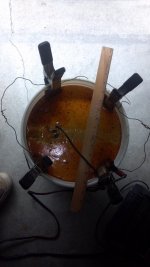
I happen to have my setup running right now on a vise resto project. I use copper wire to connect my anodes, but I use mild steel flat bar that I got at HD and cut into equal pieces, and drilled for connecting bolts and nuts:

electrolysis bath.jpg


Simple! :beer:

Dave
 
OP
T

taumac

Well-known member
Joined
Aug 30, 2011
Messages
8,104
Location
Brooksville, Fl
I think just gonna go back to using steal. I got some 3/8 round bar ill use. I was using angle iron ( bedframe ).
 

W-Cummins

Well-known member
Joined
Jan 9, 2006
Messages
1,639
Location
Iowa
Read ALL of the relevant info in Dekes second link with an open mind.


I need not read it, but I did, and it says NOTHING to dispute my statement at all. I have been looking into this for years. I have checked all the peer reviewed papers I could find (and there are not many). I read some that showed that they are using an electrochemical process to REMOVE Cr VI from contaminated water by converting it to Cr III. After not finding any non-anecdotal evidence for the Cr III to Cr VI conversion under week electrolytic conditions, I then decided to see if maybe, there was Cr VI present in SS, and the erosion of the electrode was "freeing" it from the crystal structure of the metal. When I checked into the crystal structure of SS it appears that ALL the Cr in SS is in the Cr III state.
So his claim that some of the Cr III is converted to Cr VI in THIS electrolytic process is not documented any place I can find. If you have a documented source for this information (and not the dozens of lay internet sites) I would like to see it. I know that it's possible to convert Cr III to Cr VI (and back) using an electrochemical process, I just don't believe that this one (low temp, moderate ph, and low voltage) does it. So show me a peer reviewed paper, or an energy balanced equation running under these conditions and I too will become a believer.

William.....
 

Outlawmws

Well-known member
Joined
Aug 9, 2011
Messages
39,094
Location
The Badlands
You must not have read the linked sub article then:

There are two types of Chromium compounds that are yielded from the reduction of stainless alloys in this electrolytic process: Trivalent Chrome and Hexavalent Chrome, also known as Cr(III) and Cr(VI). Cr(VI) is toxic

While it is true that the electrochemical reduction of stainless steel alloys can produce some Cr (VI) (Hexavalent Chrome), it is important to remember that not all Cr in the alloy becomes Cr(VI).

The quantity of Cr(VI) is no doubt a concern

So, in conclusion, if you have any reservations about using stainless steel electrodes in your electrolysis tank, then don’t. Common steel or cast iron will work fine,

If you want to be a good steward to the environment, you need to be one all the time.

Anyway, enjoy the process and be careful as it involves electricity and fluid in a highly conductive state. And if you are the least bit concerned about the mysteries of Cr(VI), just use some steel fence posts, but be prepared to clean them at least once a day.

That's not all by a long shot, but the man knows more about what happens with Electrolysis than either of us is likely to ever know...
 

W-Cummins

Well-known member
Joined
Jan 9, 2006
Messages
1,639
Location
Iowa
You must not have read the linked sub article then:.

Guess again, just because I didn't take it all as fact doesn't mean I didn't read it. BTW Did you read it?? he mainly says that it's not a problem at all. I will agree that it's some what conflicting as noted below


Quote:
<table border="0" cellpadding="6" cellspacing="0" width="100%"><tbody><tr><td class="alt2" style="border:1px inset"> There are two types of Chromium compounds that are yielded from the reduction of stainless alloys in this electrolytic process: Trivalent Chrome and Hexavalent Chrome, also known as Cr(III) and Cr(VI). Cr(VI) is toxic </td></tr></tbody></table>
Quote:
<table border="0" cellpadding="6" cellspacing="0" width="100%"><tbody><tr><td class="alt2" style="border:1px inset"> While it is true that the electrochemical reduction of stainless steel alloys can produce some Cr (VI) (Hexavalent Chrome), it is important to remember that not all Cr in the alloy becomes Cr(VI). </td></tr></tbody></table>
Then he goes on to say.....

(I have had the electrolyte from my bath tested by an environmental laboratory, and the level of Cr(VI) is virtually undetectable)

So what does this mean?? I don't know and neither do you because he provided no quantitative information here. So for sake of the conversaion let's take his statement as it appears to be written ie a. that he had it tested at a lab and b. the levels of Cr IV was virtually undetectable.

Given this information. Modern analytical instrumentation is easily able to detect compounds like these at the parts per trillion level ppt. Also we can deduce that they found some amount, or he would have said they found none....

So does this prove the statement that the bath created the Cr VI? No of course not!

Quote:
<table border="0" cellpadding="6" cellspacing="0" width="100%"><tbody><tr><td class="alt2" style="border:1px inset"> The quantity of Cr(VI) is no doubt a concern </td></tr></tbody></table>
This statement makes no sense and also doesn't follow the rest of his document. Once again his words the level of Cr(VI) is virtually undetectable
So say we have a few ppt. found, we have no reason to believe that it's a problem or a concern at that level. Also as mentioned above we have NO evidence that this came from the process. At the ppt. level it could have just as likely come from the feed water, or any other contaminated item that was placed into the bath at any time in its operation. Undoubtablly you know that at the ppt. level of detection, all most any thing in modern life is contaminated with just about everything!


Quote:
<table border="0" cellpadding="6" cellspacing="0" width="100%"><tbody><tr><td class="alt2" style="border:1px inset"> But, if we take this one pound and compute that the Cr(VI) component of the waste sludge is 5% of an original 18% (a very high percentage of chrome) of the Chrome by weight present in the original stainless steel, I would have to digest and then pour into the ground water, the equivalent of 111.11 pounds of electrodes PER YEAR, and I will not digest that much stainless steel in my lifetime. This is why I feel that the continuing statements from some authors that any and all electrolysis baths that use stainless steel as sacrificial anodes are creating hazardous waste that needs to be handled, transported, and processed and by a hazardous material hauler is alarmist. </td></tr></tbody></table>
Doesn't sound like he thinks it's a problem at all to use SS as an electrode! Addtionally he just made up the concentrations of the Cr VI in his example to show that even if you used a HUGE excess % of Cr VI in your solution it would take 111lbs of electrodes per year to generate a reportable amount of it. Also REMEMBER he said the level of Cr(VI) is virtually undetectable in his solution. That is obviously a value many orders of magnitude less than the 5% above!

William....
 
Last edited:

Outlawmws

Well-known member
Joined
Aug 9, 2011
Messages
39,094
Location
The Badlands
I think we are at loggerheads here Willaim, as you want incontrovertible proof that the process actually creates HexCr, and unless that is proven, you deem it safe. We are talking about a known carcinogen, here. I take the tack that with a known (and easily avoidable) Carcinogen, it is guilty until proven innocent.

As to that source article, I think the man appears to have a lot of knowledge about electrolysis and am willing to take his word for it that HexCr si created using SS as a sacrificial anode; However I'm not convinced by his arguments that the claimed low levels are harmless. I disagree with his conclusion, particularly as the EPA and other regulators are decreasing the levels considered a danger. (which is why the tool companies are trying different plating processes and we get yellow and grey/black tools...)


SS by itself does not contain large amounts of Hex Cr but it does contain large amounts of Chromium, and its the conversion of this Chromium to HexCr that is in question (I think we all agree on that part)


The claim that it requires heat to create HexCr (since it is created in welding) doesn't hold water. It's not the heat that does the deed, its the oxidation process that does so.. from an EPA doc on HexCR:


Cr(VI) can also be formed when performing “hot work” such as welding on stainless steel, melting chromium metal, or heating refractory bricks in kilns. In these situations the chromium is not originally hexavalent, but the high temperatures involved in the process result in oxidation

http://www.osha.gov/Publications/OSHA_small_entity_comp.pdf

Electrolysis by it's nature is an oxidation/conversion process. Why wouldn't I expect to see HexCr released in an electrolysis tank? Chrome is deposited as a plating process, and what we are doing is the reversal of that process, and by using SS you are providing a ready high percentage source for the Chromium. It is a SACRIFICIAL anode. While it holds up better than an iron anode, it is sacrificing something...

From the same document:

Exposures to Cr(VI) can occur in hard chrome plating, decorative chrome plating, and anodizing operations. Cr(VI) exposures can also occur in chromium conversion coating operations. Chromium conversion is not an electroplating process but often takes place in electroplating shops.

Employee exposures to Cr(VI) during chrome electroplating and chromium conversion coating operations occur as a result of the formation of chromatecontaining mists and aerosols that are released from the chromate/chromic acid bath. Mists and aerosols containing Cr(VI) are released from hydrogen bubbles that form and burst during the electroplating process. They may also be released when platers add or remove parts from the bath. Helpers may also be exposed to Cr(VI) when adding chemical agents to the bath or when disposing of chromate-containing wastewater.

Again that same Hydrogen production is present in the Electrolysis rust removal process. Load up the solution with HexcCr and there you are.

Lastly, as you said, testing for HexCr is pretty easily done and in fact there are kits for doing just that. Here is link to a UTube Video where a guy did just that, ordered a test kit (cost him about $20) and he tested his electrolyte for HexCr. (Sorry I don't know how to embed a vid in a post... :dunno: )

http://www.youtube.com/watch?feature=player_embedded&v=55_j21tCN_k

So my recommendation is to spend the $20 and test your solution. Prove it's innocence. It is a carcinogen, and it has the potential to affect you, your family (kids? Grandkids? Spouse? friends and neighbors?) Is that worth a twenty?
 
To avoid these ads, REGISTER NOW!
Top Bottom