To avoid these ads, REGISTER NOW!

Electrolysis safe for precision parts?

bareass172

Well-known member
Joined
Aug 5, 2012
Messages
817
Location
N'awlins
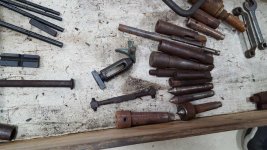
I recently acquired a new lathe and some of the accessories are rusty. Some a little, some a lot. Can I use electrolysis to clean these parts since that should only remove rust? If it depends on the piece/part can you give me an idea of what to watch out for?

Most of what's rusty is dead centers, tool holders, a wrench, a key for a chuck, and simple items like that which aren't as "precision" as the big parts like ways, tail stock, carriage, etc.

Any guidance is appreciated. :beer:
 
To avoid these ads, REGISTER NOW!

paulsomlo

Well-known member
Joined
Jul 16, 2013
Messages
3,949
Location
Northern Colorado
I think you could use electrolysis on all of it. Small parts, like fasteners and such, that can be packed tightly can be put into a container with Evaporust. What kind of lathe did you get?
 

spongerich

Well-known member
Joined
Apr 17, 2010
Messages
2,339
Location
Monroe, NY
Electrolysis will only attack rust. Any good (ferrous) metals will be just fine.

I'd highly recommend getting some graphite electrodes as they make much less of a mess and the parts will come out a little cleaner. Evaporust is good for smaller stuff, but it gets expensive.

Take a look at my How To thread for more information than you probably want.

http://garagejournal.com/forum/showthread.php?t=154196
 

Roberts210

Well-known member
Joined
Dec 21, 2015
Messages
3,177
Location
Missouri
The only problem will be trying to find a small part and fish it out of the bucket.

139521153.jpg
 
To avoid these ads, REGISTER NOW!

MBfreak

MEMBER EMERITUS
Joined
Dec 10, 2010
Messages
2,301
Location
Linkoping , Sweden
My $0,02.

As long as you have only ferrous parts I can not see a problem.
However, should there be some bronze bushings, copper gaskets etc they will loose some material that may be deposited on the clean ferrous surfaces.

This is based on my experience. Not a big problem, but may be noted.

Ola
 
OP
B

bareass172

Well-known member
Joined
Aug 5, 2012
Messages
817
Location
N'awlins
It's a Craftsman 101 series, I'm happy with it for what I'll use it for. I attached a picture to show what I'm needing. Almost all the precision pieces are fine, a couple have very very minor surface rust which I can wipe off with an oily rag. The centers are rusty and a couple other small items like the wrenches. What Sponge said about only attacking the rust was exactly how I always understood it to work, but wanted to check. I've read your thread Sponge, thanks for it. I was doing something a couple weeks ago and having problems so I referred to it often.

Thanks for the feedback, I'll probably get it cooking tomorrow or over the weekend.
 

Attachments

  • 20160301_112.jpg
    20160301_112.jpg
    161.1 KB · Views: 34
  • 20160301_122.jpg
    20160301_122.jpg
    158.6 KB · Views: 38

spongerich

Well-known member
Joined
Apr 17, 2010
Messages
2,339
Location
Monroe, NY
Those are definitely the best of the Atlas/Craftsmans.

There's good info on them at http://www.lathes.co.uk/craftsman/page4.html

Toss the centers and other rusty Morse taper stuff. They're hardly worth bothering with. If they're really pitted, they may not hold well and if they spin in your tailstock or spindle, they can cause galling which is the last thing you want.

That sort of tooling is cheap and plentiful. You're gonna spend a shitload of money on tooling anyway, so you'd might as well start now. :beer:
 

rlitman

Well-known member
Joined
Oct 18, 2010
Messages
24,736
Location
Long Island
...Toss the centers and other rusty Morse taper stuff. They're hardly worth bothering with. If they're really pitted, they may not hold well and if they spin in your tailstock or spindle, they can cause galling which is the last thing you want...

I wouldn't toss them so quickly. I also would not use electrolysis on any of this stuff.

A browned piece of steel is one which is less likely to further rust in the future. Think of the first layer of rust as potentially a protective layer.

Just do not try to use the rusty centers as-is. You MUST remove any loose rust first. I'd use a fine wire wheel (NOT a knotted wire wheel) until it is all gone. Then go over it with gun oil (i.e. a corrosion inhibiting oil) and steel wool until it feels smooth.

I feel it important to point out that rust PITS, which is what is left behind after the rust is knocked off, will do no harm in a taper, as they sit below the contact surface. However, loose rust, will sit above the taper's surface, and is a big problem. This distinction is important, as anything that sits above the surface will make the first contact with the morse taper socket and interfere with the fit, and that is where you will run into problems, just as if the surface has burrs (which can also easily be stoned off).

Just stick to a fine wire wheel and steel wool for cleaning. It won't do any damage.
Do not resort to abrasives, or even scotchbrite, on the taper mating surfaces. If you did that, THEN yeah, they're junk.
 
OP
B

bareass172

Well-known member
Joined
Aug 5, 2012
Messages
817
Location
N'awlins
Sponge, thanks for the link to that site. I found it when I was researching the lathe before I bought it and couldn't find it again afterwards. Bookmarked!
I was thinking more along the lines of what rlitman said - the rust, once cleaned, should not be a problem to fitment in the taper. I also think that much of what I see is a mix of dirt/old oil and some rust, but I see almost no rust that is bad enough that I expect heavy pitting. I think I'm gonna E-tank them and see what happens.
I really appreciate the feedback, I thought it would be ok but wanted to be sure there wasn't something I was overlooking since precision machines like this are fairly new to me. I understand machining and all the precision aspects of it, but I've never been entrusted with the care and maintenance of a machine before. ;)
 
To avoid these ads, REGISTER NOW!
Top Bottom