To avoid these ads, REGISTER NOW!

Electrolysis

VOH

Well-known member
Joined
Jan 2, 2009
Messages
102
Location
New Braunfels, TX
Has anyone had luck performing electrolysis with a new battery charger? I attempted this over the weekend and could not get my digital charger to start. Was able to get the same setup to work borrowing the neighbors "old" charger, which lead me to believe the digital one has some level of safety that was preventing it from starting.
 
To avoid these ads, REGISTER NOW!

dogdog

Well-known member
Joined
Nov 15, 2011
Messages
12,711
Any dc power supply will work for electrolysis. 10amp ish will work fine. 12v 10 amp is cheap
 

1320stang

Well-known member
Joined
Dec 28, 2006
Messages
4,571
Location
Edmond, OK
Not sure how big of setup your running but make sure its well ventilated if its on the bigger scale. I've had success with both it and molasses. Electrolysis is line of site whereas molasses gets all the crevices, it just stinks to high heaven.
 

bdbecker

ALLIANCE MEMBER
Joined
Nov 18, 2015
Messages
5,551
Location
Iowa
Any dc power supply will work for electrolysis. 10amp ish will work fine. 12v 10 amp is cheap

Sort of... I just built an electrolysis setup using a 12V/10A constant voltage power supply (temporarily mounted components to a board for testing)...

full


I'm learning some interesting things with this setup. The main thing is that if you don't have your anode and cathode surface area ratio setup correctly, you can easily overload a 10A power supply. In my case, I've got four pieces of 3" channel iron, roughly 12" long, spaced evenly around a 5 gallon bucket to serve as my anodes. When I put my axe head (cathode) in the bucket to clean it, the power supply will not turn on if all four anodes are connected. It will run around 7A with two anodes connected, which is a bit higher than I'd like to see.

Thankfully, @Uofime set me straight on using a constant current power supply instead of a constant voltage supply for an application like this. Basically, set the current to what you want and let the voltage vary as needed. I see the bench top power supply I had my eye on is on sale again, so I'll be placing an order and will repurpose the current components into a future project.

Power supply:

More info on my marginally successful build can be found here if anyone is interested:
https://www.garagejournal.com/forum/threads/the-****-shack.332912/post-10249360
 

Shiftless

Well-known member
Joined
Mar 9, 2014
Messages
14,512
Location
East Bay SFO
Hook up a battery in line to "trick" your charger. It worked for me

I thought about that. Thank you sir!
Yeah…that’s what you have to do with many “modern“ chargers.
Electrolysis has worked for me in situations where Evaporust did not.

For the benefit of those less experienced, what Mark probably means by “in line” is to hook up the battery to run your electrolysis set up and then clip the battery charger wires to the battery.
In technical terms this is a parallel connection and not an in line series connection.

Unless a guy is absolutely certain that wires will never touch, if there is a car battery involved, I recommend putting a fuse in the circuit. Maybe 10 amps. Short circuited car batteries can explode.
 
To avoid these ads, REGISTER NOW!

driftpin

Well-known member
Joined
Dec 22, 2016
Messages
11,218
Location
Miami-Dade/Broward Co. Florida
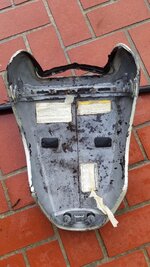
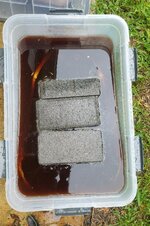
And if you're reluctant to work with electrolysis, cleaning vinegar, available at your grocery store. I've found 6% works well for my use, cleaning rusty tools and motorcycle gas tanks or other parts. Big Box Stores I've seen up to 30% concentration, I would dilute that to < 10%. Also be careful of trying to clean potmetal as it may just disappear.

Before
VMax vinegar.04.jpg

After
VMax vinegar.05.jpg

During
VMax vinegar-bricks.01.jpg

Bricks take up volume, so less liquid is required.

VMax vinegar-bricks.02.jpg

This was 6% vinegar, and 2 days.
 

dogdog

Well-known member
Joined
Nov 15, 2011
Messages
12,711
Sort of... I just built an electrolysis setup using a 12V/10A constant voltage power supply (temporarily mounted components to a board for testing)...

full


I'm learning some interesting things with this setup. The main thing is that if you don't have your anode and cathode surface area ratio setup correctly, you can easily overload a 10A power supply. In my case, I've got four pieces of 3" channel iron, roughly 12" long, spaced evenly around a 5 gallon bucket to serve as my anodes. When I put my axe head (cathode) in the bucket to clean it, the power supply will not turn on if all four anodes are connected. It will run around 7A with two anodes connected, which is a bit higher than I'd like to see.

Thankfully, @Uofime set me straight on using a constant current power supply instead of a constant voltage supply for an application like this. Basically, set the current to what you want and let the voltage vary as needed. I see the bench top power supply I had my eye on is on sale again, so I'll be placing an order and will repurpose the current components into a future project.

Power supply:

More info on my marginally successful build can be found here if anyone is interested:
https://www.garagejournal.com/forum/threads/the-****-shack.332912/post-10249360


Yes you are correct, just don’t connect too many anode, the initial current on fresh batch of water will be high it will dial down automatically

There are cc /cv controllers on eBay that you can convert your non regulated power supply to a regulated power supply or you can go low tech and ad an automotive auto reset fuse 10amp like the ones in the old chargers. (The one on the hf unit is a 30amp) I think they have different selections on the fuse isle.

I would go 24v if I were to add a cv/cc controller though. Voltage does matter. But higher voltage also gets hydrogen embrittlement on your cast iron piece. At least I think that is the real terms used. 🤔

And yes there are good power supplies and bad one, other than accuracy and ripple currents, the good ones have over voltage and over current protection.
 

BigMike782

Well-known member
Joined
Dec 19, 2008
Messages
1,852
Location
49120
I have always wanted to try electrolysis using my Syncrowave 250 as the power source but have never been brave enough.
 

dogdog

Well-known member
Joined
Nov 15, 2011
Messages
12,711
some guy here used his syncrowave or something tig welder for etching and that turned out well, not too sure if it is good for electrolysis dependents on the ocv some have as high as 48vdc open circuit voltage.
 

andyvh1959

Well-known member
Joined
Feb 15, 2020
Messages
2,590
Location
Green Bay WI
I have an old style Craftsman battery charger that should work well. I have a set of solid but rusty headers for a 5.2 Magnum, which likely have rust on the inside as well as all the external nooks and tight spots. Those may be my 1st attempt at electrolysis.
 

Mr.N

Well-known member
Joined
Jul 13, 2005
Messages
2,221
Location
Mpls, MN
I would guess a good computer power sully would be good clean dc.
Bingo, this is what I have moved to. I've two backups expecting to fry one... so far it is holding up very well.

Has anyone had luck performing electrolysis with a new battery charger? I attempted this over the weekend and could not get my digital charger to start. Was able to get the same setup to work borrowing the neighbors "old" charger, which lead me to believe the digital one has some level of safety that was preventing it from starting.
Yes, I've had great luck with new battery chargers performing electrolysis. I think I went through 4 of them.
 

Uofime

Well-known member
Joined
Jan 11, 2021
Messages
170
Location
Charleston SC
Electrolysis doesn’t care how clean your power is, so cheap and dirty is fine though it is a process that takes lots of time so I needs to be able to regulate itself and not overheat. The electro chemistry itself doesn’t need a very high voltage to proceed. If the rate is low you can increase the electrode size and/or decrease the electrolyte resistance
 
To avoid these ads, REGISTER NOW!
Top Bottom