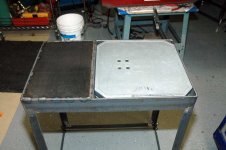
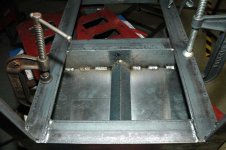
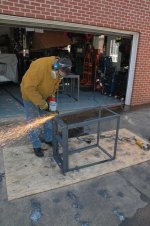
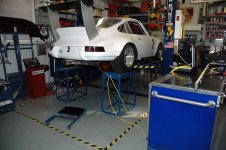
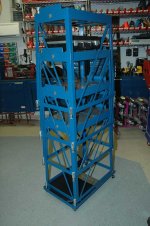
I have been doing my own alignment setups and corner balancing in the home shop. I use a set of 12 inch pad Longacre scales in homemade scale levelers, a camber gauge and a set of Smart Strings from SRP. One dislike I had with doing alignments and corner-balancing was having to kneel down during setup and while making adjustments. In addition to my getting up and kneeling down 2,389 times during each, perhaps slightly obsessive alignment with the floor level scales I had to reach under the car and fumble around while making adjustments. This is no fun but better than lifting the car up to make some changes and then try and resettle the car. Being lazy and having come into possession of a scale set that had 15 inch plates I decided this was a good time to move up to a set of elevated scale platforms. I had a good idea of what I wanted and wandered around the internet for a day or two looking for reasonably priced off the shelf scale platforms. The Pre-made units I found were not what I was looking for at all. They were a mix of expensive, poorly made or both with no roll off area or very expensive and bulky. The very expensive ones that had roll off areas had no provision for storage and were shorter than I had envisioned a set should be. This ruled out the clickety click credit card quick cure. Bulky was not going to work regardless of cost. I needed to be able to store the scale platforms in a small area of floor space when not in use.
Pencil and paper in hand and 43 revisions later I had a set of cut and build plans. After working up a materials list a call and visit was made to my metal mecca, Potomac steel in Springfield VA. $300 worth of 1/4 inch thick steel, each stick 20 feet long in various profiles hanging on the side of the truck and I was in business.
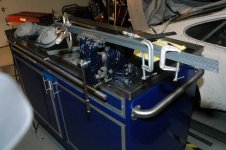
My shop is too small to be able to manipulate a 20 foot stick of steel and feed it through a standard metal cutting band saw so I lay the steel out on saw horses and bring a portable band saw to it. Using a small mechanics square held to the metal by a strong magnet and a carbide tipped scribe to mark makes it easy to get the measurements and lines relatively accurate. If you take some care this setup of saw and lines makes surprisingly straight reproducible cuts. Mark, check, cut, check the piece and move the rolling table to catch the next cut as it drops. Mark, cut, check, mark, cut, check, count cuts off the list, repeat until cuts list runs out.
Pencil and paper in hand and 43 revisions later I had a set of cut and build plans. After working up a materials list a call and visit was made to my metal mecca, Potomac steel in Springfield VA. $300 worth of 1/4 inch thick steel, each stick 20 feet long in various profiles hanging on the side of the truck and I was in business.
My shop is too small to be able to manipulate a 20 foot stick of steel and feed it through a standard metal cutting band saw so I lay the steel out on saw horses and bring a portable band saw to it. Using a small mechanics square held to the metal by a strong magnet and a carbide tipped scribe to mark makes it easy to get the measurements and lines relatively accurate. If you take some care this setup of saw and lines makes surprisingly straight reproducible cuts. Mark, check, cut, check the piece and move the rolling table to catch the next cut as it drops. Mark, cut, check, mark, cut, check, count cuts off the list, repeat until cuts list runs out.
Attachments


Last edited: