To avoid these ads, REGISTER NOW!

emergency heating

r80sdon

New member
Joined
Dec 13, 2011
Messages
2
I would like to "plug in" my home generator to the the oil burner's emergency
on/off switch at the top of the stairway. If I turn off the main circuit breaker for my home, can I safely run my oil burner this way in an emergency? I use extension cords for my refrigerator and tv directly from the generator.How should i configure the breakers ? I know which breaker powers the oil burner.Thanks for the help..
 
To avoid these ads, REGISTER NOW!

Charles (in GA)

Well-known member
Joined
Jan 11, 2006
Messages
12,489
Location
50 mi south of Atlanta
A little bit of a kludge, but to be safe, I would take that circuit and add a receptacle to it, then put a SO cord and plug from the switch to it. When you need to connect the generator, unplug the plug and connect it to the extension cord. No chance of accidentally putting power into the panel/back feed the line and tick off or kill a lineman.

Charles
 
OP
R

r80sdon

New member
Joined
Dec 13, 2011
Messages
2
Do I merely put a receptacle on the on/off switch? Should I also turn off the main circuit breaker to avoid backfeeding into the panel?When I plug the generator into the switch/receptacle do I need to turn the burner's circuit breaker off even though I cut off the main breaker? Sorry for my electrical ineptitude....I do appreciate your help...
 

rlitman

Well-known member
Joined
Oct 18, 2010
Messages
24,745
Location
Long Island
A little bit of a kludge, but to be safe, I would take that circuit and add a receptacle to it, then put a SO cord and plug from the switch to it. When you need to connect the generator, unplug the plug and connect it to the extension cord. No chance of accidentally putting power into the panel/back feed the line and tick off or kill a lineman.

Charles

+1.

What I did, was I found the circuit that feeds my boiler, between the main panel, and the disconnect switch, and cut the wire there (with the power off). Next, I ended the live side of the wire with an outlet. Then I terminated the boiler side of the wire in a box, hung about 6' of SO cord with a plug on the end from the box, and plugged the boiler into the outlet. When the power is out and I want to use my small generator, I just unplug the boiler from that outlet, and plug it into an extension cord.

The point is, if you unplug the boiler from the outlet, it is off. Done this way, there is no risk of back-feeding.
 

KenB

Well-known member
Joined
Dec 8, 2008
Messages
335
Location
Pittsburgh, PA
You should probably check with an electrician. Code often requires that furnaces be hardwired for normal use. You could use a DPDT (center off) switch, like this http://www.amazon.com/dp/B003AUIRBG/?tag=atomicindus08-20 to select between normal (from the fuse box) or emergency (from the SO cord previously suggested) power. I'd wire it so that the emergency disconnect switch at the top of the stairway works for both sources of power.


Ken
(not an electrician)
 

malibu101

Well-known member
Joined
Jul 1, 2005
Messages
3,910
Location
Walnutport PA
My dad has what KenB described. A box with a DPDT center off switch.
Utility power comes in and there is a piece of SO cord coming out.
One position is utility and the other is SO cord. Just plug the cord in, throw the switch and be warm.
I don't know if it's 100% code legal put it is easy to use and safe.
 

flintsghost

Well-known member
Joined
Dec 6, 2011
Messages
139
Location
Colorado
My furnace is natural gas not oil. What we did years ago was install a 3 way switch onto the furnace...110-off-generator. That way there can be no mistake. I run a heavy extension cord from my generator to my furnace and it attaches to a receptacle that is hooked to the 3 way switch. I have a short cord with a grounded plug at both ends which plugs into the receptacle and then I plug a regular HD extension cord into the double ended cord.

For years I used a McCulloch Generator to run it in times where the winter weather took out the power. I gave up that generator and got a new one this year looking for a easier start. After having a new Armstrong furnace installed with new AC unit 2 years ago, little did I know the armstrong had a computerized circuit board. The first Honda's I tried were all inverter or cyclo inverter style. These have a ground directly to the frame of the generator and the manuals state that if the receptacles are tested they will not show anything on the ground. The computer board on the furnace reads that as a polarity problem and spits out a code. What it means is it is reading no power even though your multi meter shows you have 120 at the plug. The meter when you will check will read zero at the ground.

Solution: Eventually what was determined is that inverter or cyclo inverter technology generators won't work for newer furnaces. You will need an older stator/rotor design. In Honda's line there were three. The smallest was an EB3800 that weighed 185lbs dry, had wheels and has 4 120 outlets and one 240. It worked well and with a 6.6 gal tank will run the furnace for 15 hours on a fill. Remember that while a 1/2 horse fan in a furnace draws about 750 volts from a generator while on, it takes about 2400 to kick it on to start. So depending upon furnace size you will probably need a generator that does 2500 at a minimum. You may be able to get by with inverter styles if you have an older furnace. But when you go to a newer one that has energy saving technology it won't work. So if you are buying a generator for that purpose buy an old stator/rotor design. It will work no matter what kind of furnace you have. This info is current as of 12/10/12 which is when we finally changed to the EB3800 and it worked. I still have a Honda EU1000 that I use for hunting and 4 wheeling and like it. It will run all kinds of appliances including computers and recharge cell phones, car batteries etc.
But not a furnace. Good luck.
 

gatchel

Well-known member
Joined
Dec 12, 2009
Messages
672
Location
West of King of Prussia, PA

theoldwizard1

Well-known member
Joined
Feb 22, 2011
Messages
43,521
Location
SE MI
That is a great suggestion.

Although, it does seem kinda pricey to only have one circuit. You can get an interlock add on depending on your panel, and for a few bucks more you can have power to the whole house. (OK maybe another $100 to $200 more depending)
The interlock is the cheap part.

Wiring the input will cost at least as much again. Fine if you have a big enough generator and are willing to cough up the money.
 
To avoid these ads, REGISTER NOW!

theoldwizard1

Well-known member
Joined
Feb 22, 2011
Messages
43,521
Location
SE MI
My furnace is natural gas not oil. What we did years ago was install a 3 way switch onto the furnace...110-off-generator. That way there can be no mistake. I run a heavy extension cord from my generator to my furnace and it attaches to a receptacle that is hooked to the 3 way switch. I have a short cord with a grounded plug at both ends which plugs into the receptacle and then I plug a regular HD extension cord into the double ended cord.

For years I used a McCulloch Generator to run it in times where the winter weather took out the power. I gave up that generator and got a new one this year looking for a easier start. After having a new Armstrong furnace installed with new AC unit 2 years ago, little did I know the armstrong had a computerized circuit board. The first Honda's I tried were all inverter or cyclo inverter style. These have a ground directly to the frame of the generator and the manuals state that if the receptacles are tested they will not show anything on the ground. The computer board on the furnace reads that as a polarity problem and spits out a code. What it means is it is reading no power even though your multi meter shows you have 120 at the plug. The meter when you will check will read zero at the ground.
I am not am electrician, but I think this problem is because the little Honda generator does not have ground and neutral "bonded". It has a floating ground.

View media item 14073
Your furnace and other modern electrical equipment do not like this. I do not know the best way to accomplish this. It depends a lot on the wiring inside the transfer box (in your case, the electrical box with the 3 way switch.)

Professionals care to step in here ?
 
Last edited:

flintsghost

Well-known member
Joined
Dec 6, 2011
Messages
139
Location
Colorado
I am not am electrician, but I think this problem is because the little Honda generator does not have ground and neutral "bonded". It has a floating ground.

View media item 14073
Your furnace and other modern electrical equipment do not like this. I do not know the best way to accomplish this. It depends a lot on the wiring inside the transfer box (in your case, the electrical box with the 3 way switch.)

Professionals care to step in here ?

Well youre correct when you say, "I am not an electrician". You're also right in that the generator has to have a neutral bond. The only generators that do are all stator/rotor design. All the others which use inverter or cyclo inverter technology are internally grounded to themselves and won't run a furnace unless the furnace doesn't require a neutral bond. That means the furnace must be older at least 5 years old or more to be run by one of the newer style compact generators. It has absolutely, NOTHING WHATSOEVER, to do with the 3 way switch and wiring in the transfer of power that was installed by a professional electrician. To infer so indicates a total lack of knowledge of electrical power and wiring. We had no ground shown at the receptacle at the input at the furnace because we had no ground or neutral bond at the generator. It IS the generator itself not the switch or wiring at the switch. My professional electrician confirmed that and so did Honda North America Technical people. Honda sheepishly admits that their newer generators only work with older furnaces not the newer computerized energy saving variety due to lack of a neutral bond or ground reading in the receptacle. We solved the problem with one of the only three stator/rotor generators left in the entire Honda line. In my case an EB3800. There is also an EB5000 and an EB6000. Any of those will work. None of the other 25 or so generators in the Honda line have a neutral bond and they can't be re-wired (according to Honda) to obtain a neutral bond so that the receptacle will read ground when tested.
 
Last edited:

rlitman

Well-known member
Joined
Oct 18, 2010
Messages
24,745
Location
Long Island
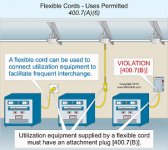
Using a cord is not in compliance with NEC 400.7.

This is patently false. 400.7 lists 11 uses of flexible cord that are allowed, including:
"Connection of utilization equipment to facilitate frequent interchange [422.16], but only when used with attachment plugs [400.7(B)], as shown in Fig. 2."

You cannot run flexible cord through your walls, but please quote me a real reason why you can't use a short length that is openly visible, for disconnect purposes, IF you use the proper connectors (that don't allow the conductors to carry strain), and plugs.
 

Attachments

  • 006ecmCBfig2x.jpg
    006ecmCBfig2x.jpg
    61.7 KB · Views: 27

theoldwizard1

Well-known member
Joined
Feb 22, 2011
Messages
43,521
Location
SE MI
It has absolutely, NOTHING WHATSOEVER, to do with the 3 way switch and wiring in the transfer of power that was installed by a professional electrician.
I'm sorry if I implied that the switch was wired incorrectly !

It IS the generator itself not the switch or wiring at the switch.
I agree 100%

My professional electrician confirmed that and so did Honda North America Technical people. Honda sheepishly admits that their newer generators only work with older furnaces not the newer computerized energy saving variety due to lack of a neutral bond or ground reading in the receptacle. We solved the problem with one of the only three stator/rotor generators left in the entire Honda line. In my case an EB3800.
Glad to see you hired a pro and you have a solution.

My point was there has to be a solution for solving this problem (lack of neutral bond in the generator) short of buying a different type of generator, despite what Honda says.

If the feed was into the main panel, the bond would occur there (same true for 240V generators with 4 wire cords). I just don't know how to do it at a junction box.


(FYI - I saw a very similar problem about 20 years ago on some 3 phase computer equipment. The electrician did not bother pulling a ground, assuming neutral was "good enough". The equipment would not run. Adding the ground brought the equipment to life !)
 
Last edited:

Alchymist

Well-known member
Joined
Mar 1, 2009
Messages
4,423
Location
Central PA
I'm sorry if I implied that the switch was wired incorrectly !


I agree 100%


Glad to see you hired a pro and you have a solution.

My point was there has to be a solution for solving this problem (lack of neutral bond in the generator) short of buying a different type of generator, despite what Honda says.

If the feed was into the main panel, the bond would occur there (same true for 240V generators with 4 wire cords). I just don't know how to do it at a junction box.


(FYI - I saw a very similar problem about 20 years ago on some 3 phase computer equipment. The electrician did not bother pulling a ground, assuming neutral was "good enough". The equipment would not run. Adding the ground brought the equipment to life !)
Run the generator through a transformer. Ground and neutral can be tied together on the secondary.....furnace won't know the difference, neither will the generator.
 

aandpdan

Well-known member
Joined
Nov 12, 2009
Messages
849
Location
In between MA and PA
This is patently false. 400.7 lists 11 uses of flexible cord that are allowed, including:
"Connection of utilization equipment to facilitate frequent interchange [422.16], but only when used with attachment plugs [400.7(B)], as shown in Fig. 2."

You cannot run flexible cord through your walls, but please quote me a real reason why you can't use a short length that is openly visible, for disconnect purposes, IF you use the proper connectors (that don't allow the conductors to carry strain), and plugs.

It's in 422.16 - keep reading.

(A) General. Flexible cord shall be permitted (1) for the
connection of appliances to facilitate their frequent interchange
or to prevent the transmission of noise or vibration or
(2) to facilitate the removal or disconnection of appliances that
are fastened in place, where the fastening means and mechanical
connections are specifically designed to permit ready removal
for maintenance or repair and the appliance is intended
or identified for flexible cord connection.


Is it in the installation instructions? How often do you change out a boiler or furnace for "frequent interchange" or for "repair?"

Ultimately it's not up to us anyways, its up to our AHJ.
 

theoldwizard1

Well-known member
Joined
Feb 22, 2011
Messages
43,521
Location
SE MI
My point was there has to be a solution for solving this problem (lack of neutral bond in the generator) short of buying a different type of generator, despite what Honda says.

Run the generator through a transformer. Ground and neutral can be tied together on the secondary.....furnace won't know the difference, neither will the generator.

Excellent suggestion ! A surplus 2.0 KVA transformer should probably cost less than $100.
 

Alchymist

Well-known member
Joined
Mar 1, 2009
Messages
4,423
Location
Central PA
At the risk of opening up another 100 page debate, (been discussed in a number of threads):

1) If the transfer switch switches the neutral as well as the hot conductors, the generator frame (ground) and neutral must be bonded.

2) If the transfer switch does not switch the neutral, the generator neutral must be floating, not tied to ground.

NOTE: We're talking residential systems, not commercial/industrial, which have a whole other set of rules.
 
To avoid these ads, REGISTER NOW!
Top Bottom