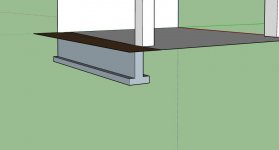
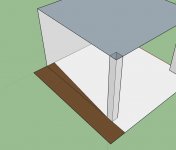
So I'm about to start a project to enclose a carport and I wanted to double check a few things. Previous owners converted the old garage into laundry room and storage, then built out post and beam support for an open carport (so thick solid beam and beams with poured footings). The current "garage" pad is what was presumably the flat pad which was the old driveway. There's a clear division of newer concrete however which was likely the footing. My plan is to enclose walls and extend the pad a bit (it's not truely squared to the house).
I haven't dug under yet, but I'm planning to dig out underneath the current pad to inspect the integrity and possibly add a long foundation inline with where the future wall will be on the one side that's not square. When I look into footings, typical "T" shaped ones are seen, but that's to be under the foundation wall. I'm not making foundation walls for a house, Just a standard 2x4 framed wall with fiberboard siding to match the house. So....
A. make a form that extends current pad size to where it needs to be at same 4 inch thickness.
B. dig deeper than current pad inline with beam on top to make a wider footing (say 8 inches wide x 6 inches thick) and once that's set then extend the pad over this and place a wall over it.
C. Neither, both are stupid, I have a better idea. And it is....(please share)
Also, only one edge of the pad is available to dig under. The other abuts a walkway entry to the home and is rather set in place (slate slabs).
Since the carport construction is coded properly (assumed as it was a permitted renovation) then adding the walls isn't going to really add that much weight, maybe a few hundred pounds??
I haven't dug under yet, but I'm planning to dig out underneath the current pad to inspect the integrity and possibly add a long foundation inline with where the future wall will be on the one side that's not square. When I look into footings, typical "T" shaped ones are seen, but that's to be under the foundation wall. I'm not making foundation walls for a house, Just a standard 2x4 framed wall with fiberboard siding to match the house. So....
A. make a form that extends current pad size to where it needs to be at same 4 inch thickness.
B. dig deeper than current pad inline with beam on top to make a wider footing (say 8 inches wide x 6 inches thick) and once that's set then extend the pad over this and place a wall over it.
C. Neither, both are stupid, I have a better idea. And it is....(please share)
Also, only one edge of the pad is available to dig under. The other abuts a walkway entry to the home and is rather set in place (slate slabs).
Since the carport construction is coded properly (assumed as it was a permitted renovation) then adding the walls isn't going to really add that much weight, maybe a few hundred pounds??