To avoid these ads, REGISTER NOW!

Engine hoist capacity beware

whateg01

Well-known member
Joined
Mar 13, 2006
Messages
11,191
Location
doo dah, kansas, usa
Helping the local makerspace move this past weekend. Roughly 1800# welding bench about a foot in the air, when the caster broke, causing the bench to swing in that direction and downward, then bend the leg on my old HF engine hoist. We were using safe lifting practices (aside from relying on a HF tool), so nobody was hurt.

While looking for casters for another project, I found that there was little in a 1000# rating available in anything smaller than 4" or 5" and even those were pretty beefy looking. The casters on all of the common engine hoists have very thin webs and fairly small axles.

That got a buddy and me wondering where they get the 2T weight rating for these engine hoists. Even with the boom fully retracted, the CG of the load is well forward of the middle of the casters, but even if it was centered, that would be 1000# on each caster. With a safety factor, each caster ought to be able to handle far more than that.

What I surmise happened here is this. Some years back, I got tired of fighting 4-wheel uncontrolled steering and used the original front wheels to make fixed casters. The cast web being as thin as it is won't withstand much lateral loading. If the caster was able to swivel, then the lateral load becomes not a lateral load fairly quickly. Since these were made fixed, perhaps the welding bench swayed slightly left, and in doing so increased the load over that caster while simultaneously loading it laterally. As the weight started down the sort distance until the caster frame hit the floor, the table gained some momentum and when the caster frame hit the floor, the additional force on the leg caused it to bend at its weak point where there is also a point load. Compared to the old engine hoist my dad has that has 3/16" wall tubing for every piece, these little thin wall tubed machines always seemed rather flimsy to me.

I've always avoided moving things around up in the air until the last moment. I've also always tried to make any necessary movement with loads in the air a straight forward or rearward movement. Still seems a good practice. Be careful with these things!

attachment.php


attachment.php


Dave
 

Attachments

  • shattered caster.jpg
    shattered caster.jpg
    101.7 KB · Views: 1,917
  • bent leg.jpg
    bent leg.jpg
    107.6 KB · Views: 1,940
To avoid these ads, REGISTER NOW!

u2slow

Well-known member
Joined
Nov 20, 2011
Messages
3,583
Location
BC
I have the same design engine hoist. I put larger/stronger casters on it.

Since getting a very basic 1-ton rolling gantry crane, the engine hoist doesn't get used very much. Better tool for most jobs....
 
OP
W

whateg01

Well-known member
Joined
Mar 13, 2006
Messages
11,191
Location
doo dah, kansas, usa
I had always planned to put bigger casters on it by welding plates to the top of the existing legs and bolting the casters to those. Never did, though, as it kept doing the job. I just always hated how tall the legs ended up being because it was a 7-step process to get loads down off the engine hoist and then down onto the pallet jack.

Dave
 

c39er

Well-known member
Joined
Mar 23, 2008
Messages
1,660
Location
Seattle, Washington
Chinese unsafe junk tools.
I have used that same hoist once.
Four swivel casters...really awkward to use and not stable...glad I have my old Blue Bird hoist.
 
OP
W

whateg01

Well-known member
Joined
Mar 13, 2006
Messages
11,191
Location
doo dah, kansas, usa
Chinese unsafe junk tools.
I have used that same hoist once.
Four swivel casters...really awkward to use and not stable...glad I have my old Blue Bird hoist.

For most people, lifting engines from hot rods, they are sufficient. The ratings are misleading though. To build and sell a machine that is actually good for 4000# would require a lot more metal and the consumers these are aimed at won't pay that. It's not that they are Chinese. It's that they are really a consumer product sold at the lowest dollar. There same design made in the USA would likely fail just the same.

Dave
 

Jagmandave

Well-known member
Joined
Nov 6, 2011
Messages
6,299
Location
Overland Park, Ks.
Could have just been a porous or bad casting that failed in the wheel.

That looks like one of the older engine hoists, I think they've really improved the quality control of their metallurgy in the last 10 years.

The problem I have with larger casters is that sometimes it's difficult to get the legs under what I'm lifting. For example, I have an engine test run stand, the HF lift I have just barely fits under it to allow me to set an engine in the stand.

I also wonder if a U shape to the bottom legs would work, allowing it to straddle things better?
 
OP
W

whateg01

Well-known member
Joined
Mar 13, 2006
Messages
11,191
Location
doo dah, kansas, usa
That's why some use a plate welded to the top of the tube to mount the casters to. I could do that, put 5" casters on and still be lower than I am now. As it is, I can't reach the top of the legs with my pallet jack. The web in these caster wheels is only about an 1/8" thick and completely flat.
 

u2slow

Well-known member
Joined
Nov 20, 2011
Messages
3,583
Location
BC
That looks like one of the older engine hoists, I think they've really improved the quality control of their metallurgy in the last 10 years.

The problem I have with larger casters is that sometimes it's difficult to get the legs under what I'm lifting. For example, I have an engine test run stand, the HF lift I have just barely fits under it to allow me to set an engine in the stand.

Mine is a chinese fold-up unit, and 20 years old. Its appears no different than same cheapo made today that sells for more money. The larger casters are an improvement (no longer have 'low' vehicles) but it sits folded up in the corner mostly as I use the chinese gantry 90% of the time instead.
 

matt_i

Well-known member
Joined
Mar 14, 2008
Messages
10,722
Location
SE Michigan
The "spoked" wheel with "lightening holes" seems to starve it for structure in a critical area. A solid-web wheel would be a good design improvement in my opinion.

I think you are correct, the safety factor is a little low for this design. Not what we are used to for traditional rigging and lifting devices.
 

johnnyradiant

Well-known member
Joined
Mar 27, 2017
Messages
833
Location
Vancouver, BC
Is it the hydraulic ram that is rated as 2 ton therefore they can market it as a 2 ton unit?
Either way at least others now know 2 of the weaker spots.
 

u2slow

Well-known member
Joined
Nov 20, 2011
Messages
3,583
Location
BC
Is it the hydraulic ram that is rated as 2 ton therefore they can market it as a 2 ton unit?
Either way at least others now know 2 of the weaker spots.

No, the boom has that rating in its shortest position.

The ram must be rated several times higher. Basic lever physics math.
 

metalmagpie

Well-known member
Joined
Nov 1, 2011
Messages
796
Location
Seattle
When lifting heavy loads the legs must be fully extended and tight. Were yours?

The manual for your hoist certainly said to never roll the hoist with a load lifted. Mine did. You can lift quite a bit if you do it right. But as soon as you roll it the casters will be destroyed.

That's the way 2 ton engine hoists are. Embrace it.
 

Monza Harry

Well-known member
Joined
Dec 29, 2018
Messages
1,433
Location
Windsor ON
You could when/if you fix it just double up the new wheels of similar size and higher rating, one on each side of the leg, [spaced out duals], or even tandem duals, that would give you eight wheels on the front and only need 1/2 an inch clearance on the bottom of the tube to the floor. Just an idea to start with. Harry
 

like2wheel

Well-known member
Joined
Oct 29, 2014
Messages
1,693
Location
On an as needed basis
The manual for your hoist certainly said to never roll the hoist with a load lifted. Mine did. You can lift quite a bit if you do it right. But as soon as you roll it the casters will be destroyed.

That's the way 2 ton engine hoists are. Embrace it.

I don't think that's true at all.
It would make for a pretty impractical engine hoist if you had to always roll the car out from under the engine. I only remember doing that once, & it was because of space considerations. Was a pain in the ***.
 
OP
W

whateg01

Well-known member
Joined
Mar 13, 2006
Messages
11,191
Location
doo dah, kansas, usa
I don't think that's true at all.
It would make for a pretty impractical engine hoist if you had to always roll the car out from under the engine. I only remember doing that once, & it was because of space considerations. Was a pain in the ***.

I was going to say exactly this!

Extending the legs all the way out on this machine would be an awful idea. With the tubing used, it would be subject to buckling in the middle, or where the stress riser formed as the smaller tube exited the larger tube. The casters would probably be saved, though. For comparison, my smaller engine hoist, rated also for 4000# does not have legs that extend and with the boom all the way in for that load rating, extends about 2/3 the distance of the legs.

I may or may not replace the legs on this one. If I do, it will be with thicker tubing, and maybe a larger size. The casters will also be replaced with, probably a 5" wheel. Comparing the original casters, which, at a minimum, for an evenly distributed 4000# load should support 1000# each, to these "good" casters (http://www.steelcasterstore.com/3-x-1-1-4-semi-steel-swivel-caster-tp-350-lbs-capacity/) it's clear that they are extremely over-rated. If the good casters have a safety factor of 4:1, then they are actually good for over 1200# each, barely more than the minimum that casters should be rated for in this application. Can you honestly look at each of those and tell me that the engine hoist casters are as strong as the others?

For reference, the boom was in the 3000# hole and it did not show signs of failure at all. My smaller one was used in that same configuration and with a 3000# load, it buckled over the ram. It did not originally have a truss across the top, but it does now.

Dave
 
To avoid these ads, REGISTER NOW!

tre873

Well-known member
Joined
Mar 1, 2017
Messages
607
Location
NE TX
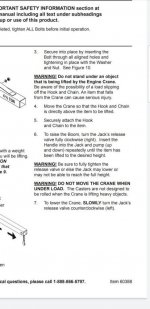
Below is a screenshot from the current engine hoist offered by Harbor Freight. It specifically states not to move the hoist while it's under loadScreenshot_20200317-140645_Drive.jpg
 

Grimpala

Well-known member
Joined
Jul 16, 2012
Messages
1,404
Seems like you like to modify and/or abuse your hoists. Might be time to get an industrial setup.
 
OP
W

whateg01

Well-known member
Joined
Mar 13, 2006
Messages
11,191
Location
doo dah, kansas, usa
Seems like you like to modify and/or abuse your hoists. Might be time to get an industrial setup.

Working on that design right now. Some copying of features from others, but mostly the same design. May use straight legs so I can get the pallet jack and engine stand between the legs. Also lowering the height of the legs to slide under cars or loads better. Mostly just heavier, though.

Not sure I would say I abuse them. Where do you get that? I do modify as needed, such as adding provisions for a tongue to pull behind the garden tractor with lighter loads and pneumatic tires. Otherwise, I have only come remotely close to the load limit once, and that wasn't really close to the load limit. That was a 3000# lathe that bent the boom on the smaller engine hoist before it even lifted the lathe. That was with the pin in the 3000# hole. But designed without a truss across the top, the roughly 3x2.5" tube wasn't able to lift it. I haven't tried to lift the lathe again as I haven't needed to, but the new tube has a truss and I think it would handle it fine. I have serious doubts about the casters, though, even in a static state.

Dave
 

fsae0607

Well-known member
Joined
Aug 15, 2011
Messages
2,290
Location
San Fernando Valley, CA
Below is a screenshot from the current engine hoist offered by Harbor Freight. It specifically states not to move the hoist while it's under loadScreenshot_20200317-140645_Drive.jpg

:headscrat
I've always lifted an engine, then scooted the hoist back a bit to clear the radiator support, then lower it. Vice versa for installation.
 

like2wheel

Well-known member
Joined
Oct 29, 2014
Messages
1,693
Location
On an as needed basis
Below is a screenshot from the current engine hoist offered by Harbor Freight. It specifically states not to move the hoist while it's under loadScreenshot_20200317-140645_Drive.jpg

And on page 2 of that same manual, it says: "4. Before moving, lower the load to
the lowest possible point."

Chinese manuals always have questionable wording. At best it's just an unrealistic disclaimer.

Have you guys actually ever done this?
It's ridiculous to expect a person to shimmy a vehicle forward/back/left/right to install an engine when the crane has wheels.

The last 2 I've done were 8 cyl AWD SUV's. Can't move them after you disassemble what is necessary to remove the engine.


.
 
Last edited:

HotrodHR

Well-known member
Joined
Nov 22, 2009
Messages
445
Location
North Alabama
You get what you pay for... I too have a Horrid Freight engine hoist/crane. I use it carefully although I probably shouldn't have used it to lift the end of my 4-post lift (in the crate) to put 3 inch pipe segments to to help pull my trailer out to offload...

I guess should have shopped around... Grainger has a 1000 lb heavy duty counter balanced, mobile, no front legs crane for a mere $4300 bucks.

They also have a Mobile Floor Crane, Heavy Duty, 6000 Capacity (Lb.), 88 Height (In.), 53 Length (In.) for only $12,775...

https://www.grainger.com/product/VESTIL-Mobile-Floor-Crane-5XPG4

https://www.grainger.com/product/OTC-Mobile-Floor-Crane-48XV28
 

onewheat

Well-known member
Joined
Feb 19, 2012
Messages
1,286
Location
Knoxville, TN
That caster looks like it failed from being side-loaded - the table swing would put a lateral load on the web and cause failure.
 

MushCreek

Well-known member
Joined
Jan 14, 2015
Messages
9,741
Location
Upstate South Carolina
I remember seeing a ram fail on one we had at work. I don't remember what they were lifting, but the rod actually folded abruptly. And that was on an expensive, 'Merican hoist. I've moved several milling machines with mine (2000 lbs), and it's spooky. It won't roll worth a **** with that much weight on it. An engine is child's play by comparison.
 

cj7jeep81

Well-known member
Joined
Jul 11, 2006
Messages
463
Location
S.E. Indiana
I don't think that's true at all.
It would make for a pretty impractical engine hoist if you had to always roll the car out from under the engine. I only remember doing that once, & it was because of space considerations. Was a pain in the ***.

Really depends on how much you are lifting. 500-600 pound engine would be fine, as its "rated" for 7 or 8 times that. But if you are lifting close to (or at) full capacity, you don't want to roll it while loaded.
 

mikeinri

Well-known member
Joined
Nov 29, 2019
Messages
8,206
Location
MA
Dave (OP),

Thanks for posting this. I just purchased a HF 2-ton unit. Other than very cheesy hardware (especially the R-clips), it seems OK.

I used it to lift a 600+ lb mill/drill. Was able to move it a short distance (maybe 10-15 feet, including a 90-degree turn) with the weight suspended. Didn't need to add hydraulic fluid, or bleed the jack (at least I don't think so).

Would be very interested to know whether those solid wheels work better for you. Why do you assume a 4x safety margin?

Am also interested in more details on your mods (tractor hitch, soft wheels, etc.)!

Mike
 

Falcon67

Well-known member
Joined
Jun 11, 2009
Messages
18,371
Location
Merkel, TX
The manual for your hoist certainly said to never roll the hoist with a load lifted. Mine did. You can lift quite a bit if you do it right. But as soon as you roll it the casters will be destroyed.

That's the way 2 ton engine hoists are. Embrace it.

A hoist would be pretty useless if it could not be moved with with a load on it. I move mine around all the time with a motor hanging on it. Granted, safe practice is to lower the load for most moves. But it pretty much has to be up to get a motor/trans in or out of the car. Mine is a Big Red, and the steel is pretty substantial. It helps on all of these things to take the casters apart and smooth the axle tubes and grease/oil things. Did that on the HF car skates and they went from useless to kid toys for flying down a slopped driveway. :)

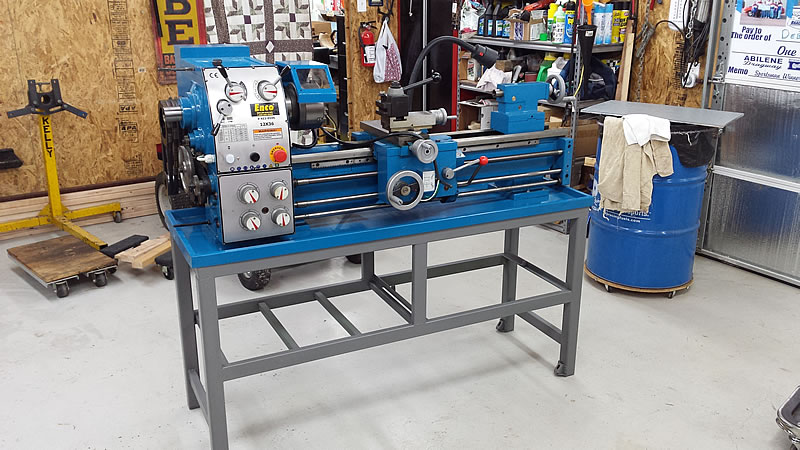
This lathe weighs around 1500, no problem using the hoist to set it on the stand, then move the assembly

12x36Stand_010.jpg
 

pancho400cid

Well-known member
Joined
Sep 26, 2014
Messages
4,510
Location
Austin, TX
I have seen other posts on other forums about that same failure in HF hoists.

Any tool of that nature should have generous safety margins built into the design. The disclaimer in the HF instructions is ridiculous and dangerous. An engine hoist that cant be moved while supporting an engine is of no practical use.

As said, it's a pretty simple fix to upgrade with some shop-made wheels or better casters altogether.

As far as lifting without extending the legs, you DO NOT want to get the legs too short. the front wheels need to be out beyond the hoisted engine if you want to avoid the exciting experience of having the whole enchilada tip forward. Don't ask how I know.


[URL="


...
 
Last edited:

Kev442

Well-known member
Joined
Jan 15, 2009
Messages
5,386
Location
Wi
I always used to yank my HF hoist (made in Mexico 25 years ago) around with the engine hanging. Then one decided to rotate almost 90 degrees and tried to tip things over. Actually twisted the lower frame a bit.
Now I clear the radiator support and then get it down onto some 4x4's I lay across the legs. Can push it anywhere after that.
 

Grimpala

Well-known member
Joined
Jul 16, 2012
Messages
1,404
Working on that design right now. Some copying of features from others, but mostly the same design. May use straight legs so I can get the pallet jack and engine stand between the legs. Also lowering the height of the legs to slide under cars or loads better. Mostly just heavier, though.

Not sure I would say I abuse them. Where do you get that? I do modify as needed, such as adding provisions for a tongue to pull behind the garden tractor with lighter loads and pneumatic tires. Otherwise, I have only come remotely close to the load limit once, and that wasn't really close to the load limit. That was a 3000# lathe that bent the boom on the smaller engine hoist before it even lifted the lathe. That was with the pin in the 3000# hole. But designed without a truss across the top, the roughly 3x2.5" tube wasn't able to lift it. I haven't tried to lift the lathe again as I haven't needed to, but the new tube has a truss and I think it would handle it fine. I have serious doubts about the casters, though, even in a static state.

Dave

You use the lift at it's max capacity and then move it(even though the manual says not to). That to me is abusing it. Modifying the wheels to not swivel is a modification that the design engineers didn't engineer into their calculations.

This thread shouldn't necessarily be a caution to those of us using HF or Northern hoists, but a caution to not modify and abuse your hoist or it might fail.

You own this one all yourself as far as I'm concerned, not HF.
 

mikeinri

Well-known member
Joined
Nov 29, 2019
Messages
8,206
Location
MA
It helps on all of these things to take the casters apart and smooth the axle tubes and grease/oil things. Did that on the HF car skates and they went from useless to kid toys for flying down a slopped driveway. :)

What did you do to "smooth the axle tubes?"


Now I clear the radiator support and then get it down onto some 4x4's I lay across the legs. Can push it anywhere after that.

Really great idea, get the weight down low so momentum doesn't make it want to flip. Not sure if that really helps the wheels, but maybe it puts less leverage on them?

Mike
 
Last edited:

Kev442

Well-known member
Joined
Jan 15, 2009
Messages
5,386
Location
Wi
Equalizes the weight across all 4 wheels, so much easier on them. Just need enough tension on the ram to keep the things from flopping around.
 
OP
W

whateg01

Well-known member
Joined
Mar 13, 2006
Messages
11,191
Location
doo dah, kansas, usa
You use the lift at it's max capacity and then move it(even though the manual says not to). That to me is abusing it. Modifying the wheels to not swivel is a modification that the design engineers didn't engineer into their calculations.

This thread shouldn't necessarily be a caution to those of us using HF or Northern hoists, but a caution to not modify and abuse your hoist or it might fail.

You own this one all yourself as far as I'm concerned, not HF.

How is 2000# at its max capacity? 2000# is half of its max capacity. I don't know what kind of math you are using. And what of all of the other people using these machines the same way I did, but with engines instead of welding benches? Or lathes? Or transmissions? Or whatever? As has been stated, a machine that can lift an engine out of a car but not be moved once the engine is in the air is pretty close to worthless. How do you propose using one to get a table or whatever into the air to load on a trailer without moving it? Just scooch the trailer sideways under it? How much sense does that make?

Dave
 
OP
W

whateg01

Well-known member
Joined
Mar 13, 2006
Messages
11,191
Location
doo dah, kansas, usa
Equalizes the weight across all 4 wheels, so much easier on them. Just need enough tension on the ram to keep the things from flopping around.

Assuming the weight is at the same place fore/aft, the weight distribution doesn't change. It does take the force off of the boom and mast, but the wheels all see the same weight no matter what. The same applies if you are lifting an object that is heavy on one end. Even though it hangs far out to one side, the center of gravity will always be directly below the hook, unless it's swinging around.

Dave
 

finn

Well-known member
Joined
Mar 27, 2005
Messages
16,184
Location
The UP, God's country
Assuming the weight is at the same place fore/aft, the weight distribution doesn't change. It does take the force off of the boom and mast, but the wheels all see the same weight no matter what. The same applies if you are lifting an object that is heavy on one end. Even though it hangs far out to one side, the center of gravity will always be directly below the hook, unless it's swinging around.

Dave

Statics says you’re wrong. The closer the suspended mass is to one end, the higher the load is on that end.

That’s the reason a previous posters lift tipped forward when he moved a suspended load without extending the legs.

Try it. I had a similar experience pulling an engine from a low slung car where the front legs wouldn’t fit under the suspension. Almost the entire mass over the front wheels makes for a tippy situation. Casters modified so they won’t swivel increase side load on the web, too.

Simple static’s.

Dropping the boom as far as possible when moving the loaded lift reduces the load on the assembly too. Simple dynamics.
 
Last edited:
OP
W

whateg01

Well-known member
Joined
Mar 13, 2006
Messages
11,191
Location
doo dah, kansas, usa
Statics says you’re wrong. The closer the suspended mass is to one end, the higher idle load is on that end.

That’s the reason a previous posters lift tipped forward when he moved a suspended load without extending the legs.

Try it. I had a similar experience pulling an engine from a low slung car where the front legs wouldn’t fit under the suspension. Almost the entire mass over the front wheels makes for a tippy situation. Casters modified so they won’t swivel increase side load on the web, too.

Simple static’s.

Dropping the boom as far as possible when moving the loaded lift reduces the load on the assembly too. Simple dynamics.

My very first sentence in that reply said, assuming the load doesn't move fore/aft, the load on the casters will remain the same so statics says I'm right. If the load starts swinging, that's a different story. I should clarify that the same is true for left/right weight distribution. If the boom is hanging in the center of the perfectly level hoist, the left/right distribution will remain the same whether the boom is all the way up or all the way down. That is something that should be paid attention to also, as not all booms travel straight up the center of the hoist, and side ways on a hill, the boom could easily extend past the vertical plane of the casters.

Lowering the load reduces the load on the boom/mast and lowers the cg, but if the cg is 10" behind the front casters while it is in the air and 10" behind the front casters when it is sitting on the legs, the weight on each caster remains the same. Lowering the boom may make that better or worse. On small items with not much height, where the load can be kept close to the boom, as it swings downward, below horizontal, the load does come closer to the mast. However, that's not always the case. When lifting my surface grinder, the boom was above horizontal when the grinder was on the ground. So, lowering it actually moved the cg farther forward. I had the legs extended far enough forward to not be a tipping hazard, and I still lowered the load to get the cg as low as I could for an already top-heavy item.

I've stated several times that I am well aware that making the front casters fixed increased the side load. I think I stated that in the first post. These particular casters do not take that well, unlike better casters from other manufacturers that are rated for far less weight than these apparently are.

Mention of similar failures on hoists that have not been modified in this way support rating these wheels at a lower weight. Comparison of reputable caster manufactures' wheels and their weight ratings to these support the same.

Dave
 
Last edited:
To avoid these ads, REGISTER NOW!
Top Bottom