To avoid these ads, REGISTER NOW!

Engineering a Better Garage/Workshop

AustinRoepke

Well-known member
Joined
May 30, 2010
Messages
161
Location
Not Chicago, Illinois
Hello everyone,

I just joined today, so this is my first post and topic. I'll try and make it count!

(Life story. Skip if you don't care.) First, a bit of back story on me. I grew up on a farm in southern Illinois and I've always had access to a pretty good sized shop, but for some reason it is impossible for everything to be organized ever. Having a massive case of OCD makes this a nightmare for me (the neighbors know when I can't find the ___ ____ 1/2" drive ratchet... and they live half a mile away). Now I'm studying to be an engineer at the University of Illinois, and I've come to look at the organizational problems with our shed in a new way. From cable management to tool organization, I've been trying to implement new designs and systems to bring orderliness to the chaos that is our shop (the gap between school and my summer job has left me with way too much free time).


A few problems I'm working on:

1. Cable managment.
Problem: Every powertool has a short cord. This is because if every tool had a 50ft cord, each shed would have more copper in its powertool wires than in a small house. Because of these short cords, extension cords are necessary. But how to organize them?

Semi-Solution: I found a couple of cable reels when I cleaned out the shed. The male end feeds through first, coming out of side of the reel, aligned with its axis of rotation. When the reel is wound up, the male end is spun around, causing the male end to also spin.

Ideal Solution: In a perfect cable reel, it would be spring-loaded with the end connecting to the power source not spinning. This would be accomplished with the axis of rotation only being occupied with the pulley/reel (and possibly a rubber-band connecting the pulley to the axis), and the cord only being tangential to it. That's the basic principle. I'm going to make a 3D model and put a rendered image up here sometime soon.

Other problems:
Organization of larger power tools (circular saws, welders, etc.)
Efficient and Effective socket set, open-end wrench, etc. organization
many, many more


With that, I ask this: What methods have you guys developed for organization in your shops? Everyone has their own way of doing things, and I'm sure there's guys on here that have perfected the art of an organized workplace. I am not one of these guys. What do you do to maximize floor space, make it easier to find and access tools, these kinds of things?

Are there improvements you would want to make to the design of organizational systems (racks, shelves, toolboxes, etc.) but have never seemed to cross the minds of the guys that design them?

If so, I'd like to hear them. And I'll do my best to make a 3D model of them, too. (because I honestly have waaaay too much free time this week. Well, as long as our replant doesn't get flooded out)

I looked at other threads, and they asked similar questions, but not as directly.

Thanks for looking!

Austin
 
To avoid these ads, REGISTER NOW!

Torque1st

MEMBER EMERITUS
Joined
Sep 14, 2008
Messages
5,668
Location
KC Metro, Kansas
The basic problem discussed over the years is space and what is termed the "clutter quotient". We also have a saying: "A place for everything and everything in it's place."

Not all of us have the space and resources to build a huge shop building. Even the guys that say; "Figure out what you need and build it bigger," will admit it never is big enough.

Storage solutions help but there is a limit to the amount of **** you can pack in a 5# bag...

Inventing a TARDIS or some other folded infinite space would be a real godsend. Of course it would have to be affordable.

:beer:
 

sberry

Banned
Joined
Jun 18, 2005
Messages
35,747
Location
Brethren, Michigan
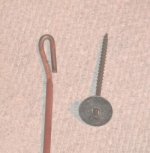
Ideally is to reduce the clutter to start with if possible, I created other space in other buildings for stuff that doesn't have to be in the shop. As for cords I create hangers and have them all over but I am not scared to run circuits where really needed to reduce the need for them as much as possible.
Doing some sketches may help some but finding out what works cannot be duplicated on paper at some point. I like to create things that can be changed as needed, just because something started there doesn't mean its got to be there forever.
 

Attachments

  • cord hanger screw.JPG
    cord hanger screw.JPG
    27.6 KB · Views: 33
  • cord hanger.JPG
    cord hanger.JPG
    29 KB · Views: 42

crewchief888

Well-known member
Joined
Dec 3, 2009
Messages
13,744
Location
NW indiana
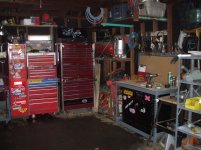
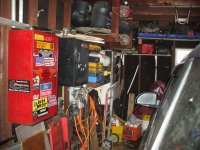
IMHO, creating floor space is key, i moved out a rented 35x45 building back into my 19x22 garage at home. i spent 4 mid winter weekends moving tools, and spare parts, and my s-10.
i put everything i could in acrobins ( that i already had ), on shelves as high as i could get them. all the shelving, and shelf brackets i had laying around from other projects, and fabricated a few out of scrap angle iron.
lightweight stuff, and spare wheels are up in the rafters, along with stuff i dont "need" all the time.
i mounted a couple of small side boxes to the wall, one holds spray bombs, the other has 4 1/2" grinders, welding wire, gloves and hole saws, another steel wall cab in under the workbench for storage, another wooden cab with door is wall mounted that holds oil, AF, ATF, and grease.
i moved tools around from 4 sets of boxes, into 2 sets, stored one set of boxes downstairs, gave one set away to a friend, store my small tool work stands, and roller stands downstairs.

it was a royal pain in the *** moving, and rearanging everything, and it took 3 months to finally get it all sorted out where i can find things again.

the wife is kind enough to park her car outside since it's nicer weather so i have so room to work. with her car and my s-10 blazer wheeling truck in there, theres barely enough room to walk around. i wish i would have had a lot more time to plan where things were going to go, but it never seems to work that way.

:beer:
 

Attachments

  • 1-16-10.jpg
    1-16-10.jpg
    143.8 KB · Views: 129
  • 1-16-10-3.jpg
    1-16-10-3.jpg
    147.6 KB · Views: 113
  • garage 1.jpg
    garage 1.jpg
    139 KB · Views: 114

mixxmstrmike

Well-known member
Joined
Apr 15, 2010
Messages
330
Location
San Jose, CA
With that, I ask this: What methods have you guys developed for organization in your shops? Everyone has their own way of doing things, and I'm sure there's guys on here that have perfected the art of an organized workplace. I am not one of these guys. What do you do to maximize floor space, make it easier to find and access tools, these kinds of things?

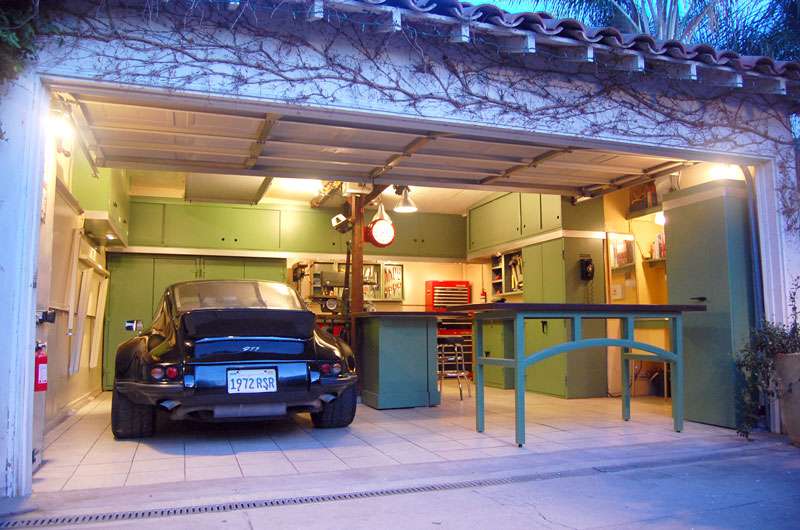
Without even looking at the other responses, I thought of Jack Olsen's garage. Thankfully, someone posted the link.

His garage, IMHO, is a great example maximizing space to its full potential, in a very clean, orderly manner.

Welcome to GJ!

-Mike
 
To avoid these ads, REGISTER NOW!

Jack Olsen

Super Moderator
Staff member
Joined
Mar 22, 2009
Messages
6,678
Location
Los Angeles
Thanks for the compliments, guys. My 'rules' were pretty simple. Nothing on the floor (if I could help it) -- I wanted to be able to clean it with a leaf blower. I wanted the storage to be enclosed, so I didn't have to use the leaf blower to get the dust, metal shavings and sawdust off of everything I'd already put away. And I wanted a lot of work surfaces.

I think there's a danger to over-thinking how you're going to store every single thing you own. More to the point, I don't think it makes sense to build too much storage that's absolutely custom to the tools you own right now. Why? Because over time, I think the particular tools you're storing (and the types of jobs you're doing) are going to change, and I think for most of us there's maybe one big garage re-do that you've got in you. Beyond that, you have to hope you've come up with storage and work space that's flexible enough to adapt to the stuff you're doing and the tools you're using to do it.

My last rule was plain ol' poverty. I couldn't afford to have a crew come in with a lot of shiny cabinets and light fixtures. So everything in my garage is pretty much home-made, used or re-purposed.

Gratuitous pictures:

allaround.jpg


benches.jpg
 

sstruckguy

Well-known member
Joined
Sep 1, 2008
Messages
592
Location
Paducah, KY
Without even looking at the other responses, I thought of Jack Olsen's garage. Thankfully, someone posted the link.

His garage, IMHO, is a great example maximizing space to its full potential, in a very clean, orderly manner.

Welcome to GJ!

-Mike

I think everyone will agree, one of the most important things that Jack has going for him is, large quantities of hidden storage.

It looks larger than it is, but has plenty of storage for the things that get in the way (for most of us).

As stated before, if you make it large, you have large(er) storage issues. If you have a smaller space, you make things work. (ala Jacks garage)

I am in my 5th man cave. I have had everything from a 20 x 30 to a 48 x 64. I am actually happier in my current 28 x 40 than any of them. Reason being is, I planned, re-planned, and then planned again. I used every tool and computer program to make sure I didn't leave 6 inches for "spare" space.

I have always made plans for a possible 20% expansion. This is because that you always forget something, or make that "I always wanted it" purchase. It has always been enough cushion(for me) to allow for error and what ifs.

With that being said, my current AND previous caves were built by me. The other 3 were "make do caves". My thinking never changed, other than making do, as Jack has.(not taking away from Jack, but that IS the point)

You have taken the first step,(in my opinion) and asked for outside assistance. Take ALL the ideas, suggestions and previous successes, roll them into a large ball, and extract what you need.

After all, thats what its all about...right?
 

PassnThru

Well-known member
Joined
Jan 5, 2010
Messages
6,510
Location
Bowling Green KY
Inventing a TARDIS or some other folded infinite space would be a real godsend. Of course it would have to be affordable.

:beer:

**** - you had to mention affordable didn't you. Why can't you people pay when I invent these things???????
Anyway - best way to utilize space is to divide it. Take a portion of your space and fill it to the max. Ignore the other space - it doesn't exist for you. Concentrate on one wall - and spend a few weeks with it. Arrange - rearrange. You get the idea.
 
OP
A

AustinRoepke

Well-known member
Joined
May 30, 2010
Messages
161
Location
Not Chicago, Illinois
Right now I'm trying to make shelving for boxes (the ones power tools come in) so that they can be left opened in the shelf and simply closed when needed elsewhere (ie. the back of a truck to work on something in the field).

I'm also using your theory, PassinThru. I've done some of the maximization of space so far, but I might go take pictures tomorrow for a before/after comparison.

Classes are about to start up for me again, so hopefully I'll be done by Monday (*fingers crossed*)

Thanks everyone!
 

Kevin54

MEMBER EMERITUS
Joined
Jan 12, 2005
Messages
29,341
Location
Urbana, Ohio
Cabinets.

Shelving is nice but I prefer doors on my shelving. I am the type that does not like to see items, tools, etc sitting on shelves. For one, any flat horizontal surface will be a catch-all for dust, dirt, and something you don't want to put away right away. If you have doors it will hide the clutter that is easy to accumulate.

If you plan on making your garage a working garage as far as grinding, welding, having the doors open......try to design any overhead cabinet so it goes to the ceiling or build a soffit down to the top of the overhead so dirt does not collect on top of them. Check XcYZ's garage for his soffits / storage. http://www.garagejournal.com/forum/showthread.php?t=45022
 
To avoid these ads, REGISTER NOW!
Top Bottom