To avoid these ads, REGISTER NOW!

Engineering input needed for hanging i-beam/hoist

6shooter

Well-known member
Joined
Nov 8, 2015
Messages
49
Hey guys, looking for some input on how I should go about installing an i-beam in my garage to safely hold 1,000 lbs. This post will get a little long winded just because I want to be thorough, but if anyone happens to know a good engineering website they could point me to to help out it would be greatly appreciated.

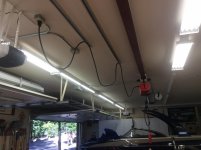
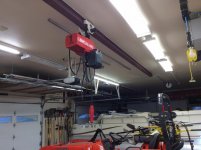
I stumbled upon a deal I couldn't pass up; Two 5" aluminum i-beams, 29' long each with half a dozen hangers and a trolley on each beam as well for $300. The web thickness of this aluminum is .225" and the closest I could find online for comparison was 5"x3"x.210" web, a 25' length was $688 from metals depot. I'm going to use 26' of one beam and hang it at that length. The hangers on the beam are 3/8" plate with clamps and 3/4" hardware that grab the top rail, then 3/4" threaded rod extends up to attach to whatever hanger I use on the joists. This is going on a 1st floor ceiling with 2x10" exposed floor joists on 16" center and the second floor is sheeted, which prevents me from just running straps over the 2x10's.

So my questions are about the hangers I need to fab up as well as spacing. I first need to know how far apart on 5" aluminum i-beam I can place my hangers and still safely lift 1,000 lbs without the beam deflecting between hangers. I plan on using 2" angle iron probably 1/4" thick and through-bolting it to my 2x10's with plate on the backside, basically sandwiching the 2x between the angle iron and the bar stock. The 2" angle iron will also be gusseted to make sure it stays in shape under load. My 2x10 floor joists currently span about 12', so would I need to double up all the 2x10's that I end up attaching this angle iron to? Or would a single 2x10 be able to handle 1,000 lbs on a beam attached to it without pulling down significantly? I will be adding pieces of 2x10 as spacers from the supporting 2x10 to the one next to it to help keep the 2x10 from deflecting forward under load as well. I've attached some pics of the beam and hangers as well a very crude drawing of the hanger style I will be doing. Any input is appreciated!
 

Attachments

  • IMG_0745.jpg
    IMG_0745.jpg
    155.1 KB · Views: 125
  • IMG_0759.jpg
    IMG_0759.jpg
    79.4 KB · Views: 129
  • IMG_712.jpg
    IMG_712.jpg
    87.8 KB · Views: 132
Last edited:
To avoid these ads, REGISTER NOW!

tarmy

Well-known member
Joined
May 28, 2014
Messages
4,662
Location
Nor Cal
The rafters need to be carefully thought about. The top in compression...where your three holes are. Try not to put them to high on the rafter...and avoid all the holes in alignment like that.

I hung a 20’ 4x4 I beam from my rafters which were designed for the loading. Similar to you...I used a length of 4” plate about 3’ long to spread the load along each rafter...only two holes spaced out toward the ends.

You are on the right track...but I would still suggest that you have an engineer look at your sketches and roof framing to see if they concur. Cheap insurance if you plan to be under anything you plan to pick up.

327127DC-B74E-4D86-90CB-C66C011D0A8D.jpg

127FE947-33F7-4253-933C-0C3328D115D5.jpg

D7DC322E-6E19-427A-A96D-6784F696B3B7.jpg
 

Ben W

Well-known member
Joined
Oct 20, 2008
Messages
67
Location
NY
I'd suggest your statement 'without the beam deflecting between hangers' is not the right question. All beams deflect, but do they deflect more than what is tolerable? more than what is noticeable? more than what is serviceable? Why do you not want the beam to deflect?

I'd be more concern about the beam not collapsing or my floor not collapsing. 2nd would be not cracking the sheetrock or tile above.

Deflection-wise, I think you could see deflection in your bolts (deforming the holes in the joists), deflection in your 2x2 angle, slop in the hardware, and lastly deflection in your beam. I think I'd want to cinch this beam so tight to the floor joists that your almost pre-tensioning it if I was worried about deflection.

In a simple sense, your bending capacity is M(moment) = Fy(yield strength) times Sx(bending capacity).
So what type of aluminum? What is it's yield strength?
What's the Sx for this shape? Math or can be pulled from a chart (probably next to what you already found.
When you multiply these two together you get your moment capacity.

Then you need to compare the actual moment to this capacity:
Point load moment = P*L/4
P = 1000 lbs.
L = spacing.

Pay attention to your units. And then you need to do this all over again for your floor joists, but now with wood.
 
OP
6

6shooter

Well-known member
Joined
Nov 8, 2015
Messages
49
I'd suggest your statement 'without the beam deflecting between hangers' is not the right question. All beams deflect, but do they deflect more than what is tolerable? more than what is noticeable? more than what is serviceable? Why do you not want the beam to deflect?

I'd be more concern about the beam not collapsing or my floor not collapsing. 2nd would be not cracking the sheetrock or tile above.

Deflection-wise, I think you could see deflection in your bolts (deforming the holes in the joists), deflection in your 2x2 angle, slop in the hardware, and lastly deflection in your beam. I think I'd want to cinch this beam so tight to the floor joists that your almost pre-tensioning it if I was worried about deflection.

In a simple sense, your bending capacity is M(moment) = Fy(yield strength) times Sx(bending capacity).
So what type of aluminum? What is it's yield strength?
What's the Sx for this shape? Math or can be pulled from a chart (probably next to what you already found.
When you multiply these two together you get your moment capacity.

Then you need to compare the actual moment to this capacity:
Point load moment = P*L/4
P = 1000 lbs.
L = spacing.

Pay attention to your units. And then you need to do this all over again for your floor joists, but now with wood.

I don't want to have to worry about my trolley taking off under heavy load to the low point of deflection. I know everything will move somewhat. I'm not worried about the floor above, it's only 3/4" subfloor in a storage space. I'll never get it finished upstairs because I'll be moved out of state before then. Using 3/4" hardware throughout I'm also not worried about fasteners deforming. I'm a heavy equipment mechanic and have pulled 6,000 lb engines using 3/8" hardware, this 3/4" stuff will never deflect any notable amount under only 1,000 lbs. The 2x2" angle is also going to be gusseted so 1,000 lbs shouldn't affect that, either. Thanks for those formulas, I'll have to sit down after work and do some figuring. I also need to find out what material this is. It was taken out of a Kodak plant in Rochester NY so I'm sure it wasn't just some cheap stuff. Thanks for all the help!

Your rafter hangers look pretty good. Do you know how it was previously mounted?

I do not, but the beam came out of a Kodak plant so I'd assume it had the 3/4" all thread run right up into steel framing of some sort that was way overbuilt for what this beam needed.

The rafters need to be carefully thought about. The top in compression...where your three holes are. Try not to put them to high on the rafter...and avoid all the holes in alignment like that.

I hung a 20’ 4x4 I beam from my rafters which were designed for the loading. Similar to you...I used a length of 4” plate about 3’ long to spread the load along each rafter...only two holes spaced out toward the ends.

You are on the right track...but I would still suggest that you have an engineer look at your sketches and roof framing to see if they concur. Cheap insurance if you plan to be under anything you plan to pick up.

How do you even go about finding an engineer for this kind of thing? Just google structural engineer and see if one would make a home visit without charging an arm and a leg?

Blue Ketchep Deflection App for smartphone.

Thanks, I'll check that out!
 
To avoid these ads, REGISTER NOW!

CraigStu

Well-known member
Joined
May 22, 2014
Messages
4,014
Location
Blacksburg, Va
There was a thread here a while ago w/ similar situation. One answer I liked was hang the beam etc on the ceiling. Have a couple of posts either adjustable or prefitted. When you actually lift something sit those posts on either side to support the beam and the lifted load. When done put the supports in the corner. If you honestly stay at <1000# I don't see a problem.
 

readhead

Well-known member
Joined
Dec 8, 2012
Messages
6,175
Location
Durango, Co.
The first thing you need to do is figure out what you have. The Kodak connection made me think that the beam may not be very heavy duty and may have been selected for its corrosion resistance to handle light material in a chemical setting. Just because it was inexpensive doesn’t mean it was a good deal.
 

pbon

Well-known member
Joined
May 14, 2017
Messages
3,498
From the picture of the beam with hangers, it looks like doubled 2x10 would fit well between them. Maybe even triple.

Another thought would be to cut out several strips of the flooring above so you could have a steel strap span multiple joists but still be level with the floor (probably need chamfers for the bolt holes).

I will be doing a mini version of this to lift things from my 1st floor to my 2nd floor. I was thinking about how to attach the I beam and like your bolt together plate and wedge system that is then hung from joists with threaded rod or similar.
 

fourbyford

Well-known member
Joined
Aug 3, 2017
Messages
913
Location
North Idaho... almost Canada!
First, let me begin by saying that I am NOT an engineer... but I have (over) built a metric ton of stuff that has worked... nothing has failed yet! ...lol

"...so would I need to double up all the 2 x 10's..."

In my mind, the answer to this depends on where along the 12'span you plan to hang the beam. If it's close to the ends of the joists, probably not. If it will be in the center of the span, I, personally, would double up the joists. A 12' 2 x 10 (around here at least) costs in the neighborhood of $15... if you were to space your hangers every 4' along the beam, you would need 7 2x's... a bit more than $100 will let you use this thing with confidence.
So, is a hanging bracket every 4' enough?? I honestly don't know the answer to that and without seeing the beam, it would be hard to say. Someone smarter than me could figure this out... but I won't go there. I will say that a 1,000# load isn't all that much and I would hazard a guess that an approximate 4' spacing should get you in the ball park.
The last thing I will mention is that I would add a second piece of angle at the bottom of each 2 x 10 and through-bolted like the upper ones. I would use the jam-nut principle... a nut above and below the angle mounting clip tightened against one another. This will result in a pull that is essentially vertical, instead of pulling from the top which would try to twist the joist under a load.
Again, I am not an engineer... but, I think this project will work! Be sure to let us know how it goes!
...D
20200218_052641.jpg

Sent from my SM-N960U using The Garage Journal mobile app
 

matt_i

Well-known member
Joined
Mar 14, 2008
Messages
10,725
Location
SE Michigan
It seems like a lot of load to me without doing any calculations.

Some reasons.
- the trolley looks far undersized from any 1000# trolley that I have ever seen used. No safety-ears on the trolley either in case you lose an axle/bearing. The wheels seem small to keep a 1000lb load smoothly rolling.
- the two L-shaped clips seem barely adequate to hold 1000# between the pair at a single point on the rail. Im of course guessing at scale, are they 1/4" thick x 1-1/2" wide? I am not sure how many supports that you have total...

I like the design and great detailed sketches, I would recommend this...copy and mirror the angle iron and flat over to the next joist, and then bridge between those two supports with 2 more angles to make a "box" as viewed from the top. Now hang your threaded rods from the center of the joist space. This does a couple of things. Makes 2 joists share the load, and removes the possible twist of the joist from the end due to the off-center loading.

I would consider downsizing to 3/8" or 1/2" threaded rods as well, use Grade B7 which approximates a Grade 5 bolt in tensile strength. Will also be a smaller hole in the support structure.

I ran some rough numbers and guessed at an Ixx value of 15 in^4 for the cross section. I'd support roughly every 4ft. I'd feel better about a working load of 500 lbs mainly due to the trolley. As mentioned the use of aluminum in hoist systems is purely from an environmental/corrosion standpoint. Steel is your material of choice for hoist systems when cost and strength are factors.
 
To avoid these ads, REGISTER NOW!
Top Bottom