To avoid these ads, REGISTER NOW!

Epoxy and control cuts

Augus7us

Well-known member
Joined
Jan 14, 2017
Messages
1,190
Location
Central Ohio
Hey All,

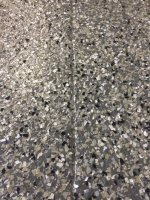
I finished half my epoxy floor Tuesday (4th coat...) and givin all the issues I've ran into, I'm very happy with the results so far.

While walking over it for the first time this morning I noticed we may have gotten a little two much epoxy in the control cuts. My aim was to get a thin coat over it so if it cracked, it cracked in the control joints, but still looked good. I'm worried it may be a little thick. If so should I cut in the epoxy in the joints to ensure my epoxy doesn't crack outside the joint? Assuming my concrete moves a little in the changing climate or something similar?

Not sure how worried I should be about this as I've seen guys fill the cuts with a flexible caulk of some sort and epoxy over it. The epoxy isn't flexible so I still see the floor cracking in this scenario. Am I missing something or overthinking this?

-Clint
 
To avoid these ads, REGISTER NOW!

Slide-Lok

Member
Joined
Jun 5, 2018
Messages
9
Location
Phoenix
Hi Clint,

So I can't speak for your epoxy but I can speak for coatings in general.

If your concrete is going to crack it will crack. If there is a coating on it regardless of the brand given a strong enough shift in the concrete the coating will crack too. Some coatings that are more flexible will sustain longer for those tiny hairline cracks but will eventually give and crack too.

As far as what it sounds like you're describing with epoxy dried in the control joints I guess it depends how much is really in there? I've been on many garage floors and it's inevitable eventually you push a little too much material into the joints. At which point while it's still wet we usually try to push it out or spread it as much as possible. It sounds like your floor is now dry and you've missed this window. Unless it looks really bad (so full it's flush with the floor), I would probably just leave it and move on with life. I would not cut down the middle of your coating in the joints trying to create a joint within the epoxy coating itself.

If it is really bothering you. What you could do is cut out the epoxy as best you can down to the concrete within the joint and then patch it. This would be more work than it is worth. So it really depends how much it is bothering you. If your concrete is going to crack then it's going to happen anyways and so no need to stress about it right now. Repair the coating crack in the future if it appears and bothers you enough.

Cheers! :beer:
 
OP
A

Augus7us

Well-known member
Joined
Jan 14, 2017
Messages
1,190
Location
Central Ohio
Thanks for the info sidelok. I'm inclined to agree with you on this. The floor is 14 years old so I don't see any major movement, in fact I'm only bringing it up because folks seemed adamant that if you fill your control cuts in, you must do it with something flexible. To me this implies you do so because parts of your pad may move slightly. Now maybe what I'm missing is this is only relevant if the floor is newly poured or something else I may not be seeing.

As far as looks go, no complaints here. They are somewhat filled but still visible which was important to me in the event I put a lift in there. If I were to fix them my plan was get a small circular saw with a depth stop set to 1/4" or 1/2", and run a diamond blade on a chalk line. If it looked like **** I'd come back with a brush at each step and lightly go over it with a brush, while doing the other side of my shop.

Photo of the crack in question.

attachment.php


Not bad for a Po' Boy full broadcast :D
 

Attachments

  • IMG_1253.jpg
    IMG_1253.jpg
    154.6 KB · Views: 162
To avoid these ads, REGISTER NOW!

NitroShark

Well-known member
Joined
Jan 8, 2010
Messages
518
Location
Greenville, SC
If you want a smooth floor look-- then you use a special “surface epoxy” (not flexible like silka) the epoxy manufacture will recommend their compatible formulas.

Use foam backing laid into the control joint ½ -3/8 inch down. Then coat over with the surface epoxy, Then you can prime/coat/top coat.

Before you go with this type of system be sure the slab is stable from further movements.


No cracks in my last DIY install after nearly 4 years.


.

attachment.php


attachment.php
 

Attachments

  • prep6.jpg
    prep6.jpg
    88.4 KB · Views: 145
  • floor11s.jpg
    floor11s.jpg
    55.2 KB · Views: 151

Armorpoxy

Well-known member
Joined
Aug 18, 2013
Messages
3,735
Location
NJ
Our opinion is to leave it be. You did a great job. The slabs, bring older most likely won't shift and crack,and the flecks would hide this just fine.

Go have a beer!
 
To avoid these ads, REGISTER NOW!
Top Bottom