To avoid these ads, REGISTER NOW!

Epoxy disappearing after throwing flake

DarrinW

Active member
Joined
Mar 8, 2024
Messages
27
Hello everyone I am new to the forum. I am applying epoxy to our warehouse floor. We are using a 100% percent solids epoxy with flake and a polyaspartic top coat.

We prepared our concrete by grinding with 30/40 diamonds. Cleaned vacuumed etc.

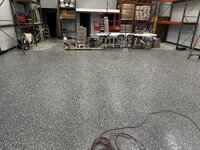
The product we are using is Duravel E-100 100% solids epoxy and Ps-90 polyaspartic. It says you can get 450 SQF per kit (3 gallon kit 2/1 ratio A/B) on the E-100. Now after applying at an even lower SQF (410 per), everything looks uniform and covered. But after throwing the flake (1/4” flake) you start to notice the epoxy under the flake thinning out disappearing almost and you can clearly see concrete. This is not happening everywhere just some places.

Our slab is about 60 years old. And probably is not laser level. But even then I do not feel this should be happening. I imagine if I did a primer coat with color and then a second coat would avoid this but still I don’t think that is necessary. Does any experts have any idea as to why this happens. I’ve watched many vids and happen seen similar results.
 

Attachments

  • IMG_6500.jpeg
    IMG_6500.jpeg
    1 MB · Views: 136
To avoid these ads, REGISTER NOW!

Shea

Well-known member
Joined
Sep 19, 2012
Messages
2,863
Location
California
Hello everyone I am new to the forum. I am applying epoxy to our warehouse floor. We are using a 100% percent solids epoxy with flake and a polyaspartic top coat.

We prepared our concrete by grinding with 30/40 diamonds. Cleaned vacuumed etc.

The product we are using is Duravel E-100 100% solids epoxy and Ps-90 polyaspartic. It says you can get 450 SQF per kit (3 gallon kit 2/1 ratio A/B) on the E-100. Now after applying at an even lower SQF (410 per), everything looks uniform and covered. But after throwing the flake (1/4” flake) you start to notice the epoxy under the flake thinning out disappearing almost and you can clearly see concrete. This is not happening everywhere just some places.

Our slab is about 60 years old. And probably is not laser level. But even then I do not feel this should be happening. I imagine if I did a primer coat with color and then a second coat would avoid this but still I don’t think that is necessary. Does any experts have any idea as to why this happens. I’ve watched many vids and happen seen similar results.
Epoxy will typically react like that when it comes in contact with a contaminant. Did you just vacuum after grinding or did you introduce water and cleaners to the concrete afterward?
 
OP
D

DarrinW

Active member
Joined
Mar 8, 2024
Messages
27
Epoxy will typically react like that when it comes in contact with a contaminant. Did you just vacuum after grinding or did you introduce water and cleaners to the concrete afterward?
I understand what you’re saying but this isn’t the case in this situation because it has happen two times. Different applications. And only in certain spots. Like I was saying it’s fine before I apply the flake. I mean there’s a possibility I am just doing it too thin and just need to find the sweet spot but I am not sure. Was hoping someone has experienced this. But no cleaners or water whatsoever
 

Matty J

Active member
Joined
Dec 22, 2023
Messages
38
Who manufactured the flakes that you are using? The choice is pretty much Torginol or Estes, but I am guessing since you are using Duravel products, you are using Estes Flakes. I have heard of issues with Estes flakes having moisture issues and creating similar issues to what you are experiencing. But other options are contamination of the slab, or high spots. I know you ground the floor down but it can still have some high and low spots and epoxy will fall down the high spots.
 
OP
D

DarrinW

Active member
Joined
Mar 8, 2024
Messages
27
Who manufactured the flakes that you are using? The choice is pretty much Torginol or Estes, but I am guessing since you are using Duravel products, you are using Estes Flakes. I have heard of issues with Estes flakes having moisture issues and creating similar issues to what you are experiencing. But other options are contamination of the slab, or high spots. I know you ground the floor down but it can still have some high and low spots and epoxy will fall down the high spots.
Yea it’s def Estes. And I have noticed they turn rubbery and soak up after setting for a minute. But I thought that it could be high and low spots but than I realized it’s pretty much the entire slab. Overall it looks great. The thing about Duravel is they say there product can go 30% more. But so far on 2 slabs I’ve had the issue I’m going to try and run it at 380 sqf and see if I get a nice coverage. And probably going to try and tad bit smaller flake.
 

Attachments

  • IMG_6513.jpeg
    IMG_6513.jpeg
    1.9 MB · Views: 101

Matty J

Active member
Joined
Dec 22, 2023
Messages
38
Yea it’s def Estes. And I have noticed they turn rubbery and soak up after setting for a minute. But I thought that it could be high and low spots but than I realized it’s pretty much the entire slab. Overall it looks great. The thing about Duravel is they say there product can go 30% more. But so far on 2 slabs I’ve had the issue I’m going to try and run it at 380 sqf and see if I get a nice coverage. And probably going to try and tad bit smaller flake.

Are you in the Charlotte area? Im just guessing that by your product choice. Or maybe the Raleigh area.

Im usually around 120sq ft per gallon for my epoxy basecoat. Another thing I like to do is after I squeegee and backroll the epoxy, I let it kick for a little bit before broadcasting the flake into it. That way I can see if anything is going to fish eye or have other surface issues. Also keeps the flake from sinking.
 
To avoid these ads, REGISTER NOW!
OP
D

DarrinW

Active member
Joined
Mar 8, 2024
Messages
27
This is why a primer is recommended. The concrete is absorbing your epoxy in these areas.
I thought that but when doing the water test absorption was very slow. So I didn’t do it. Def will do that next time
 
OP
D

DarrinW

Active member
Joined
Mar 8, 2024
Messages
27
Are you in the Charlotte area? Im just guessing that by your product choice. Or maybe the Raleigh area.

Im usually around 120sq ft per gallon for my epoxy basecoat. Another thing I like to do is after I squeegee and backroll the epoxy, I let it kick for a little bit before broadcasting the flake into it. That way I can see if anything is going to fish eye or have other surface issues. Also keeps the flake from sinking.
Thanks a lot yes that is my area. Do you use a similar product or a 100% solids? So for example with a 3 gallon kit 2 parts A 1 part B you lay it around 360 square feet? Duravle claims to get 30% more coverage per kit so that would make sense that other people lay it at a lower square footage. Do you also do a primer coat? Or when would you ever do one. I probably should have. I’m guessing I either layed it too thin or the concrete is taking it all.
 
Joined
Oct 31, 2010
Messages
14
Location
Houston Texas
Sounds like your concrete is more porous than thought. The epoxy was seeping into it and probably would have been sufficient enough to cover it, But once you put flakes in the flakes started to absorb the coating therefore not leaving enough coating to soak in to the very rough or porous areas. It sounds like you put the floor coating down at about 135 ft² per gallon which is typically enough but super rough floors can sometimes require more. I've seen this same thing happen even when applying the coating at 100 ft² per gallon, But it was the worst slab I had ever seen. The cheapest way to fix it if you're not willing to live with it Is to rebroadcast another layer of chips into a clear Polyaspartic that you put over the existing floor after sanding it. But honestly the pictures look fine I would live with it. I personally think it's a good looking floor.
 

ryanmworkman

Member
Joined
Sep 16, 2021
Messages
12
Thanks a lot yes that is my area. Do you use a similar product or a 100% solids? So for example with a 3 gallon kit 2 parts A 1 part B you lay it around 360 square feet? Duravle claims to get 30% more coverage per kit so that would make sense that other people lay it at a lower square footage. Do you also do a primer coat? Or when would you ever do one. I probably should have. I’m guessing I either layed it too thin or the concrete is taking it all.
Like Matty J, I am also in the Charlotte area and have used Duravel and estes flake in an emergency, but I don't make it a normal thing. Estes flake unfortunately is absolutely terrible. I've had it ruin a couple projects for me before because it absorbs moisture terribly. I can recovery torginol flakes from the floor and reuse on later jobs with the same color, but the Estes flakes have always been one and done because they absorb so much residual moisture out of the air on humid days that they clump up and cannot be reused.

Duravel's epoxy (which is just SurfKoat) is very low viscosity from my experience with it. The downside to this is when it goes over a porous substrate, it really gets sucked into the floor and you often end up with transparency issues like you're seeing. To avoid this, you need to go thicker--more in the 120-130/sf per gallon range like Matty J recommends, or do a primer coat first. Doesn't help you now I know, but if you do any additional epoxy in the future, buy something that has a more moderate viscosity with a heavy pigment load. Did you pigment clear, or did they have a pre-pigmented version?

I've never had great success pigment pods in low viscosity epoxy unless it was a dark gray or a black. I've used dozens of products over the years on 1500+ installations and nearly 2 million sf, and have never been let down by NPI products, so if you're an installer and not just doing this as a DIY project, I'd talk to them. I also keep some of their products in stock if you ever need any in a pinch. I use other brands as well, but NPI 707 is the best workhorse epoxy I've ever used.
 
OP
D

DarrinW

Active member
Joined
Mar 8, 2024
Messages
27
Sounds like your concrete is more porous than thought. The epoxy was seeping into it and probably would have been sufficient enough to cover it, But once you put flakes in the flakes started to absorb the coating therefore not leaving enough coating to soak in to the very rough or porous areas. It sounds like you put the floor coating down at about 135 ft² per gallon which is typically enough but super rough floors can sometimes require more. I've seen this same thing happen even when applying the coating at 100 ft² per gallon, But it was the worst slab I had ever seen. The cheapest way to fix it if you're not willing to live with it Is to rebroadcast another layer of chips into a clear Polyaspartic that you put over the existing floor after sanding it. But honestly the pictures look fine I would live with it. I personally think it's a good looking floor.
Thanks man I just find it hard to believe it was so porous it’s atleast a 30 year old slab I did a water test it did not seems to soak it up that quick but I’m new to this so I wouldn’t know. So if I wanted to fix it are you saying I would sand what I got now and then apply polyaspartic and then flake? No second coat to cover the flake again?
 
OP
D

DarrinW

Active member
Joined
Mar 8, 2024
Messages
27
Like Matty J, I am also in the Charlotte area and have used Duravel and estes flake in an emergency, but I don't make it a normal thing. Estes flake unfortunately is absolutely terrible. I've had it ruin a couple projects for me before because it absorbs moisture terribly. I can recovery torginol flakes from the floor and reuse on later jobs with the same color, but the Estes flakes have always been one and done because they absorb so much residual moisture out of the air on humid days that they clump up and cannot be reused.

Duravel's epoxy (which is just SurfKoat) is very low viscosity from my experience with it. The downside to this is when it goes over a porous substrate, it really gets sucked into the floor and you often end up with transparency issues like you're seeing. To avoid this, you need to go thicker--more in the 120-130/sf per gallon range like Matty J recommends, or do a primer coat first. Doesn't help you now I know, but if you do any additional epoxy in the future, buy something that has a more moderate viscosity with a heavy pigment load. Did you pigment clear, or did they have a pre-pigmented version?

I've never had great success pigment pods in low viscosity epoxy unless it was a dark gray or a black. I've used dozens of products over the years on 1500+ installations and nearly 2 million sf, and have never been let down by NPI products, so if you're an installer and not just doing this as a DIY project, I'd talk to them. I also keep some of their products in stock if you ever need any in a pinch. I use other brands as well, but NPI 707 is the best workhorse epoxy I've ever used.
I noticed problems with the flake absorbing moisture and it was my first time. I knew something was up. So with duravel epoxy you add a liquid color or it’s just a thick color you dump into the part A. How exactly does NPI work? As far as adding color to the base coat. Are they local in the Charlotte area? I would like to try a different supplier on the next slab in our warehouse. I really did not think the concrete was very porous I did this water test and it didn’t completely soak into the concrete very fast it soaked up but took a while. I know I could have done a primer and added a solvent to get a little more out of it but I’d love to not have to do that.
 
To avoid these ads, REGISTER NOW!
Top Bottom