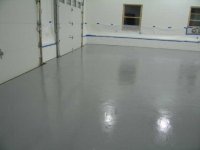
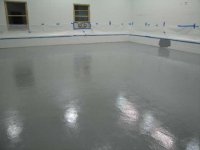
Well...first coat is down...
I went ahead and put a first coat on the floor. Took me about 2-1/2 to 2-3/4 hours to coat the floor (850 sq ft). I reduced the epoxy 1pint per gallon as recommended by Sherwin Williams. I think it turned out great. The sad part is I wasted about 2 gallons of epoxy (gulp). I ended up only using about 2 gallons of my 4 gallon batch. Looks like Sherwin Williams coverage numbers don't hold up when you reduce the mix. Oh well, lesson learned. When I do the second coat I plan on not reducing...we'll see.
In any event, it's now close to 8pm. I started a 1pm, so I'm getting ready to turn the heat back on...I let it run at 70 degreees for several days.
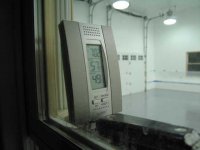
I did everything possible to contain the heat inside the garage. The forecast for today was high in the low 40's. I insulated the entire perimeter of the garage block wall with 2" rigid foam insulation. In my testing this has kept the floor a couple of degrees warmer than without the insulation. To monitor the temps during the whole process, I used this wireless temp monitor thing I got last Christmas. It worked great. I sat the unit on the window sash so that it would be viewable from outside. The top temp shows the air temp right inside the window, which is usually colder than the air temp inside the building (at the time of the picture, the air temp in the building was 64 degrees). The lower temp is the temp at the wireless sensor site. I placed the wireless sensor on the apron, right inside the garage door. This location is the coldest part of the floor, so this will be my "worst case" temp if you will. In my testing the floor surface is up to 5-6 degrees warmer than the temp at the apron. I have another LCD monitor like the one in the window inside the house. It communicates to the wireless sensor as well, so I can monitor the coldest temp from inside the house (really cool).
To vent the fumes, I borrowed my parents window fan. It has a wireless remote to enable you to turn it on an off from a distance. I've used it to throttle the venting of the fumes since it has a low and high speed. Once the floor was coated, I kicked it into high so the room would vent better, but I kept it on low while I was coating to help keep the heat in the garage. Also, to help contain the heat from escaping the window, I put a towel on the outside of the window. This keeps any wind/cold air from entering the garage. When the fans are on, the towel still allows the vapor to escape, but heat is still retained somewhat in the garage. I did testing without the towel and the temp in the garage would drop 15 degrees in about an hour (yikes), which is why I came up with the towel idea. With the towel in place, the garage only lost 6 degrees in 5 hours...amazing.
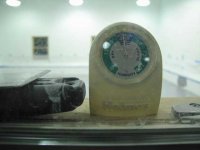
Also, I used a hygrometer (just inside the window...originally on the floor, but moved for obvious reasons) to keep an eye on the humidity. One thing I noted, once the coating was down, the humidity dropped to almost 20% or less. I took this to mean that the "humid" air was being displaced by the coating vapor. Now as the coating starts to cure (and loses solvent), the humidity comes back up to where it was originally. This may be helpful for others when coating their floor, as this may help gauge the vapor content of the room.
I also used an infrared thermometer (Raytek MT6) to gauge the temp of the floor in various locations, too. Before coating, all locations where at least about 58 degrees, with the middle of the garage being close to air temp (70 degrees).
Oh yea, that gray patch on the wall is a test. I was going to use the remainder of the epoxy to start coating the walls, but I decided I better test it out first and then coat the walls when the floor is done. I'm glad I did, as putting epoxy on the wall was not really easy since there are so many little voids to fill (even with the block filler). It would have taken a while to do the floor AND the wall at the same time.
Hope this helps anyone else in a similar situation. Coming soon.... 2nd coat.