To avoid these ads, REGISTER NOW!

Etching rather than grinding to avoid swirl marks?

jetranger

Well-known member
Joined
Jul 18, 2014
Messages
129
Location
USA
I just helped a buddy epoxy his garage floor. We rented 2 Diamabrush tools from HD. He did no flake, which is what I want as well. From my eye level, I can look down and see swirl marks in his floor.

I talked to Scotty on the phone today and he mentioned flakes are the best thing to 'hide' swirl marks.

I like the look of a smooth, single color floor. Has anybody opted to acid etch rather than grind to avoid swirl marks? I know it is the less preferred of the two, but it might have a better appearance for the end result.
 
To avoid these ads, REGISTER NOW!
OP
J

jetranger

Well-known member
Joined
Jul 18, 2014
Messages
129
Location
USA
20150828_082447.jpg
 

tncatadjuster

Well-known member
Joined
Jan 3, 2010
Messages
1,985
Location
Memphis, TN
First and foremost at what rate is the coating applied?
Thick coats hide a lot of sins, I like a 16 mil thickness or 100 sf per gallon for 100% solids. Are the fibers we see from a cheap cover or fiber in the slab?

Once I was able to grind instead of etch, I have never gone back to etching.
 
OP
J

jetranger

Well-known member
Joined
Jul 18, 2014
Messages
129
Location
USA
I think the fibers are from a cheap cover... I'm not sure though. I wasn't there when he purchased or unwrapped them.

I agree a thicker coat hides a lot, but these seemed to be some deep swirl marks. Those pictures are taken after 2 coats of 70% solids. 750 sq ft, and 12 gallons total 6 part A, 6 part B).

My garage is 580. I ordered the 600 sq ft kit from Legacy, including primer and clear.

Does anybody have any good techniques or tricks for avoiding swirl marks with the diamabrush?

Thanks
 

INTMD8

Well-known member
Joined
Sep 17, 2013
Messages
314
Location
Lake Villa Il.
I used a 7" diamabrush when I ground my floor and noticed when the tool was starting to wear out it made a much smoother finish. I suppose I could go back to where I started and smooth out the tool marks but don't think it's worth the effort.

Other than smoothing out the floor with finer grit tooling I think the only other thing you could do is more coats/thicker material.
 

12ozd

Well-known member
Joined
Apr 6, 2012
Messages
808
Location
at the kegerator
I agree a thicker coat hides a lot, but these seemed to be some deep swirl marks. Those pictures are taken after 2 coats of 70% solids. 750 sq ft, and 12 gallons total 6 part A, 6 part B).
That would be appx. 18 mil.

Remember at 70% solids, you are losing 30% of the applied thickness to evaporation.
My garage is 580. I ordered the 600 sq ft kit from Legacy, including primer and clear.
What is the dry film thickness of that kit?
 

Trey T

Well-known member
Joined
Aug 3, 2011
Messages
3,749
Location
Houston, TX
I just helped a buddy epoxy his garage floor. We rented 2 Diamabrush tools from HD. He did no flake, which is what I want as well. From my eye level, I can look down and see swirl marks in his floor.

I talked to Scotty on the phone today and he mentioned flakes are the best thing to 'hide' swirl marks.

I like the look of a smooth, single color floor. Has anybody opted to acid etch rather than grind to avoid swirl marks? I know it is the less preferred of the two, but it might have a better appearance for the end result.

Grinding is to ensure 100% removal of non-concrete material but if you got a brand new floor (regular troweled), it doesn't make sense to grind, just etch the floor to have consistent roughness across the floor. If you ever handled these high-solid or 100% solid epoxy, they're nasty; another word, they will stick to anything you apply to. If you get it on your hand, good luck on take it off in a day, even w/ solvent cleaners.

I believe grinding takes out the guess work for contractor and epoxy sellers to guaranteed their products. It ensure proper roughness across the floor to promote consistent mechanical cohesion. It's a good practice to grind but I believe it's unnecessary as described above.
 
Last edited:

tncatadjuster

Well-known member
Joined
Jan 3, 2010
Messages
1,985
Location
Memphis, TN
Grinding is to ensure 100% removal of non-concrete material but if you got a brand new floor (regular troweled), it doesn't make sense to grind, just etch the floor to have consistent roughness across the floor. If you ever handled these high-solid or 100% solid epoxy, they're nasty; another word, they will stick to anything you apply to. If you get it on your hand, good luck on take it off in a day, even w/ solvent cleaners.

I believe grinding takes out the guess work for contractor and epoxy sellers to guaranteed their products. It ensure proper roughness across the floor to promote consistent mechanical cohesion. It's a good practice to grind but I believe it's unnecessary as described above.


Really:dunno:
 

Garage Flooring

ALLIANCE MEMBER
Joined
May 21, 2011
Messages
5,288
Location
Grand Junction, CO
Respectfully, grinding is a much better way to prep for epoxy than etching. Especially today when so many contractors add cure and seal and other products into the mix that the average consumer would never see.

Etching does work often. Just do a test spot first. 100% solids epoxy absolutely requires the right surface profile for proper adhesion.
 

benwah

Well-known member
Joined
May 21, 2014
Messages
980
Location
Crested Butte, Colorado
Grinding is not unnecessary, I will have to disagree. Grinding, shot-blasting, or abrasive blasting as a means to create a profile in concrete or CMU is the correct path to take. Especially when coating with a thin film, or thicker system. Grinding not only removes laitance, curing compounds, hardeners, and sealers but also creates a profile for adhesion and opens up the concrete for proper penetration.

Acid etching is the absolute minimum amount of surface preparation one can do. And it is not guaranteed that your coating will adhere properly. It will not remove sealers, curing compounds, hardeners or and it can also leave behind a chemical residue if not properly neutralized and rinsed. Etching will provide the least amount of profile, can lead to moisture vapor issues if not let to dry for long enough, and is generally looked at as a short-cut in the coatings industry.

Sure it may "work" at least temporarily, in most cases. But if you're spending hundreds, or thousands of dollars to coat your floor with a quality product, why skimp out on surface preparation?
 
Last edited:

Trey T

Well-known member
Joined
Aug 3, 2011
Messages
3,749
Location
Houston, TX
What I stated is very clear on when to etch, but benwah even clarify when not to etch which I agree. However, I haven't seen testing done on what I described. Again it's a good practice to grind the floor to cover the uncertainties.

The first question we all have to answer is this (assumption is no foreign material at surface): what is the minimum roughness required to provide an appropriate mechanical cohesion? If there such a practice to determine that value, how do we measure it?
 

benwah

Well-known member
Joined
May 21, 2014
Messages
980
Location
Crested Butte, Colorado
The first question we all have to answer is this (assumption is no foreign material at surface): what is the minimum roughness required to provide an appropriate mechanical cohesion? If there such a practice to determine that value, how do we measure it?

First question is easy, and the answer is "whatever the manufacturer recommends." They've done the testing, so they will tell you the minimum concrete surface profile or CSP standard to achieve.

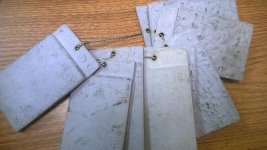
Second, you measure it by sight and feel. ICRI-CSP has 9 levels of surface preparation. 1 being the least aggressive and 9 being the most aggressive. Here are some pics of a tool one can use to measure the profile on a concrete substrate. Yeah they're a bit dirty and used, but you get the idea.

As you can see, the profile becomes more aggressive as the numbers get higher. This is a great tool for field testing, but after doing this for a while you can gauge at least the first 4 or 5 levels by sight and feel.
 

Attachments

  • unnamed.jpg
    unnamed.jpg
    70.8 KB · Views: 89
  • unnamed (1).jpg
    unnamed (1).jpg
    70.1 KB · Views: 81
Last edited:

Garage Flooring

ALLIANCE MEMBER
Joined
May 21, 2011
Messages
5,288
Location
Grand Junction, CO
Grinding is not unnecessary, I will have to disagree. Grinding, shot-blasting, or abrasive blasting as a means to create a profile in concrete or CMU is the correct path to take. Especially when coating with a thin film, or thicker system. Grinding not only removes laitance, curing compounds, hardeners, and sealers but also creates a profile for adhesion and opens up the concrete for proper penetration.

Acid etching is the absolute minimum amount of surface preparation one can do. And it is not guaranteed that your coating will adhere properly. It will not remove sealers, curing compounds, hardeners or and it can also leave behind a chemical residue if not properly neutralized and rinsed. Etching will provide the least amount of profile, can lead to moisture vapor issues if not let to dry for long enough, and is generally looked at as a short-cut in the coatings industry.

Sure it may "work" at least temporarily, in most cases. But if you're spending hundreds, or thousands of dollars to coat your floor with a quality product, why skimp out on surface preparation?

What I stated is very clear on when to etch, but benwah even clarify when not to etch which I agree. However, I haven't seen testing done on what I described. Again it's a good practice to grind the floor to cover the uncertainties.

The first question we all have to answer is this (assumption is no foreign material at surface): what is the minimum roughness required to provide an appropriate mechanical cohesion? If there such a practice to determine that value, how do we measure it?

OK so that is exactly the problem. ASSUMPTIONS.


We all have to make them and sometimes they come back and bite us in the..... First assumption is that there is nothing in or on the concrete. I'm not sure what percentage of jobs are new homes, and even then, you ask the homeowner if a cure n seal was used and many have no idea. Our house was 10 years old when we bought it. We have no way of knowing what has been done to that floor.

The next assumption is that people are going to use the right product and the right dilution. Not only does what is on the concrete affect prep, but the type of concrete, hardness, and several other factors can affect how you have to etch the floor.

Assuming that is done correctly, you have to assume that the folks properly neutralize the whole floor.

If all that is done correctly, you can still look at a floor that has seen a grinder vs a floor that has been etched and tell the difference.

So take our high solids (or anyone's) over a good primer over a floor that has been adequately etched and you probably have a pretty good floor. 100% solids adds a little more doubt, but again assuming a good primer, you should be ok.

In almost every case epoxy failure can be dialed down to improper application, product selection, or preparation. Grinding and priming go a long way to preventing many application issues IMHO as it is more likely to deal with unknowns in an effective manner
 
To avoid these ads, REGISTER NOW!

Shea

Well-known member
Joined
Sep 19, 2012
Messages
2,866
Location
California
In almost every case epoxy failure can be dialed down to improper application, product selection, or preparation. Grinding and priming go a long way to preventing many application issues IMHO as it is more likely to deal with unknowns in an effective manner

What he said :thumbup:
 

EricVonHa

Well-known member
Joined
Oct 30, 2005
Messages
167
Location
Eastern Pa
I've read a couple things in this thread that prompted me to type something here.

The use of the floor will generally dictate the level of CSP (concrete surface preparedness)

Look for this spec on any manufacturer's product. If there is nothing published, all bets are off. The floor will look great for a while (months? year? 2 years?). After that, hot tire pick-up of the floor coating may occur. The floor may chip easily (think drop a hammer from 4'). Cheap products and single coating epoxies apply here. Film thickness and the level of the prep are imperative.

A basic floor coating can be a 2-part epoxy in single gallon cans from Home Depot or Sherwin Williams or Rustoleum. Will the stuff last? It depends upon the level of prep. What you buy at a RETAIL store is not necessarily formulated to survive heavy traffic and abuse. The commercial stuff costs $$$$.

Either way, always diamond the floor. It cannot hurt. It only helps. An ounce of effort and a $100-$200 rental will save you some headache in the long run. It is all about prep. Do not short cut. The grinding process removes filler and other non-essential garbage from the top of the floor's surface. Concrete is poured (think pourous). The evaporative qualities of concrete bring pollutants to the surface. The imperfections need to be ground away in order to provide the proper bonding capability of any installed flooring product.
 

stokessd

Member
Joined
Dec 28, 2011
Messages
22
Location
Grantham NH
Wow! I just spent 4+ hours grinding my 500sqft garage yesterday with a diamabrush, and I WISH mine was aggressive enough to make swirls like that. In places that I wanted more bite, I was putting one foot on the grinder motor and pushing it around like it was a scooter. Even with weight on the head, paint came off really slowly.

I must have had a knackered one, or you had a brand new one.


10 years ago I epoxy painted my three stall garage in my previous house. I acid etched that floor and it was damn near worthless. The grind vs etch in my very limited experience is night and day. Diamabrushes didn't exist back then and I didn't want to deal with an industrial grinder or shot peener.

Sheldon
 
Last edited:

Armorpoxy

Well-known member
Joined
Aug 18, 2013
Messages
3,735
Location
NJ
We have sold tens of thousands of garage kits where people etch and it has worked out fine. The problem with renting a Diamabrush from a home center is that the blades can be either new or worn, and that does affect the outcome a lot. Also the blades come in 2 grits, 25 (will most likely scratch the floor) and 100 (most likely won't). Our garage floor systems do not require grinding, etching is just fine in most cases. Of course every job is different so if any questions, always ask your supplier.

When we grind professionally from our Prep-Crete Division with our big grinders, swirls from the grinders don't start disappearing until about #100 diamonds get on the machines. We would never coat a floor grinded with #25 size diamonds alone, its almost guaranteed to be a problem and the rented Diamabrushes we have heard often come with 25's on them, so always check. When we do a grind/seal only (very popular in NYC area) for offices and such, we grind to #120 before sealing.
 
Last edited:
OP
J

jetranger

Well-known member
Joined
Jul 18, 2014
Messages
129
Location
USA
We would never coat a floor grinded with #25 size diamonds alone, its almost guaranteed to be a problem. When we do a grind/seal only (very popular in NYC area) for offices and such, we grind to #120 before sealing.

All good info, thanks. Do you think it would take way too long to start with the #100? Is it necessary to do the #25 first to knock it down? So the #120 leaves little/no scratches and marks?

I'm not sure home depot rents different grits of Diamabrush... I'll have to ask them next week.

Thanks again
 

stokessd

Member
Joined
Dec 28, 2011
Messages
22
Location
Grantham NH
I'm not sure home depot rents different grits of Diamabrush... I'll have to ask them next week.


The two home depots I've been to (New Hampshire) only had two diamabrush attachments, there is the concrete prep tool with a lot of diamond coated fingers, and the concrete strip tool which has about half to one third as many fingers.

Those were the choices, no grit choice and no reservations, first come first served. The pained expressions and disinterested attitude to my questions was free though. :dunno:

Also the local Home Depot didn't have the dust collar, so I rented a polisher with built-in dust collection. That was worthless.

Sheldon
 

LegacyIndustrial

ALLIANCE MEMBER
Joined
Jun 7, 2010
Messages
7,994
Location
deerfield, IL
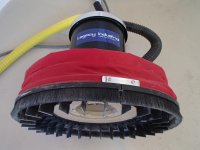
We use the Diamabrush system in addition to a diamond grinder. It works well and a boat load better than etching. No swirls with the 25 at all. Diamond cup wheels mounted to hand grinders will leave nice swirls if you are not careful.
P1010187.jpg


Sheldon see if your local rental places rent a 10" edco. That is also a good machine. Hopefully they have a diamond plate and not the serts.
IMAG0209.jpg


Sent from my iPhone using Tapatalk
 
Last edited:

stokessd

Member
Joined
Dec 28, 2011
Messages
22
Location
Grantham NH
Sheldon see if your local rental places rent a 10" edco. That is also a good machine. Hopefully they have a diamond plate and not the serts.

Thanks for the info, I rented the grinder yesterday afternoon and ground last night for four hours. It turned out really nicely (lots of paint spray on the floor from the dreaded previous owner). Wrangling that polisher for four hours really showed me how much of a desk jockey I've become.

Primer went down this morning and is just about all cured now. Tomorrow is the big day...
 
To avoid these ads, REGISTER NOW!
Top Bottom