To avoid these ads, REGISTER NOW!

Ethernet Patch Cable Confuson

u3b3rg33k

Well-known member
Joined
Dec 18, 2017
Messages
4,048
@Mr onetwo the primarys reason for terminating instead of using pre-term are twofold:
1: knowing exactly how long things are is hard. if someone's drawing is off, or the electricians don't install the pipe exactly where it needs to go, you can have a truckload of pre-term that is unusable.

2: pulling the connector ends through pipe is harder than pulling unterminated cable.

also: the coupler adds length to the connection. this has to be accounted for in the wall/floor/desk boxes.
 
To avoid these ads, REGISTER NOW!
OP
M

Mr onetwo

Well-known member
Joined
Apr 6, 2011
Messages
2,010
Location
Coastal Maine
This is an industry standard description of CMR..." CMR cable, often called “riser-rated cable,” is constructed to prevent fires from spreading floor to floor in vertical installations." The "riser" being a vertical conduit. The cables I am asking about are going to be installed within walls just like nm/b...no conduits of any kind. Nm/b wire has no special smoke/flame rating.This is all in existing structure so accurate measurements are very easy to obtain.
 
OP
M

Mr onetwo

Well-known member
Joined
Apr 6, 2011
Messages
2,010
Location
Coastal Maine
Riser rated patch cables are not a thing. No one runs path cables from floor to floor. that's what structured cable is for.

It's better to have keystone jacks for the same reason you don't plug your tv into the breaker box.
The screen shot I posted is of a Belden riser rated patch cord
 

wyliesdiesels

Well-known member
Joined
Aug 14, 2012
Messages
20,067
Location
Modesto, CA
This is an industry standard description of CMR..." CMR cable, often called “riser-rated cable,” is constructed to prevent fires from spreading floor to floor in vertical installations." The "riser" being a vertical conduit. The cables I am asking about are going to be installed within walls just like nm/b...no conduits of any kind. Nm/b wire has no special smoke/flame rating.This is all in existing structure so accurate measurements are very easy to obtain.
and riser rated cable is also used for horizontal cabling.
 

Denwood

Well-known member
Joined
Sep 22, 2014
Messages
4,199
Location
Thunder Bay, Ontario, Canada
You don't need much for tools to terminate the correct bulk cable into keystone wall inserts, and use the same for a simple 16 port patch panel in your electrical room.

I won't bother rehashing why you shouldn't use patch in walls, but the chances of damaging the ends is pretty high..and then you'll be left trying to repair a stranded cable...which is not feasible in the field. Keystone jacks termination is just cutting the outer jacket back, matching the color coded wires to the connector, trim loose ends, and snapping a few plastic caps on. It is about the easiest way to do it.

If you do use patch for your runs, and damage the end later (very easy to do) there is no repair path with patch, vs an easy fix if you use the correct (non stranded) cable.

If you can wire a 120V receptacle, then you can terminate a keystone insert. Spend $30 on a cheap RJ45 tester/wire trace, and label everything!

I use the slim patch in pretty much all of our LAN closets now...it's awesome.

The TPlink TL-SG108 8 port switch, or Netgear GS308 are fine based on your needs. We use them often when required to add a few ports at the end of a single LAN run, in a pinch. They are both low power consumers, have metal cases, are fan-less.
 
Last edited:

u3b3rg33k

Well-known member
Joined
Dec 18, 2017
Messages
4,048
You don't need much for tools to terminate the correct bulk cable into keystone wall inserts, and use the same for a simple 16 port patch panel in your electrical room.

I won't bother rehashing why you shouldn't use patch in walls, but the chances of damaging the ends is pretty high..and then you'll be left trying to repair a stranded cable...which is not feasible in the field. Keystone jacks termination is just cutting the outer jacket back, matching the color coded wires to the connector, trim loose ends, and snapping a few plastic caps on. It is about the easiest way to do it.

If you do use patch for your runs, and damage the end later (very easy to do) there is no repair path with patch, vs an easy fix if you use the correct (non stranded) cable.

If you can wire a 120V receptacle, then you can terminate a keystone insert. Spend $30 on a cheap RJ45 tester/wire trace, and label everything!

I use the slim patch in pretty much all of our LAN closets now...it's awesome.

The TPlink TL-SG108 8 port switch, or Netgear GS308 are fine based on your needs. We use them often when required to add a few ports at the end of a single LAN run, in a pinch. They are both low power consumers, have metal cases, are fan-less.
you forgot "and keeping the twist tight in the connector". the most important part, and the part people mess up the most. I've seen tons of mistakes made on things that were "working". some so bad they're obvious from 10' away.

sometimes we'd have to crimp ends on connectors (usually for a WAP) where the other end is punched down. the difference between barely passing the certification and +4dB of headroom is about 1/8" of twist in a connector for cat5e. it's tighter for 6, and not cost effective for 6A. at that point you just float a jack in the ceiling and patch into that.

here's a picture I found online. it would likely fail to pass cat6 testing. the twist needs to be maintained well into the connector.

Screen Shot 2022-04-03 at 00.31.49.png


it's the main reason I like this idea:
iu-14.jpeg

at least you can pull the twist in and then crimp it down.
 
OP
M

Mr onetwo

Well-known member
Joined
Apr 6, 2011
Messages
2,010
Location
Coastal Maine
I appreciate everyone's comments very much and I have learned a lot. There are several partial rolls of Belden and Commscope Cat6 in auctions on Ebay right now.I will try to get a roll for a reasonable cost and go from there. Any advice on tools for making up punch down keystone jacks would be helpful. I already have a TP-Link TL-SG105 5-port gigabit switch on hand.Can I just get another 5 port and use them together or just pick up a single 8 port? https://www.tp-link.com/us/business-networking/unmanaged-switch/tl-sg105/
 
To avoid these ads, REGISTER NOW!

u3b3rg33k

Well-known member
Joined
Dec 18, 2017
Messages
4,048
any 110 punchdown tool should do the job for you. just make sure you have the "cut" side on the OUTSIDE when you terminate, or you'll get to do it again.

yes, you can "daisy chain" ethernet switches, to a point. but it is not best practice. if you find yourself with 6 or 7 done that way, you're doing it wrong.
You will be limited to gigabit between the two switches, whereas in a switch you have gigabit between each port. this probably won't matter to you, but it depends on what you do.
 
Last edited:

Denwood

Well-known member
Joined
Sep 22, 2014
Messages
4,199
Location
Thunder Bay, Ontario, Canada
you forgot "and keeping the twist tight in the connector". the most important part, and the part people mess up the most. I've seen tons of mistakes made on things that were "working". some so bad they're obvious from 10' away.

sometimes we'd have to crimp ends on connectors (usually for a WAP) where the other end is punched down. the difference between barely passing the certification and +4dB of headroom is about 1/8" of twist in a connector for cat5e. it's tighter for 6, and not cost effective for 6A. at that point you just float a jack in the ceiling and patch into that.

here's a picture I found online. it would likely fail to pass cat6 testing. the twist needs to be maintained well into the connector.

Screen Shot 2022-04-03 at 00.31.49.png


it's the main reason I like this idea:
iu-14.jpeg

at least you can pull the twist in and then crimp it down.
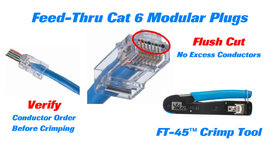
I am using the feed thru and corresponding crimper currently, but I'll admit it drives me a bit nutty terminating cables vs just using patch. The advantage of the feed through is you can strip back further (so eaiser to line up the conductors), but if too long, they are a beast to keep lined up for insertion. The upside, is yes...you can pull through further and reduce the untwisted area. The keystone female inserts are just quicker, particularly if you're using a good system...they're not all the same.

I've had very few issues with CAT5e, and ran 10Gbe over it with no issues at my commercial building where we did video edit from a central server over 10Gbe. The runs are likely under 100ft, but still...it worked flawlessly at wire speed.

Mr, there are tool-less CAt5/6 connectors out there like this: https://www.primecables.ca/p-322053-cab-1040-cat6-rj45-toolless-keystone-blue-primecables#sku322057

Using a punchdown is also easy peasy:


Milton Shaw

Well-known member
Joined
Feb 11, 2011
Messages
4,845
The keystones are much easier to terminate and get right than the ends on patch cords. Also when you are doing them LeGran makes a tool that punches and cuts all 8 wires at one time if you are using their terminals. Make sure you get a tester to check your wiring so you know everything is correctly terminated. Have a lot of fun and put extra's in incase you change your mind on locations of your equipment.
 

wyliesdiesels

Well-known member
Joined
Aug 14, 2012
Messages
20,067
Location
Modesto, CA
The keystones are much easier to terminate and get right than the ends on patch cords. Also when you are doing them LeGran makes a tool that punches and cuts all 8 wires at one time if you are using their terminals. Make sure you get a tester to check your wiring so you know everything is correctly terminated. Have a lot of fun and put extra's in incase you change your mind on locations of your equipment.
there are many brands that have a quick termination tool....
 
To avoid these ads, REGISTER NOW!
Top Bottom