To avoid these ads, REGISTER NOW!

Evapo Rust Better Work . . .

OP
T

Teken

Well-known member
Joined
Jan 2, 2010
Messages
8,214
Location
The Bad Lands
What is the results of using molasses? Is it faster in removing the rust then vinegar, and does it make the item you're restoring blacken as much as that solution?

As I am trying to balance performance vs cost as I have several large items that simply will require at least 3 gallons of this mixture.

I wouldn't be able to afford Evapo Rust in that quantity to be honest.

Insight . . .
 
To avoid these ads, REGISTER NOW!

lipadj46

Well-known member
Joined
Jan 25, 2010
Messages
1,044
Try soaking in cola. It has sugar and citric acid in it (though don't think it is the sugar in molasses that does anything they say it contains chelating agents). Add some molasses, vinegar and degreaser and experiment a bit.
 
Last edited:

lipadj46

Well-known member
Joined
Jan 25, 2010
Messages
1,044
Also for those of your worried about evaporation just add water back to the solution. The active ingredient solute will not dissolve just the water solvent.
 
OP
T

Teken

Well-known member
Joined
Jan 2, 2010
Messages
8,214
Location
The Bad Lands
Also for those of your worried about evaporation just add water back to the solution. The active ingredient solute will not dissolve just the water solvent.

How many times and quantity of water can you add in? Say I have one liter of this stuff is it possible to add in 50% more water to the solution or will that dilute the chemical reaction too much?
 

lipadj46

Well-known member
Joined
Jan 25, 2010
Messages
1,044
How many times and quantity of water can you add in? Say I have one liter of this stuff is it possible to add in 50% more water to the solution or will that dilute the chemical reaction too much?

I'm not sure, diluting any solution will decrease the rate of reaction. Some chemical reactions need a certain concentration of reactants in order to proceed. I'm not exactly sure what the chelating agents here are but I would suspect that diluting it would not affect the overall reaction just slow it down.
 
OP
T

Teken

Well-known member
Joined
Jan 2, 2010
Messages
8,214
Location
The Bad Lands
I'm not sure, diluting any solution will decrease the rate of reaction. Some chemical reactions need a certain concentration of reactants in order to proceed. I'm not exactly sure what the chelating agents here are but I would suspect that diluting it would not affect the overall reaction just slow it down.

If I had money to burn . . . I would simply add in some vinegar, what have you to the solution just to see what would happen!

Right now I am more than happy with this product and don't want to waste or contaminate it with other chemicals just to see what will happen.

Now, maybe someone who reads this and has ample supply of said product would mind doing a experiment for the class that would be great! :thumbup:
 

Buck_nekid

Well-known member
Joined
Feb 28, 2006
Messages
189
Location
Northern WV
I love evaporust. I stopped in HF to buy a $59 ultrasonic cleaner and spotted the gallon jugs. I grabbed up two of them. I experimented with the ultrasonic using different chemicals. Settled on purple power then stepped up the game and put evaporust in the ultrasonic. Very happy with the heated evaporust and the results it gave me. It seemed to work faster but it could of been "new toy syndrome."
 
To avoid these ads, REGISTER NOW!

kc-steve

Well-known member
Joined
Jun 22, 2010
Messages
4,240
Location
Kansas City
I have tried the electrolysis method of rust removal but it is extremely SLOW. It often takes days, where Evapo-rust takes minutes. And electrolysis is highly flammable because you are making hydrogen from water.

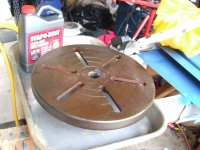
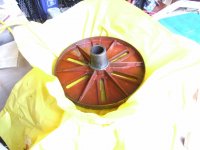
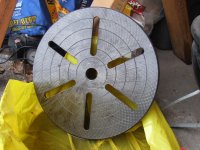
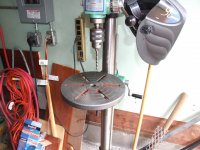
Here's a couple photos of my evapo-rust test. In this test I used a quart for 2 hours on a rusty drill press table. I also used a trash bag because didn't have anything big enough for the table. It saved me quite a bit of money if I had bought a new table, but I picked up the floor model press for $75 so evapo-rust was worth the money ($10) to me.

Steve
 

Attachments

  • 101.jpg
    101.jpg
    95.4 KB · Views: 81
  • 102.jpg
    102.jpg
    68.5 KB · Views: 78
  • 104.jpg
    104.jpg
    120.8 KB · Views: 81
  • 105.jpg
    105.jpg
    105.3 KB · Views: 72
Last edited:

Kenwc

Well-known member
Joined
Aug 7, 2007
Messages
603
I've been using Evpo-Rust for about 2 years in restoring old woodworking and metal working machines. I'm on my 3rd gallon.

I've spoken at length to a techie where they make it and he told me the chelating process it uses is accelerated if you can get the solution up around 90 degrees.

This last winter I tried that by just sitting it in the path of my shop heater and I really did get better (faster) results with less blackening.

And on the blackening...this is not a bad thing as its effectively a black oxide which is a protectant in its own rights. The techie told me you can rinse with water, prime and paint right over the black. I've painted by leaving AND by removing the black and I've not seen any difference in adhesion,

I've heard all sorts of concoctions suggested to remove rust but E/R us the best IMHO.
 
Last edited:
OP
T

Teken

Well-known member
Joined
Jan 2, 2010
Messages
8,214
Location
The Bad Lands
I've been using Evpo-Rust for about 2 years in restoring old woodworking and metal working machines. I'm on my 3rd gallon.

I've spoken at length to a techie where they make it and he told me the chelating process it uses is accelerated if you can get the solution up around 90 degrees.

This last winter I tried that by just sitting it in the path of my shop heater and I really did get better (faster) results with less blackening.

And on the blackening...this is not a bad thing and as its effectively a black oxide which is a protectant in its own rights. The techie told me you can rinse with water, prime and paint right over the black. I've painted by leaving AND by removing the black and I've not seen any difference in adhesion,

I've heard all sorts of concoctions suggested to remove rust but E/R us the best IMHO.

Nobody has ever asked that Q before about the blackening. That is great info in regard to just leaving it on or painting right over it.

I appreciate all the feed-back on it from all the members. Now I just need to get those really big 1 gallon jugs you guys can purchase here locally.
 

Vinko

Well-known member
Joined
Jul 7, 2008
Messages
5,829
Location
Los Angeles
Apparently very safe. I personally suspect the main ingredient is some sort of sugar, but that's just a wild guess. I've tossed it on the lawn and the flowers to no ill effect.

interesting. I left a tub of it (uncovered) with a few bolts I'd forgotten, and when I got to it a month or so later, it was evaporated down to a tub of black/brown goo. Nasty stuff.

But other than that, it's worked really well for me.
 
To avoid these ads, REGISTER NOW!
Top Bottom