
You are using an out of date browser. It may not display this or other websites correctly.
You should upgrade or use an alternative browser.
You should upgrade or use an alternative browser.
Ever seen on of these?
- Thread starter RivennHewn
- Start date
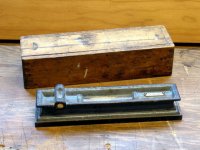
It appears to be a master precision level?
For those not aware, such a level with a clean vial and flat base will easily and accurately show variations from level of .0005" per 10" (10 arc seconds) or four times that accuracy with careful use and reading.
I've never seen that style before, but it appears to be an early 1800's design if I was to guess, based on the style alone. Although it could be a little older yet, I suppose. The basic idea for a spirit level goes back to the early 1600's but it is unclear to me when, exactly, the technology matured.
What is certain is the precision ground glass level vial was a mature technology by the early 1800's and presumably somewhat earlier as T. Oswald Blackett in his 1838 book "An Essay on the Use of the Spirit Level: as Applied to Engineering and Other Purposes" describes a level vial hardly distinguishable from modern practice. In the introduction he refers to "antiquated" publications on the subject of precision spirit levels so one can guess they had been around a while even then.
Patternmakers and designers of tools in the 1700's through mid 1800's have their design roots in furniture and classical architectur. Many transferred furniture and building-like qualities over over to their products, as evidenced in most machine and tool designs of the period. The use of such features became increasingly rare until they were all but extinct by the first part of the 20th century when a new style of design took over, one which we're still experiencing and shaping today.
Therefore, I'd wager a guess it's design (although maybe not the level itself) very likely predates the design of my Pratt and Whitney master precision level by at least 50 years. The first P&W master precision level was produced shortly after 1860 and the design was never revised when P&W stopped producing them in early 1960's, about 100 years later. By the mid 1800's, metal products were developing their own unique style and identity as designers of metal products stopped borrowing styling ideas from furniture and began to develop a style all their own.
I have often figured that the design reference for my 1930's P&W master precision level was likely a Lattice or Warren truss, both commonly used elements in the design of bridges, not a piece of furniture or classical architecture. Although, iron lattice bridges were a new thing in 1860. The first the first iron lattice truss bridge was erected in 1859 over the Mohawk River at Schenectady, only 130 miles from West Hartford, CT, home of P&W!
A wooden Lattice Truss:

An iron Warren Truss:

My level:

For those not aware, such a level with a clean vial and flat base will easily and accurately show variations from level of .0005" per 10" (10 arc seconds) or four times that accuracy with careful use and reading.
I've never seen that style before, but it appears to be an early 1800's design if I was to guess, based on the style alone. Although it could be a little older yet, I suppose. The basic idea for a spirit level goes back to the early 1600's but it is unclear to me when, exactly, the technology matured.
What is certain is the precision ground glass level vial was a mature technology by the early 1800's and presumably somewhat earlier as T. Oswald Blackett in his 1838 book "An Essay on the Use of the Spirit Level: as Applied to Engineering and Other Purposes" describes a level vial hardly distinguishable from modern practice. In the introduction he refers to "antiquated" publications on the subject of precision spirit levels so one can guess they had been around a while even then.
Patternmakers and designers of tools in the 1700's through mid 1800's have their design roots in furniture and classical architectur. Many transferred furniture and building-like qualities over over to their products, as evidenced in most machine and tool designs of the period. The use of such features became increasingly rare until they were all but extinct by the first part of the 20th century when a new style of design took over, one which we're still experiencing and shaping today.
Therefore, I'd wager a guess it's design (although maybe not the level itself) very likely predates the design of my Pratt and Whitney master precision level by at least 50 years. The first P&W master precision level was produced shortly after 1860 and the design was never revised when P&W stopped producing them in early 1960's, about 100 years later. By the mid 1800's, metal products were developing their own unique style and identity as designers of metal products stopped borrowing styling ideas from furniture and began to develop a style all their own.
I have often figured that the design reference for my 1930's P&W master precision level was likely a Lattice or Warren truss, both commonly used elements in the design of bridges, not a piece of furniture or classical architecture. Although, iron lattice bridges were a new thing in 1860. The first the first iron lattice truss bridge was erected in 1859 over the Mohawk River at Schenectady, only 130 miles from West Hartford, CT, home of P&W!
A wooden Lattice Truss:
An iron Warren Truss:
My level:
Last edited:
Very interesting post A_Pmech.
RivennHewn's level has a wide base with a second level for the width as well. You would expect a machinist level to have a 2nd level to be a vertical level like a carpenter's level if any, rather than the wide base with that 90' level. How big are these levels and is there any v-groove in the base for seating on round objects?
RivennHewn's level has a wide base with a second level for the width as well. You would expect a machinist level to have a 2nd level to be a vertical level like a carpenter's level if any, rather than the wide base with that 90' level. How big are these levels and is there any v-groove in the base for seating on round objects?
OP
RivennHewn
Well-known member
Mine is about 7" long, and it does have a V-notched bottom.
Pmech, that is about the coolest looking level I've ever seen. Where do I get one?
Pmech, that is about the coolest looking level I've ever seen. Where do I get one?