You are using an out of date browser. It may not display this or other websites correctly.
You should upgrade or use an alternative browser.
You should upgrade or use an alternative browser.
Everything you need to know about bench vises...
- Thread starter mjozefow
- Start date
General Geoff
Well-known member
Home made or not, it looks really strong! 
Q: How much is this old vise worth?
A: I will let you know when I come across a well used vise worth over $1/lb unless it is a very rare configuration. This is one man's opinion. If the vise needs work or has been sitting a long time $.60/lb is more reasonable.
I am looking for an old vise as I'm going to be doing some welding/fabrication. The prices in my area (Pacific Northwest) are absolutely stratospheric on Craigslist. $1 per pound would be a dream come true. The asking prices are more like $5 per pound. Where does a guy find a deal on a good vise? Also, it seems that the market is now crowded with "collectors." What a joke - I just want something to use.
A: I will let you know when I come across a well used vise worth over $1/lb unless it is a very rare configuration. This is one man's opinion. If the vise needs work or has been sitting a long time $.60/lb is more reasonable.
I am looking for an old vise as I'm going to be doing some welding/fabrication. The prices in my area (Pacific Northwest) are absolutely stratospheric on Craigslist. $1 per pound would be a dream come true. The asking prices are more like $5 per pound. Where does a guy find a deal on a good vise? Also, it seems that the market is now crowded with "collectors." What a joke - I just want something to use.
Q: How much is this old vise worth?
A: I will let you know when I come across a well used vise worth over $1/lb unless it is a very rare configuration. This is one man's opinion. If the vise needs work or has been sitting a long time $.60/lb is more reasonable.
I am looking for an old vise as I'm going to be doing some welding/fabrication. The prices in my area (Pacific Northwest) are absolutely stratospheric on Craigslist. $1 per pound would be a dream come true. The asking prices are more like $5 per pound. Where does a guy find a deal on a good vise? Also, it seems that the market is now crowded with "collectors." What a joke - I just want something to use.
Well Craigslist is uaually where i find the deals. You gotta be quick,have cash,and know what youre looking at,and contact the seller asap. If not someone else is gonna grab it. However if youre looking for something to keep,im willing to bet theres alot of guys in this forum that can hook you up.
Outlawmws
Well-known member
Q: How much is this old vise worth?
A: I will let you know when I come across a well used vise worth over $1/lb unless it is a very rare configuration. This is one man's opinion. If the vise needs work or has been sitting a long time $.60/lb is more reasonable.
I am looking for an old vise as I'm going to be doing some welding/fabrication. The prices in my area (Pacific Northwest) are absolutely stratospheric on Craigslist. $1 per pound would be a dream come true. The asking prices are more like $5 per pound. Where does a guy find a deal on a good vise? Also, it seems that the market is now crowded with "collectors." What a joke - I just want something to use.
Even when that post you quoted was current, it was way out of date. Vise value is in the eyes of the beholder, and there are just too many deep pockets out there, so places like Eprey and CL are no good deals unless you get real lucky. Yard sales still surface deals, but you have to be into it for that to work...
Even when that post you quoted was current, it was way out of date. Vise value is in the eyes of the beholder, and there are just too many deep pockets out there, so places like Eprey and CL are no good deals unless you get real lucky. Yard sales still surface deals, but you have to be into it for that to work...
Yeah, I figured it was outdated at best. What I've noticed in my search is that almost every listing says "collectible" or "vintage" and a lot of them have several pics with a professional background as if they're selling on eBay (hate that site).
I just need a good tool, and it seems everything in this country has turned into an "investment" where somebody is looking to scalp the next guy. It doesn't help that the new tools are Chinese garbage. What in the heck happened to this country?
What in the heck happened to this country?
GREED and politics.
3baygarage
Well-known member
Why not put a want ad on this site?
I sold a couple here. Let us know what you are looking for in style and size, someone could have one reasonable.
I get what you are saying though because I collect. Not vises in particular, except when priced to my liking.
I sold a couple here. Let us know what you are looking for in style and size, someone could have one reasonable.
I get what you are saying though because I collect. Not vises in particular, except when priced to my liking.
Why not put a want ad on this site?
I sold a couple here. Let us know what you are looking for in style and size, someone could have one reasonable.
I get what you are saying though because I collect. Not vises in particular, except when priced to my liking.
Thanks for the suggestion but I tried it and need 100 posts for a WTB ad. I don't see myself getting there anytime soon, even this year. I mostly read here.
Thanks for the suggestion but I tried it and need 100 posts for a WTB ad. I don't see myself getting there anytime soon, even this year. I mostly read here.
Member Drivesitfar is from the Seattle area and has more than a few vises! I'm sure he'd have something nice that would fit into almost any budget.
He's a nice guy and might be able to help you out.
https://allentown.craigslist.org/tls/5981327411.html
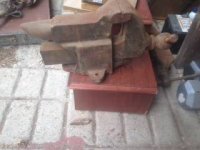
Not sure if this is the best place to post this, but I came across an anvil vise on Craigslist that really piqued my curiosity. It looks particularly beefy for this type of anvil vise and while I'm a newbie to vises I've looked at thousands of them thanks to this site, and I don't recall seeing one quite like this before. I've seen some Parkers of a similar style, but they didn't look quite as beefy, and this doesn't look like a Parker.
The seller says that it's marked "Aetna Ball and Roller Co. Chicago" but I can't find any evidence of this company making/selling vises, so I'm wondering if anyone recognizes it and if it were actually manufactured by a different company. Pictures are pretty low res, unfortunately.
Also, if this is something worth buying and someone else in the area wants to pick it up, please feel free to because I'm in a rental right now and I absolutely can't buy another vise.
Not sure if this is the best place to post this, but I came across an anvil vise on Craigslist that really piqued my curiosity. It looks particularly beefy for this type of anvil vise and while I'm a newbie to vises I've looked at thousands of them thanks to this site, and I don't recall seeing one quite like this before. I've seen some Parkers of a similar style, but they didn't look quite as beefy, and this doesn't look like a Parker.
The seller says that it's marked "Aetna Ball and Roller Co. Chicago" but I can't find any evidence of this company making/selling vises, so I'm wondering if anyone recognizes it and if it were actually manufactured by a different company. Pictures are pretty low res, unfortunately.
Also, if this is something worth buying and someone else in the area wants to pick it up, please feel free to because I'm in a rental right now and I absolutely can't buy another vise.
Attachments
bl00
Well-known member
It looks like a Rock Island. They used a huge anvil compared to the other vise makers.
bubinga
Well-known member
https://allentown.craigslist.org/tls/5981327411.html
Not sure if this is the best place to post this, but I came across an anvil vise on Craigslist that really piqued my curiosity. It looks particularly beefy for this type of anvil vise and while I'm a newbie to vises I've looked at thousands of them thanks to this site, and I don't recall seeing one quite like this before. I've seen some Parkers of a similar style, but they didn't look quite as beefy, and this doesn't look like a Parker.
The seller says that it's marked "Aetna Ball and Roller Co. Chicago" but I can't find any evidence of this company making/selling vises, so I'm wondering if anyone recognizes it and if it were actually manufactured by a different company. Pictures are pretty low res, unfortunately.
Also, if this is something worth buying and someone else in the area wants to pick it up, please feel free to because I'm in a rental right now and I absolutely can't buy another vise.
Not a Bad price for a big old vise, is it?It looks like a Rock Island. They used a huge anvil compared to the other vise makers.
drivesitfar
Well-known member
Gerard: i think Bl00 hit it on the head (AGAIN) that his guess for a ROCK ISLAND is right on. i think i see the scallops on the top of the vise towers and it is pretty stout and Rock Island's are stout. this vise looks like it should have pipe jaws too which would make it an even rarer vise so i'd probably have to buy it if it was close to me. make sure the handle isn't loose cause doesn't look quite right. if it works like a vise should and no cracks or welds it would have my money.
I think you guys nailed it. I managed to stumble upon a similar one in the big vise thread.
http://www.garagejournal.com/forum/showpost.php?p=3227705&postcount=8967
Sure looks basically identical other than being a swivel version.
Also an ad here:
https://books.google.com/books?id=o...=onepage&q=Rock Island 241 anvil vise&f=false
Listing still hasn't been removed... trying to resist the temptation...
http://www.garagejournal.com/forum/showpost.php?p=3227705&postcount=8967
Sure looks basically identical other than being a swivel version.
Also an ad here:
https://books.google.com/books?id=o...=onepage&q=Rock Island 241 anvil vise&f=false
Listing still hasn't been removed... trying to resist the temptation...
Last edited:
I just want to note that the original post says:
"The machinist's vise is considered the "cream of the crop". They are stoutly made and are finely machined. The jaws should match up perfectly, and they will be made of very high grade (60,000psi or greater) cast* iron."
This is pretty much wrong. OK, totally wrong. Some poor sap could read this post and think that all machinist vises are made from 60ksi cast iron.
Machinist vises are NOT all made from 60ksi cast iron. Especially old ones, older than the 60's or 70's. They are also not "the cream of the crop". Why was this information never corrected?
"The machinist's vise is considered the "cream of the crop". They are stoutly made and are finely machined. The jaws should match up perfectly, and they will be made of very high grade (60,000psi or greater) cast* iron."
This is pretty much wrong. OK, totally wrong. Some poor sap could read this post and think that all machinist vises are made from 60ksi cast iron.
Machinist vises are NOT all made from 60ksi cast iron. Especially old ones, older than the 60's or 70's. They are also not "the cream of the crop". Why was this information never corrected?
Last edited:
bl00
Well-known member
You should send a PM to the original poster. This is not a wiki, so no one else can change his post.
Possible reasons the info has remained:
1. no one cares
2. person who posted is no longer here
3. original poster believes his post is correct
Possible reasons the info has remained:
1. no one cares
2. person who posted is no longer here
3. original poster believes his post is correct
I just want to note that the original post says:
"The machinist's vise is considered the "cream of the crop". They are stoutly made and are finely machined. The jaws should match up perfectly, and they will be made of very high grade (60,000psi or greater) cast* iron."
This is pretty much wrong. OK, totally wrong. Some poor sap could read this post and think that all machinist vises are made from 60ksi cast iron.
Machinist vises are NOT all made from 60ksi cast iron. Especially old ones, older than the 60's or 70's. They are also not "the cream of the crop". Why was this information never corrected?
It was never "corrected" because there's nothing to correct.
In general that information is still largely true in the context of bench vises. Vises marketed as machinist vises are almost always the highest quality line a company offers. In that sense, they are the cream of the crop. They are only being compared to other bench vises. As far as materials go, the thread has plenty of information to help folks get a better handle on that topic.
It was never "corrected" because there's nothing to correct.
In general that information is still largely true in the context of bench vises. Vises marketed as machinist vises are almost always the highest quality line a company offers. In that sense, they are the cream of the crop. They are only being compared to other bench vises. As far as materials go, the thread has plenty of information to help folks get a better handle on that topic.
Sorry. It's dead wrong. It's totally dead wrong. If you read the post, it says that they are all made of 60,000psi ductile cast iron.
I'm not the smartest guy around, but I know wrong when I read it.
The worst part is if some new guy reads this post and starts buying old machinists vises for stupid prices because he thinks that they're all made of a material that's only been used in a few vises.
Last edited:
I'm not the smartest guy around, but I know wrong when I read it.
you might also be reading everything TOO LITERALLY
its an internet post, not a legal contract, and the world is not going to fall. If there are some caveats to general information being shared to guide people, so be it.
Last edited:
Sorry. It's dead wrong. It's totally dead wrong. If you read the post, it says that they are all made of 60,000psi ductile cast iron.
I'm not the smartest guy around, but I know wrong when I read it.
The worst part is if some new guy reads this post and starts buying old machinists vises for stupid prices because he thinks that they're all made of a material that's only been used in a few vises.
For someone being so literal, you are 100% wrong. The post does not say they are all made of 60,000psi ductile cast iron. If nothing else, you missed the "or greater" part. That would mean some were made with higher than 60,000psi ductile iron.
As I said previously, there are many more posts covering materials that someone can use to educate themselves. Yes, vises were made of other materials then, and now.
If someone buys a machinist vise from any of the big manufacturers that was made in the last 100 years or so, and it's in good condition, the material used is pretty much irrelevant...they were all generally good enough or they wouldn't have lasted that long.
Last edited:
Outlawmws
Well-known member
This is a good concern, however CALLING something a Machinist vise does not make it one. period, There are many "vise shaped objects" that are NOT machinists vises regardless of some marketing geeks attempts to claim so.
I think the OP is fine.
I think the OP is fine.
The OP has not posted since 8/2015.You should send a PM to the original poster. This is not a wiki, so no one else can change his post.
Possible reasons the info has remained:
1. no one cares
2. person who posted is no longer here
3. original poster believes his post is correct
Outlawmws
Well-known member
Just for full closure, your concern was covered in the next paragraph under the picture:
Taken out of context, anything can be inaccurate.
*Technically, machinist's vises are almost always made of ductile iron, not cast iron. And yes, before some wag says "well they're cast in a mold, so it's cast iron," the phrase cast iron usually implies grey or white cast irons, which are brittle due to significant graphite content existing in the iron in flakes. Ductile iron's graphite is in a nodular shape which inhibits cracking. It's an important distinction in vises, because high quality vises are made from nodular or spheroidal (ductile) iron, and cheaply made economy vises (often imported) are made of grey cast iron. - Thanks zrexxer
Taken out of context, anything can be inaccurate.
merim123
Well-known member
I like what he had on here about pricing, but that was 2010. What's the updated version 1/lb? 30-35 per jaw open inch? I'm looking for a vise now for the garage and this was good advice.
kwoswalt99
Well-known member
If someone buys a machinist vise from any of the big manufacturers that was made in the last 100 years or so, and it's in good condition, the material used is pretty much irrelevant...they were all generally good enough or they wouldn't have lasted that long.
There were many that didn't last that long though... I actually started a photo collection of the ones that didn't.

depends on what vise you are talking about.I like what he had on here about pricing, but that was 2010. What's the updated version 1/lb? 30-35 per jaw open inch? I'm looking for a vise now for the garage and this was good advice.
Sent from my SM-G920P using Tapatalk
Outlawmws
Well-known member
depends on what vise you are talking about.
Sent from my SM-G920P using Tapatalk
Exactly; it is VERY dependent on area, particular vise, knowledge of the seller, and how bad the buyer wants it...
charliemoose
Member
Wilton Vises and Big Vises 150 plus pounds are going through the roof I just wonder why
ALLFAST
Well-known member
I received an e-flyer from the Certi-Flat welding table kit company. He advised that the price of steel has DOUBLED in the last two months.
I'm sure some resident experts in the metal business will chime in soon. It makes sense to me.
I'm sure some resident experts in the metal business will chime in soon. It makes sense to me.
SERRATED VISE JAWS
Guys, the serratred jaws on your vise might be the most important part of that work piece. If your jaws are nice or very new, try to avoid putting certain pieces of metal in them like small steel rod, threaded bolts, small pipe etc. These photos show what, from the top, looks like nice jaws, well aligned, but when you see that jaws from the side, its obvious that its user cranked down threaded rod, bolts, and the like basically f*&%$g them up.
They are ways to avoid ruining your jaws, One, get a cheap, small pipe vise and mount it to a 2"X4". When you need to hold rod or small pipe, let your bench vise then hold your pipe vise and proceed. Also find some old leather, like one of your old belts, and cut off a few sections. Cradle a bolt with double leather on each side to protect the jaws. Those of you that have vises with forged jaws that are still nice, keep copper liners on permently. I hope these tips add something to "Everything you wanted to know about bench vises"


Re: Everything you need to know about bench vises...
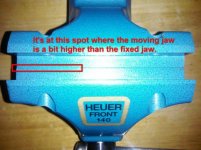
Question about looking at used vices... How OCD is acceptable or necessesary with jaw alignement?
There have been a couple threads on this topic...including on some 'not cheap' new/oem vises.
wilton - Re: Am I being too picky? (new Wilton Vise complaint)
http://www.garagejournal.com/forum/showpost.php?p=4331393&postcount=41
>
A German Made Bench Vise (Brockhaus Heuer Jaw compaint)
http://www.garagejournal.com/forum/showpost.php?p=5979623&postcount=1
vs a Perfect alignment (Rigid/Peddinghaus vise jaw)

Attachments
Last edited:
General Geoff
Well-known member
A misalignment of up to about 1mm is OK with me, as long as the mating of the jaws is still perfectly parallel.
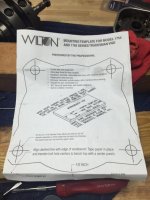
Quick question and I apologize if I overlooked it in the thread. I have a Wilton Bullet with a swivel base and x2 mounting tabs/ears are spaced wider apart on one side vs the other. Basically its not an equally spaced array. What's the proper way to mount them on the bench? Wider stance in front or back?
Outlawmws
Well-known member
Yes, this allows you to get the static jaw past the bench edge.
Yes, this allows you to get the static jaw past the bench edge.
Makes total sense, thanks

akasrick
Well-known member
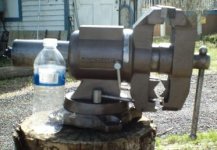
Quick question and I apologize if I overlooked it in the thread. I have a Wilton Bullet with a swivel base and x2 mounting tabs/ears are spaced wider apart on one side vs the other. Basically its not an equally spaced array. What's the proper way to mount them on the bench? Wider stance in front or back?
Wider stance points to the (front) edge of the bench.
Attachments
Last edited:
big daddy 3902
Member
- Joined
- Dec 22, 2014
- Messages
- 8