To avoid these ads, REGISTER NOW!

EVSE choices?

u3b3rg33k

Well-known member
Joined
Dec 18, 2017
Messages
4,048
There are dozens of manufacturers that offer a 48A max charger that comes equipped with a 14-50 plug and cord. They recommend 6AWG Copper. If it were one or two of them, I'd say that they just dont understand. But it seems to be the most common. Surely they cant ALL be wrong.
CD
if you're selling a charger that can draw 48A with a 50A plug on it, that's a code violation and it won't pass UL/ETL testing. 80%/125% rule applies to all EVSEs as they're considered continuous loads.

the only way i could possibly see around that is if the EVSE automatically de-rates itself after a (relatively) short period of time.

I've seen this with plug-in induction burners. you can get 1800W out of them for 5min or so, then they de-rate to 12A input. that gets you a faster boil but keeps you from violating the continuous load rule.
 
To avoid these ads, REGISTER NOW!

Denwood

Well-known member
Joined
Sep 22, 2014
Messages
4,191
Location
Thunder Bay, Ontario, Canada
We have two of the OEM Nissan 32A@240V EVSEs which can be plugged into a 15A@120V outlet, or NEMA 14-50R receptacle using a max of 32A@240V. We also use two third party EVSEs which can run at up to 16A@250V. The plug in used in my shop is a NEMA 6-20R , max 20A@240V and will allow the third party EVSEs to plug in for extended use 16A@240V. That adds 10%/hour to the pack. I use one of these at camp, running 16A@120V via a 30 amp RV plug. The camp setup adds 5%/hour to the pack.

I just added a plug in to our driveway, installing an outdoor 14-50R, fused at 40A for our second EV. One of the Nissan EVSEs runs off this at 6.6kW. It’s left plugged in, locked into the outdoor box.

This setup is far less expensive than a dedicated wall charger, but has the flexibility to use other types of OEM charge ports as they change, eventually all to NACS (the Tesla port). The faster charge in the driveway is handy to have if we’re doing a camp run and did not charge to 100% overnight. That adds 20%/hour to the pack.

I see no point to paying more for a wall charger when all the functionality you need is already built into the car. Charge timers, monitoring, remote charge starting, etc are already there via an app controlling the car. All three of our EVSEs stay plugged in.
 

cybrdyke

Well-known member
Joined
Sep 9, 2014
Messages
3,447
Location
USA
if you're selling a charger that can draw 48A with a 50A plug on it, that's a code violation and it won't pass UL/ETL testing. 80%/125% rule applies to all EVSEs as they're considered continuous loads.

the only way i could possibly see around that is if the EVSE automatically de-rates itself after a (relatively) short period of time.

I've seen this with plug-in induction burners. you can get 1800W out of them for 5min or so, then they de-rate to 12A input. that gets you a faster boil but keeps you from violating the continuous load rule.
At the risk of de-railing this thread, we all agree that if the EVSE is set to 48A, the breaker needs to be a 60A breaker to do what it's supposed to do, protect the circuit from overcurrent as a continuous load. However, plugs and connectors dont require the 20% overhead because they are rated to handle their maximum current (50A) safely under normal operating conditions and dont have any tripping mechanisms or continuous operation concerns. ETL in US & Canada
CD
 

u3b3rg33k

Well-known member
Joined
Dec 18, 2017
Messages
4,048
At the risk of de-railing this thread, we all agree that if the EVSE is set to 48A, the breaker needs to be a 60A breaker to do what it's supposed to do, protect the circuit from overcurrent as a continuous load. However, plugs and connectors dont require the 20% overhead because they are rated to handle their maximum current (50A) safely under normal operating conditions and dont have any tripping mechanisms or continuous operation concerns. ETL in US & Canada
CD
I think it's on-topic enough.

somewhere in the code there's something about using an appropriately rated plug/receptacle if it exists.

that's why you're allowed to use a 50A plug for 40A stuff (like stoves/ranges) because no 40A plug exists, but if a 60A plug exists, you're supposed to use it if it's applicable.

also note that's under-loading a plug/receptacle. they don't allow you to use a 14-30 instead of a 14-50, even if they're mechanically the same on the current carrying conductors.

also note that code allows a 15A duplex receptacle to be used on a 20A branch circuit, but EVSEs that can pull 16A must use the 20A plug.

given that there's enough marginal 14-50 plugs/receptacles out there that have slagged themselves on EVSEs, I would not want to err on the side of "screw it, it'll be fine".

1724786842071.png1724786851761.png
 

dcg9381

Well-known member
Joined
Jun 20, 2018
Messages
11,766
Location
Austin, TX
However, plugs and connectors dont require the 20% overhead because they are rated to handle their maximum current (50A) safely under normal operating conditions and dont have any tripping mechanisms or continuous operation concerns.
That's right, the plug can handle it at 100% of continuous load. But the plug must have over-current protection and residential breakers are only rated to 80% for continuous use. So use of a 14-50 allows for 50A, but must be on a 50A breaker, which is rated for 80% continuous, so you're still have to play within that 80% rule and keep your EVSE at 40A or below.

I use 14-50 as our "standard" 240V plug. I have several circuits that are on 30A breakers and 14-50 plugs. I label the face plates "30A max", but as it's just me using them, I don't worry about it. Use is for RVs, welders, plasma cutter, etc. Portable stuff.

I see no point to paying more for a wall charger when all the functionality you need is already built into the car. Charge timers, monitoring, remote charge starting, etc are already there via an app controlling the car. All three of our EVSEs stay plugged in.
This is right. In the end, it's the "car" that negotiates the charge rate, but is subject to the amp limits set within the EVSE. If you have a car with a "smart" charging system, you can further control the rate, set the charging timing, etc etc... Not all EVs or PHEVs have these functions though.
 

Denwood

Well-known member
Joined
Sep 22, 2014
Messages
4,191
Location
Thunder Bay, Ontario, Canada
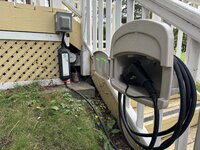
Here the setup with a 14-50R receptacle outside. It’s fused at 40 amps as the EVSE max’s out at 32 amps.

I modified a “Suncast Hose Hangout” to keep the J1772 connector out of the elements when not in use. Found that tip on the interwebs somewhere…

IMG_0928.jpeg

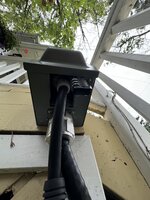
Locking box keeps the honest folks from borrowing our EVSE :)

IMG_0929.jpeg

Maybe 2 hours to install this, including drilling through a 12” concrete foundation.
 
Last edited:

Denwood

Well-known member
Joined
Sep 22, 2014
Messages
4,191
Location
Thunder Bay, Ontario, Canada
Just another point of safety here with regard to these setups. Once you commission a wall charger, receptacle or whatever, I strongly suggest you charge for 30-45 minutes and then check the connections at the panel, receptacle etc. with a temp gun, FLiR etc.

Nothing in your home runs such a high load for potentially such a long time. We had an issue a few years back where just 16A@240V was causing a breaker trip after 35-40 minutes, not in the shop, but at the house panel feeding the shop. It was a resistive (bad) connection at the 30amp fuse holder feeding the shop that was getting very hot. Charging an EV will highlight any existing issue straight up, if you look for them.
 
Last edited:

75gmck25

Well-known member
Joined
Jul 21, 2014
Messages
1,325
Location
Alexandria, VA
Checking the heat generation with a temp gun is an excellent idea if you are drawing high amps for a long period of time.

I have a four wire 240 volt GE range (with 120 for the controls) that had worked fine for several years on a 50 amp breaker and 6/3 copper wire. However, during Covid my wife decided to start baking bread at home, and she needed to heat the oven up to 450 degrees and leave it there for long periods of time.

After a short time we started having issues with the entire range shutting down intermittently, but then coming back to life if I turned the breaker on and off, and I thought maybe the excess oven heat had caused a problem with wiring or ICs for the controls. After buying a new control panel, replacing the 240 volt plug, and doing other troubleshooting it turned out that my relatively new Square D 50 amp breaker was failing internally. It was what was specified for this range, but it apparently could not handle the high amperage load for an extended period of time.
 

wyliesdiesels

Well-known member
Joined
Aug 14, 2012
Messages
20,021
Location
Modesto, CA
Stay away from any "budget" NEMA 10-50R. I have read stories of them failing not from insertion cycles, but from heat. Applies mostly to EVSE that provide 48Amps. I suspect one reason the Tesla Wall EVSE is no longer available with a NEMA 14-50P, and must be hardwired.
shouldnt be using a 10-50R. it is 120/240v non-grounding...
 

rlitman

Well-known member
Joined
Oct 18, 2010
Messages
24,609
Location
Long Island
Stay away from any "budget" NEMA 10-50R. I have read stories of them failing not from insertion cycles, but from heat. Applies mostly to EVSE that provide 48Amps. I suspect one reason the Tesla Wall EVSE is no longer available with a NEMA 14-50P, and must be hardwired.
A 14-50 is rated for only 40A continuous load, not 48A and not 50A. So every EVSE that wants to apply more than 40A MUST be hardwired. I recently installed a Clipper Creek that will supply 80A (using a 100A breaker; so far as I'm aware this is the biggest level 2 EVSE available), so hard wiring was clearly the only option.

That being said, budget 14-50R outlets are known to be troublemakers with EVSE use. It could be from the thermoplastic not supporting the spring contacts sufficiently as it warms up, could be from crappy contacts, I don't know, but the Hubbell is known to not have that issue.
 

mm08822

Well-known member
Joined
Jan 13, 2012
Messages
5,941
Location
NJ
EVSEs are the new test for plug/receptacle contacts. AC circuits have had many problems with the cb connection at the panel buss stabs. Adding another failure point in the evse circuit doesn't make sense to me. Hardwire them in garage/exterior.

Who knows, maybe we'll soon see a special EVSE cb on the market that improves today's squeeze connection.
 

u3b3rg33k

Well-known member
Joined
Dec 18, 2017
Messages
4,048
EVSEs are the new test for plug/receptacle contacts. AC circuits have had many problems with the cb connection at the panel buss stabs. Adding another failure point in the evse circuit doesn't make sense to me. Hardwire them in garage/exterior.

Who knows, maybe we'll soon see a special EVSE cb on the market that improves today's squeeze connection.
if you've ever installed a 90-125A QO breaker, some of them can require UNCOMFORTABLE levels of force to push into the panel.

way more than a 30-50A breaker.

I take that as a good sign for contact.
 

mm08822

Well-known member
Joined
Jan 13, 2012
Messages
5,941
Location
NJ
It's not the initial spread/grip of the contacts.
Put em thru a couple thousand thermal cycles.

Why do do many ac breakers fail at the buss stabs?
Why do bolt on cb's exist?
 

mm08822

Well-known member
Joined
Jan 13, 2012
Messages
5,941
Location
NJ
Why do you say that?
CD
A 50 recept is only allowed to be ocp'd @ 50A per NEC Table 210.24(1). A continuous load of 48A would require 125% of 48A (60A) for the ckt conductors and the cb.
Since 210.24(1) specifies the max ocp value, a continuous load situation is not permitted for the recept. (2 hours and 59 mins is another story, but we'll assume most evse situations go way past 3 hours.)
 

rlitman

Well-known member
Joined
Oct 18, 2010
Messages
24,609
Location
Long Island
...
Why do do many ac breakers fail at the buss stabs?
Why do bolt on cb's exist?
In my (LIMITED) experience, I've had several bolt-on CBs burn up the bus in their locations, and never had a residential breaker do that. Of course that's completely anecdotal and means little more than that bolt-on breakers don't solve all issues.

My understanding of why bolt-on breakers were preferred, was that their attachment to the bus was fairly solid in a dead-short condition where the enormous current flow would ordinarily push the contact surfaces apart (think rail gun). However, in reading the literature on the Square D I-Line bus (something I deal with quite a bit), Schneider goes into the fact that the I-Line push-on connectors clamp more tightly to the bus during dead-short current conditions, and I trust these push-on breakers far more than any bolt-on product I've seen.

My experience with failures at connections is that they're caused by corrosion which is accelerated by heat. It's a chicken/egg problem, where heat can directly cause corrosion leading to more heat, or corrosion from a hostile environment can start the process.

Clean oxidation resistant plating, proper use of lubricants (to further protect surfaces from oxidation) and properly torqued terminals (to prevent heating) generally avoid these issues. Re-use of old breakers (wearing off contact plating or factory applied grease), use of unplated bus bars (cheaping out on materials) and poor workmanship raise the risks. But in the end, most of the equipment we use is generally pretty resilient to problems (WAY more than 99.9997% reliable), or else the insurance industry wouldn't allow it. And I suspect that the EVSE market will be pushing the next code cycle forward as we learn more.
 

wyliesdiesels

Well-known member
Joined
Aug 14, 2012
Messages
20,021
Location
Modesto, CA
In my (LIMITED) experience, I've had several bolt-on CBs burn up the bus in their locations, and never had a residential breaker do that. Of course that's completely anecdotal and means little more than that bolt-on breakers don't solve all issues.

My understanding of why bolt-on breakers were preferred, was that their attachment to the bus was fairly solid in a dead-short condition where the enormous current flow would ordinarily push the contact surfaces apart (think rail gun). However, in reading the literature on the Square D I-Line bus (something I deal with quite a bit), Schneider goes into the fact that the I-Line push-on connectors clamp more tightly to the bus during dead-short current conditions, and I trust these push-on breakers far more than any bolt-on product I've seen.

My experience with failures at connections is that they're caused by corrosion which is accelerated by heat. It's a chicken/egg problem, where heat can directly cause corrosion leading to more heat, or corrosion from a hostile environment can start the process.

Clean oxidation resistant plating, proper use of lubricants (to further protect surfaces from oxidation) and properly torqued terminals (to prevent heating) generally avoid these issues. Re-use of old breakers (wearing off contact plating or factory applied grease), use of unplated bus bars (cheaping out on materials) and poor workmanship raise the risks. But in the end, most of the equipment we use is generally pretty resilient to problems (WAY more than 99.9997% reliable), or else the insurance industry wouldn't allow it. And I suspect that the EVSE market will be pushing the next code cycle forward as we learn more.
pretty rare for that too happen but most likely cause is it wasnt torqued properly, to spec.
 

cybrdyke

Well-known member
Joined
Sep 9, 2014
Messages
3,447
Location
USA
A 50 recept is only allowed to be ocp'd @ 50A per NEC Table 210.24(1). A continuous load of 48A would require 125% of 48A (60A) for the ckt conductors and the cb.
Since 210.24(1) specifies the max ocp value, a continuous load situation is not permitted for the recept. (2 hours and 59 mins is another story, but we'll assume most evse situations go way past 3 hours.)
I would agree that the EVSE is a continuous load. If set to output 48A, it needs to be protected by a 60A breaker and wire to match, like you suggest. Code mentions conductors and breakers. However, the 14-50 plug & receptacle are rated for, and capable of, continuous load at 50A, so they are fine and that's why the EVSE manufacturers are providing them with their units. How is that wrong?
CD
 
To avoid these ads, REGISTER NOW!

rlitman

Well-known member
Joined
Oct 18, 2010
Messages
24,609
Location
Long Island
I would agree that the EVSE is a continuous load. If set to output 48A, it needs to be protected by a 60A breaker and wire to match, like you suggest. Code mentions conductors and breakers. However, the 14-50 plug & receptacle are rated for, and capable of, continuous load at 50A, so they are fine and that's why the EVSE manufacturers are providing them with their units. How is that wrong?
CD
Where are you getting the idea you can supply the 14-50 with a 60A breaker for the purposes of an EVSE? There are deratings for things like welders with a low power factor where you can use a shockingly small wire between a 50A breaker and a 14-50, and possibly even up-size the breaker to handle inrush currents, but I'm not aware of anything allowing you to use a 60A breaker with a plug-in EVSE, unless that plug is actually rated for 60A. And I'm also not aware of any pin & sleeve corded EVSE on the market (because I do actually work with some 60A plug-in equipment, but it's all pin & sleeve). Every 48A EVSE I've seen requires hard wiring.

There is another option though. You could seek out a 100% rated 50A breaker, if that's something made for your panel (unlikely). However, looking at the Leviton heavy duty 14-50R made specifically for EVSE use spec sheet, I see a 60C rating, while the Hubbell HBL9450A is 75C rated, so it's not a huge surprise to me that LOTS of people are reporting Leviton 14-50Rs melting, and it's equally no surprise that at least Tesla is so aware of the issue that they built a temperature sensor into their plug. So sure, it may be legal to stretch the code to it's limits with a 100% breaker, but this is one place where I don't think that's a good idea.

edit (one more thought):
Oh, and at 60C, you're limited to a 55A ampacity on 6AWG, so that's a hard limit of 44A, NOT 48A, because you don't get to round up the ampacity, HOWEVER, if your wiring system allows for 75C (i.e. conduit and not NM), AND you use the 75C rated Hubbell connector (and not the Leviton), then you could theoretically use a 100% rated 50A breaker with a 14-50 plug-in EVSE set to 48A. But that's as far as you can push the envelope without hard wiring.
 
Last edited:

mm08822

Well-known member
Joined
Jan 13, 2012
Messages
5,941
Location
NJ
I would agree that the EVSE is a continuous load. If set to output 48A, it needs to be protected by a 60A breaker and wire to match, like you suggest. Code mentions conductors and breakers. However, the 14-50 plug & receptacle are rated for, and capable of, continuous load at 50A, so they are fine and that's why the EVSE manufacturers are providing them with their units. How is that wrong?
CD
I'm not suggesting, I'm telling you the NEC requirements.
Where does any mfr or code state that the rating is continuous?
Why does NEC specify a max cb rating of 50A for a 50A recept in Table 210.24(1)?

Here's an example of the same charger available with plug or hardwired input. Depending on which input connection method is chosen, the charge rate advertised/specified is different.

1725393463396.png 1725393359733.png
1725393078317.png


Attachments

  • 1725393226313.png
    1725393226313.png
    460.5 KB · Views: 3

mm08822

Well-known member
Joined
Jan 13, 2012
Messages
5,941
Location
NJ
In my (LIMITED) experience, I've had several bolt-on CBs burn up the bus in their locations, and never had a residential breaker do that. Of course that's completely anecdotal and means little more than that bolt-on breakers don't solve all issues.

My understanding of why bolt-on breakers were preferred, was that their attachment to the bus was fairly solid in a dead-short condition where the enormous current flow would ordinarily push the contact surfaces apart (think rail gun). However, in reading the literature on the Square D I-Line bus (something I deal with quite a bit), Schneider goes into the fact that the I-Line push-on connectors clamp more tightly to the bus during dead-short current conditions, and I trust these push-on breakers far more than any bolt-on product I've seen.

My experience with failures at connections is that they're caused by corrosion which is accelerated by heat. It's a chicken/egg problem, where heat can directly cause corrosion leading to more heat, or corrosion from a hostile environment can start the process.

Clean oxidation resistant plating, proper use of lubricants (to further protect surfaces from oxidation) and properly torqued terminals (to prevent heating) generally avoid these issues. Re-use of old breakers (wearing off contact plating or factory applied grease), use of unplated bus bars (cheaping out on materials) and poor workmanship raise the risks. But in the end, most of the equipment we use is generally pretty resilient to problems (WAY more than 99.9997% reliable), or else the insurance industry wouldn't allow it. And I suspect that the EVSE market will be pushing the next code cycle forward as we learn more.
I've seen several cb's with problems at the buss stab, mostly ac units in residential/commercial settings. I can't speak to the specific history of the loads that those failures belong with. Could have easily been the old original cb with a second once-new compressor.

I-Line panels are a whole world apart from the resi grade junk.
 

cybrdyke

Well-known member
Joined
Sep 9, 2014
Messages
3,447
Location
USA
Why does NEC specify a max cb rating of 50A for a 50A recept in Table 210.24(1)?
I'm curious why that rule would apply if there's only one receptacle?

210.24 Branch-Circuit Requirements - Summary​

The requirements for circuits that have two or more outlets or receptacles, other than the receptacle circuits of 210.11(C)(1), (C)(2), and (C)(3), are summarized in Table 210.24(1)
 

rlitman

Well-known member
Joined
Oct 18, 2010
Messages
24,609
Location
Long Island
I'm curious why that rule would apply if there's only one receptacle?
It doesn't. Go back to 210.21 (B)(1) Single Receptacle on an Individual Branch Circuit
A single receptacle installed on an individual branch circuit shall have an ampere rating not less than that of the branch circuit.
With the exceptions (as I referenced above; welders etc.) that are not relevant to EVSE uses.

The main takeaway from 210.24(1) vs 210.21(B)(1) is that you can have a 15A duplex receptacle on a 20A circuit, but if you use a single receptacle on a 20A circuit, it must be a 20A one. 210.21(B)(3) goes on to allow a 40A breaker behind a 50A receptacle, but nowhere are you allowed to have a 60A breaker behind a 50A receptacle (for an EVSE).
 
Last edited:

mm08822

Well-known member
Joined
Jan 13, 2012
Messages
5,941
Location
NJ
I'm curious why that rule would apply if there's only one receptacle?

210.24 Branch-Circuit Requirements - Summary​

The requirements for circuits that have two or more outlets or receptacles, other than the receptacle circuits of 210.11(C)(1), (C)(2), and (C)(3), are summarized in Table 210.24(1)
It doesn't as written. I read too quick but had the intent of 210.21B1 in mind.
 

mm08822

Well-known member
Joined
Jan 13, 2012
Messages
5,941
Location
NJ
I seems Leviton has already jumped on the EVSE receptacle issues. There is now an EV rated version of the 14-50R. Even available in a "WR" rated version.

The EVSE versions are copper only and have a torque requirement of 75"#. Where the "standard" 14-50R accepted Al but only had a 45"# torque requirement.

1725589470066.png
 

rlitman

Well-known member
Joined
Oct 18, 2010
Messages
24,609
Location
Long Island
I seems Leviton has already jumped on the EVSE receptacle issues. There is now an EV rated version of the 14-50R. Even available in a "WR" rated version.

The EVSE versions are copper only and have a torque requirement of 75"#. Where the "standard" 14-50R accepted Al but only had a 45"# torque requirement.

1725589470066.png
That's the receptacle I found and mentioned above. So the new EV receptacle is copper only with more torque, and still only rated for 60C (as I found in the literature), when the old one clearly shows 75C in your picture. It's no wonder the old one got so much anger directed at it, but I still wouldn't touch the new one.
 
OP
D

dscheidt

Well-known member
Joined
Apr 26, 2017
Messages
2,894
"EV rated" seems like marketing, not anything technical

Still feels odd to use a plug for the higher draw units, anyway. I think this is an appliance that should be treated as hardwire only, at least above a threshold of maybe 24a

Putting in a plug lets you sell a garage, or a spot in a multi-tenant garage, as 'EV ready', without the expense of an EVSE that might not be used.
 

mike93lx

ALLIANCE MEMBER
Joined
Dec 9, 2013
Messages
37,575
Location
Richmond, VA
Putting in a plug lets you sell a garage, or a spot in a multi-tenant garage, as 'EV ready', without the expense of an EVSE that might not be used.
Convenience shouldn't trump safety.

I get why people do it, I just disagree with the approach.
 
OP
D

dscheidt

Well-known member
Joined
Apr 26, 2017
Messages
2,894
Convenience shouldn't trump safety.

I get why people do it, I just disagree with the approach.
There's nothing inherently unsafe about a high current receptacle and plug, though. Cars are always going to be connected with a plug, so there's no good reason that both sides of the evse can't be.
 

mike93lx

ALLIANCE MEMBER
Joined
Dec 9, 2013
Messages
37,575
Location
Richmond, VA
There's nothing inherently unsafe about a high current receptacle and plug, though. Cars are always going to be connected with a plug, so there's no good reason that both sides of the evse can't be.
That's fair, but on the vehicle side, it's a connector designed for the application and on the house side, we are using receptacles and plugs thay really are not, evidenced by the problems.
 

mm08822

Well-known member
Joined
Jan 13, 2012
Messages
5,941
Location
NJ
That's the receptacle I found and mentioned above. So the new EV receptacle is copper only with more torque, and still only rated for 60C (as I found in the literature), when the old one clearly shows 75C in your picture. It's no wonder the old one got so much anger directed at it, but I still wouldn't touch the new one.
Not able to determine from the literature if the contacts have any further improvement. Conductor connections are only one of two areas of concern I have.

As for the prohibition of AL, Cu will have a lower coefficient of expansion and then adding higher torque spec (almost 2x) will mimimize the chances of poor connection on that end. Also going to a 60C rating could increase the wire size required and further eliminate some of the heating effect in the copper supply conductors.

There is still very limited internal copper mass for each pole, so heat any generated from either end of it still effects the entire copper mass.

Safest method is to eliminate the plug/recept all together and eliminate 6 additional failure points.
 
Last edited:

mm08822

Well-known member
Joined
Jan 13, 2012
Messages
5,941
Location
NJ
That's fair, but on the vehicle side, it's a connector designed for the application and on the house side, we are using receptacles and plugs thay really are not, evidenced by the problems.
I think it was a quick jump to think that current high amperage recepts could handle the demands of EVSE's. The sustained loading and frequency of usage of EVSE is very different than that of electric stoves, range tops, dryers, welders. Basically, different stress testing is needed.
 

mm08822

Well-known member
Joined
Jan 13, 2012
Messages
5,941
Location
NJ
Putting in a plug lets you sell a garage, or a spot in a multi-tenant garage, as 'EV ready', without the expense of an EVSE that might not be used.
Still a lot of marketing hype built in to "minimze" the inconvenience of having to tether your car to a 21st century hitching post.
Last thing I want is to remember one more thing to load into my car for a trip. Equate this to having to remember a spare tire.
 
OP
D

dscheidt

Well-known member
Joined
Apr 26, 2017
Messages
2,894
Because they couldnt just run the circuit and leave excess wire coiled up in a 4 sq box with a cover on it so a charger can be hardwired?

If you were renting a parking space, would you prefer the one where you can plug your evse in, or the one where you have to hire the complex's electrician to install (and remove, when you leave) an EVSE? the solution to bad plug and cord connections is better plugs and cords, and properly installing them.
 

mm08822

Well-known member
Joined
Jan 13, 2012
Messages
5,941
Location
NJ
That's the receptacle I found and mentioned above. So the new EV receptacle is copper only with more torque, and still only rated for 60C (as I found in the literature), when the old one clearly shows 75C in your picture. It's no wonder the old one got so much anger directed at it, but I still wouldn't touch the new one.
I missed your point of Leviton having a new version on the market. I thought you were referring to the vintage model.
 
Last edited:
To avoid these ads, REGISTER NOW!
Top Bottom