To avoid these ads, REGISTER NOW!

Exactly what does Plastigage tell you?

ms fowler

Well-known member
Joined
Jun 27, 2012
Messages
450
Location
Littlestown, PA _ 6 miles south of Gettysburg
OK, I will admit that I have a tenancy to overthink things.
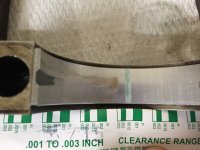
We have all used Plastigage...lay it across the journal, torque down the cap, remove the cap and read the clearance by comparing the squashed bit of Plasitgage to the picture on the wrapper.

But what are the results, exactly? Is it the gap where you are measuring? or is it the total clearance of the bearing? To pick a simple example--suppose the Plastigage measures .002". Does that mean there is .002 " clearance where you measured, PLUS another .002" on the opposite side? If you miked the Bearing and the Journal would you see a difference of .002" or .004"
 
To avoid these ads, REGISTER NOW!

RVDan

Well-known member
Joined
Oct 9, 2011
Messages
2,213
Location
North America
I've always wondered too. Is the crank magically floating in the middle of the bearings or is it resting on one side and I'm reading twice as much clearance.

I tried using a mic to read the I.D. of the bearings with the cap installed but I didn't trust that measurement either because they may not have been completely seated without the crank pushing them in.
 

tcianci

Well-known member
Joined
Feb 7, 2009
Messages
4,242
Location
Walpole, Ma
Ok, you crushed the plastigage, right? Then there is no clearance on the other side. Plastigage measures the actual bearing clearance.

Yikes, you guys scare me.
 

laser3kw

Well-known member
Joined
Nov 17, 2012
Messages
7,276
Location
northen IL
Net clearance
example:
2.000 bearing (installed) & 1.998" crank = plastigage .002
so if your crank was magically floating in the perfect center, there would be .001 all the way around.
Do not confuse this with a manufactures clearance spec. they call for the net clearance, as mathematically calculate (example above)
 

jfcasey

Well-known member
Joined
Jan 30, 2010
Messages
1,358
Location
New Hampshire
The crank "floats" on a film of oil that is between the journal and the main bearings. I believe you are measuring the space the oil has to fill. I have always thought a .002" measurement means there is .002" of difference between the od of the journal and the id of the bearing. I would figure the actual space around the journal when the engine runs is less than that on any particular side because the crank is centered by the oil film.

I'm hoping an engineer can jump in and explain better with math; but in short, a plastigauge reading of .002" doesn't mean there is that much space on all sides of the journal.

Sent from my SM-G935V using Tapatalk
 

JJThrasher

Well-known member
Joined
May 30, 2013
Messages
1,416
Location
Indiana
Dump the plastigage and get a dial bore gauge and a micrometer. Then you'll know what you're measuring.
 

LXCam

ALLIANCE MEMBER
Joined
Apr 23, 2013
Messages
19,172
Location
AZ
Don't take our word for it find out for yourself. Use it on the cap and get your clearance. Than set in on both side of the journal and do it again. If it double phucked flat then you'll know your original measurement was a total.
 

Ironcrow

Well-known member
Joined
Sep 30, 2005
Messages
1,169
Location
Arizona
The plastigage is measuring one side. The other is smashed together. Bearing clearance is all the way around, that is the difference between OD of journal and ID of cap. The magic is when they make the plastigage they take this into account, so when you line the smashed plastigage (one side) up on the paper ruler that comes with it, the result you read is the diametrical clearance (both sides). Give or take. Like everybody says, buy a good mic.
 

Dr Stan

Well-known member
Joined
Nov 17, 2016
Messages
496
Location
Owensboro, KY
Dump the plastigage and get a dial bore gauge and a micrometer. Then you'll know what you're measuring.

I believe you are referring to telescoping gages, commonly referred to as "snap gages" due to the sound they make.

http://www.travers.com/telescoping-gages-sets/p/419257/

This link will show one a dial bore gage. Considerably more accurate and expensive. One really also should have a set of gage blocks to set them correctly. Another every expensive item. I have seen them set with a mic, but unless it is calibrated correctly the bore gage will be off.

http://www.travers.com/dial-bore-gage-sets/p/99545/?keyword=dial+bore+gauge

BTW, the example of .002" is correct. That would give you .001" of clearance/side.

I've known engine builders who coat the moving parts with white grease during assembly. Previously used STP oil treatment, but I have not seen that for years. They also rig up a drill driver to run the oil pump before turning it over by hand before the first start up.
 

LXCam

ALLIANCE MEMBER
Joined
Apr 23, 2013
Messages
19,172
Location
AZ
I believe I said dial bore gauge, not telescoping gauge.
You did which is the correct way and not with gauge blocks either.

Doc, for future reference you zero your dial bore gauge then use a mic to get your journal size then adjust the mic to zero your dial bore gauge. You then subtract your journal size from the measurement taken off the dial bore gauge and that's your clearance.
 

four.cycle

Well-known member
Joined
Oct 19, 2015
Messages
29,056
Location
Tacoma, Washington
JJThrasher said:
Dump the plastigage and get a dial bore gauge and a micrometer. Then you'll know what you're measuring.

:thumbup:

We didn't have any Plastigauge in the building. We had a guy in the back that turned the cranks and he had this magical instrument called a "micrometer".

The guy who ran the boring bar had some kind of gizmo, but at the moment I can't recall what the correct name for it is.

Never forget the phone call from some jackass who managed to toast a perfectly good long block on startup yammering at the owner on the phone.
Guy on phone: "Don't you guys use Plastigauge?!?!?!?!"
Owner: "You ever heard of a mic?"
 
OP
M

ms fowler

Well-known member
Joined
Jun 27, 2012
Messages
450
Location
Littlestown, PA _ 6 miles south of Gettysburg
Thanks for the replies--
Plastigage is popular because it is easy.
Mics and gage blocks all require the user to master and know the "feel" of the gages when they are adjusted correcty. That takes practice and experience. Anyone should be able to match the Plastigag to the paper ruler and know the clearance.

When you guys say that crushing the plastigage means that you have moved the shaft so that there is no clearance on the opposite side--Is that an assumption, or what? Plastigage deforms rather easily would it actually push the shaft?
 

larry4406

Well-known member
Joined
Jan 27, 2006
Messages
19,454
Location
Northern Virginia
Plastigage is used to measure diametral clearance. There are different colors which are intended to measure different ranges of clearance. Knowing what clearance should be present (from your manual), you select the color range in advance.

The gage itself is a thin round strip of plastic/wax material. You lay it on the completely dry journal and bearing, assemble the cap, and torque to spec. DO NOT rotate the shaft. This squishes the gage material. Upon disassembly, you compare the squished width of the material to the chart provided to determine the clearance. The smaller the clearance, the wider the squish pattern conversely, the larger the clearance the more narrow the squish pattern.

http://www.plastigaugeusa.com/how.html

I used it when I rebuilt my Mitsubishi 3.5L 6G74 on our Montero Sport.
 

Attachments

  • Plastigage on main 1 typical.jpg
    Plastigage on main 1 typical.jpg
    89.1 KB · Views: 118
  • Plastigage for checking mains.jpg
    Plastigage for checking mains.jpg
    78 KB · Views: 119
  • main bearing clearance greater than 1.5 mils.jpg
    main bearing clearance greater than 1.5 mils.jpg
    140.8 KB · Views: 130
  • main bearing clearance less than 2 mils.jpg
    main bearing clearance less than 2 mils.jpg
    141.3 KB · Views: 119
Last edited:

red61cj5

Well-known member
Joined
Mar 31, 2016
Messages
3,752
Location
West Virginia
:thumbup:

We didn't have any Plastigauge in the building. We had a guy in the back that turned the cranks and he had this magical instrument called a "micrometer".

The guy who ran the boring bar had some kind of gizmo, but at the moment I can't recall what the correct name for it is.

Never forget the phone call from some jackass who managed to toast a perfectly good long block on startup yammering at the owner on the phone.
Guy on phone: "Don't you guys use Plastigauge?!?!?!?!"
Owner: "You ever heard of a mic?"

How did he toast the engine? Just curious.:dunno:
 

LS6 Tommy

Well-known member
Joined
Dec 27, 2013
Messages
26,162
Location
Northern NJ
What does Plastigage tell you? It tells you that you have the excuse to buy micrometer & dial bore gauge sets...

Tommy
 
Last edited:

ratdoggy

Well-known member
Joined
Mar 27, 2009
Messages
11,972
Location
Akron-Canton area OH
This is garage journal...
Buy $5K in tools when a $10 pack of plastigage will give you the same basic answer
I always thought plastigage was for double checking your stuff at assembly..
 
To avoid these ads, REGISTER NOW!

LS6 Tommy

Well-known member
Joined
Dec 27, 2013
Messages
26,162
Location
Northern NJ
This is garage journal...
Buy $5K in tools when a $10 pack of plastigage will give you the same basic answer
I always thought plastigage was for double checking your stuff at assembly..

X2. Only used it once, and it was only because the engine owner was a newbie and wanted to double check and also to see if it was accurate. It wasn't. It will be close enough to let you know if you're in spec, but that's all. Anyone who is going to do more than just a low buck rebuild for a daily driver engine is going to have the tools. Mine probably didn't cost more than $150.00...

Tommy
 

helterskelter

Well-known member
Joined
Mar 26, 2010
Messages
296
What does Plastigage tell you? It tells you that you have the excuse to buy micrometer & dial bore gauge sets...

Tommy

What do you use to set your dial bore gages? I've always found those to be finicky without having a ring master gage to set to. Having ring masters for each size bearing in a home shop adds up quickly. Maybe there's a better way that I'm missing? Set using gage block stack?
 

helterskelter

Well-known member
Joined
Mar 26, 2010
Messages
296
So you set the bore gages using the micrometers? Maybe I don't have the right touch (I don't use them often), but I've had mixed success attempting to set bore gages to micrometers. Only thing I was ever 100% confident with was using a ring master gage to set them. Again I rarely use bore gages. I probably trust plastigage more than my ability to set bore mics to OD mics.
 

LS6 Tommy

Well-known member
Joined
Dec 27, 2013
Messages
26,162
Location
Northern NJ
True machinists will probably tell me I'm way wrong, but I do it the way my engine builder taught my friend to do it when he worked there. I set the bore gage up to ***.**" and lock the anvils in the mic, then "rock" the boregage between the anvils (just like checking a bore) and zero the bore gage to that dimesnion. Using the bore gage itself is pretty much a multiple test, record results and average method.

Never lost a bearing yet...

Tommy
 
Last edited:

penright

ALLIANCE MEMBER
Joined
Dec 27, 2016
Messages
618
Location
SW of Mustang, OK
This thread reminds me when my friend an I were teenagers. He had a 454 3/4 Chevy. Being teenagers, he spun a bearing. Drop the pan, a little emery cloth, bought a standard size, plastigage it, then went back and bought the one over size bearing, put it all back together. He sold the truck years latter. We were still tanagers and drove it like a rental and pulled boats. Never had an issue.
Before I get yelled at, I am not suggesting this is proper repairs, just saying I learned that engines are tougher than we think sometimes.
 

four.cycle

Well-known member
Joined
Oct 19, 2015
Messages
29,056
Location
Tacoma, Washington
red61cj5 said:
How did he toast the engine? Just curious

I only remember the phone conversation, I don't recall the details on that particular engine. It might not even have been one of my accounts - we had three other guys on the road too.
There are a million ways you can screw up a perfectly good engine on start-up: failure to prime;forgetting to pour the oil into the engine before firing it; clogged radiator; going cheap and using an old water pump; forgetting to pour coolant into the radiator; a malfunctioning carburetor that floods the engine with raw fuel and washes all the oil out of the cylinder; ad nauseum.
But I am by no means a machinist, and certainly don't qualify as a "mechanic", I just sold the damn things - it was just another widget to me.
Only difference was they weighed about 325 pounds on a skid.

penright said:
"..engines are tougher than we think sometimes."

Unfortunately "they don't build them like they used to", and you probably wouldn't get away with that on a later-model engine.
On the older stuff, you might have a bit of leeway. When I was working up in Yelm I sold a guy a set of rod shells for an old Chev 235 6. He came in the next day to show me what he pulled out when he removed the connecting rod cap: a neatly-trimmed piece of old leather boot tongue. Best part was: he had been driving that old 3100 for over a decade and never had any problem with it. ;)
 
Last edited:

LS6 Tommy

Well-known member
Joined
Dec 27, 2013
Messages
26,162
Location
Northern NJ
This thread reminds me when my friend an I were teenagers. He had a 454 3/4 Chevy. Being teenagers, he spun a bearing. Drop the pan, a little emery cloth, bought a standard size, plastigage it, then went back and bought the one over size bearing, put it all back together. He sold the truck years latter. We were still tanagers and drove it like a rental and pulled boats. Never had an issue.
Before I get yelled at, I am not suggesting this is proper repairs, just saying I learned that engines are tougher than we think sometimes.

IMO, that is exactly the type of thing Plastigage is for. :thumbup:

Tommy
 

helterskelter

Well-known member
Joined
Mar 26, 2010
Messages
296
True machinists will probably tell me I'm way wrong, but I do it the way my engine builder taught my friend to do it when he worked there. I set the mic with the boregage blanks. Using the bore gage itself is pretty much an multiple test, record results and average method.

Never lost a bearing yet...

Tommy

I'll give it a shot. Will probably still over-check with plastigage. We work on turbine engine bores at work. All diameters have a NIST traceable ring master to set the gages. I can measure one of those bores and be 100% confident that I hit the number within .0001. But every-time I've used a mic to set the bore gage I haven't been confident with the results.
 

LS6 Tommy

Well-known member
Joined
Dec 27, 2013
Messages
26,162
Location
Northern NJ
I'll give it a shot. Will probably still over-check with plastigage. We work on turbine engine bores at work. All diameters have a NIST traceable ring master to set the gages. I can measure one of those bores and be 100% confident that I hit the number within .0001. But every-time I've used a mic to set the bore gage I haven't been confident with the results.

Yeah, you're working within much tighter tolerances.

I forgot exactly how it's done since it's been a while and screwed up one one item- Don't set the mic to the bore gage blanks, use the actual bearing journal mic measurement to set the bore gage.

Tommy
 
Last edited:

padroo

Well-known member
Joined
Nov 25, 2011
Messages
564
Location
Chesterton, In.
Plastigauge has its place, here is my example. I had a neighbor lady that delivered news papers and she knocked a hole in her oil pan and drove it home. By the time I looked at it the car would not turn over but the starter would spin. I checked it out and what ever she hit bent the flex plate too so the engine had to come out. When I removed the engine and got the motor upside down and removed the oil pan I removed all the bearing caps and inspected the crank and bearings for damage and none was obvious. I Plasti gagged all the crank and rod bearings and found them to be within specs. I put a new oil pan on the car and another flex plate and reinstalled the engine and the engine was fine.

This is a good example of a time and place to use Plasti gauge because you would have to do a complete tear down of the engine to spec out the engine using any other type of precision measuring equipment.
 

like2wheel

Well-known member
Joined
Oct 29, 2014
Messages
1,693
Location
On an as needed basis
I dont know why Plastigauge gets such a bad rap.

Although I always use a mic & bore gauge to measure clearances before assembly, I'll often use plastigauge during assembly. If the 2 don't agree, you'd better find out why, because plastigauge by design can't be wrong. Maybe something moved, or a piece of something got somewhere, but unless it's old or been mishandled, it's not plastigauge lying to you.

I especially find it useful when putting a used crank back in service. The squish pattern tells you a lot about the condition of the shaft such as subtle taper and diameter variations that might not be felt and are bridged by the mic anvil.

I think that often times people that dis plastigauge either dont know how to use it correctly, or just like to brag about the tools they have.
 
Last edited:

BillK

Well-known member
Joined
Aug 24, 2006
Messages
9,349
Location
Beautiful Southern Maryland
The magic is when they make the plastigage they take this into account,

Sorry,
There is no magic here. If you compress a piece of plastigage until it is .002" thick, it will measure .002" on the "ruler" on the package. Nothing magic about it. It is used in many other applications and it measures the actual thickness it is compressed to.

In the case of automotive crankshafts it is measuring the bearing clearance which as everyone else has stated is the difference between the crankshaft OD and the bearing ID. Simple.
 
Last edited:

LS6 Tommy

Well-known member
Joined
Dec 27, 2013
Messages
26,162
Location
Northern NJ
In the case of automotive crankshafts it is measuring the bearing clearance which as everyone else has stated is the difference between the crankshaft of and the bearing id. Simple.

Crank OD minus bearing ID X .5 gives you the actual oil thickness.

Tommy
 
Last edited:

justanengineer

Well-known member
Joined
Apr 5, 2011
Messages
7,722
Location
Motor City
Thanks for the replies--
Plastigage is popular because it is easy.

Not particularly, plastigage hasnt been used in industry in ~50 years bc its repeatability ***** and even most hobbyists wont touch it for the same reason. You're correct in that developing the feel for using a bore gage takes quite awhile but with modern engines its really a necessity to do things properly. OTOH, bearings do take craploads of abuse as do other engine components and getting one to run another 100k+ miles is pretty easy, many do successfully fudge their way through a rebuild by various other means.
 

LS6 Tommy

Well-known member
Joined
Dec 27, 2013
Messages
26,162
Location
Northern NJ
Wrong, wrong, wrong ..... !

Bearing ID minus crankshaft OD is bearing clearance. That is what plastigage measures.

You posted faster than I could edit. :lol_hitti I edited my post. It didn't include everything I typed the first time.

Tommy
 

MikeF2316

Well-known member
Joined
Dec 29, 2012
Messages
9,605
Location
Thornhill, ON
Call me old fashioned, but I like plastigage too. Like others, I don't do this kind of work often enough so I'm confident I've aligned/set the measuring tools correctly. You put the platsigage in there, you know if there's proper clearance or not.
 
To avoid these ads, REGISTER NOW!
Top Bottom