To avoid these ads, REGISTER NOW!

Excavation and fill question(s)

biggziff

Well-known member
Joined
Apr 9, 2015
Messages
623
Location
Upstate NY
I tore down an old 10X10 shed and am prepping for a 20X20 metal building. I had about 3' of fall from the left side to the right side that I filled with coarse fill (about 1' worth) and then Crusher Run for the rest. I have a pad now that's about 24X24 where there is 6" of crusher on the left side running to 2-3' on the right side to get it all level. We tracked it in with a 10K mini, then I've run a plate compacter on it 4-5 times. Watered it well, compacted it a few more times and watered it again. We tamped the thick edges with the bucket and have a good angle of repose on the thick sides. I'll probably dump 2" of #2 stone on top and hog out some shoulders around the interior perimeter of the forms for edge strength. Pouring 6" of 4500 PSI with fiber.

My question is....at what thickness would you consider installing some kind of retaining wall? It's already hardened up like concrete, but I wonder about the thick edges.
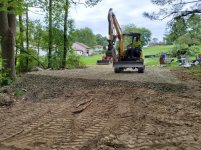
 

Attachments

  • 20200912_165946.jpg
    20200912_165946.jpg
    148.4 KB · Views: 150
  • 20200912_165837.jpg
    20200912_165837.jpg
    157.4 KB · Views: 131
To avoid these ads, REGISTER NOW!

matt_i

Well-known member
Joined
Mar 14, 2008
Messages
10,728
Location
SE Michigan
I can't tell 100% from the photos...but does the underlying dirt go downhill from the road towards the building area?

My concern would be that while the potential waterflow isnt going to wash out the stone base, it could undermine the soil however,

It could prove useful to create a shallow swale so that water is directed to the sides and around the pad, so that the pad is the highest plane in all directions.

ALso, what sort of prep did you do in relation to removing potential tree stumps in the area? As that could also affect the subgrade.

Last, you didn't ask, but I would either go with no fibermesh or put in welded steel reinforcing mesh, even if its hooked into position as concrete is placed. Pay attention to cutting control joints and concrete curing (either wet or curins sealer) and I think it will turn out great.
 

theoldwizard1

Well-known member
Joined
Feb 22, 2011
Messages
43,198
Location
SE MI
As matt_j was saying a lot de[pends on water flow.

BUT, anything over 2' I would want some kind of retaining wall. The only other option is a lot more fill and tapering the slope down to around 15°-20° (?).

You get a lot of frost in upstate NY, so your retaining wall should start a couple of feet BELOW grade. At the frost line would be best.
 
OP
B

biggziff

Well-known member
Joined
Apr 9, 2015
Messages
623
Location
Upstate NY
I can't tell 100% from the photos...but does the underlying dirt go downhill from the road towards the building area?

My concern would be that while the potential waterflow isnt going to wash out the stone base, it could undermine the soil however,

It could prove useful to create a shallow swale so that water is directed to the sides and around the pad, so that the pad is the highest plane in all directions.

ALso, what sort of prep did you do in relation to removing potential tree stumps in the area? As that could also affect the subgrade.

Last, you didn't ask, but I would either go with no fibermesh or put in welded steel reinforcing mesh, even if its hooked into position as concrete is placed. Pay attention to cutting control joints and concrete curing (either wet or curins sealer) and I think it will turn out great.

Good questions.

The left side of the pad (facing front) is near the edge of my property. About 30' away is a ditch I dug in 20 years ago to capture and route surface water coming from the fields and such that are uphill from my property. This pad, save for the left side, will be the highest point in that area.

The only stumps I removed were one at the front right of the pad (beyond the pad's area) and a small one about in the middle of the left edge, also outside the area of the pad. The ground under the pad was undisturbed save for removing a few roots. It's been undisturbed since 1986 when the old shed was built and set on concrete blocks.

Why no fiber? I can easily grab some welded wire mesh to drop in there, but when I poured my 38X26 a few years ago I used no steel and only fiber for that single pour and have no cracks to date there. This is a shady spot and it's cooling down here so curing should be low and slow (I hope)
 
OP
B

biggziff

Well-known member
Joined
Apr 9, 2015
Messages
623
Location
Upstate NY
As matt_j was saying a lot de[pends on water flow.

BUT, anything over 2' I would want some kind of retaining wall. The only other option is a lot more fill and tapering the slope down to around 15°-20° (?).

You get a lot of frost in upstate NY, so your retaining wall should start a couple of feet BELOW grade. At the frost line would be best.

We are at 42" for footers here so if I do anything, I'd do something similar to what you're thinking with more fill or rip rap. Some railroad ties, but I think I'd just use driven pipe (2-3' into the ground) to hold them in place (surface mounted) and back fill with coarse fill topped with crusher or dirt. That would likely be here long after I'm gone...I think!
 

theoldwizard1

Well-known member
Joined
Feb 22, 2011
Messages
43,198
Location
SE MI
We are at 42" for footers here so if I do anything, I'd do something similar to what you're thinking with more fill or rip rap. Some railroad ties, but I think I'd just use driven pipe (2-3' into the ground) to hold them in place (surface mounted) and back fill with coarse fill topped with crusher or dirt. That would likely be here long after I'm gone...I think!
Real railroad ties (creosote not PT) will rot in less than 10 years. The only way to use them that will last even that long is with proper tie-back, but it is already to late for that (tie-back needs to be under your pad).

Retaining wall fail due to 1) improper foundation and/or 2) water pressure behind the wall and no place to go.

Do it right or you will be doing it over probably in less than 10 years and possibly after having the building SINK along that side
 

77flh

Member
Joined
Sep 14, 2020
Messages
9
Location
WV
I’d consider using the dry stack, pre cast retaining wall blocks. Our redi-mix plant sells large ones that you’d set with your excavator.
 

ConCretin

Well-known member
Joined
Jan 20, 2011
Messages
3,378
Location
Central Maine
I don't see any need for a retaining wall. A 20x20 building on a 24x24 pad is fine. A retaining wall is an unnecessary complication and expense.

I would however go with a slightly thickened edge on your pad and welded wire fabric. I might even throw a #4 par around the perimeter. Floating slabs are subject to a lot more movement than a traditional slab on grade. The thickened edge and steel reinforcing helps hold everything together if you happen to get some cracking.

Fiber helps reduce plastic shrinkage cracking but that's not much of a concern on a slab this small. It won't help at all if you get any cracks from movement.
 
Last edited:
To avoid these ads, REGISTER NOW!

TonyG109

Well-known member
Joined
Aug 22, 2016
Messages
94
Location
Maryland's Eastern Shore
I had a similar situation on my 30' x 50' garage and had to add over 2' of fill on one side. The builders only added enough fill to pour the slab and left it up to me to finish off the back fill. Speaking from experience, the fill eroded fairly quickly and would have soon undermined the slab. As TheOldWizard1 said, adding more fill and tapering it off has solved the problem.

That being said, there is another issue that may come into play. Changing the grade by adding fill can kill nearby trees. It takes several years but it does happen. I can't tell from the pictures, but that one large tree on the right by the yellow diamond sign may fall victim to this, especially if more fill is added to taper the grade. I hate to take down trees but if you have any that are nearby and would be an issue to remove after the building is in place, you may want to remove them first. Consider it an ounce of prevention.
 

NUTTSGT

Super Moderator
Staff member
Joined
Sep 14, 2009
Messages
50,987
Location
Northern Central Ohio
RR ties will last a long time if you put stone under them and allow them to get drainage.

I think my biggest fear would be rainwater run off from your roof. I'd make sure to put some gutters/downspouts and have them drain into field tile the runs down hill away from your building.
 

TractorJeff

Well-known member
Joined
Dec 8, 2013
Messages
3,309
Location
Elkhorn, WI
I'd just build a retaining wall with big rocks out of your fields to minimize material movement from the building. Kind of like the Farmers did in the old days!
 

theoldwizard1

Well-known member
Joined
Feb 22, 2011
Messages
43,198
Location
SE MI
I don't see any need for a retaining wall. A 20x20 building on a 24x24 pad is fine. A retaining wall is an unnecessary complication and expense.

I would however go with a slightly thickened edge on your pad and welded wire fabric. I might even throw a #4 par around the perimeter. Floating slabs are subject to a lot more movement than a traditional slab on grade. The thickened edge and steel reinforcing helps hold everything together if you happen to get some cracking.
WOW ! I know you are a professional, but I am SHOCKED :shocking: at your response !

I would never consider a floating slab there. I would want a full depth (below the frost level) footer at least on that side. If it does start to wash out, you have a chance of saving the pad and building before it completely fails !
 

50pascals

Well-known member
Joined
May 26, 2020
Messages
55
Location
Rochester, NY
I am also in Upstate NY. My neighbors garage was built the same way, only with less elevation on the "low" side and no chance of water running by. The stone has separated from the slab by 6 inches in spots.

To stabilize it, we just piled large stones (from a foundation I was taking down) downhill from it and on top of the stone slopes. Then we worked sand / peastone back under the slab with a small demo hammer.

Using stone like this is called rip-rap in the earthwork trades.

I know you will have plenty of big stones lying around. Add them to your berm on the low side. It will swallow up more stone than you think.

P.S. - The proper way to compact that much fill is in 4" or 6" layers. It sounds like you did it all at once. So even though the top is hard and feels solid, the bottom is probably only at 88% - 92% compaction. So you will get some settling.

P.P.S - I don't think your mini weighs 10,000 pounds. I have a Kubota KX-91 that is quite a bit bigger than that and it only weighs 7,700 pounds. You can find all that information at a site called Ritchiespecs.com
 

50pascals

Well-known member
Joined
May 26, 2020
Messages
55
Location
Rochester, NY
WOW ! I know you are a professional, but I am SHOCKED :shocking: at your response !

I would never consider a floating slab there. I would want a full depth (below the frost level) footer at least on that side. If it does start to wash out, you have a chance of saving the pad and building before it completely fails !

Thickened edge slabs are common in freeze-prone areas. I have never seen a "failure" as-in collapse. I have seen cracked slabs, but it was also fast and easy and will outlive the OP.
 

ConCretin

Well-known member
Joined
Jan 20, 2011
Messages
3,378
Location
Central Maine
WOW ! I know you are a professional, but I am SHOCKED :shocking: at your response !

I would never consider a floating slab there. I would want a full depth (below the frost level) footer at least on that side. If it does start to wash out, you have a chance of saving the pad and building before it completely fails !

A properly constructed structural fill with a monolithic slab is perfectly acceptable and is used every day. I have a 28 x 32 garage and a subsequent 14 x 38 addition on structural fills very similar to the OP's. Never had an issue. You obviously need to make provisions for proper drainage but that's not all that complicated.

Your idea is flawed in that you aren't providing uniform support for the slab. Frost protecting one side and not the other is a recipe for failure.
 
To avoid these ads, REGISTER NOW!
Top Bottom