To avoid these ads, REGISTER NOW!

exhaust fan with shutters

hetkind

Banned
Joined
Sep 28, 2008
Messages
995
Location
Johnson City, Tennessee
Time to start finishing the rest of the wall and ceiling in the shop...34'x40' with a 20' eve height. Once I close in the ceiling with 2x6 sleepers and OSB and 12" insulation batts, I will lose the soffet and ridge ventilation.

So I am thinking, a exhaust fan mounted high on the wall, with shutters to keep the heat in during the winter, and a variable speed control should do it. I would probably need to size out the fan fairly quickly so I would start finishing the walls.

20x34x40 would be 27,200 cubic feet, and if you figure 5 air changes an hour, 136,000 cubic of air/hour or a fan rated in 2267 cfm. This would also require panels with shutters on the opposite end of the building for make up air.

This will allow me to run a vehicle inside with the fan on or have plenty of ventilation for painting or welding.

Does anyone have a favorite supplier of fans and shutters?

Howard

 
To avoid these ads, REGISTER NOW!

PassnThru

Well-known member
Joined
Jan 5, 2010
Messages
6,512
Location
Bowling Green KY
I'm not sure what you did - are you saying that you finally finished your ceiling so you no longer have the soffets and ridge vent for ventilation or did you finish the rafters themselves? For the former, what I did in my garage for ventilation and cooling was to put a whole house fan in it. Working in the garage at night in the summer I can open the widows or crack the doors and get plenty of air flow without the mosquitoes. Also, it's great on those 100 + degree days. It only takes about 10 minutes once I turn it on to bring the attic temp down to the outside temp.
 
OP
H

hetkind

Banned
Joined
Sep 28, 2008
Messages
995
Location
Johnson City, Tennessee
I haven't closed in the ceiling yet, but I plan to, as part of the insulation project.

I am not worried about comfort ventilation, since I can open the bay door and since I live way in the mountains, AC isn't needed very often.

I just would like some mechanical ventilation to exhaust welding fumes, painting aerosal and engine exhuast. Typical values for this are 3 to 5 air changes per hour, so a fan spec'd around 2,000 cfm should do it, and that is readily available as a axial fan, prepackaged with a set of shutters. The automatic shutters are nice to keep the heat in when the fan is off.

Now, for every cubic foot of air you exhuast out the fan, you need to let a cubic foot of air in, and again, automatic shutters do a wonderful job of directing the air, providing security and preventing things like sucking air down the chimney for the wood stove.

It is also far easier to rough the fan and shutter out now, before the interior walls go up.

I was merely inquiring if anyone had a favorite source for the fan and shutters...
 

s_ontario

Well-known member
Joined
Jan 5, 2006
Messages
552
Location
canada
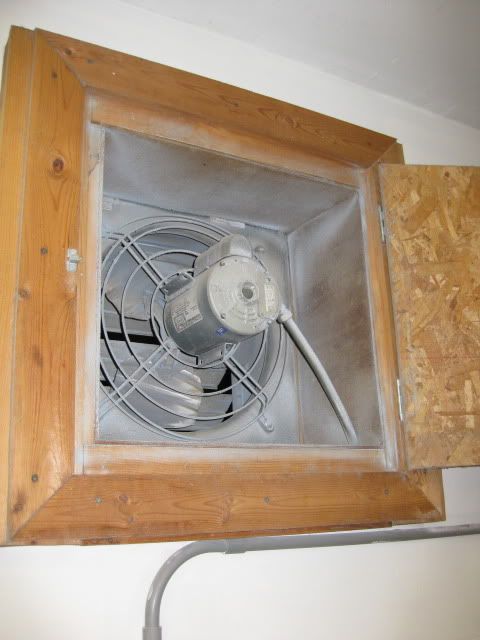
my shop is 48'x40' 15' ceilings and i have a 20" exhaust fan that works very well for exhausting welding fumes and diesel fumes start up a IH 466 and you know what diesel fumes are
but i perfer fan just at head height so breathing zone is kept clear first. inside the wood cabinet is the 20"x20" shutter fan
 

Attachments

  • shop-2 002sm.jpg
    shop-2 002sm.jpg
    94.6 KB · Views: 158

Ainzo

New member
Joined
Mar 1, 2010
Messages
1
I recently bought exhaust fan in our DIY store. Actually, I already have fans in my shop and I figured out that exhaust fans will improve the circulation of air especially in a poor-ventilated rooms like the comfort rooms. My new exhaust fans has control and shutters for better performance. Ceiling Fans
 
Last edited:
To avoid these ads, REGISTER NOW!

redsky49

Well-known member
Joined
Jan 21, 2009
Messages
582
Location
near the coast in eastern North Carolina
I am assuming that you are looking at propeller fans. Axial is a term that generally leads to a different (and much more expensive) style of fan such as the vane-axial type. Prop fans work great for low static pressure applications, i.e., no attached ductwork.

You have one design decision - gravity or motorized dampers. There are also several levels of damper blade seals. My suggestion would be to select a motorized damper with blade edge seals - both for the exhaust (fan) end, as well as the make-up air side.

Operation would be as follows:

1. "Fan Start" button energizes system
2. Damper blades go to full open position as confirmed by end position switches - both dampers.
3. Upon confirmation of both dampers at full open position, fan starts.

Quality U.S. commercial fan suppliers, that I can vouch for, include the following:

Barry Blower
Chicago Blower
Greenheck Fan
Loren Cook
Penn Ventilator
Twin City Fan

These manufacturers all have models and sizes that would suit your purposes. I would probably look at Penn first, since it is a national player and has an easily followed catalog.

http://www.pennbarry.com/images/pdf/catalog/BZW.pdf

You will need the wall sleeves, insect screens, controls, etc. All available, and best purchased, from a single source. I would recommend a direct drive fan unless this turns out to be an every day usage item, in which case I would suggest a belt drive unit.

Note that a high mount location may not be the best place to exhaust fumes at floor level. Plan your installation accordingly.

As always, offered only as opinion
 

930dreamer

Super Moderator
Staff member
Joined
Oct 7, 2009
Messages
22,995
Location
Amarillo,TX and Stinnett,TX
I bought an air handler thats 6'X24"X24" with a two speed fan, it sits on the bathroom ceiling /storage. No duct work, just moves air. I'm sure I could open the wall and vent.
 

jonny o

Well-known member
Joined
Sep 9, 2009
Messages
95
Not sure if the fan itself is the same make as the control, but this thing has been a dream for pumping exhaust fumes out. Know that it's not nearly as efficient as ducting the exhaust straight out. Make sure you have a good detector.

The shutters on the outside and plywood door do a decent job of cutting the infiltration in the winter, but I ran a foam weatherstrip on the door "flange" and coated the door in a couple layers of foam board for insulation. If I was building it I would build the door out of sandwiched foam and ply for a little r-value.

Coolest control knob on the planet to boot.

IMG_0933.jpg


IMG_0932.jpg
 
OP
H

hetkind

Banned
Joined
Sep 28, 2008
Messages
995
Location
Johnson City, Tennessee
I am assuming that you are looking at propeller fans. Axial is a term that generally leads to a different (and much more expensive) style of fan such as the vane-axial type. Prop fans work great for low static pressure applications, i.e., no attached ductwork.

You have one design decision - gravity or motorized dampers. There are also several levels of damper blade seals. My suggestion would be to select a motorized damper with blade edge seals - both for the exhaust (fan) end, as well as the make-up air side.

Operation would be as follows:

1. "Fan Start" button energizes system
2. Damper blades go to full open position as confirmed by end position switches - both dampers.
3. Upon confirmation of both dampers at full open position, fan starts.

Quality U.S. commercial fan suppliers, that I can vouch for, include the following:

Barry Blower
Chicago Blower
Greenheck Fan
Loren Cook
Penn Ventilator
Twin City Fan

These manufacturers all have models and sizes that would suit your purposes. I would probably look at Penn first, since it is a national player and has an easily followed catalog.

http://www.pennbarry.com/images/pdf/catalog/BZW.pdf

You will need the wall sleeves, insect screens, controls, etc. All available, and best purchased, from a single source. I would recommend a direct drive fan unless this turns out to be an every day usage item, in which case I would suggest a belt drive unit.

Note that a high mount location may not be the best place to exhaust fumes at floor level. Plan your installation accordingly.

As always, offered only as opinion

All excellent advice...note: a propeller fan is a type of axial fan:)

I keep of copy of the ACGIH Ventilation handbook handy...

Howard
 
To avoid these ads, REGISTER NOW!
Top Bottom