To avoid these ads, REGISTER NOW!

Exhaust Freezing

schnid21

Member
Joined
Jan 15, 2024
Messages
5
Hi All

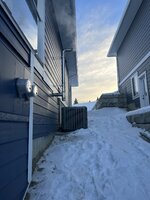
When we bought our house one of the things I had the builder install was a Modine Hot Dawg garage heater. Love it so far except for one issue. The exhaust pipe keeps freezing up with water on the outside of the house. I've attached a few pictures to show what I mean.

I don't know all of the building code rules around here, but what the builder did was install a tee with a very small water drain in the bottom. Then went vertical to get the exhaust up high away from a future sidewalk.

Unfortunately as the water is dripping out, the drain is freezing up and after about 12 hours I get the block of ice you see in the attached picture. The first time I noticed the issue was when water started dripping in my garage because the ice block had gotten so big. Its pretty cold here right now so its only started to happen recently.

I've asked the builder to take a look, but I'm sure it will be forever before he gets around to it, so I would prefer to come up with a solution myself. Any ideas on what could be done differently? I thought about maybe making the bottom portion as short as possible so it has less area for water to build up and maybe just the exhaust temps would keep it from freezing? Or possibly just go to a straight out drain, but I need to figure out what the building code is here to determine if I can do that.

Thanks

Jason
 

Attachments

  • IMG_6313.JPG
    IMG_6313.JPG
    628.2 KB · Views: 149
  • IMG_6316.JPG
    IMG_6316.JPG
    604.6 KB · Views: 145
  • IMG_6317.JPG
    IMG_6317.JPG
    870.2 KB · Views: 157
  • IMG_6319.JPG
    IMG_6319.JPG
    666.1 KB · Views: 160
To avoid these ads, REGISTER NOW!

Copymutt

Well-known member
Joined
Sep 3, 2016
Messages
3,386
Location
Colorado
Thinking outside the box. Can you wrap the drain in heat tape and feed it from a thermo cube?
 

KenC

Well-known member
Joined
Dec 20, 2009
Messages
2,577
I'd try wrapping the entire 4 with fiberglass insulation with a 'neat as possible' aluminum tape cover. If that works consider a real metal covering.
 
OP
S

schnid21

Member
Joined
Jan 15, 2024
Messages
5
Thinking outside the box. Can you wrap the drain in heat tape and feed it from a thermo cube?
I had debated that one as a last resort. Hoping to not need to go to that route , but if I can't come up with anything else I do believe that could work.
 

fitter30

Well-known member
Joined
Jun 23, 2019
Messages
2,967
Location
Peace Valley,mo
Call tech at the manufacturer to get a design layout. Probably needs a tee inside with a trap to a drain with a pitched flue back towards the heater.
 
OP
S

schnid21

Member
Joined
Jan 15, 2024
Messages
5
The company that installed the HVAC in my house and also that heater came by today and gave me the full rundown. The garage heat was done as an afterthought. The fresh air intake for the furnace is also on the same side of the house as the garage exhaust. So code said the exhaust had to be 10 feet away from the furnace intake. Hence the stack.

Option one to fix was to run a new furnace air intake which involves tearing up half of the drywall in the garage and the basement. Massive job.

Option two was to try the heat tape since this only seems to be happening on really cold days.

A drain inside was also discussed but there is nothing to drain into anywhere remotely close and that would require some pretty intensive concrete work if we were to go that route.

Guess I'll give the heat tape a try and see how it holds up.
 

PoorUB

Well-known member
Joined
Mar 29, 2021
Messages
11,622
Location
Fargo, ND
The company that installed the HVAC in my house and also that heater came by today and gave me the full rundown. The garage heat was done as an afterthought. The fresh air intake for the furnace is also on the same side of the house as the garage exhaust. So code said the exhaust had to be 10 feet away from the furnace intake. Hence the stack.
I don't see the furnace intake in the picture. is it hiding behind the AC unit?

The problem is all the condensate from the exhaust. Personally, I would say the hell with code, and remove the tee. extend the vent out and other foot or two and see what happens. The exhaust from the heater wanted to go up. Wind might cause it to swirl and got drawn into the furnace intake, but I doubt it.

Modine's instructions say 6 feet from any other combustion air intake.

If the furnace intake draws in a bit of the Modine exhaust about the only issue is possibly frosting up the furnace intake.
 

PoorUB

Well-known member
Joined
Mar 29, 2021
Messages
11,622
Location
Fargo, ND
Call tech at the manufacturer to get a design layout. Probably needs a tee inside with a trap to a drain with a pitched flue back towards the heater.
I doubt Modine would approve the vent installation! There venting requirements are straight out the wall or straight up. That exposed vertical run out side would not pass, I will bet.

I sure would not have attempted it. I would have mounted the heater else where in the garage, or vented it elsewhere.

Once in a while you run into an install that should not be done.
 

danski0224

Well-known member
Joined
Jan 29, 2005
Messages
13,358
Location
Near Naperville, IL
Any ideas on what could be done differently?
It's not vented properly. The exposed vertical is a no go. It should be enclosed by an insulated chase with a drywalled interior, but that does not fix the top part. Insulating the flue itself is a no-go.

Venting instructions are in the installation manual. There are pages and pages of how it needs to be done. Unfortunately, the people that installed yours did not read the directions, or the builder told them to just do it (and yes, that happens). Sometimes, one also needs to read the instructions that come with the venting components.

These things can all be downloaded from the Internet if you do not have them.

Or you will need an external power venter and the resources to install it. This is probably the best solution.

In any case, there are still possible issues with proximity to other mechanical equipment air intakes, maybe that AC unit and property lines/adjacent structures (noise- where I am located, power vent appliances are not supposed to be vented to the "side yard"). If that is a dryer vent hiding behind the AC unit, good luck with that.

The standoffs and clamps are nice, though.

I am surprised that the venting passed the final inspections.
 
Last edited:

Plumber338

Member
Joined
Jan 28, 2022
Messages
6
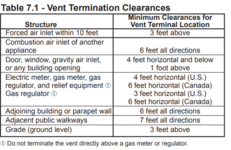
Is there some reason you can't use a Modine concentric vent? It looks like you have the necessary clearances to utilities, windows and the adjoining structure. It's in the HDS manual 6-584.13 pages 10-11.

HDS Manual Page 10.png

HDS Manual Page 11.png
 
Last edited:
To avoid these ads, REGISTER NOW!

danski0224

Well-known member
Joined
Jan 29, 2005
Messages
13,358
Location
Near Naperville, IL
The fresh air intake for the furnace is also on the same side of the house as the garage exhaust. So code said the exhaust had to be 10 feet away from the furnace intake.
Um, no.

A "fresh air intake" is not the same as a "combustion air intake". The fuel burning appliance has a "combustion air intake".

Yes, a "fresh air intake" (as in outside air taken inside for human consumption) has to be at least 10 feet away from any exhaust, some places are further- depends on local code.

In the venting instructions, there is a neat little picture of a house that shows where a combustion exhaust can be located with respect to another combustion appliance intake. There's a little table under the picture with words.

There are slight differences whether or not the appliance is direct vent (2 pipe) or single vent (exhaust only) and depending on rated btu input.

Including detailed venting instructions, this part of the installation manual is many pages long and typically includes all information needed. The only big "gotcha" is whether or not the municipality requires further separation between any type of exhaust and a fresh/outside air intake.

Again, instructions not read or followed.
 

PoorUB

Well-known member
Joined
Mar 29, 2021
Messages
11,622
Location
Fargo, ND
Is there some reason you can't use a Modine concentric vent? It looks like you have the necessary clearances to utilities, windows and the adjoining structure. It's in the HDS manual 6-584.13 pages 10-11.

HDS Manual Page 10.png

HDS Manual Page 11.png
That has nothing to do with the OP's issues.
 

toyotadriver

Well-known member
Joined
Dec 30, 2010
Messages
1,586
I don't see the furnace intake in the picture. is it hiding behind the AC unit?

The problem is all the condensate from the exhaust. Personally, I would say the hell with code, and remove the tee. extend the vent out and other foot or two and see what happens. The exhaust from the heater wanted to go up. Wind might cause it to swirl and got drawn into the furnace intake, but I doubt it.

Modine's instructions say 6 feet from any other combustion air intake.

If the furnace intake draws in a bit of the Modine exhaust about the only issue is possibly frosting up the furnace intake.


I agree with this solution. That looks like a pellet stove install. There is no way that will ever work when it’s really cold.


Nothing in this post should be misunderstood, interpreted, misinterpreted, or construed to be of a political nature.
 
OP
S

schnid21

Member
Joined
Jan 15, 2024
Messages
5
Just to be clear something up. The intake that is on that side of the house tucked up near the AC unit is a fresh air make up intake. (Fresh air for the house). Not the furnace combustion intake which is located on a different side of the house. That was a mistake on my part earlier.

As per the HVAC guys the exhaust had to be 10 feet away from the air make up intake.

I agree 100% that they did not follow the instructions when installing the unit. They added it in without any thought when laying the house out and unfortunately while the house was being built we were living on the opposite side of the country, so we didn't get a chance to keep an eye on this.

I also don't think there is going to be a way to make the current setup work. That big vertical pipe just creates too much condensation when its cold out.

I don't think they can move the heater unfortunately at this point. Moving it towards the front of the house (away from the fresh air intake) you quickly run into the power meter and all that stuff. Back obviously makes it worse. And the main floor of the house is above the heater so going vertical isn't an option either.

I was going to talk to the builder about what my options are for moving the fresh air intake far enough away from the exhaust that the exhaust could become a straight out option. Possibly duct the fresh air intake along the exterior of the house away from the exhaust? Not sure if that can be done or not, but it was an idea.

It will still not meet the walkway clearance requirement as there will eventually be a walkway to my backyard passing directly by that area. But at least it won't freeze and the walkway will only get used occasionally in the winter.

Any thoughts on that?

1706205191766.png
 

4x4Pete

Well-known member
Joined
Aug 26, 2019
Messages
791
Location
Stroud
Is the air inlet "forced" meaning a fan pulling the air in? Also is there a "Public" walkway to your backyard? The electric meters are not a problem. Just sayin'. I would look at removing the tee and replacing it with a 90 elbow then put the tee inside and deal with the condensate, maybe a 3/8 tubing pumped to a drain or whatever would work, a small drain tubing may be easier to deal with. Really though it's wrong. Following the instructions completely is the right way, regardless of the difficulty involved. I would consider making the builder/ installer make it right.
 
OP
S

schnid21

Member
Joined
Jan 15, 2024
Messages
5
The way the fresh air intake worn is it goes to the cold side of the furnace. So the furnace is constantly pulling in a small amount of fresh air from outside. An exhaust fan in the house is always exhausting a small amount. Apparently it’s a Bc building code.

It won’t be “Public” walkway. It will be a walkway that I will use to access the backyard though.

Drain in the garage was also considered. But there is nothing remotely close to that area and would require some extensive concrete work.
 

brewchief

Well-known member
Joined
Sep 20, 2008
Messages
2,370
Location
Michigan
It has to be 3 foot above the fresh air inlet, is it right at 3 foot or is it higher? How far away is the fresh air inlet? How close to 10 foot is it?
That stainless pipe is available in double wall, that should help reduce the amount of condensate but impossible to predict if it would reduce it enough.
 

danski0224

Well-known member
Joined
Jan 29, 2005
Messages
13,358
Location
Near Naperville, IL
Option one to fix was to run a new furnace air intake which involves tearing up half of the drywall in the garage and the basement. Massive job.
I was going to talk to the builder about what my options are for moving the fresh air intake far enough away from the exhaust that the exhaust could become a straight out option. Possibly duct the fresh air intake along the exterior of the house away from the exhaust? Not sure if that can be done or not, but it was an idea.

Moving the fresh air intake (FAI) is the only option.

The heater exhaust needs to be a minimum of ~4' (IIRC) from an operable window because it is single pipe (exhaust only).

Any ductwork on the outside of the house will look like ****.

Whatever drywall work needs to be done, that's the only feasible option. You might be able to run the fresh air duct exposed in the garage, but you will need to check local codes for that.

Once the FAI is relocated, then terminate the heater exhaust properly outside.

This really shouldn't be on "you", if the installation was handled properly through the builder. If "you" did it as a side job as the house was being built, then it is your problem.

Again, I am really surprised that the installation passed inspection and was granted occupancy.
A drain inside was also discussed but there is nothing to drain into anywhere remotely close and that would require some pretty intensive concrete work if we were to go that route.
In my area, a floor drain inside the garage will never fly in an incorporated area, unless there are some odd grandfathered rules. New construction, pretty much no way.
 

PoorUB

Well-known member
Joined
Mar 29, 2021
Messages
11,622
Location
Fargo, ND
This really shouldn't be on "you", if the installation was handled properly through the builder. If "you" did it as a side job as the house was being built, then it is your problem.
Yup, the installers screwed it up. I HVAC company worth their salt would have walked away from the job, or found a reasonable work around that met codes.

When I was in the trade I ran across stuff like this all the time. I would do a walk through with the customer and explain why and go from there. Once in a awhile it just can not be done.

We did HVAC in a several million dollar home. I had a natural gas boiler, gas water heater and three 90+ furnaces to vent out. I got instructins that we couldn't vent any of the appliances on the front of the house. I was able to vent the three furnaces out the back wall, but it was a battle running three 3" intakes and three 3" exhausts across the house. The boiler and water heater needed to go pretty much straight up and there wasn't a chase for them. I got with the general contractor and the architect and explained my problem. The architect was a **** and basically told me to figure it out and walked away. The general contractor pointed me back to the architect! So I did nothing. Next week the architect approached me about the venting and why it wasn't done, again I asked where to vent them? I got the same response, so I did nothing. This went on for weeks! Pretty soon the GC was getting flack from the architect because he wasn't hanging sheet rock in that area. He just shrugged his shoulders and said he was waiting for me to run my venting. The **** hit the fan that day and were were told to run the venting or we were fired. So I did. I ran the venting, right up through the middle of the master bedroom's walk in closet. and out the roof, being reasonable as I could and following code. The GC just laughed.

The architect showed up and about had an heart attack. I explained to him I did what he wanted and it meet codes, and they could simply frame around it and uen it into a decorative column. After that he exploded, He walked away mumbling to himself, arms flailing in the air! A week later we got an update with changes to do what we needed to do. We moved the equipment a few feet, which reqired moving a wall in the basement and he found a place to run the venting. The best part of it all is we were doing the job getting paid time and material so we got paid to do it wrong, paid to tear it out and paid to do it correctly.

We still had issues with venting coming out theroof in the front of the house and that turned into another fiasco. We did it as neatly was we could, but it was a bit of an eye sore. We got the job done, signed off and paid.

A year or so later the homeowner called and complained of ice crashing down the roof in that area. I went out and looked and the architect had built basically a copula over the venting, like you would see on barn roofs, but a bit fancier. The copula would build up with ice, then eventually the ice would fall off and come crashing down. None of it met code, and I told the home owner that. We were out there the next summer and they rebuilt the copula and we were there to redo the venting so it all met code and everyone was happy.
 

danski0224

Well-known member
Joined
Jan 29, 2005
Messages
13,358
Location
Near Naperville, IL
The architect was a **** and basically told me to figure it out and walked away. The general contractor pointed me back to the architect!
And thus the circle of life.

I have recently discovered the power of the RFI (Request For Information).

A week later we got an update with changes to do what we needed to do. We moved the equipment a few feet, which reqired moving a wall in the basement and he found a place to run the venting. The best part of it all is we were doing the job getting paid

And this is why.

People above me complain about the "hours" on the job, but there is no way to track re-design or problem solving. Thus, if the issue takes more than a limited amount of time to figure out, or there is much more than shown on the drawing (usually because it is wrong), the RFI gets created and the people above me figure it out. Been working OK so far and has generated additional PAID hours.
 
To avoid these ads, REGISTER NOW!
Top Bottom