I've exhausted the Google machine and the GJ search function, with no real answers to my particular conundrum.
I am in the process of purchasing a home that will allow me to build an additional attached garage that will be my dedicated auto workshop.
Issue: I will (obviously) need dedicated power in the workshop. My plan is for a 240V/90A supply using 2-2-2-4 Aluminum SER. The shop will have lighting, many 120v/20A outlets, a 240v/20A outlet for a 60gal 5hp compressor, 3-4 240v/50A outlets for a Hobart 210 welder, plasma cutter/TIG machine (not run simultaneously), 120v/20A outlet for fan for propane ceiling mounted heater, and power for a 2 post lift.
Situation: The electric service entrance and the 2 main boxes is in the basement on the opposite side of the house. I am assuming, based on the home's build date (2005) and it's size, that the service is either 300A or 400A. I don't know why they would run 2 boxes for 200A service. BTW, each box has only a hand full of breakers in each.
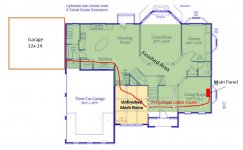
It is a 70-ish foot run from one end to the other through the basement ceiling, based on my routing plan. A good portion of the route would be through finished sections of the basement. (amateur sketch below, for reference)
Questions:
Is 2-2-2-4 the right choice based on my shop general power requirements?What are this requirements for routing SER through a finished ceiling space? I assume no insulation and I also assume a good portion, if not all, may be perpendicular through the joists. There also may be areas where I run parallel to the ceiling joists
In the perpendicular runs, I want to get more towards the centers of the joists. Wouldn't I also need to install nail plates where the cable runs through each joist?
For the parallel runs (this is where I couldn't find a definitive answer) am I required to secure the cable to the joist, or can it lay on the drywall in the joist bay? As I (non-professional) interpreted Article 334 of the NEC, when SER cable is run inside a single family residence, the SER cable is to be treated like NM wire. And there is nothing in the NEC, that I could find, that specifies how NM should be secured when running through finished ceiling or floor joist bays. I certainly never secured 12AWG Romex when installing recessed lights in an existing ceiling.
All and all help, advice, comments, or criticisms are welcome.
Thanks in advance!
Cheers,
Stump
I am in the process of purchasing a home that will allow me to build an additional attached garage that will be my dedicated auto workshop.
Issue: I will (obviously) need dedicated power in the workshop. My plan is for a 240V/90A supply using 2-2-2-4 Aluminum SER. The shop will have lighting, many 120v/20A outlets, a 240v/20A outlet for a 60gal 5hp compressor, 3-4 240v/50A outlets for a Hobart 210 welder, plasma cutter/TIG machine (not run simultaneously), 120v/20A outlet for fan for propane ceiling mounted heater, and power for a 2 post lift.
Situation: The electric service entrance and the 2 main boxes is in the basement on the opposite side of the house. I am assuming, based on the home's build date (2005) and it's size, that the service is either 300A or 400A. I don't know why they would run 2 boxes for 200A service. BTW, each box has only a hand full of breakers in each.
It is a 70-ish foot run from one end to the other through the basement ceiling, based on my routing plan. A good portion of the route would be through finished sections of the basement. (amateur sketch below, for reference)
Questions:
Is 2-2-2-4 the right choice based on my shop general power requirements?What are this requirements for routing SER through a finished ceiling space? I assume no insulation and I also assume a good portion, if not all, may be perpendicular through the joists. There also may be areas where I run parallel to the ceiling joists
In the perpendicular runs, I want to get more towards the centers of the joists. Wouldn't I also need to install nail plates where the cable runs through each joist?
For the parallel runs (this is where I couldn't find a definitive answer) am I required to secure the cable to the joist, or can it lay on the drywall in the joist bay? As I (non-professional) interpreted Article 334 of the NEC, when SER cable is run inside a single family residence, the SER cable is to be treated like NM wire. And there is nothing in the NEC, that I could find, that specifies how NM should be secured when running through finished ceiling or floor joist bays. I certainly never secured 12AWG Romex when installing recessed lights in an existing ceiling.
All and all help, advice, comments, or criticisms are welcome.
Thanks in advance!
Cheers,
Stump
Last edited:
![URL]](https://photos.app.goo.gl/iZg7d7i6mYSjQ4Cw9[/URL])