To avoid these ads, REGISTER NOW!

Existing panel & subpanel, add another w/ question

wolfsburged

Well-known member
Joined
Jan 31, 2011
Messages
128
Location
Cary, NC
Recently bought a house that has a main panel and a secondary panel next to each other. I believe at some point the lower level was finished, the garage was added, and a sunroom was put on which prompted the second panel for expansion room.

Main panel is 200A, second panel is 100A.

Currently the garage has a single 20A circuit feeding all of 3 outlets, and this circuit is shared to an outside shed. Don't like that set up. I want to add another subpanel in the garage and rewire for more outlets on different circuits, and add some 240V outlets for future welder, air compressor, and an 18k BTU window AC unit. I would like to make this a 100A service inside of maybe a 200A main panel for space.

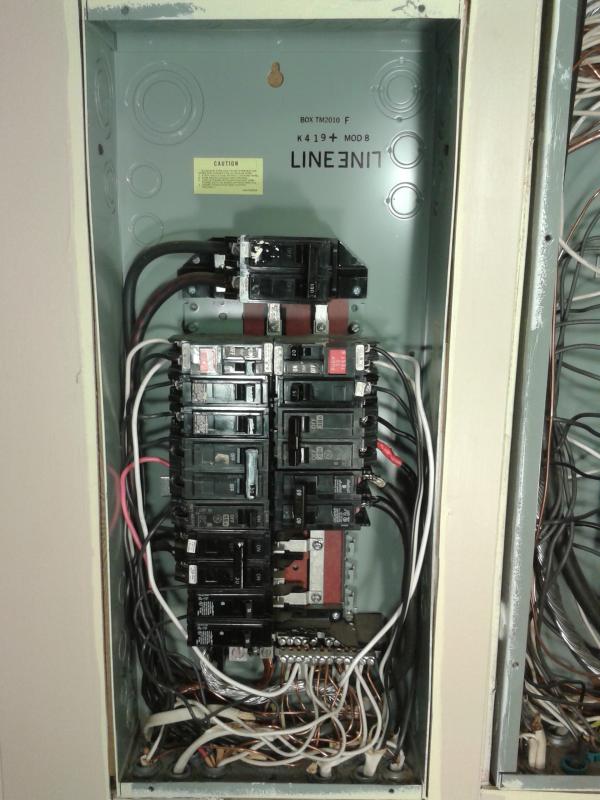
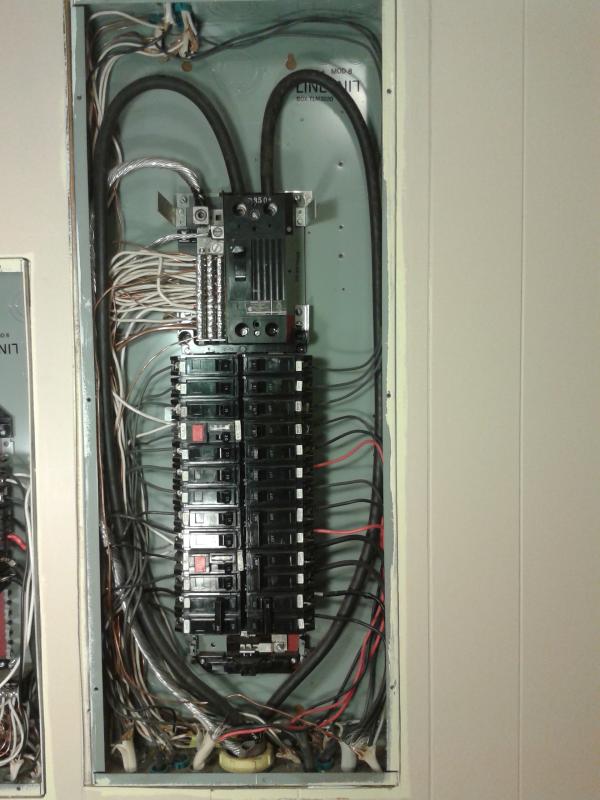
Now here is the oddity: the two existing panels both seem to be fed from the main service entrance/meter. The wire feeding the 100A panel doesn't seem to enter the 200A panel at any point.

200A panel:
panel1.jpg


100A panel:
panel2.jpg


SO my question is: can I add another panel for the garage in this context? There are 4 empty spaces at the bottom of the 200A panel, two per side, in which I could fit a 100A breaker. But, would I have an issue with potentially overloading the house service since all of the panels don't seem to go through a single main breaker? Would there be another breaker inside the meter box (I don't think there is?).

I went outside to look at the meter box to determine the service to the house, but the feed from the utility is from the ground inside conduit, and the feeds into the house go straight into the wall and into the panels, no way to see really. There is one of those security clips on the latch to the meter.
 
To avoid these ads, REGISTER NOW!

Charles (in GA)

Well-known member
Joined
Jan 11, 2006
Messages
12,489
Location
50 mi south of Atlanta
Each of those panels has its own main disconnect. Looks like they double tapped the meter (some are designed to be double tapped, so this could be a legitimate situation). You could easily add a breaker, say 60 amp or 90 amp in the main panel and run it to the garage. You cannot overload anything as the larger panel has a main that will trip if the combination of the house and the garage exceed the 200 amp. House circuits do not draw near as much as most people think. Water heaters, electric heat or heat pumps and electric stoves and ovens are the largest draws, the remainder is an amp or two here and there.

Charles
 

pattenp

Well-known member
Joined
Jun 4, 2008
Messages
10,175
Location
Virginia - USA
If you are looking at a max of 100A capacity in your sub I would not waste the money on a 200A box. Look at a 125A main lug panel.
 

jvitez

Well-known member
Joined
Nov 30, 2009
Messages
2,429
Location
Big Sky Country, Canada
Whenever it comes to electrical upgrades, do the math. No other way to be sure.

1. Check out an online NEC residential load calc, and complete it to get a baseline for your house.
2. Add up the wattage of everything you could possibly run at the same time in your garage, now and in the future.
3.Add this to the total wattage of your previous load calc. Divide by 240. Are you under 200 amps? If so, your good to go.

This even gives a fudge factor as it looks like you have two double tapped panels. You'll have even less load running a subpanel off of the 200 amp main panel, as nothing in the existing 100 amp panel goes through the 200 amp one. If the above calculation is over 200 amps, then you'll need to do some permutations: what on the 100 amp panel can you subtract from your initial load calc, then add the garage subpanel load. But you'll probably be OK. Most houses are nowhere near 200 amps with an NEC load calc.
 
OP
W

wolfsburged

Well-known member
Joined
Jan 31, 2011
Messages
128
Location
Cary, NC
Attached garage, 22x28.

So here is where I'm still a little hung up. Theoretically even without the extra panel, if I managed to pull 199A in the one panel and 99A in the other, would I damage/overload the meter/service connection? Would the service to the meter be standard 200A residential?

Otherwise I am following as the 200A breaker will protect the feed cabling back to the meter.

As far as sizing the panel in the garage, I mainly just want ample spots for circuit breakers. I want to run a number of 20A circuits but stagger outlets on different circuits so that I don't trip circuits using a few things on the same wall.

For usage in the garage, I am thinking of doing 3 separate 20A receptacle circuits to stagger. 60A total there. A dedicated 50A circuit 240V for future possible welder. Don't have one now, and if I do end up with one it may not be a huge one either, so this may only draw 20A max. I will eventually be putting in a window AC unit and have a line on an 18k BTU model. So probably 15A on 240V draw there, so upsize to a 20A 240V breaker. Right now I have a small 8gal air compressor that runs 120. Eventually if I got a larger compressor I'm not sure but I would imagine I would not need more than a 30A circuit depending on what I end up with, just a home mechanic.

So essentially:
20A - outlets
20A - outlets
20A - outlets
50A - welder
20A - AC
30A - compressor?

That totals 160A max draw but in reality If I'm welding I won't be running the AC and can turn off the compressor, and otherwise don't see a lot of issues overloading 100A service in practice. If the breaker in the main panel nuisance trips occasionally I can deal.

The garage is attached and I've got basements under the house (split level, two basements). I would like to avoid having to run conduit so I will need to look for some sheathed wiring to run. I keep seeing referenced to large gauge aluminum sheathed wire referred to as mobile home feed wire, but I can't find many product links online for such a thing from Lowes or Home Depot. Also if possible would like to do a sheathed copper vs aluminum.
 

jvitez

Well-known member
Joined
Nov 30, 2009
Messages
2,429
Location
Big Sky Country, Canada
So essentially:
20A - outlets
20A - outlets
20A - outlets
50A - welder
20A - AC
30A - compressor?

That totals 160A max draw but in reality If I'm welding I won't be running the AC and can turn off the compressor, and otherwise don't see a lot of issues overloading 100A service in practice. If the breaker in the main panel nuisance trips occasionally I can deal.

Sorry, but you don't add up amperages like that to calculate load, you're going to be way off. Add up wattage, then divide by 240 to get amps. What do you foresee running at the same time? The AC and compressor together, sure. What are their wattage ratings? What else? Lights from this subpanel? How many watts there? Anything plugged into a receptacle? Think it through in detail, plus anything you might want to add in the future. But remember, it's the wattage you're running at the same time that matters.
 

mrobins297aaa

Well-known member
Joined
Sep 20, 2010
Messages
3,283
Location
south east michigan
I have 200 amp panel and 2 100 amp sub panels fed off the 200 amp panel. One right next to it and one in the barn. I didn't need more power, I needed more circuits. I think one time I had the 200 amp panel cover off and with just the normal household stuff running I put a amp probe around one leg and I was drawing 25 amps.
Like Charles said you'll probably never come close to using that 200 amps.
 
OP
W

wolfsburged

Well-known member
Joined
Jan 31, 2011
Messages
128
Location
Cary, NC
120V circuits:
(3) 20A circuits, 2,400W ea = 7,200W max

240V circuits:
50A = 12,000W
30A = 7,200W
20A = 4,800W
Total 240V circuits = 24,000W

Total combined = 31,200W
31,200W/240V = 130A maximum assuming everything is on.

Lights and garage door opener are already on existing circuits from the main, I think I will leave them as they are so that does not need to add to this calculation.

As far as 120V I mainly want the three circuits so that if I have my current compressor which is a "2HP" unit it can be on its own circuit, and I can still use other power tools such as a drill, grinder, etc. Three circuits could allow me to use the compressor and 2 other power tools at once, at least. Its usually just me or me and the wife out there, so I don't forsee that being a huge issue.

Honest load would probably be a max of 20A on 120V at once, the 20A 240V circuit of the AC and 30A on the compressor circuit at once. That would be 14,400W or 60A total draw.

As long as I wasn't welding with everything else maxed out, that would run me 19,200W or 80A total draw, which is fine.

And theoretically if I ran everything minus the compressor, so welding with the AC on and all the 120 maxed out, that'd be right at 100A.

So I think I'm still comfortable with a 100A service. This is assuming I get a mac daddy welder and a huge air compressor and using all to their limits.
 

sberry

Banned
Joined
Jun 18, 2005
Messages
35,747
Location
Brethren, Michigan
I am all for load calcs but,,, you have an incredible amount of available power there and unless this is all electric house with electric heat and hot tub with 3 teenage girls going full blast available power isn't an issue and in reality other than air cond small garages are not much of a load factor, other than lights its so intermittent its just about irrelevant. A new 100A feed will be sufficient. Got a bud runs a working garage fed with a 60, never had a trip, 30A air comp, 20A air cond on occasion and way too many lights.
 
Last edited:

pattenp

Well-known member
Joined
Jun 4, 2008
Messages
10,175
Location
Virginia - USA
If you do go for the full 100A, use 2/0 AL SER to the sub-panel. As sberry was saying about the 60A feed. I too have a garage that's on a 60A sub. I have a 240V/20A circuit for window AC/heater, 2 120V/20A circuit for outlets, 240V/30A circuit for welder, 240V/30A circuit for compressor and 240V/25A for a lift. Oh and a 120V/15A for lights. I've never tripped the 60A breaker.
 
OP
W

wolfsburged

Well-known member
Joined
Jan 31, 2011
Messages
128
Location
Cary, NC
Not to beat this into the ground, but I'm still confused/concerned about this double tapped meter situation.

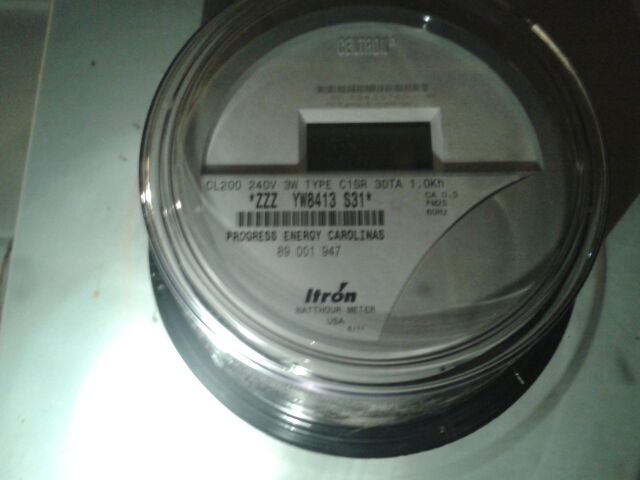
I looked at the front of my meter. It is an Itron Watthour Meter and says "CL200 240V 3W TYPE C1SR 30TA 1.0Kh"

Based on that I would assume this is a 200A service meter, and thus my house service would be 200A and not 320A or 400A. And as such, if my 100A and 200A panel are both independently connected to the service entrance, I could *theoretically* pull greater than 200A from the service. Granted not likely to happen, but this seems like it would be a code violation to have the total panel draw with rated breakers over the service rating.

I called my power company and they told me they don't have any records on file as to the size of my service and that I would need a qualified electrician to look at the meter. But the meter box has a security tag on it, and I assumed this would be a power company thing to open, not some random electrician. Aren't there fines for cutting off those tags?

Maybe I'm getting wrapped up in this "by the book" but when it comes to stuff like this I want to be extra sure.
 

sberry

Banned
Joined
Jun 18, 2005
Messages
35,747
Location
Brethren, Michigan
Granted not likely to happen, but this seems like it would be a code violation to have the total panel draw with rated breakers over the service rating.
This is where the load calc comes in to play, it isn't the possible allowed by all the breakers but the electrician has calculated the normal likely load.
As a side note, my neighbor, mechanic that works for me and knows his way around a watt had a main issue a while back with an obsolete panel he didn't feel like replacing right away, for giggles he amp the current turning on everything he could think of and was like 50A or some ridiculous low number, probably didn't turn the range wide open and I forget the demand items he has but he found a 60 or something main to use, some deal to replace this failing 100, he just wanted to know before he swapped.
In my area we have very little electric heat, few hot tubs and only come air cond, few central units, I haven't seen an overloaded service since I replace a 60/A fuse panel for a bud who had all electric appliances, it was functioning but cooked. Range, water heater and dryer + all the other stuff, heavy microwave added to the problem. . I saw a bar with overloaded 200 that trip on current on hot Friday evening, air cond, several electric fryers, broaster, only 2 cases that come to mind right off I can recall.
Now days with CFL lights a guy can have everything on in the place for couple amps. Like the man said earlier, find on line load calc, maybe selfhelpandmore, run it, don't add the garage yet and see what it says, maybe a pic of the meter base would be a good idea.
 
To avoid these ads, REGISTER NOW!
OP
W

wolfsburged

Well-known member
Joined
Jan 31, 2011
Messages
128
Location
Cary, NC
I'll have to calculate it all when I get home, but it *is* an all electric house.

Heatpump w/ electric resistance backup heat
AC
Two water heaters
Electric range
etc, etc

Here is the meter. Sorry for the dark picture.
meter.jpg


As I said before, it does appear that it is a 200A meter.

Aside from the load calc point, I guess the thing I'm wondering is if having 200A feed two separate breakers with combined rating above the service is in-and-of-itself a code issue, or if this is fine provided the normal load calc for attached circuits is less than the service. I just don't want to run into an inspector who wants me to upgrade the house service or rewire everything to pass. I haven't gotten far enough to contact the permits dept or a licensed electrician, but it appears I may want to.

I just need to tiptoe I suppose as I don't want to necessarily call myself out on a code violation.
 

sberry

Banned
Joined
Jun 18, 2005
Messages
35,747
Location
Brethren, Michigan
Ok, the electric heat and the 2 water heaters do bring it up some, the air cond isnt used while the heat is on etc. We should have said, pic of the meter base itself, the whole can. How big is the electric heat? As we eluded to earlier, a garage of this nature really doesn't add much to the demand load. You wont be air cond if the heat is on etc.
I really should add a disclaimer to that, garages generally do not add much to load demand if a guy isn't adding something like a powder coat oven or a pottery kiln.
 
Last edited:
OP
W

wolfsburged

Well-known member
Joined
Jan 31, 2011
Messages
128
Location
Cary, NC
If you do go for the full 100A, use 2/0 AL SER to the sub-panel. As sberry was saying about the 60A feed. I too have a garage that's on a 60A sub. I have a 240V/20A circuit for window AC/heater, 2 120V/20A circuit for outlets, 240V/30A circuit for welder, 240V/30A circuit for compressor and 240V/25A for a lift. Oh and a 120V/15A for lights. I've never tripped the 60A breaker.

Why go to 2/0 for 100A aside from leaving a lot of headroom? Isn't 2/0 enough for 150A? The 200A panel in my house is 4/0 AL.

I was figuring that I could do either 3AWG copper or 2AWG aluminum. Looks like 3-3-3-5 is an option for copper or 2-2-2-4 in aluminum.

Just wondering.
 

Charles (in GA)

Well-known member
Joined
Jan 11, 2006
Messages
12,489
Location
50 mi south of Atlanta
There are few 200 amp meter sockets with actual double taps. I would not be surprised if this is a less than kosher double tap.

I would talk further to the power company. You really need to talk to an engineer who sets up new and replacement services. It might be worth it to have them come out and tell you what it would cost to replace the service cables to the meter (if they are not suitable for 300 amps) and replace the meter can. They can tell you if you own the meter can or if they do.

If you replace it and have to provide the meter socket, I would use a combination unit that has the disconnects built into it.

Charles
 

pattenp

Well-known member
Joined
Jun 4, 2008
Messages
10,175
Location
Virginia - USA
Number 2 @ 90 for this application, # 1 for 100A

My understanding is that feeds need to be sized from the 60 degree column which shows #2AL good to 69A, #1AL to 80A, 1/0AL to 94A and 2/0AL to 108A. Am I wrong on this or using the wrong NEC chart. 2011 NEC 310.15(B)(2)(1)

I believe I'm correct under NEC 110.14(c)(1)(a)

Ooops - wrong chart - should be 310.15(16) #2AL 75A, #1AL 85A, #1/0AL 100A, #2/0AL 115A.

Looks like I owe you a beer sberry.
 
Last edited:

sberry

Banned
Joined
Jun 18, 2005
Messages
35,747
Location
Brethren, Michigan
One of the code guru's can tell you, I forget more of this stuff than I can remember anymore. Only reason I know is that they used to allow 2 to 100A and the 2008 revised it to 90.
Nearest book I have is 02 and most of this stuff I never really did learn all that well to begin with and really don't know anything about electricity anyway. I am familiar with the basics pertaining to the nature of the work I do and a few specialized pieces of equipment common to this type of work/install,, that and service entrance so I get the pretty green sticker and the poco will hook up, 95% of this is all mechanical installation type work anyway and no one ever wonders wtf??? ha There are a couple particulars about grounding and steel buildings etc that I have paid attn to and I also remember what I didn't know way back when. Kind of focus on where the mis-understandings are common.
 
Last edited:

pattenp

Well-known member
Joined
Jun 4, 2008
Messages
10,175
Location
Virginia - USA
One of the code guru's can tell you, I forget more of this stuff than I can remember anymore. Only reason I know is that they used to allow 2 to 100A and the 2008 revised it to 90.

Wait a second, I'm taking that beer back. You'd have to use #1 for 90A and #1/0 for 100A.
 

sberry

Banned
Joined
Jun 18, 2005
Messages
35,747
Location
Brethren, Michigan
Norcal and Aceman are a couple of the real code guru types here, they are recent thru the school, books and the tests etc. I don't know enough about electric probably to pass a test, at least without some diligent study and not sure I could do the calculations on a masters.
Like I said, my book, 02 and was current when I got it, I follow a couple guys on DIY and ETF for about a year, just found out I couldn't get it straight from real world hearsay etc. Finally it kind of click when I hear the same thing from a couple different people. As simple as it may seem I think it was a couple papers on grounding finally register from Keis on a forum that made sense. That and seeing same questions over and over and trying to beat someone to the answers,,, I just repeat it till I got some concept.
 
Last edited:

sberry

Banned
Joined
Jun 18, 2005
Messages
35,747
Location
Brethren, Michigan
You might want to wait on all the beer stuff,,, maybe it depends on wire type etc, I need glasses to read it and I really don't care all that much, ha but Aceman caught me on this, they still allow 2/100 for service entrance but not for other feeds.
 

Aceman

Well-known member
Joined
Jan 28, 2007
Messages
2,513
Location
Eastern Oregon
I just glanced at the thread so I don't know all the specifics, but here's a post I quoted from Mike Holt's site to save me some typing:

As already noted the 2008 NEC requires that SER cable installed as inside branch circuits and feeders are required to be installed in accordance with Part II of Article 334 including 334.80 which limits the ampacity of the SER cable to the 60 degree column of 310.16. (See 338.10(B)(4)(a))

Now the 2011 modified this by allowing the use of the 75 degree column if the SER cable is not installed in direct contact with thermal insulation.


So a 100 amp sub could use #1 AL at 75 degree or 1/0 AL at 60 degree depending on installation.
 

pattenp

Well-known member
Joined
Jun 4, 2008
Messages
10,175
Location
Virginia - USA
So how does 110.14(c)(1)(a) come in to play. I believe most breakers are rated at 60/75 degree and under 110.14(c)(1)(a) you would have to use the lower 60 degree rating for the wire.
 

Aceman

Well-known member
Joined
Jan 28, 2007
Messages
2,513
Location
Eastern Oregon
Here's a copy of a PM I sent to somebody else a while back:

Did a little digging and here's what I got, straight from UL's Circuit Breaker Marking Guide:

20. 60/75°C Wire — All circuit breakers rated 125 A or less are marked for use with 60° C,
60/75°C or 75°C only wire. This marking indicates the proper wire size for termination in
accordance with Table 310.16 of the NEC . It is acceptable to use wire with a higher insulation
rating if the ampacity is based on the wire temperature rating marked on the breaker. For breakers
rated more than 125 A, the proper wire temperature rating is 75°C and it is optional for the breaker
to bear this marking.

So as you can see, it has nothing to do with the amount of breakers around it, only the wire insulation.

I got all this from Page 11 if you want to look for yourself:

http://www.ul.com/global/documents/o...BreakersMG.pdf
 
Last edited:
To avoid these ads, REGISTER NOW!
Top Bottom