To avoid these ads, REGISTER NOW!

Explain like I’m 5 - Big Maxx venting

allinon72

Well-known member
Joined
Jul 5, 2010
Messages
3,305
Location
Indianapolis
Just got my Big Maxx mounted, gas and electrical ran. Now to the venting - there’s so much information on this that my head is spinning. Hopefully you guys can help me clarify a few things.

First, the challenges of my roof. It’s an attached garage, new construction house with extremely steep and high ceilings. Where my heater is mounted, if I went straight up through the ceiling to the roof line, it would be just over 17 feet. Is it normal/OK to have that length of run? Can I jog over with 2 45s so it’s not as high on the roof? What are the requirements of the flue placement on the roof itself?

Onto the vent material - I know I should run class III stainless b vent, but say I have a long run as mentioned above, do I run the entire length in this material, or can I transition to something else (cheaper) once I get into the attic? If I have to do the whole thing in double walled stainless b vent, it’s gonna cost a small fortune.

Thanks in advance
 
To avoid these ads, REGISTER NOW!

Steve in UT

Well-known member
Joined
Oct 30, 2018
Messages
205
Location
....
I thought these things were power vented? Can't you just stick it out the wall and be done?
 
OP
A

allinon72

Well-known member
Joined
Jul 5, 2010
Messages
3,305
Location
Indianapolis
I thought these things were power vented? Can't you just stick it out the wall and be done?

Not sure about higher models, but I have the smaller 50k unit. It can be vented horizontally through a wall but I don’t have a clear path out a wall.
 

Mr. Roboto

Well-known member
Joined
Dec 11, 2012
Messages
2,160
Location
New Hampshire
It's been years since I did mine, but I did a lot of reading at the time. Between the instruction manual for my Hot Dawg and the technical documentation for the duravent piping I used, all of the requirements were outlined in there. I also spoke with my town on local requirements, since I chose to go the proper way and get my install inspected/permitted. I am almost certain Class III is only required for horizontal venting from what I can remember.

The venting is the most critical part. This is usually what dictates the location of the heater installation. No to sound harsh, but you should have had a plan in place for this before mounting the unit. Maybe take some photos and draw a diagram and we can try to help come up with a plan.
 

stokefire7

Well-known member
Joined
Oct 5, 2011
Messages
616
The manual for the unit takes precedent over code. That's where you need to start, it gives you installation parameters.
 
OP
A

allinon72

Well-known member
Joined
Jul 5, 2010
Messages
3,305
Location
Indianapolis
The manual for the unit takes precedent over code. That's where you need to start, it gives you installation parameters.

Really? That seems odd. But yes I've poured over the manual several times, problem is it just gives generics. I'm a dummy about this topic and need things spelled out. :willy_nil
 

The Cobbler

Super Moderator
Staff member
Joined
Oct 24, 2013
Messages
25,827
Location
Niagara Region, Ontario, Canada
b vent for vertical runs is usually aluminum inner with galvanized outer . stainless is required for horizontal runs.
as mentioned the install manual should have all of the specs for max length, elbows etc .
I am pretty sure the 17' run will be fine but it should all be int he install manual
 
OP
A

allinon72

Well-known member
Joined
Jul 5, 2010
Messages
3,305
Location
Indianapolis
It's been years since I did mine, but I did a lot of reading at the time. Between the instruction manual for my Hot Dawg and the technical documentation for the duravent piping I used, all of the requirements were outlined in there. I also spoke with my town on local requirements, since I chose to go the proper way and get my install inspected/permitted. I am almost certain Class III is only required for horizontal venting from what I can remember.

The venting is the most critical part. This is usually what dictates the location of the heater installation. No to sound harsh, but you should have had a plan in place for this before mounting the unit. Maybe take some photos and draw a diagram and we can try to help come up with a plan.

Thank you for your comment about class III - you are correct, I only need single wall b-vent. This is a big relief.

I think I about got a plan put together, except for the location of the penetration through the roof. Can anyone educate me on what determines that? Does the rain cap have to be above the highest point of the roof, or can I go lower? If I can put it lower on the roof, I can cut the length of the run and the complexity in half.
 

spudley

Well-known member
Joined
Dec 27, 2016
Messages
702
Location
Northeast Wisconsin
Thank you for your comment about class III - you are correct, I only need single wall b-vent. This is a big relief.

I think I about got a plan put together, except for the location of the penetration through the roof. Can anyone educate me on what determines that? Does the rain cap have to be above the highest point of the roof, or can I go lower? If I can put it lower on the roof, I can cut the length of the run and the complexity in half.
Ideally you'd go straight up but you may need an elbow or two to avoid obstructions. DuraVent, a very common B-vent, has a good website with clear instructions of use including a termination above roof table that allows as little as 1' for low pitch roofs. (A 12/12 pitch, requires 4-5' from penetration to cap.)

B-vent isn't technically single wall as it has an inner and outer pipe, and needs a minimum 1" clear spacing from any combustibles.

Other B-Vent manufacturers may have differing instructions so make sure you buy a product that meets your needs.
 

Mr. Roboto

Well-known member
Joined
Dec 11, 2012
Messages
2,160
Location
New Hampshire
I believe the 2-10 rule applies here:

https://www.nachi.org/roof-penetrations-part3-20.htm

As spud said, it is double wall. However, you only need the double wall pipe where it passes through unconditioned space (again, from memory when I read up years ago) so if you have a long run inside the garage, you can use the cheaper single wall pipe. I chose to run b vent for the entire run, since I only had a few feet inside the conditioned space of my garage.

I remember reading the hot dawg manual, as well as the maxx manual. The hot dawg manual gave extremely detailed directions that would apply to in the installation of either unit. Look up the pdf of that manual and give it a read. It does a great job
 

stokefire7

Well-known member
Joined
Oct 5, 2011
Messages
616
This maybe an issue.

A9. Avoid venting through unheated space when possible. When venting does pass through an unheated space or
if the unit is installed in an environment that promotes condensation, insulate runs greater than 5' to minimize condensation. Inspect for leakage prior to insulating and use insulation that is noncombustible with a rating of not less than 400°F. Install a tee fitting at the low point of the vent system and provide a drip leg with a clean out cap as shown in Figure 8.1.
 

stokefire7

Well-known member
Joined
Oct 5, 2011
Messages
616
This might be an issue.

B6. All vertically vented heaters that are Category I must be connected to a chimney or vent complying with a recognized standard, or a lined masonry (or concrete) chimney with
a material acceptable to the authority having jurisdiction. Venting into an unlined masonry chimney is not permitted. Refer to the National Fuel Gas Code for common venting and pages 11-12 of this manual.
 

Mr. Roboto

Well-known member
Joined
Dec 11, 2012
Messages
2,160
Location
New Hampshire
For what it's worth, here is my setup:

attachment.php


attachment.php
 
OP
A

allinon72

Well-known member
Joined
Jul 5, 2010
Messages
3,305
Location
Indianapolis
I believe the 2-10 rule applies here:

https://www.nachi.org/roof-penetrations-part3-20.htm

As spud said, it is double wall. However, you only need the double wall pipe where it passes through unconditioned space (again, from memory when I read up years ago) so if you have a long run inside the garage, you can use the cheaper single wall pipe. I chose to run b vent for the entire run, since I only had a few feet inside the conditioned space of my garage.

I remember reading the hot dawg manual, as well as the maxx manual. The hot dawg manual gave extremely detailed directions that would apply to in the installation of either unit. Look up the pdf of that manual and give it a read. It does a great job

Thanks for the suggestions - roof pitch is 12/12 on the front and back and even steeper on the sides so it looks like I’m going all the way up.
 

SarcasticDwarf

Well-known member
Joined
Dec 30, 2009
Messages
236
Location
North Dakota
I installed mine a few weeks ago using double-walled b vent through the garage attic and roof. The attic will be insulated next year but there is soffit and ridge venting. After our first snow it seems that the heat from the ~2' section of b vent in the attic is melting the snow on the roof above it. Suggestions?
 

stokefire7

Well-known member
Joined
Oct 5, 2011
Messages
616
This is an issue.

9. The vent must extend at least 3’ (1m) above the highest point where it passes through a roof of a building and at least 2’ (0.6m) higher than any part of a building within a horizontal distance of 10’ (3.05m) unless otherwise specified by the (American) National Fuel Gas Code, ANSI Z223.1 or (Canada) CAN/CGA-B149 Installation Code. The vent must extend at least 5’ (1.6m) above the highest connected equipment flue collar.


If you can place your penetration 10' (horizontal) from the peak, then your vent terminal need only be 5' above the roof.
 
Last edited:

Showkey

"MEMBER EMERITUS"
Joined
Aug 9, 2014
Messages
8,638
Location
Wausau WI
I installed mine a few weeks ago using double-walled b vent through the garage attic and roof. The attic will be insulated next year but there is soffit and ridge venting. After our first snow it seems that the heat from the ~2' section of b vent in the attic is melting the snow on the roof above it. Suggestions?

If your running the heater with no insulation.........the melting of snow on the roof will only get worse as the season goes on. Depending temperatures and snow depth, the melting and refreezing might get bad enough to cause an ice dam, which might cause a leak.
 

SarcasticDwarf

Well-known member
Joined
Dec 30, 2009
Messages
236
Location
North Dakota
If your running the heater with no insulation.........the melting of snow on the roof will only get worse as the season goes on. Depending temperatures and snow depth, the melting and refreezing might get bad enough to cause an ice dam, which might cause a leak.

Please explain what I am missing.

The attic is vented (soffits + ridge). Insulation will be blown in fiberglass. The problem is with the heat generated by the part of the b vent passing through the attic.
Visible melting is only occurring in the 24" space between the two purlins where the b vent passes through. It is also only occurring in the space between where the vent is and the peak. Exhausted air is also not likely to be the cause as the melting is not occurring in the direction of the wind.

If the problem were the heat from the garage passing through the ceiling drywall and heating the attic space, wouldn't you expect to see melt in more than the one spot?
 
To avoid these ads, REGISTER NOW!

stokefire7

Well-known member
Joined
Oct 5, 2011
Messages
616
I installed mine a few weeks ago using double-walled b vent through the garage attic and roof. The attic will be insulated next year but there is soffit and ridge venting. After our first snow it seems that the heat from the ~2' section of b vent in the attic is melting the snow on the roof above it. Suggestions?

What about insulating a small section before and after ?
 

spudley

Well-known member
Joined
Dec 27, 2016
Messages
702
Location
Northeast Wisconsin
This maybe an issue.

A9. Avoid venting through unheated space when possible. When venting does pass through an unheated space or
if the unit is installed in an environment that promotes condensation, insulate runs greater than 5' to minimize condensation. Inspect for leakage prior to insulating and use insulation that is noncombustible with a rating of not less than 400°F. Install a tee fitting at the low point of the vent system and provide a drip leg with a clean out cap as shown in Figure 8.1.

This might be an issue.

B6. All vertically vented heaters that are Category I must be connected to a chimney or vent complying with a recognized standard, or a lined masonry (or concrete) chimney with
a material acceptable to the authority having jurisdiction. Venting into an unlined masonry chimney is not permitted. Refer to the National Fuel Gas Code for common venting and pages 11-12 of this manual.

This is an issue.

9. The vent must extend at least 3’ (1m) above the highest point where it passes through a roof of a building and at least 2’ (0.6m) higher than any part of a building within a horizontal distance of 10’ (3.05m) unless otherwise specified by the (American) National Fuel Gas Code, ANSI Z223.1 or (Canada) CAN/CGA-B149 Installation Code. The vent must extend at least 5’ (1.6m) above the highest connected equipment flue collar.


If you can place your penetration 10' (horizontal) from the peak, then your vent terminal need only be 3' above the roof.
Looks like you're referencing "single" wall pipe, not double wall B-vent. The OP should carefully read the vent manufacturers instructions. The Big Maxx install instructions are not close to the detail of the Hot Dawg instructions but they do point to following the vent manufacturers installation instructions.
 
OP
A

allinon72

Well-known member
Joined
Jul 5, 2010
Messages
3,305
Location
Indianapolis
B-vent must have 1" clearance to anything combustible. The rim you see keeps that space open. The hole you don't see is the size of the b-vent going through it.

Is it ok to use a wall thimble instead of a “fire stop” as long as that 1” clearance exists? Or are they the same thing?
 

Showkey

"MEMBER EMERITUS"
Joined
Aug 9, 2014
Messages
8,638
Location
Wausau WI
Please explain what I am missing.

The attic is vented (soffits + ridge). Insulation will be blown in fiberglass. The problem is with the heat generated by the part of the b vent passing through the attic.
Visible melting is only occurring in the 24" space between the two purlins where the b vent passes through. It is also only occurring in the space between where the vent is and the peak. Exhausted air is also not likely to be the cause as the melting is not occurring in the direction of the wind.

If the problem were the heat from the garage passing through the ceiling drywall and heating the attic space, wouldn't you expect to see melt in more than the one spot?


Your high jacking the original thread......but.......the roof deck in an ideal situation should be the same Temperature as the outside temperature. The area around your B vent is warmer causing the localized melting for now. If you insulate the ceiling the deck will be cooler. If you run the heater in true FULL winter conditions the melting will be more uniform but still greater in the vent area. Which is exactly what you do NOT a want.

Done with the high jack.....:dunno:
 

stokefire7

Well-known member
Joined
Oct 5, 2011
Messages
616
Looks like you're referencing "single" wall pipe, not double wall B-vent. The OP should carefully read the vent manufacturers instructions. The Big Maxx install instructions are not close to the detail of the Hot Dawg instructions but they do point to following the vent manufacturers installation instructions.

Lay it out for us cause I'm curious.
 

D45

Well-known member
Joined
Mar 21, 2014
Messages
4,834
Location
NW INDIANA
This is an issue.

9. The vent must extend at least 3’ (1m) above the highest point where it passes through a roof of a building and at least 2’ (0.6m) higher than any part of a building within a horizontal distance of 10’ (3.05m) unless otherwise specified by the (American) National Fuel Gas Code, ANSI Z223.1 or (Canada) CAN/CGA-B149 Installation Code. The vent must extend at least 5’ (1.6m) above the highest connected equipment flue collar.


If you can place your penetration 10' (horizontal) from the peak, then your vent terminal need only be 5' above the roof.


It depends on the roof pitch as well, which may vary based on the brand of the vent. Follow the manufacturers installation manual with what vent kit you choose
 

Attachments

  • 22_zpsergta7hw.jpg
    22_zpsergta7hw.jpg
    47.1 KB · Views: 26

stokefire7

Well-known member
Joined
Oct 5, 2011
Messages
616
It depends on the roof pitch as well, which may vary based on the brand of the vent. Follow the manufacturers installation manual with what vent kit you choose

It would be better to penetrate near the peak.
 

spudley

Well-known member
Joined
Dec 27, 2016
Messages
702
Location
Northeast Wisconsin
Is it ok to use a wall thimble instead of a “fire stop” as long as that 1” clearance exists? Or are they the same thing?
Fire stops are much cheaper than thimbles and meant to 1) stop the path of a fire, 2) keep the vent pipe away from combustibles. Normally you'd attach the firestop to framing which, if done correctly, keeps your vent pipe plumb.
 

Mr. Roboto

Well-known member
Joined
Dec 11, 2012
Messages
2,160
Location
New Hampshire
Quality install for sure. Why is the fire stop diameter larger than the pipe?

There is another hole inside of that that matches the diameter of the pipe. The flange portion you see hanging down there is on either side of the plate to maintain the clearance to combustibles. It does look like it's in backwards, but it's a mirror image.
 

spudley

Well-known member
Joined
Dec 27, 2016
Messages
702
Location
Northeast Wisconsin
There is another hole inside of that that matches the diameter of the pipe. The flange portion you see hanging down there is on either side of the plate to maintain the clearance to combustibles. It does look like it's in backwards, but it's a mirror image.
Aaaha...mystery solved. Your install looked so good I suspected you did it right.
 
OP
A

allinon72

Well-known member
Joined
Jul 5, 2010
Messages
3,305
Location
Indianapolis
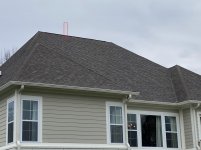
Finally, here are pics of my roof. You can see how expansive it is inside, necessitating a tricky vent installation. I'll have to build a ladder system just to get up to the top :) The front and back is 12/12, but the sides are way steeper.

Also, there are no existing flues, so esthetics are tricky.
 

Attachments

  • IMG_1312.jpg
    IMG_1312.jpg
    137.8 KB · Views: 42
  • IMG_1317.jpg
    IMG_1317.jpg
    148.1 KB · Views: 38
  • IMG_1318.jpg
    IMG_1318.jpg
    151.2 KB · Views: 35
  • IMG_1319.jpg
    IMG_1319.jpg
    148 KB · Views: 36

stokefire7

Well-known member
Joined
Oct 5, 2011
Messages
616
Finally, here are pics of my roof. You can see how expansive it is inside, necessitating a tricky vent installation. I'll have to build a ladder system just to get up to the top :) The front and back is 12/12, but the sides are way steeper.

Also, there are no existing flues, so esthetics are tricky.

Penetration near the peak is in your best interest.
 

spudley

Well-known member
Joined
Dec 27, 2016
Messages
702
Location
Northeast Wisconsin
Anyone know if black or brown vent and rain cap material exists? That would make it blend in a bit better.
Black or brown spray paint exists. I've spray painted plastic plumbing vents to match roofing and aluminum holds paint even better.

Are you putting this up? That's a pretty steep roof.
 
OP
A

allinon72

Well-known member
Joined
Jul 5, 2010
Messages
3,305
Location
Indianapolis
Black or brown spray paint exists. I've spray painted plastic plumbing vents to match roofing and aluminum holds paint even better.

Are you putting this up? That's a pretty steep roof.

I’m undecided at the moment, but either way I want to map it out exactly the way I want it before moving forward. I’m getting some quotes this week but I fear they’ll be in the thousands.
 
To avoid these ads, REGISTER NOW!
Top Bottom