cajunfirehawk
Well-known member
Not sure if this has ever been posted here, if so please delete but this is kind of shocking to say the least!




This is a problem with posting something like this. We get in the car and blaze down the hiway at 70 or better yet get on a motorcycle where 1000's die every year and don't even consider the risk, 1 old air comp we got no idea what happened to makes the rounds on the internet and its all coming to the end.
Driving a car is probably 100,000 times the risk. As for draining the tank, who knows,. some day maybe it will be a problem but the only ones I ever see were baby ones, real tin and have one at near 50 in service and another 30 and everyone else I know uses a 30 yr old comp.
My Bud works on TV and thinks they are all junk but really doesn't do the math and see that for every 1 broke 100 live a long life. I am sure if you do destructive testing then you have seen th8is, ho9w many outside of your job have you seen? I have never seen one, do not know anyone has actually seen one or even heard a reliable account of it.I welded pressure vessels , I've seen NDT and also destructive tests live , no way you see me too long near a 30 yo bomb
Nothing wrong with a new thread reminding folks of safety in their shop.
December 2013, Canada
A 44-year-old man suffers extensive damage to his lower leg, forcing doctors to amputate the leg at the knee in hospital. He later died. The man and two friends were working to restore an antique car when the compressor explosion happened.
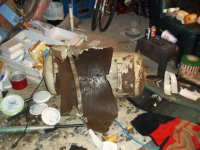
I don't know about the one in the video posted by the OP (I have seen the video a few years ago, but do not know about the compressor itself), but this failure you posted follows the theme of an old horizontal compressor failing where it unzips at the welded seam, probably due to corrosion, but also possibly due to a failed pressure relief valve.
What these small horizontal compressors have in common is, the lack of ASME certification, and the weakest point is the same place where water settles to.
In a vertical tank, the water settles into the lower bell end, which is the strongest point in the tank.
A co-worker decided to weld up a leaky compressor. It exploded and took out his guts. He made it to the door with his intestines in his hands and asked his girl friend to help him, and dropped dead.
Someone I knew just got killed on a snowmobile. My tech just walked in here and been in this 40 yrs and I just asked him, you ever seen one blown up, no, ever heard of one or have reliable story of one blown up? No, me neither. I saw a pressure vessel exploded in the news paper article in Chicago once.
This leads to the next thing. If your going to test your pressure vessel. Go find a place or somebody that can do a hydro test. Never, Never and I will repeat NEVER air test a pressure vessel.
... Also I think the tank works a lot when it gets filled up or emptied....
Exact reason why I had no interest in buying a used compressor
I don't know, I think I'd rather take my chances with an older industrial rated tank that was maintained, rather than anything you can buy in a big box store today. In fact, 30 or 40 years ago, that's what I did, still going today. I'd bet my tank is at least twice as thick, the way they cheapen everything nowadays to where it'll just barely get by, under ideal conditions.
The good news is catastrophic failures like that are NOT common. Usually, you will get a pinhole on the bottom and only a COMPLETE IDIOT would try to weld a pressure vessel without the proper inspections and welding certifications !

I don't see that much rust on the inside of the tank in the photos?? Unless the blast removed most of it. It's as if the tank cap welds failed. Scary for sure! Glad that didn't kill the gentleman.
I've got 3 small old air compressors.....
Guess I'll have to store them on my wife's side of the bed, instead of mine!
Bill

Yes, there's nothing in that picture that would scare me. Perhaps the tank was damaged in some way.
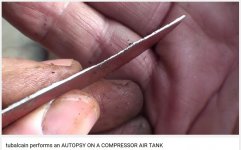
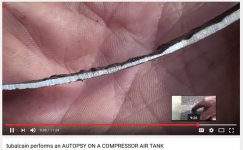
Seems like the original video is more interested in the drama of the event than explaining the causes of the failure. I like this video better (not dramatic, but educational nonetheless):