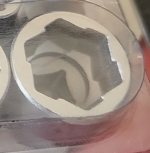
I think in terms of likelihood to extract a socket, from most likely to least likely, given all other variables the same for a rounded bolt or nut:
(1) Wedge
(2) Spiral
(3) Straight Flute
Does this seem right? This based purely off of surface area to grip the bolt. You should start from the bottom of the list and work your way up, as there's increase in probability as you go up the list of damaging the fastener.
(3) Straight Flute
One of the pros of straight flute extractors that is often advertised is that it doesn't damage the bolt. If I'm understanding correctly how these work, these attempt to grab in the middle of the flats, with the flutes not meant to be sharp enough severely damage the bolt.
(2) Spiral
The spiral flutes create more surface area, by instead of having a straight up and down flute to grab the socket, a spiral shaped is design, with each flute being overall longer in length. These extractors have probability to damage the fastener some.
(3) Wedge
If I'm understanding correctly, these types of extractors are meant to "cut" extra "points" into the rounded nut or fastener, effectively turning a 6-point fastener into a 12-point fastener. This increases surface area to grip the bolt. The bad thing with these extractors, is that if they slip, they will just round out the fastener even more, as the wedges cut into the bolt or nut and take a chunck of it off.
Deep extractor sockets = Necessary?
With most extractor sockets having an external fastener that you can grip onto with a box end wrench, I'm questioning the need for deep extractors. Is there a need for them? When shallow ones can be put through a threaded rod to unfasten a nut, if a box end wrench is used over the external hex of the socket.