To avoid these ads, REGISTER NOW!

Failed my inspection on vague code, I am confused?

remagenman

Well-known member
Joined
Oct 30, 2011
Messages
439
Hey folks, just got inspected and inspector gave me a no-go and showed me the regulation where I got the no-go on:

NEC 240.21
(4) Outside Secondary Conductors. Where the conductors
are located outside of a building or structure, except at the
point of load termination, and comply with all of the following
conditions:

Basically said I need a 2 pole, single throw breaker 60A breaker with tie down in the subpanel as a shutoff to panel.

I currently have 2 20A breakers in the sub-panel for 2 circuits and the breaker he wants is in my main panel feeding the subpanel.

I am confused because every manual/video/picture of a subpanel wiring is the way I did it and not the way he described it and me trying to explain why I was confused just agitated the older inspector.

Also, my subpanel is located in my shed, not outside, thats why the NEC code he quoted also confused me.

Thanks, just really dont know how I will feed the 20A circuits off a 60A breaker according to the inspector.
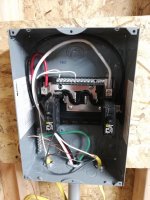
 
To avoid these ads, REGISTER NOW!
OP
R

remagenman

Well-known member
Joined
Oct 30, 2011
Messages
439
Okay, inspector called me back and gave me the correct NEC code that he gave a no-go on, NEC 225.32. SO I have to have the 6 AWG wires going into this 60A breaker back feeding the bus bar?
 

b-boy

Well-known member
Joined
Oct 2, 2013
Messages
2,155
Location
Buffalo NY
So it sounds like he's looking for a main disconnect at the panel? Sounds like it's just a means of shutting off the incoming power to the entire structure with one throw.
 

tyme2par4

Well-known member
Joined
May 16, 2016
Messages
571
Location
NH
So I'm assuming you have the feed wires tied into the main lugs of the sub panel currently, and there is no main breaker in the sub panel?
Then you have 2 breakers in the sub panel currently?

If so, then 225.33 should cover you. As long as you have 6 or fewer breakers in the sub panel, then you do not need a main breaker.
 
OP
R

remagenman

Well-known member
Joined
Oct 30, 2011
Messages
439
So I'm assuming you have the feed wires tied into the main lugs of the sub panel currently, and there is no main breaker in the sub panel?
Then you have 2 breakers in the sub panel currently?

If so, then 225.33 should cover you. As long as you have 6 or fewer breakers in the sub panel, then you do not need a main breaker.

I have a 60A breaker in the main panel feeding the subpanel, which are connected to the subpanel lugs (2 hots, a neutral and a ground).

In the subpanel I have two 20A breakers, each connected to a 12-2 NMB wiring circuit.
 

teamextreme

Well-known member
Joined
Aug 10, 2013
Messages
867
Location
Lakewood, CO
Technically you're legal with only 2 handle throws, but a lot of jurisdictions won't buy that since you can (and likely will at some point) add more breakers and exceed the 6 handle throws. So he wants a main disconnect switch at the sub panel, which is always a good idea IMO, and I always do. The backfed breaker will provide the main disconnect.
 
OP
R

remagenman

Well-known member
Joined
Oct 30, 2011
Messages
439
I'm not the smartest guy but reading the NEC 2017 here is what I'm getting:

225.31 Disconnecting Means. Means shall be provided for
disconnecting all ungrounded conductors that supply or pass
through the building or structure.

He then says I failed because of 225.32, Location. okay.

but 225.33 should make my subpanel good? Maybe?

225.33 Maximum Number of Disconnects.
(A) General. The disconnecting means for each supply
permitted by 225.30 shall consist of not more than six switches
or six circuit breakers mounted in a single enclosure, in a
group of separate enclosures, or in or on a switchboard or
switchgear. There shall be no more than six disconnects per
supply grouped in any one location.

Exception: For the purposes of this section, disconnecting means used
solely for the control circuit of the ground-fault protection system, or the
control circuit of the power-operated supply disconnecting means, instal‐
led as part of the listed equipment, shall not be considered a supply
disconnecting means.

(B) Single-Pole Units. Two or three single-pole switches or
breakers capable of individual operation shall be permitted on
multiwire circuits, one pole for each ungrounded conductor, as
one multipole disconnect, provided they are equipped with
identifed handle ties or a master handle to disconnect all
ungrounded conductors with no more than six operations of
the hand.


I have a pretty large hand and even showed him that I was able to do it, hell, I could just bring the breakers closer to each other!

ps, I also have GFCI's at the beginning of my wiring circuits in the shed.
 
Last edited:

mm08822

Well-known member
Joined
Jan 13, 2012
Messages
6,045
Location
NJ
I guess he is anticipating the future.
Panel as it stands now only has 2 cb's in it - it meets the 6 or less requirement.
Even 6 full space cb's meet the 6 or less.

IF you were to start adding twins, then you would be going over 6.

Personally I would want a main. It this case he is just wasting 2 slots in a 6 space panel.

***************
He made up his own rule. You are NEC compliant as is. You can push back and fight it.
 

Innovate1

Well-known member
Joined
Jul 28, 2014
Messages
4,292
Location
Illinois near St. Louis, Missouri
I guess he is anticipating the future.
Panel as it stands now only has 2 cb's in it - it meets the 6 or less requirement.
Even 6 full space cb's meet the 6 or less.

IF you were to start adding twins, then you would be going over 6.

Personally I would want a main. It this case he is just wasting 2 slots in a 6 space panel.

***************
He made up his own rule. You are NEC compliant as is. You can push back and fight it.

Looks like you are right. But you have to decide if it's worth fighting or put in the back fed breaker. Sometimes it's not worth the fight. Unless you really expect to need the slots the breaker will fill it may not be worth the fight.
 
OP
R

remagenman

Well-known member
Joined
Oct 30, 2011
Messages
439
I guess he is anticipating the future.
Panel as it stands now only has 2 cb's in it - it meets the 6 or less requirement.
Even 6 full space cb's meet the 6 or less.

IF you were to start adding twins, then you would be going over 6.

Personally I would want a main. It this case he is just wasting 2 slots in a 6 space panel.

***************
He made up his own rule. You are NEC compliant as is. You can push back and fight it.

Figured I'd just buy the additional breaker and rewire the way he wants it but it seems contrary to how Fine Homebuilding, Family Handyman and others show you how to install a subpanel.
 

Norcal

Well-known member
Joined
Mar 16, 2008
Messages
13,769
A inspector can’t inspect for “what if’s “ they have to inspect what is there, with two single pole breakers installed it is compliant.
 
OP
R

remagenman

Well-known member
Joined
Oct 30, 2011
Messages
439
Check out the last notation:

Minimum ratings for disconnecting means:

• For installations consisting of a single branch circuit, the disconnecting means must have a rating of at least 15A [225.39(A)].

• For installations consisting of two 2-wire branch circuits, the feeder disconnecting means must have a rating of at least 30A [225.39(B)].

• For a one-family dwelling, the feeder disconnecting means must have a rating of at least 100A, 3-wire [225.39(C)].

For all other installations, the feeder or branch circuit disconnecting means must have a rating of at least 60A [225.39(D)].

Wouldn't the 60A breaker I have in my main panel connected to my subpanel suffice then?
 

mm08822

Well-known member
Joined
Jan 13, 2012
Messages
6,045
Location
NJ
Check out the last notation:

Minimum ratings for disconnecting means:

• For installations consisting of a single branch circuit, the disconnecting means must have a rating of at least 15A [225.39(A)].

• For installations consisting of two 2-wire branch circuits, the feeder disconnecting means must have a rating of at least 30A [225.39(B)].

• For a one-family dwelling, the feeder disconnecting means must have a rating of at least 100A, 3-wire [225.39(C)].

For all other installations, the feeder or branch circuit disconnecting means must have a rating of at least 60A [225.39(D)].

There is more to this 225.39......the initial paragraph......before conditions ,A,B,C,D......

The feeder or branch circuit disconnecting means shall have a rating of now less than the calculated load to be supplied, ........
Where the branch circuit or feeder disconnecting means consists of more than one switch or cb as permitted by 225.33, combining the ratings the ratings of all the switches or cb's for determining the rating of the disconnecting means shall be permitted.

For installations consisting of two 2-wire branch circuits, the feeder disconnecting means must have a rating of at least 30A [225.39(B)].

The OP has only 2 two wire circuits installed. OCPD ratings sum to 40A.
 

checkthisout

Well-known member
Joined
Sep 5, 2008
Messages
5,232
There is more to this 225.39......the initial paragraph......before conditions ,A,B,C,D......

The feeder or branch circuit disconnecting means shall have a rating of now less than the calculated load to be supplied, ........
Where the branch circuit or feeder disconnecting means consists of more than one switch or cb as permitted by 225.33, combining the ratings the ratings of all the switches or cb's for determining the rating of the disconnecting means shall be permitted.

For installations consisting of two 2-wire branch circuits, the feeder disconnecting means must have a rating of at least 30A [225.39(B)].

The OP has only 2 two wire circuits installed. OCPD ratings sum to 40A.

See my reply above. I am guilty of speed reading and making assumptions on mobile.
 

mm08822

Well-known member
Joined
Jan 13, 2012
Messages
6,045
Location
NJ
Looks like you are right. But you have to decide if it's worth fighting or put in the back fed breaker. Sometimes it's not worth the fight. Unless you really expect to need the slots the breaker will fill it may not be worth the fight.

That's purely my speculation.

I just get pissed when inspectors make up their own bs. The OP's installation is compliant as it stands.
 

checkthisout

Well-known member
Joined
Sep 5, 2008
Messages
5,232
That's purely my speculation.

I just get pissed when inspectors make up their own bs. The OP's installation is compliant as it stands.

So each subpanel in each structure (let's say there are 10 structures on the property) can have up to 6 disconnects?
 
To avoid these ads, REGISTER NOW!

Bert_

Well-known member
Joined
Dec 24, 2016
Messages
9,775
Location
NW Iowa
Has he explained why he thinks you don't meet that particular part of the code?

Is your panel readily accessable? Is it located near where the feeder enters the building? These are pretty much the only reasons you would fail based on 225. 32.

If he references a main breaker you may want to remind him that you are allowed to have up to six disconnects and that your panel currently only has two. That would fall under 225.33 and you are fully compliant with this section.
 
OP
R

remagenman

Well-known member
Joined
Oct 30, 2011
Messages
439
Just to update, I had the re-inspection by another inspector and he said I was correct and that the other inspector was maybe confused. The original inspector was a one-day a week guy so maybe he was a little rusty.
 

yeldogt

Well-known member
Joined
Jan 2, 2012
Messages
18,184
Will those panels take doubles/twins?

Some panels only have 6 spots and can't take the twins -- just for this kind of application.

I would have done a panel w/ main ... I like being able to shut it down.
 

Norcal

Well-known member
Joined
Mar 16, 2008
Messages
13,769
The six disconnect rule is going to change with the 2020 NEC a main will be required, but that is a problem for the future.:)
 

Jim greengo

Well-known member
Joined
Sep 3, 2018
Messages
7,415
Location
Behind my house
The six disconnect rule is going to change with the 2020 NEC a main will be required, but that is a problem for the future.:)

I never saw the sense in not having a main breaker in a sub panel anyway,but that's just me.
If something goes wrong I'd rather flip off a main than trying to kick 6 of them off.
 

Norcal

Well-known member
Joined
Mar 16, 2008
Messages
13,769
I never saw the sense in not having a main breaker in a sub panel anyway,but that's just me.
If something goes wrong I'd rather flip off a main than trying to kick 6 of them off.

I do not think it will apply to sub panels in the in the same structure, just service entrance and panels supplied from other buildings on the same property.
 

theoldwizard1

Well-known member
Joined
Feb 22, 2011
Messages
43,245
Location
SE MI
The six disconnect rule is going to change with the 2020 NEC a main will be required, but that is a problem for the future.:)

So lets say it is 2020 and the new NEC is "the law of the land". Lets also say you have a brand new load center like the one pictured. If you put a 2 pole breaker on the bus and attached the feed from the 60A breaker in the house to that, would that that suffice as a "disconnect" ? (Yes, now you only have 4 slots left.)
 

yeldogt

Well-known member
Joined
Jan 2, 2012
Messages
18,184
So lets say it is 2020 and the new NEC is "the law of the land". Lets also say you have a brand new load center like the one pictured. If you put a 2 pole breaker on the bus and attached the feed from the 60A breaker in the house to that, would that that suffice as a "disconnect" ? (Yes, now you only have 4 slots left.)

Do breakers work the same way w/ reverse flow? They must ... as you are basically doing same w/ generator hookup and interlock when using a portable.

When did it change to needing a main?
 

yeldogt

Well-known member
Joined
Jan 2, 2012
Messages
18,184
I should hope so, because on AC, they’re doing that half the time anyway. ;)

Then .. why are some marked line and load ... and not rated for reversing ?

You can't go against the listing. Load = Load .... not Line
 

Norcal

Well-known member
Joined
Mar 16, 2008
Messages
13,769
Then .. why are some marked line and load ... and not rated for reversing ?

You can't go against the listing. Load = Load .... not Line

Other then GFCI, & AFCI, breakers, most residential breakers can be fed either way.
 

Lioneye724

New member
Joined
Jan 2, 2019
Messages
2
Location
Detached
Electrical inspector here. Your installation is code compliant. Yes it’s a good idea to have a MB, but not required. Yes, inspectors must look at what is there and not “what might be later”, in most cases. If you have a 60A breaker in the source panel and looking at your picture, everything else looks fine, then you’re good.
The source OCPD protects the conductors, and is not relative to the load in this case. (Add up the breakers in your 200A resi svc and see what you get. Load calls and demand calls cover that)). GFCIs are req for all 15 and 20A 120V receptacle, so good there.
That said, your inspector is the AHJ and I don’t know what area you live in, so application to the NEC and what cycle is being used varies.
 

wyliesdiesels

Well-known member
Joined
Aug 14, 2012
Messages
20,067
Location
Modesto, CA
Electrical inspector here. Your installation is code compliant. Yes it’s a good idea to have a MB, but not required. Yes, inspectors must look at what is there and not “what might be later”, in most cases. If you have a 60A breaker in the source panel and looking at your picture, everything else looks fine, then you’re good.
The source OCPD protects the conductors, and is not relative to the load in this case. (Add up the breakers in your 200A resi svc and see what you get. Load calls and demand calls cover that)). GFCIs are req for all 15 and 20A 120V receptacle, so good there.
That said, your inspector is the AHJ and I don’t know what area you live in, so application to the NEC and what cycle is being used varies.

An inspector is NOT the AHJ. An inspector is a representative of the AHJ. The reason being is that the inspector does not have the authority to make written amendments.
 

tyme2par4

Well-known member
Joined
May 16, 2016
Messages
571
Location
NH
An inspector is NOT the AHJ. An inspector is a representative of the AHJ. The reason being is that the inspector does not have the authority to make written amendments.

Well that depends on the town or city. In most small towns the building department is only 1 person.
 

rlitman

Well-known member
Joined
Oct 18, 2010
Messages
24,651
Location
Long Island
Then .. why are some marked line and load ... and not rated for reversing ?

You can't go against the listing. Load = Load .... not Line

That's an interesting question.

Overcurrent protection does not care what direction the breaker is connected in. However, not all breakers are simple mechanical devices. Once electronics are added to the package, the device will include directions for wiring that are directional.

In the case of a GFCI, that is because the load screws are directly connected to the outlet. If you were to wire a GFCI with the line and load sides reversed, devices plugged DIRECTLY into the GFCI would not receive GFCI protection, however anything downstream plugged into the "line" side would still be protected. The electronics inside would continue to work, and should there be a ground fault on something plugged into such a reversed outlet, the outlet would not lose power, but the downstream devices would as the circuit is broken.

In other cases, orientation has to do with microcontrollers in large circuit breakers receiving continuous power, even when the breaker is in the open/off state.

In both of these cases, the only difference between the correct wiring and reversed leads is due to the location of the break in the circuit. One opens it in the right place whereas the alternative does not.

Now for the question of a GFCI breaker. I posit that a GFCI breaker wired as a MAIN in reverse will even protect the panel it powers. Of course, it would have to be COMPLETELY in reverse, so the panel's neutral would have to be supplied through the GFCI's tail, and the neutral screw would need a jumper wire connecting to the neutral bus, but other than that, it would work. Such an arrangement would be highly unconventional, and may seem nonsensical if you could simply place the GFCI in the upstream feeding slot, but yet electrically it would work out just fine. Wiring a GFCI half in reverse (pulling power from it, with the tail wired to the neutral bus) would not work, as the neutral would always be out of phase, so it will trip under any usage.

Speaking of phase, the direction a wire passes through a CT matters.

An AFCI is a more nebulous question, as I am not aware of a singlular design for these. However, I would expect that some form of electrical noise isolation must exist within them, so I do not think they would operate on a backfeed as expected.
 

yeldogt

Well-known member
Joined
Jan 2, 2012
Messages
18,184
That's an interesting question.

Overcurrent protection does not care what direction the breaker is connected in. However, not all breakers are simple mechanical devices. Once electronics are added to the package, the device will include directions for wiring that are directional.

In the case of a GFCI, that is because the load screws are directly connected to the outlet. If you were to wire a GFCI with the line and load sides reversed, devices plugged DIRECTLY into the GFCI would not receive GFCI protection, however anything downstream plugged into the "line" side would still be protected. The electronics inside would continue to work, and should there be a ground fault on something plugged into such a reversed outlet, the outlet would not lose power, but the downstream devices would as the circuit is broken.

In other cases, orientation has to do with microcontrollers in large circuit breakers receiving continuous power, even when the breaker is in the open/off state.

In both of these cases, the only difference between the correct wiring and reversed leads is due to the location of the break in the circuit. One opens it in the right place whereas the alternative does not.

Now for the question of a GFCI breaker. I posit that a GFCI breaker wired as a MAIN in reverse will even protect the panel it powers. Of course, it would have to be COMPLETELY in reverse, so the panel's neutral would have to be supplied through the GFCI's tail, and the neutral screw would need a jumper wire connecting to the neutral bus, but other than that, it would work. Such an arrangement would be highly unconventional, and may seem nonsensical if you could simply place the GFCI in the upstream feeding slot, but yet electrically it would work out just fine. Wiring a GFCI half in reverse (pulling power from it, with the tail wired to the neutral bus) would not work, as the neutral would always be out of phase, so it will trip under any usage.

Speaking of phase, the direction a wire passes through a CT matters.

An AFCI is a more nebulous question, as I am not aware of a singlular design for these. However, I would expect that some form of electrical noise isolation must exist within them, so I do not think they would operate on a backfeed as expected.

The devil is always in the details !
 
To avoid these ads, REGISTER NOW!
Top Bottom